
Hot Takes for Every Top NBA Rookie So Far
Victor Wembanyama and Chet Holmgren will face off in their first regular-season meeting on Tuesday night, and anyone who saw the pair of potentially generational talents perform during a zero-stakes preseason setting knows we're in for something special.
Despite minute totals in the teens and minimal concern about the game's result, they put on a show in that Oct. 9 preseason tilt. Both cracked the 20-point mark and littered the game with "Is this even real?" highlights. They traded threes, and-1s and downhill drives, generally operating in ways 7-footers never have before.
Their first in-season meeting is a perfect opportunity to focus not just on these two mold-shattering rookies but also the other prominent members of the NBA's newest class.
Bleacher Report NBA staff writers Grant Hughes and Dan Favale are here to evaluate what the top first-year players have done so far and look toward the wonders they might work in the future.
Victor Wembanyama: Meet the 6th Rookie in NBA History to Make an All-Defense Team
1 of 11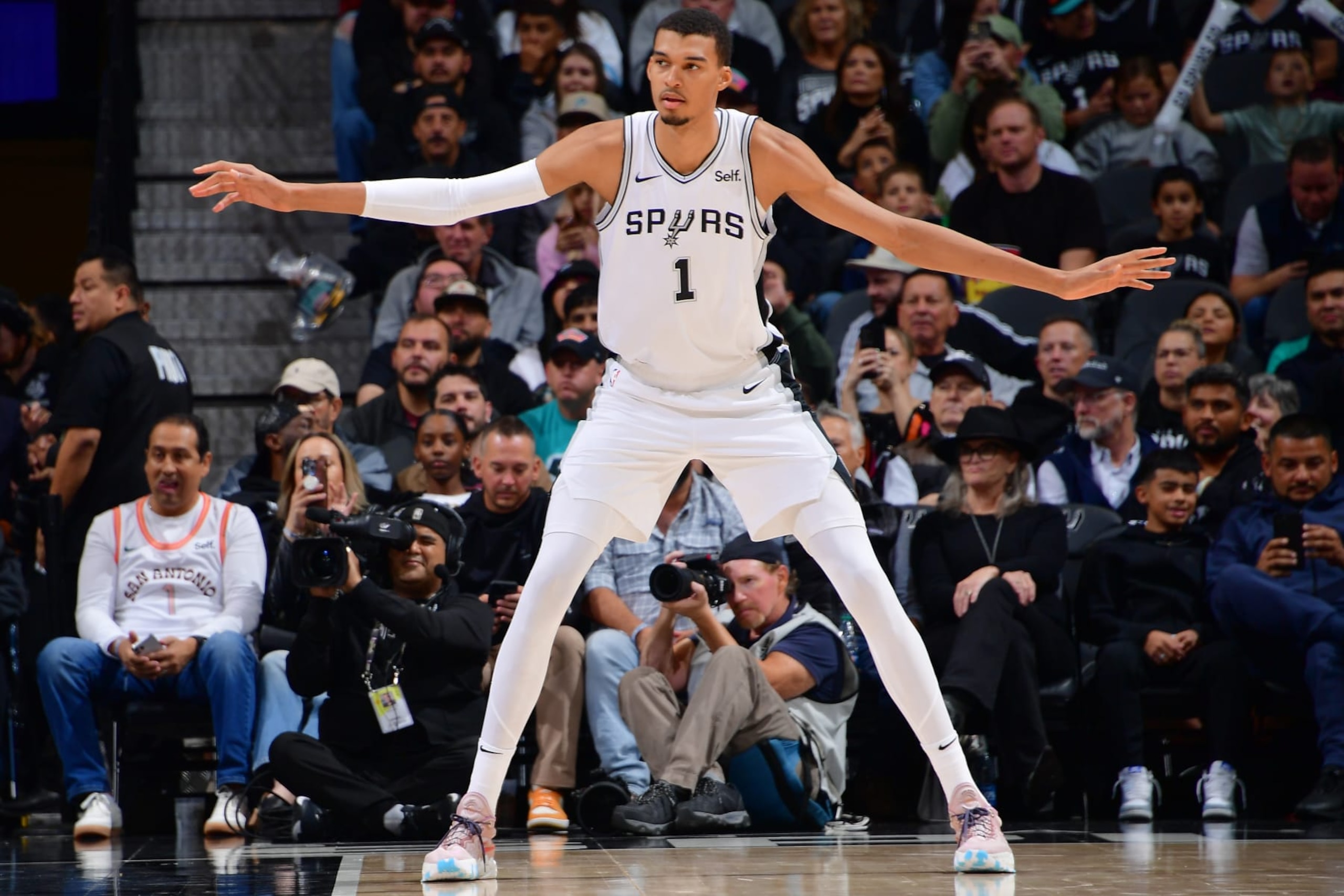
Only five NBA rookies have made an All-Defense team: Kareem Abdul-Jabbar (1970), Hakeem Olajuwon (1985), Manute Bol (1986), David Robinson (1990) and Tim Duncan (1998).
Victor Wembanyama is about to become No. 6.
This may feel a little "jump-the-sharky" knowing the San Antonio Spurs are 28th in points allowed per possession. But their defensive rating improves by nearly 15 points when this year's No. 1 overall pick is on the floor. And seven of the 10 lineups in which he's played most are posting what would be considered elite DRTGs over a larger sample size.
He is not the reason for the Spurs' hemorrhaging points. And there's enough noise in opponents' perimeter shooting to believe the team will improve.
More than anything, though, Wembanyama is already a nightmare for rival scorers. His shot-blocking presence has almost perfectly translated. Opponents are shooting 14.7 percentage points worse than their season average when facing him inside six feet—a top-five mark among 97 players to challenge at least as many of these looks as him. Scottie Barnes and Anthony Davis, meanwhile, are the only players to rack up more blocks outside 14 feet, according to PBP Stats.
The 19-year-old isn't perfect. He leaves his feet too often when guarding on the perimeter, bringing help away from the basket and swiping at the ball. He needs to work on getting position underneath the glass as well, so he's not missing out or fouling over the top of guys on rebounding opportunities.
Still, the early returns largely suggest Wembanyama's defense is already a meaningful difference-maker.
—Favale
Chet Holmgren: Wemby Will Have Company in the ROY Race
2 of 11
It's hard to overstate the heights I think Wembanyama will reach as a rookie. Let's just say I've looked up the record for blocks in a game, learned the result was 17 by Elmore Smith in 1973 and wondered only whether the Frenchman would top that number this year or wait until his second season.
Despite hyperbole not existing when it comes to my Wembanyama thoughts, I still believe Chet Holmgren is going to give him a run for his money in the Rookie of the Year race.
Wemby leads all rookies in points per game, feats of preposterous athleticism and skill for someone his size, but Holmgren has quietly had the better season so far.
The Oklahoma City Thunder center is second to the teenager in scoring but has shot the ball better from everywhere on the floor, blocked just one fewer shot and showcased a level of on-ball polish never before seen from someone standing 7'1".
Holmgren's handle is as tight, functional and creative as most guards', featuring the kind of ball-on-a-string control that looks impossible for someone his size.
The three-ball comes out of his hands cleanly, and opponents who sell out to stop it subject themselves to head-up drives defined by craft and swooping finishes with either hand.
Wembanyama's tools remain one-of-a-kind. Holmgren can't match his length, high release point or space-obliterating mobility on D. But the OKC big man's offensive game feels more fully formed, and there's a level of competitive nastiness we haven't quite seen from Wemby yet.
Holmgren, 21, will be heard from in the ROY race, and he might even win it. That's not the same thing as saying he'll have a better career than Wembanyama, but it's certainly still a hot take in light of the near-universal agreement on the Spurs starlet's generational-great status.
—Hughes
Brandon Miller: The Starting Lineup Promotion will Prove Permanent
3 of 11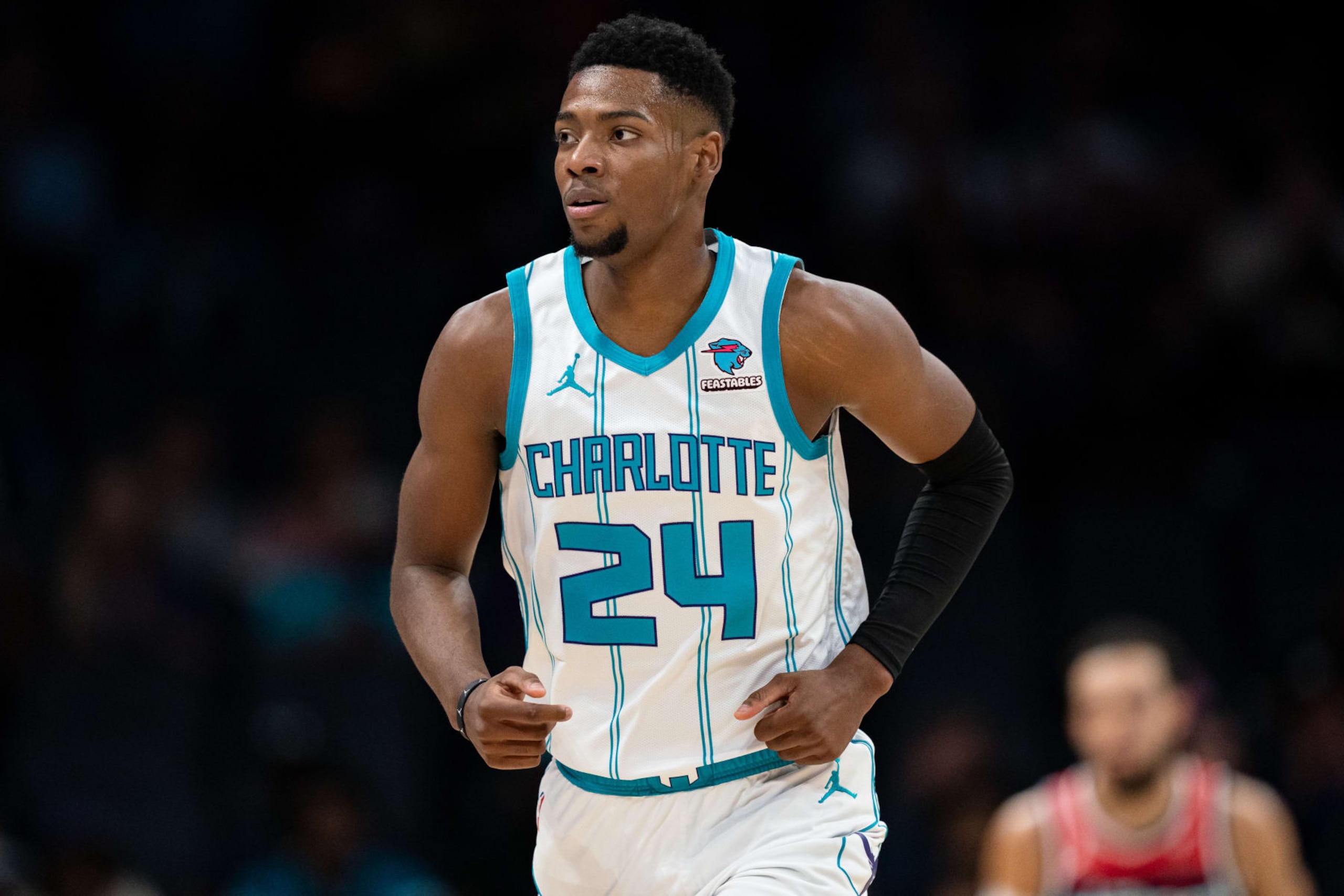
A groin injury to Terry Rozier paved the way for Brandon Miller to join the Charlotte Hornets starting five. And that is where the 20-year-old wing will stay. (Note: Miller is day-to-day after leaving Sunday's loss to the New York Knicks with a left ankle sprain.)
Please don't underestimate the spiciness of this prediction. Elevating Miller to the starting lineup is no doubt the long-term plan, but sticking immediately would be a moderate to massive surprise.
Rozier could rejoin the rotation any day now, and head coach Steve Clifford recently said Miles Bridges will have a "significant role" upon making his season debut on Friday after serving the balance of a 30-game suspension for pleading no contest to a felony domestic violence charge.
Yet, the Hornets already look like a team that will be prioritizing the bigger picture before long. Mostly, Miller has just been that good.
This isn't abundantly clear when looking at his efficiency. He is not shooting particularly well since getting the starter's nod, and his attempts want for volume at the rim, But the three-point clip will invariably improve, and he's done a nice job hustling in transition and navigating the baseline from the corners.
It also makes sense, in theory, to keep the 20-year-old tethered to LaMelo Ball if you're trying to streamline his role and optimize his efficiency.
In the end, though, it's the defense that warrants a permanent promotion. Miller is frequently checking the other team's best perimeter player and living to the tell the tale.
His use of spacing away from the ball is impressive. He's already shown he can guard low without conceding uncontested jumpers from the corners or wing, and his verticality around the basket is veteran-esque.
As The Athletic's John Hollinger also unpacked, this year's No. 2 overall pick isn't just making life difficult on primary shot-takers; he's entirely forcing the ball out of their hands.
Whatever direction the Hornets are traveling should include a heavier investment in Miller's immediate development. If he's not an inarguable starter by the quarter pole of the season, they're likely doing something wrong.
—Favale


Scoot Henderson: Injury and Slow Start Will Only Help
4 of 11
Scoot Henderson probably didn't expect his rookie season to start like this. Neither did the long line of evaluators arguing about whether he was the best point guard prospect since Derrick Rose or Chris Paul.
Sped up, foul-prone and wildly inaccurate as a shooter (2-of-21 from deep), the 19-year-old's only reprieve from a nightmare start was an ankle injury that shelved him on Nov. 1.
The hot take here is that the time off will do Henderson a world of good.
Normally, every lost minute of on-court experience is a negative for a rookie. His first few games showed he needed more seasoning than expected, and he's missing out on reps while he rehabs. In this case, though, time on the sideline can function as a soft reset for a player who'd probably like a do-over.
Better still, Henderson's absence (and that of Anfernee Simons) was the springboard teammate Shaedon Sharpe needed to establish himself as one of the top young guards in the game.
The 20-year-old's second-season tear is a confidence-builder for him and an attention-getter for opposing defenses. It'll draw focus away from Henderson when he returns.
Sharpe's capable playmaking from a wing position should also help Henderson, possibly allowing for a few more clean looks than he would have otherwise gotten.
Early injuries can derail rookies, but this one is going to get Henderson back on track.
—Hughes
Ausar Thompson: 'Stocks' Total will Remain Intact
5 of 11
Three of the NBA's top four leaders in stocks (total steals + total blocks) entering games on Monday night are rookies:
1. Victor Wembanyama: 35 (11 steals, 24 blocks)
2(t). Anthony Davis: 34 (seven steals, 27 blocks)
2(t). Ausar Thompson: 34 (13 steals, 21 blocks)
4. Chet Holmgren: 32 (nine steals, 23 blocks)
This is patently wild and most likely not at all sustainable.
Let's go ahead and predict that Thompson's stocks remain in the top seven anyway.
The 20-year-old has earned this benefit of the doubt. He is an omnipresent defensive nuisance—someone who will bust up plays on- and off-ball, with blocked jumpers and snatched passes, while trailing actions, by chasing down loose balls, the list goes on and on.
Barring a change in role or injury, his counting stats should continue aligning with his everywhere-all-at-once activity. That'll keep him near the top of the stocks category. It will also, in turn, give his rookie campaign some historical juice.
Just four players aged 22 or younger and standing shorter than 6'8" have tallied more than 75 total steals and 100 total blocks in a single season: Marques Johnson (1978), Terry Tyler (1979), Charles Barkley (1986) and Shawn Marion (2001).
Thompson is going to bring this number to five.
—Favale
Dereck Lively II: All-Rookie 1st Team Is In Play
6 of 11
Dereck Lively II is already an indispensable defensive anchor who's shown shockingly good instincts and provided more offensive production than anyone could have imagined, headlined by a 16-point, 10-rebound double-double during his professional debut.
Not bad for a big man who managed double-figure points just five times at Duke and entered the league stamped with a "project" label.
Lively's production would get him noticed under any circumstances, but he's going to get maximum shine because of the vital role into which he's been thrust.
Dallas has no interior presence when he doesn't play; both Luka Dončić and head coach Jason Kidd lamented his absence (illness) in an 11-point loss to the Toronto Raptors on Nov. 8.
The early stats support the comments from Dallas' leadership, as opponents get a lower share of rim attempts and see their offensive rebound rates plummet when Lively is on the floor.
We'll see at least a dozen rookies put up higher single-game point totals than the 19-year-old, and all the dirty work he'll do may go unnoticed. But he is going to have a real shot at making All-Rookie first team because his contributions to a successful Mavs side actually matter.
Empty points are easy to come by in Charlotte, Portland and several other lottery landing spots. But Dallas desperately needs what Lively provides, and that's going to get him noticed.
—Hughes
Cason Wallace: More Pivotal to OKC's Future by Year's End Than Josh Giddey
7 of 11
Cason Wallace has proved incredibly plug-and-play in the early going of his rookie campaign.
The 20-year-old defends his butt off, knocks down corner threes off the catch (76.9 percent) and floats toward or around the rim on teammate drives, hovering and slithering until he finds a crack in the defense that provides a point-blank outlet.
That package of skills may be more critical to the Oklahoma City Thunder's longer haul than Josh Giddey's own arsenal.
To be sure, Giddey's ceiling as a primary playmaker remains higher, but the stuff he does on-ball has finite value on a squad with Shai Gilgeous-Alexander and isn't nearly as essential when that same team also houses Jalen Williams.
Wallace's capacity to squeeze into and shine amid the larger ecosystem makes for a cleaner fit. Ditto for the on-ball defensive burdens he already appears equipped to shoulder.
Oklahoma City needn't be in a rush to choose between the two, and nor is this necessarily an either-or proposition. But there will be more urgency to cease experimental operations and identify what this roster has in place once the season ends.
And when it does, Wallace has the tools to be valued more in-house than Giddey, whose extension eligibility next summer only stands to increase the importance, and accelerate the frequency, of this discussion.
—Favale
Amen Thompson: Nobody Will Believe He Was Drafted Ahead of Ausar
8 of 11
Flash-forward a couple of years, and it's going to seem like some kind of clerical error that Amen Thompson came off the 2023 NBA draft board at No. 4, followed immediately by twin brother Ausar.
Amen was billed as the more instinctive scorer and distributor, and that may turn out to be true. But Ausar's defensive superstardom already seems assured. He's on pace to become the fifth player listed at 6'7" or shorter to average at least 9.0 rebounds and 1.5 blocks per game.
If neither twin develops a jumper, which seems plausible based on the early returns, Ausar's impact in all other areas looks like it's going to be much more significant.
Is it too soon to make proclamations like this, particularly when Amen's ankle injury interrupted his rookie season after just four games? Of course. But these are hot takes, and nothing ups the temperature like bold statements with limited evidence.
Amen has every chance to become a great player. It just seems likely that Ausar, picked one spot later, is going to be greater.
—Hughes
Jordan Hawkins: Forecast Calls for Historical Amounts of Rained 3s
9 of 11
Jordan Hawkins is already indispensable to the New Orleans Pelicans' floor balance. Just 27.2 percent (2nd percentile) of their shot attempts come from deep when he's off the court, but the number jumps to 38.5 percent (69th percentile) with him in the game.
That 11.3 percent increase is gargantuan: The third largest on-off frequency swing in the league. And even if it ebbs and flows, it's not going anywhere.
Just like Hawkins.
To that end, let's go ahead and pencil in the 21-year-old for at least 175 made threes. It's a total that would put him in rarefied air.
Here's every rookie to drill that many treys:
- Keegan Murray (2022-23): 208 threes
- Donovan Mitchell (2017-18): 187 threes
- Damian Lillard (2012-13): 185 threes
- Saddiq Bey (2020-21:) 175 threes
And that's it.
Slotting the No. 14 pick into this group is risky. Trey Murphy's eventual return could eat into his playing time, and his 35.1 percent clip from downtown is strikingly high.
But I don't care.
New Orleans' offense is too hard up for dependable spacing and shooting for it to lean on the rookie much less. If Hawkins can maintain or slightly bump up his efficiency as the season goes on, his per-minute volume will take care of the rest.
—Favale
Keyonte George: Will Never Relinquish His Starting Job
10 of 11
Three weeks of evidence said Keyonte George was not the Utah Jazz's starting point guard and anyone foolish enough to suggest he'd open more games than any other teammate at his position was sucking in a little too much of that thin Salt Lake City air.
The 20-year-old's constituents got a glimmer of hope on Nov. 8, though, as Jazz head coach Will Hardy handed the rookie his first start. It came nine games into the season and may not necessarily be the norm forever, but it's enough to justify doubling down on an old take.
That's right. Point guard belongs to George in Utah—now and in the future—because why shouldn't it?
The No. 16 pick may not shoot the deep ball much better than Talen Horton-Tucker (whom he replaced as a starter), Jordan Clarkson, Kris Dunn, Collin Sexton or anyone else taking on lead-guard duties. And he probably won't help the Jazz climb out of the bottom five on defense.
However, unlike the in-house competitors who could threaten to take back the role, George has legitimate point-guard feel and shot-creating instincts. His first two games as a starter featured 20 assists and three turnovers, and his somewhat limited highlight reel is littered with the types of thoughtful setups Utah needs from its primary ball-handler.
It's often a mistake to bet on anything consistent when it comes to rookies, so saying the No. 16 pick is now permanently locked into his spot comes with risk. But in addition to a skill set that got George the job on merit, there's also the small matter of Utah having nothing to lose by letting him keep it.
—Hughes
Others
11 of 11
Anthony Black, Orlando Magic: Jot him down for at least five career All-Defensive teams.
Ahem:
Case closed.
Bilal Coulibaly, Washington Wizards: He will be the team's best player by the end of the year.
This is not necessarily a "The Wizards will trade everyone" joke. It's one-part nod to the uninspiring play of Jordan Poole and Kyle Kuzma, eight-parts vote of confidence in Coulibaly.
Washington isn't (yet) saddling him with enough offensive usage to guarantee he'll get ample All-Rookie first-team consideration. But between his defensive energy and pleasantly surprising efficiency on wide-open triples (52.6 percent), he is putting together stretches that hint at the ceiling of a future All-Star who also wins multiple NBA Hustle Awards.
Marcus Sasser, Detroit Pistons: He will shoot better than 40 percent from three on 100-plus makes.
Only 16 rookies have made 100-plus triples while knocking them down at a clip north of 40 percent. Sasser's early role and efficiency (43.2 percent) has him in line to become No. 17.
—Favale
Unless otherwise noted, stats come courtesy of NBA.com, Basketball Reference, Stathead or Cleaning the Glass and are accurate entering games played on Monday, Nov. 13. Salary information via Spotrac. Subscribe to Dan and Grant's NBA podcast, Hardwood Knocks.

.jpg?w=2560 "Grading WWE Raw 🔠")


.jpg?w=2560 "Viral Rams Coach Vid 🖕")
.jpg?w=2560 "Injury-stricken Seahawks signing veteran RB")