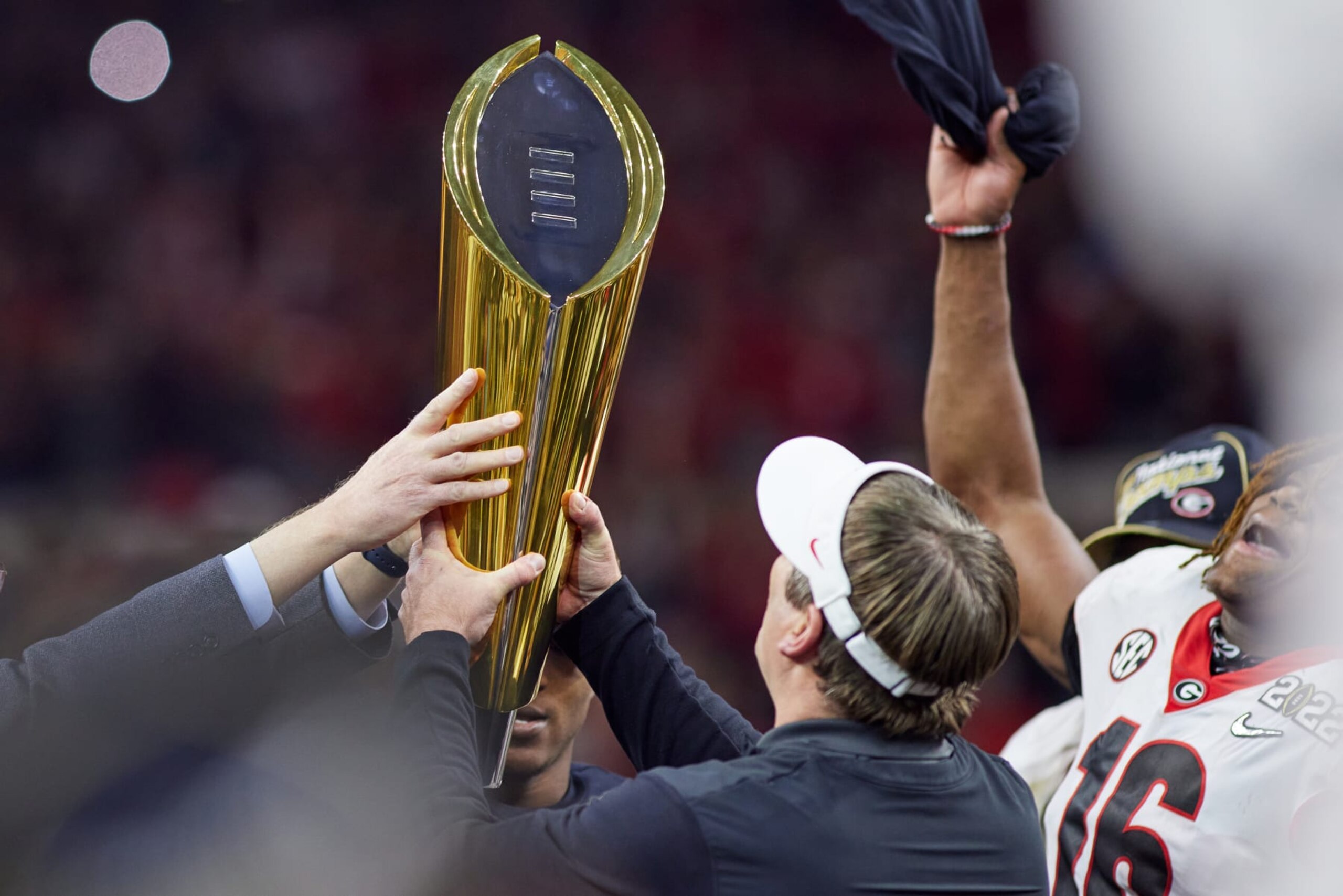

What We Love, Accept and Dislike About College Football Playoff Expansion
Based on the hundreds of millions of dollars left on the table, expanding the College Football Playoff grew increasingly inevitable in recent years. And now, we know it's coming soon.
Whether the official date is 2024, 2025 or 2026, we have a general idea of the new-look CFP.
Most prominently, there will be 12 qualifiers instead of four. But a change of that magnitude also comes with changes in venues, the selection process and several other noteworthy components.
My perception—and likely yours—will evolve in the coming years as we learn more and get to see these changes in action. These, however, are snap reactions to the future of the Football Bowl Subdivision's championship system.
Love: On-Campus Games
1 of 6
Over the past half-decade, my plea—again and again—has been that if expansion happens, a round of the CFP needs to be on college campuses. I am assuredly not alone in that regard.
Finally, it's happening.
The primary appeal of a neutral-$ite game i$ obviou$. Money, of course, is the driving force behind early September clashes in Atlanta, Las Vegas, Orlando or other locations. Concluding the CFP at neutral sites, even while considering proximity for the top-ranked team, is proper, too.
However, one of the greatest parts of the sport is the home-field advantage that students and fans create at a program's home stadium.
We don't need additional CFP games at neutral sites that—between time, travel expenses and distance—continue to effectively limit the students who can attend.
We need raucous crowds. We need "Jump Around" at Wisconsin, the stadium-swaying Aggie War Hymn at Texas A&M, Traveler trotting down the field at USC and the iconic entrances at Clemson, Oklahoma and many other schools.
The unfortunate irony is top four teams won't actually host a game. But for teams ranked 5-8 in the opening round, they can either pick a favorable neutral site or make a truly memorable CFP experience at home.
Accept: The 12-Team Format
2 of 6
Let's start with a very important note: The format of any expansion would've landed in this category.
Four teams, while an improvement from the two-team Bowl Championship Series, was imperfect. Six, eight or 16 would've had flaws, too. Eventually, the CFB world will complain about parts of the 12-team system.
As always, remember that we already cannot agree on the 68th team in March Madness. The deeper you make the field, the number of programs with a reasonable argument will grow because of their imperfections.
We're going to start arguing for and against teams with three losses. Right now, those programs are simply out of contention.
Had the incoming system been the structure since the CFP's initial season in 2014, there would have only been two instances when the entire 12-team field have owned a zero-, one- or two-loss record. During each of the past six seasons, a three-loss program would've made the cut.
Expansion is fine! However, be ready for the disagreements on the fringes that are invariably coming our way.
Dislike: Unchanged Selection Committee
3 of 6
This one comes with an asterisk since we don't have the final details of any incoming changes
The nature of expansion means the CFP selection committee's criteria has to change. For example, conference titles will be less of a potential factor in at-large discussions since the six highest-ranked champions will be automatically placed in the field.
But from the CFP release:
"The ranking of the teams will continue to be done by a selection committee whose size, composition and method of selection will remain substantially unchanged."
During the eight-year CFP era, the most frustrating aspect of the rankings has been the committee itself. The group has constantly changed which criterion—strength of schedule, head-to-head results, comparable results, etc.—has the largest weight, and it's liable to shift on a week-to-week basis or even within the same ranking.
The inconsistency has been maddening, and it seems like optimism for an adjustment is not a wise outlook.



Love: Opening-Round Byes
4 of 6
Although it's unfortunate that the top four—which will be conference champions only—cannot host an opening-round game, an initial bye is a great compromise.
After a grueling season, the extra week of rest and preparation should be immensely beneficial.
In its press release, the CFP noted a guaranteed 12-day span between conference championships and opening-round games. As a result, the top four should have approximately 20 days between its league title victory and the CFP quarterfinals.
The short version? The current preparation time (usually four weeks) is slightly reduced for top-four team.
Expect the NFL's ever-popular "Rest vs. Rust" discussion to become an annual part of the CFP discourse, but this is a positive element.
Note: The conference winner stipulation means an independent program—as in Notre Dame—cannot be a top-four team.
Accept: Automatic Qualifiers
5 of 6
Prior to the summer of 2022, I hated this concept.
The idea of a four-loss division winner springing an upset over an 11-win program on the opposite side of the conference to earn a league title and secure a CFP bid was baffling.
Aren't we trying to determine a "true" national champion? If the regular season is supposed to matter, how can anyone legitimately justify that possibility?
However, the wording is better than initially expected. The six highest-ranked champions are in, so there's a chance for both the AAC and Sun Belt to make the CFP if, say, the Pac-12 has a collectively down season, for example.
Plus, one growing trend that emerged over the summer is lessening the concern.
Beginning in 2022, the Pac-12 will feature the programs with the two best conference records in the league championship. Both the ACC and Mountain West will follow suit in 2023.
Provided the rest of college football does the same—and realignment in the Big Ten, Big 12 and SEC may necessitate it—AQs are reasonable.
Love: Increased Access
6 of 6
Parity is and will remain a lie. Throughout the first decade of the 12-team playoff, the likely outcome is a group of about 15 teams will account for most of the appearances.
There is important data to understand from the past eight seasons. Based on the incoming selection criteria, seven programs would've combined for 40 of the 96 CFP spots. Expand that to 14 teams, and those schools account for 61 of the 96 bids. The other 35 berths are scattered among 27 programs.
We are going to see many "usual suspects" in a 12-team format.
However, the benefit is a perception change now available to a much greater field. For example, schools like Arizona, Colorado, Indiana, Kansas State and Mississippi State would've earned a CFP trip. Boise State, Coastal Carolina, Memphis and Western Michigan each would've been a sixth-best conference champion and made the cut.
At a higher level, Wisconsin would have three CFP trips. Instead of being a program that always finds a way to miss, the Badgers would be viewed as a regular threat.
The nation's elite will remain the nation's elite. But a breakout team or a high-tier semi-contender suddenly has a bit more appeal in recruiting because the CFP will be more accessible.
_0.png?w=2560)




.jpg?w=2560 "Love's Body Already 'Tired'")


.jpg?w=2560 "Tyreek Deal May Come Soon")

.jpg?w=2560 "Mahomes' Wife Trolls Kubiak 💀")