
MLB Owners Only Have Themselves to Blame for Lockout Reaching a New Low Point

If there's a bright side to what's going on in Major League Baseball right now, it's that things are not as bad as they were in 1994. At least the World Series is still on the calendar.
Yet there's no ignoring all the darkness, much less that it's being cast by the league's owners.
It was the owners who locked out the players—all 1,200 of them—when the last collective bargaining agreement expired on Dec. 1. It was the owners who then stayed away from the negotiating table for over a month. It was the owners who canceled spring training games and threatened to also axe regular-season games if the MLB Players Association didn't agree to a new deal ahead of wholly arbitrary deadlines.

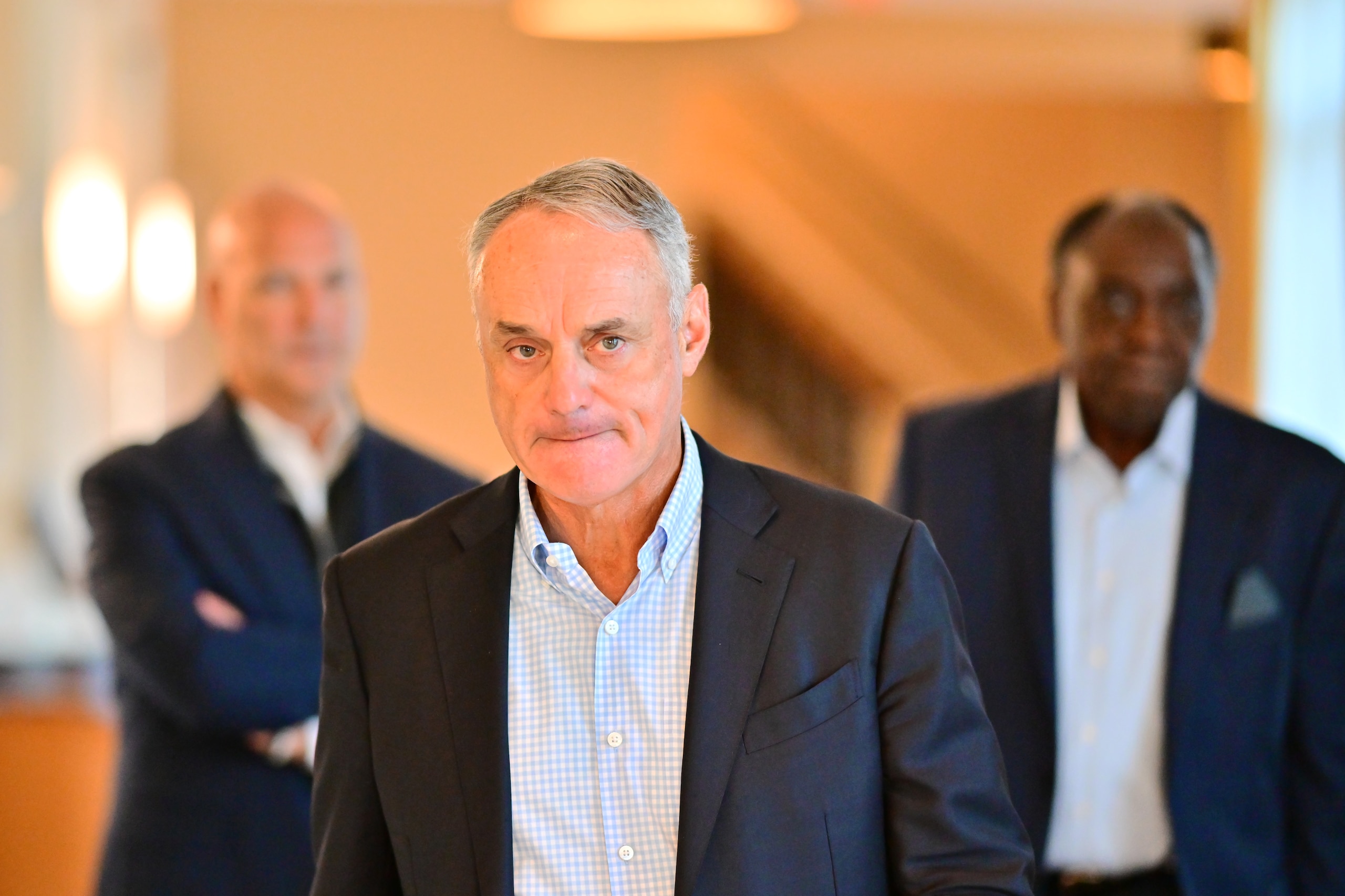
Finally, it was the owners who chose to stand by those threats when commissioner Rob Manfred announced the cancellation of the first two series of the 2022 season.
The Athletic's Evan Drellich, Ken Rosenthal and Fabian Ardaya reported MLB expressed a willingness to lose a whole month's worth of games during talks with the union on Monday, so it could have been worse. And while more games may yet be canceled, there's hope in the simple reality that there will be more negotiations.
But as this will be the league's second shortened season in the last three years, anguish is nonetheless the emotion of the moment. Or, for players who watched Manfred chuckle his way through a Q&A with the press as his bad news was still spreading, anger:
Players couldn't tweet like this back in 1994. That they now have such an unavoidable and effective mouthpiece could explain why public opinion has shifted to their side this time around. Contrary to '94, an Economist/YouGov poll from December found that those with an opinion on the latest MLB-MLBPA dispute side with the players by a 2-to-1 margin.
It could also be that the whole "millionaires vs. billionaires" thing is simply past its expiration date. As well it should be. Even setting aside how a billionaire is a millionaire a thousand times over, it never did make much sense to call the millionaires the greedy ones in this context. After all, baseball is entertainment and they're the ones doing the entertaining.
Besides, to take the owners' side now requires buying what they're selling. Not just about the general business of the sport, but also any indication that they're negotiating in good faith.
Here's some free advice in case anyone needs it: don't.
It's Good to Be the Owners
Whether it's baseball or any other sport, one of the fundamental complications in collective bargaining negotiations is that one side's slice of the revenue pie is a matter of public record and the other's generally isn't.
Setting aside Liberty Media, which turned a nifty profit in 2021 thanks to Atlanta's win in the World Series, baseball teams are privately owned. Private owners don't have to show what's in their books, so determining how profitable it is to be in the baseball business means either taking their word for it or playing an educated guessing game.
To the former, Manfred tried to make the case in February that the return on investment from owning a major league team is "below what you'd get in the stock market." And on Tuesday, he claimed that the last five years "have been very difficult from a revenue perspective for the industry given the pandemic."
Hooey.
According to Jabari Young of CNBC, there was an average return price of 669 percent on major league clubs between 2002 and 2021. That's compared to 458 percent returns on the S&P 500. Per math, that's a lower number.
Manfred's five-year revenue claim, meanwhile, was odd simply given that it was only two years ago that the COVID-19 pandemic began. Maury Brown of Forbes reported that the league pulled in $10.7 billion the year before, marking its 17th straight season of growth.
As for how player pay has fared in conjunction with these gains, Stephen Nesbitt of The Athletic put together a telling graph that quickly started making the rounds on Twitter:
The stagnation in those bottom two lines is likewise reflected in the average player salary. It was $4.17 million in 2021, down 4.8 percent from 2019 and 6.4 percent from its peak in 2017.
Again, the absence of concrete data makes it impossible to know exactly how the owners and players have been slicing up the league's revenue. Every indication, though, is that the players' slice has been getting smaller when it should have been getting larger.
The Question Is Not How, But How Much
There's no single reason why players haven't been getting paid as well as they used to, but the individual factors are all out in the open at this point.
Tanking, or the art of rebuilding while spending as little money as possible, is one. Another is that the system through which players get paid has become out of whack with how teams value talent. They're relying more and more on young players who make the league minimum before getting modest raises in arbitration. And while some veteran players still do very well in free agency, there's a whole middle class of players who have been getting pinched.
Problems like these beg for structural changes. Mercifully, that's where common ground has arisen between the league and the union. The next CBA figures to include things like:
- An increased minimum salary
- A bonus pool, draft compensation and service-time bumps for pre-arbitration-eligible players
- An NBA-style draft lottery
- Higher luxury tax thresholds, but with the same overage penalties as in the last CBA
- No more draft-pick compensation for free agents
- Permanent universal designated hitter
In theory, all these would help filter more money to the players. The draft lottery, by deterring tanking. The minimum salary increase and rewards for pre-arb players, by easing the exploitation of young players. The last three, by nixing disincentives for teams to spend in free agency.
In the words of one owner to Jon Heyman of MLB Network: “That’s a pretty good deal.”
The fact that it obviously wasn't good enough for the union, however, largely comes down to gaps between what the two sides want for the minimum salary, bonus pool and luxury-tax thresholds:
Regarding the minimum salary, even MLB's offer of $700,000 for 2022 is still less than the minimum in the NFL, NBA and NHL. And even if the MLBPA were to get its desired minimum of $725,000 for 2022, the 27 percent increase over last year's minimum of $570,500 would actually still be pretty small relative to standards of previous CBAs.
As for the luxury tax, MLB wants the baseline threshold for penalties to start out at $220 million in 2022, compared to $238 million for the union. The former is a $10 million increase from 2021, but it's noteworthy that the baseline would be closer to $300 million now if it was increasing at the same annual rate that it did between 2007 and 2011.
Though the bonus pool would unequivocally be a good thing for young players, it is a concession on the union's part. It had originally wanted to expand eligibility for Super 2 arbitration:
Per Tim Dierkes of MLB Trade Rumors, expanding Super 2 eligibility could have been worth $72.4 million to the players in 2022. Though the union's $85 million demand for the new bonus pool is above that mark, it's at least closer to hitting it than MLB's $30 million counter-offer. And that money wouldn't even come from teams, but from central revenues.
Also on the matters of concessions and revenues, Jeff Passan of ESPN reported that the players are game for expanded playoffs and on-uniform advertising. The advertising figured to be worth $150 million, while Andrew Marchand of the New York Post reports the expanded playoffs would be worth $85 million for a 12-team field and $100 million for a 14-team field.
Could an expanded playoff field also help the players? Maybe if it ends up spurring teams to more aggressively pursue upgrades before and during the season. But barring some kind of mechanism to ensure such aggressiveness, it's no sure thing. It could just as easily be a license for teams to let it ride and hope to clear the lowered bar with what's already in-house.
So for all that can be said about the specific gaps in the negotiations, the one that really matters concerns the give-and-take balance between the owners and players. The players have given a lot, yet they're still not trying to take more than what can be fairly considered, well, fair.
Where Things Go From Here
Now more than ever, it's a question of which side will blink first.
To be sure, it's hard not to blink when you're feeling the sting of lost earnings. Both the owners and the players are destined to feel it now that a chunk of the regular season is in the can.
That it was effectively the owners' call, though, indicates that they think the players will be overwhelmed by the pain sooner. In reality, all they've done is put the players into a position they prepared for:
The more patience the players exhibit, the more likely they are to get a better offer. In case there's any doubt that such an offer is out there somewhere, even Manfred struggled to explain why the "best offer" that the league made on Tuesday wasn't also its last:
Of course, watching stoic players act opposite the owners' dithering ventriloquial dummy is only fun if labor-strife theater is your jam. If you're more into baseball, this play has long since moved past merely sucking and is now a relentless soul-eating catastrophe.
It doesn't help that there's been little to no discussion of the kind of on-field quality improvements that baseball desperately needs. Say, a more consistent ball and changes that could increase action and quicken the painfully slow pace of modern games. A pitch clock. An automated strike zone. Regulations on defensive shifts. Heck, anything.
Thankfully, MLB and the MLBPA do mean to talk about these things somewhere down the line. One can only hope that by the time all the economic stuff is figured out, both sides will still have the time and energy to take these things seriously.
As for when that time will come, well, it's really up to the owners. For all the drastic actions they've taken, they have neither a new deal nor control of the narrative to show for it. All they've really succeeded in doing is wasting everyone's time.
Before they waste any more, they should remember that it is not and has never been the owners who draw fans to the ol' ballgame.
Stats courtesy of Baseball Reference.
.jpg?w=2560 "Mahomes Told Teammate to Leave Meeting")
.jpg?w=2560 "🚨 Week 8 AP Top 25 Poll")

.jpg?w=2560 "Baker Gets Glove From Rays 🧤")

.jpg?w=2560 "NFL investigating Eagles")
.jpg?w=2560 "Updates from EVERY NFL Game 🏈")
.jpg?w=2560 "CFP Bracket After Week 8 🏆")