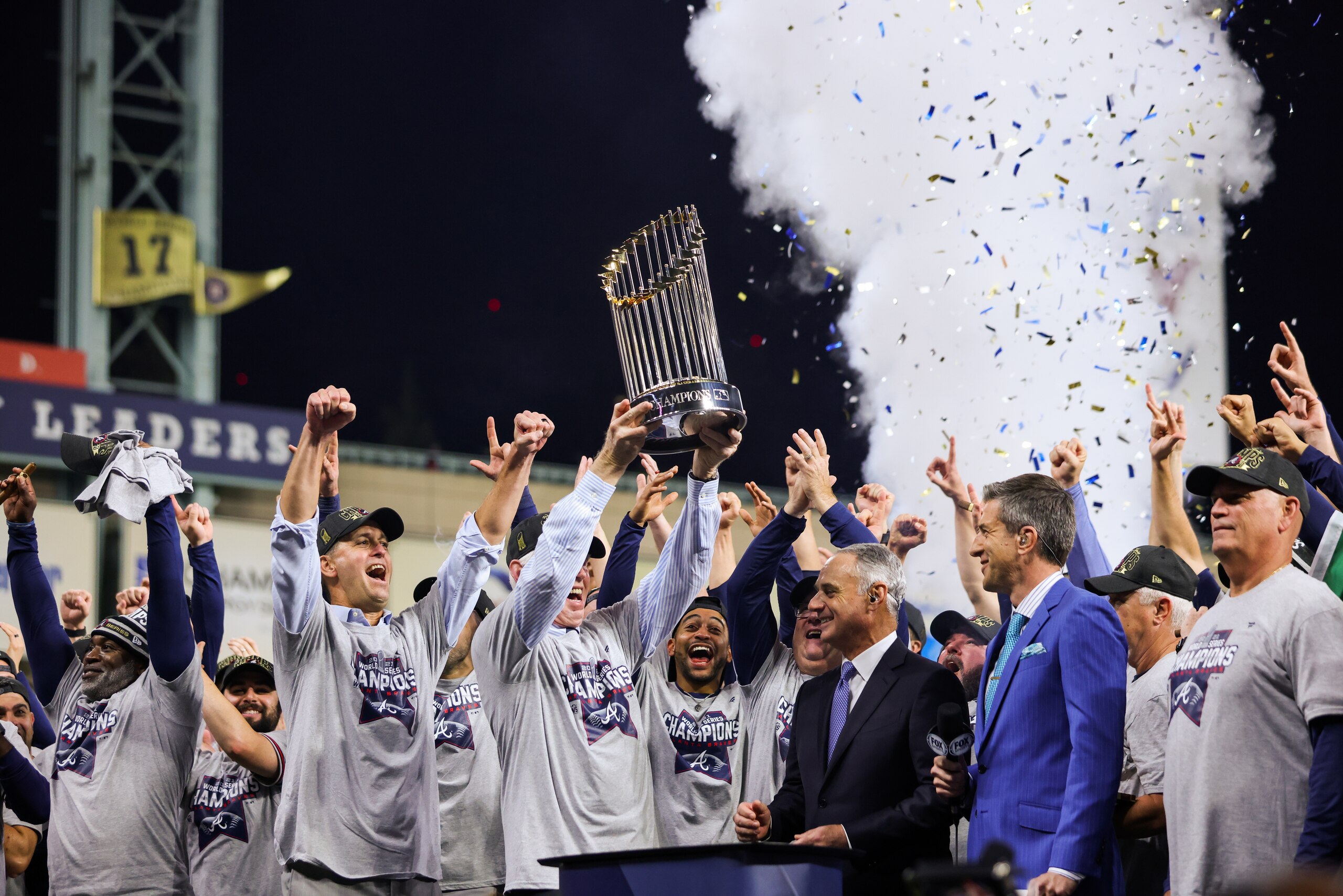

Braves World Series Win Offers 3 Key Lessons For MLB Teams in 2022
For the first time since 1995, the World Series champions reside in Atlanta. And if history is any indication, it won't be long before rival teams start picking apart how it happened so they can also walk that path to the Fall Classic.
In theory, this should be complicated. But in reality, it's pretty straightforward how Atlanta did it.
Winning the World Series required Atlanta to overcome all sorts of odds. The team went into the 2021 season burdened with less-than-optimistic projections, and its chances only got more complicated as the year went on. Never more so than when early MVP favorite Ronald Acuna Jr. tore his ACL on July 10.
TOP NEWS
Report: MLB Investigated Sonny Gray

Ranking MLB's Top 50 Rookies 🔢

Schlittler: We Didn't Show Up 🫥
Ultimately, though, the "how" of Atlanta's long-awaited championship can be boiled down to three things that other teams would be wise to take note of.
Nothing Matters More Than Winning the Home Run Battle
There's a debate to be had about whether the recent proliferation of home runs is good or bad for Major League Baseball. However, there's no doubt that this proliferation is ongoing with no end in sight.
Especially not after what Atlanta just accomplished.
Home runs were Atlanta's primary offensive weapon in the regular season, during which it cranked out 239 to rank third in MLB. So it went in the postseason, wherein manager Brian Snitker's offense paced the field with 23 long balls.
Come the World Series, Atlanta turned the home run battle into a no-contest affair. It smashed at least one long ball in all six games against the Houston Astros en route to a historic home run advantage:
If you're scoring at home, this makes it five out of the last six World Series in which the winner of the home run battle was also the winner of the series. The lone exception was in 2019, when the Astros and Washington Nationals pushed with 11 home runs apiece.
So in case anyone is still going to bat for the idea that small ball wins in October, it's past time to knock it out.
Sure, the Astros won the second and fifth games of the World Series by stringing baserunners together rather than hitting the ball out of the park. But that's harder to do in the playoffs.
Just looking at the last decade, the on-base rates with the bases either occupied or empty in the postseason are almost always lower than they are in the regular season:
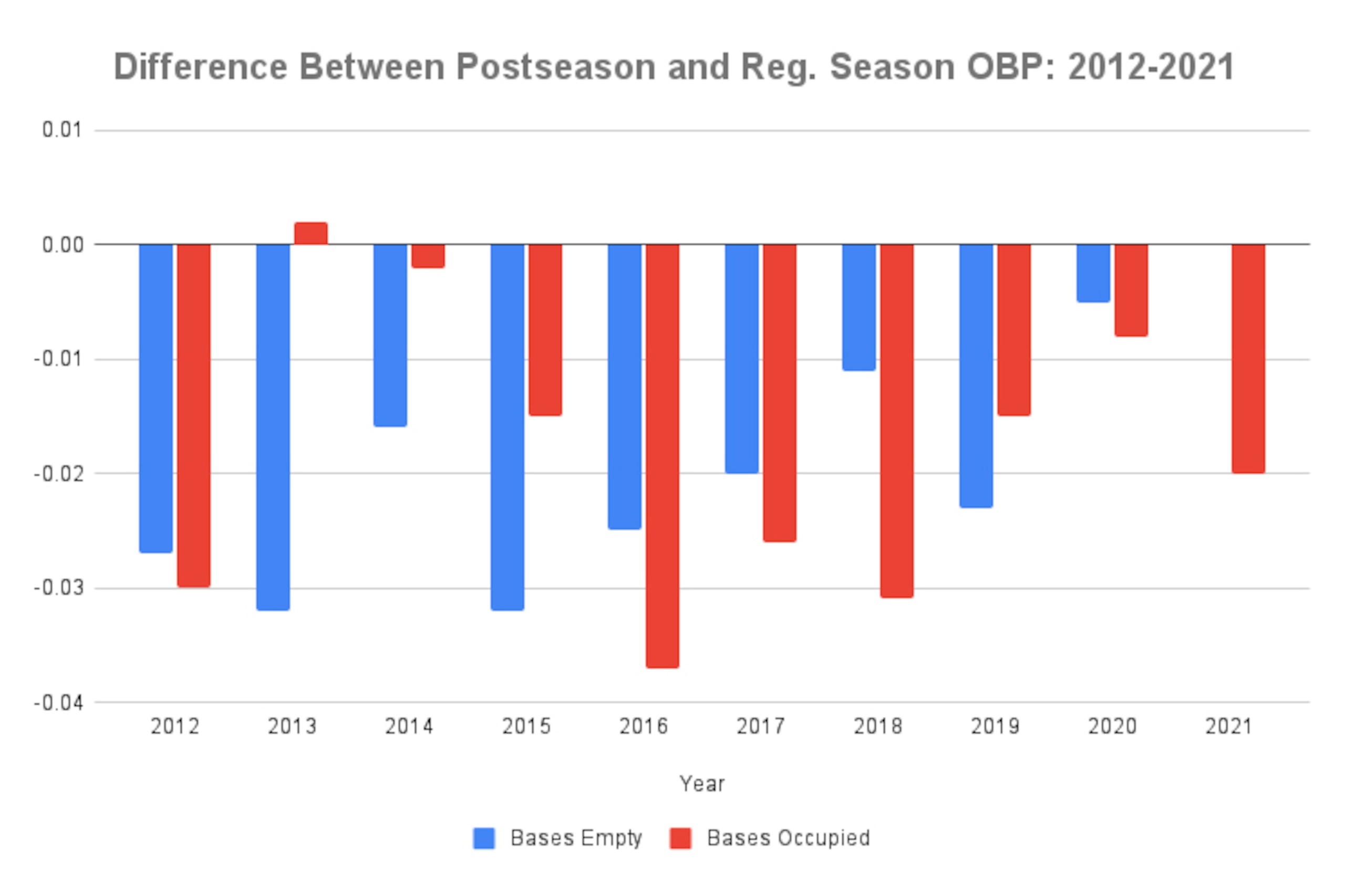
When faced with a challenge like this—namely, better pitching—the best solution isn't to work walks or hit it where they aren't. It's to hit the ball where they can't possibly catch it.
Like Jorge Soler did in Game 6:
Granted, the other side of this equation is that Atlanta's pitchers permitted Houston hitters to go yard only twice after they had done so 13 times in the first two rounds of the playoffs.
To do this, Atlanta's hurlers relied on the most democratic of pitching outcomes: the ground ball. Their 46.6 ground-ball percentage was the highest for any team in the last six World Series, and their defense gobbled them up to the tune of a .217 average allowed.
Perhaps unsurprisingly, a big key for Atlanta's arms was living at the bottom of the strike zone unlike any of the last 12 World Series teams. In so doing, they might have uncovered a market inefficiency by bucking the more recent shift toward pitching up in the zone.
Trust Pitchers To Do Their Jobs
Speaking of pitching, starting pitching was more of a strength for Atlanta in these playoffs than it was for other teams. Its four quality starts aren't much in a vacuum, but those were twice as many as any other team got.
Even still, the splits make it abundantly clear that starting pitching wasn't what buoyed Atlanta's pitching staff throughout its postseason run:
- Starters: 64.2 IP, 3.48 ERA
- Relievers: 75.1 IP, 3.11 ERA
From one perspective, there was a "necessity is the mother of invention" thing going on with Snitker's usage of his pitchers. He began the playoffs with only three viable starters in Charlie Morton, Max Fried and Ian Anderson. Once Morton broke his leg in Game 1 of the World Series, he was down to two.
Yet this is also just how things are now. The division of labor between starters and relievers has been getting more and more even for decades, and the last two seasons have nearly turned it into a 50-50 split. And as Jay Jaffe covered at FanGraphs, relievers are taking on even more work come October.
So much for the three-batter minimum rule discouraging managers from trying to exploit as many matchups as they can.
But while that bodes ill for baseball's larger pace-of-play problem, it's possible that starters will reclaim some of their former reliability after 2021.
Going from a pandemic-shortened 60-game campaign in 2020 back to 162 games in 2021 required many starters to drastically increase their innings from last year to this year. From the outside looking in, this seemed to be an underlying cause of the quick hooks we saw in the playoffs. Guys were just gassed.
But even if circumstances more or less forced him to play by these same rules, Snitker did a few things to ultimately separate his team from the pack.
For one, he didn't so much play matchups as put a ton of trust in his best relievers. Of the 75.1 innings that Atlanta's pen pitched during the playoffs, more than half (38.2) were handled by three guys: Will Smith, A.J. Minter and Tyler Matzek. And rightfully so, given that they combined to allow only seven runs with 50 strikeouts.
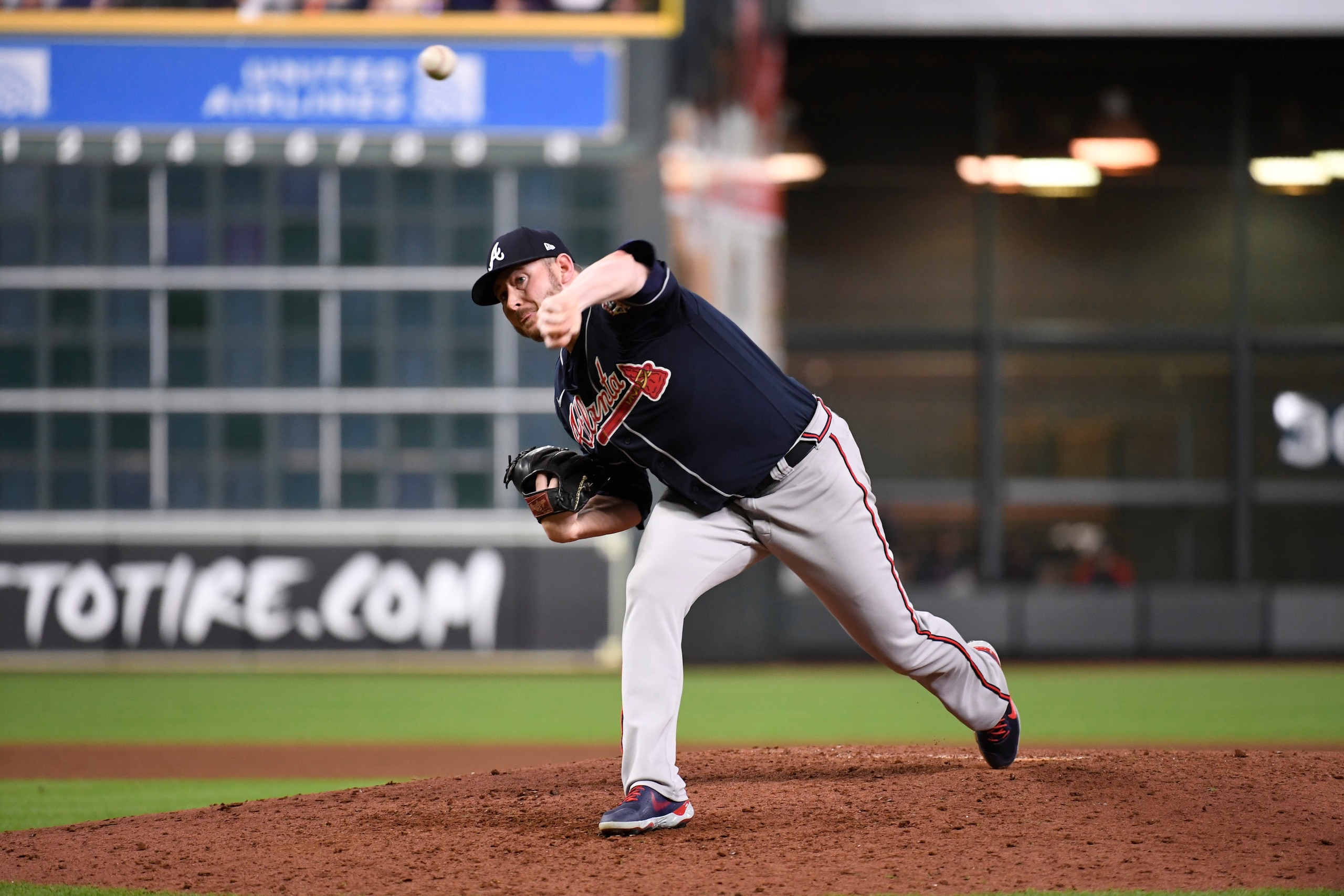
“I can't say enough about our bullpen,” Snitker told reporters after Game 5 of the World Series. “My God, I'm going to talk to ownership and send them all to Hawai'i for a week when we're done.”
Another thing Snitker did was refrain from using his best starters in relief. Which is to say, he didn't risk what the Boston Red Sox did with Nathan Eovaldi or what the Los Angeles Dodgers did with Max Scherzer and Julio Urias. Thus, there's no way Atlanta could have gotten bit like those two clubs did.
The takeaway? Maybe starting pitching isn't what it used to be, but at least let starters start and relievers relieve.
The Difference Between a Pretender and a Contender: Effort
In case there's any doubt that Atlanta general manager Alex Anthopoulos is the executive of the year, just consider that the team wouldn't have its MVPs for either the World Series or the National League Championship Series if not for him:
What's more, Soler and Eddie Rosario are just two parts of Anthopoulos' pre-trade deadline haul. He likewise fortified his outfield with Adam Duvall and Joc Pederson. Combined, the four of them hit 41 homers in the regular season and 12 more in the postseason.
Any other GM might not have been as aggressive as Anthopoulos.
In the immediate aftermath of Acuna's injury, Atlanta was below .500 and saddled with about an 8 percent chance of making the playoffs. Come the July 30 deadline, its situation hadn't improved much. Atlanta went into that day with a 51-53 record and a five-game deficit in the National League East race.
Nevertheless, Atlanta's brass calculated that there was a chance. As Anthopoulos said at the time:
"We just felt like we had a pretty good handle on our club and what the NL East was doing at the time. And even if things hadn’t gone all that well, we still felt like we had a club that had a chance to win the division. I think it’s wide open, and there’s a lot of games left."
In and of itself, it was refreshing to see a team seek upgrades even in spite of a losing record and long-shot postseason odds. That's become all too rare at a time when, as a source put it to R.J. Anderson of CBS Sports, "the attribute shared by everyone in the industry is risk aversion, not a passion for the game."
Plus, it didn't cost an arm and a leg for Atlanta to act on its optimism. In the trades it made for Soler, Rosario, Duvall and Pederson, it gave up exactly one prospect that ranked among the organization's top 30 for MLB.com. That was first baseman Bryce Ball, and even he was mired in a down year when he went to the Chicago Cubs in exchange for Pederson.
Otherwise, the most notable player to leave Atlanta was fallen star Pablo Sandoval, who went to Cleveland for Rosario as a means to balance out the finances.
Could Atlanta have aimed bigger? Sure. But to one extent or another, Soler, Rosario, Duvall and Pederson had each been stars in recent years. They were classic low-risk, high-reward additions. Maybe Atlanta didn't dare dream that they would pan out as well as they did, but it was always within the realm of possibility.
If the message wasn't clear enough then, it sure is now: Only good things can come from throwing caution to the wind and just, you know, trying.
Stats courtesy of Baseball Reference, FanGraphs, Baseball Savant and MLB.com.

.jpg?w=2560 "Weather Channel Trolls Texans-Titans 💀")



.jpg?w=2560 "Top Fantasy Waiver-Wire Adds 🔎")