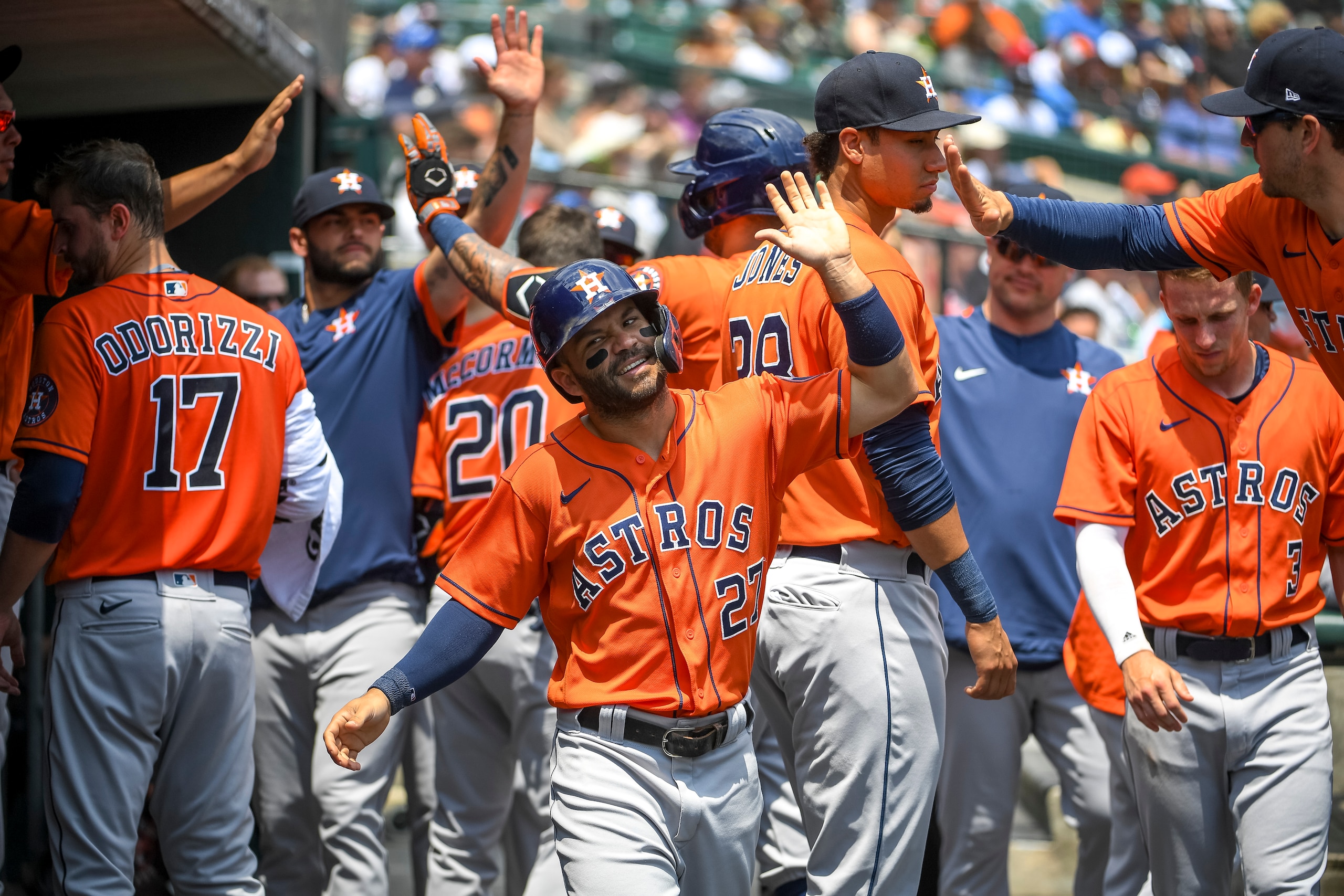

1 Year After Cheating Bombshell, Red-Hot Astros Are Reclaiming Their Elite Reputation

Back in January 2020, the Houston Astros' reputation seemed damaged beyond repair when Major League Baseball lowered the boom on the organization after discovering the sign-stealing scheme that aided its 101-win season and World Series run in 2017.
Roughly a year-and-a-half later, you'd swear that said reputation hadn't suffered so much as a scratch.
The Astros are tied for the American League's best record at 48-31, but with far and away MLB's best run differential at plus-140. They've done much of this damage over their last 28 games, in which they've gone 21-7 while outscoring opponents 183 to 88.
TOP NEWS

Brewers Complete Comeback In Game 2

World Series Game 2 Highlights 🎬

Next MLB Players to Sign $200M Contracts 💰
This doesn't mean that Houston's misdeeds from four years ago are forgotten, much less forgiven. It's doubtful that any of the players and fans who wanted the team stripped of its World Series title have changed their minds, especially not after Andy Martino confirmed that its cheating scheme remained in place throughout the 2017 playoffs:
It is, however, only getting harder to maintain the belief that the Astros were successful merely because they were willing to cheat.
After all, they followed their championship-winning season in 2017 with a 103-win campaign in 2018 and then a 107-win season and another World Series run in 2019. And while the optics were bad as the Astros went just 29-31 in last year's shortened season, they ultimately came just one win shy of winning their third AL pennant in four years.
Now the Astros are dominating once again, and it isn't because general manager James Click and manager Dusty Baker are working with a drastically different roster than the one formerly constructed by Jeff Luhnow and shepherded by manager A.J. Hinch. Sans departed outfielder George Springer and injured ace Justin Verlander, the Astros of 2021 indeed look a lot like the Astros of 2017-2019.
So, it's high time to appreciate something about the Astros that was all too easy to appreciate in those years: They just really are that good.
The Astros Have a Historically Great Offense. Again.
The Astros had a lot going for them between 2017 and 2019, but there was frankly no aspect of those teams more enviable than their offenses.
Houston's offense led the majors in all three triple-slash categories (i.e., AVG, OBP and SLG) between '17 and '19, though which of those offenses was the best depends on which park- and era-adjusted stat you prefer.
To wit, OPS+ says it was the 2017 Astros that had the best offense since the Babe Ruth/Lou Gehrig New York Yankees of the late 1920s and early 1930s, while wRC+ says that honor actually belongs to the 2019 offense. Either way, pretty good company.
After a brief descent into mediocrity in 2020, the Astros offense is now back at it in 2021.
On an individual level, the Astros are once again getting strong seasons out of Kyle Tucker (123 OPS+) and the newly re-signed Michael Brantley (149). But if it's a question of how they're making up for the loss of Springer after he paced last year's offense with a 141 OPS+, it comes down to the resurgence of four key players.
After missing all but two games last year due to injuries to both knees, 2019 AL Rookie of the Year Yordan Alvarez is back and cranking away with a .297/.366/.526 line and 13 home runs. He's been especially hot lately with four home runs in Houston's last seven games.
Though third baseman Alex Bregman—who had a modest 118 OPS+ even before he injured his quad—still isn't what he was in 2019, fellow stalwart stars Jose Altuve, Carlos Correa and Yuli Gurriel have succeeded in turning back the clock after collectively struggling in 2020:
- 2019: .294 AVG, .350 OBP, .550 SLG
- 2020: .238 AVG, .295 OBP, .371 SLG
- 2021: .308 AVG, .388 OBP, .520 SLG
From a broader perspective, the Astros are back to laying off breaking and off-speed pitches outside the strike zone after what seemed to be a telling struggle in that department last season. They're likewise back to crushing fastballs within the strike zone, against which they're hitting a sturdy .317 with a .519 slugging percentage.
Whether or not this is all related to the return of in-game video in 2021, it amounts to a practical explanation for how the Astros boast MLB's lowest strikeout rate while also ranking in the top 10 with 103 home runs. And just like old recent times, they're once again leading MLB in average, on-base and slugging.
Because the 2021 Astros are also pacing the field with 449 runs scored with underlying metrics that put even their '17 and '19 offenses to shame, it may indeed be their current offense that's most deserving of rubbing elbows with the Ruth/Gehrig Yankees.
And How About That Starting Pitching?
Even if the Astros offense is mostly responsible for the team's overall success, not to be overlooked is a starting rotation that ranks second in the American League with a 3.29 ERA.
This, of course, is no longer the province of Verlander or fellow fireballer Gerrit Cole, who parlayed two brilliant seasons with Houston into a $324 million contract with the Yankees after the 2019 season. Nowhere is this more apparent than in the average fastball velocity of Astros starters, which has gone from 94.0 mph in 2019 to 92.1 mph in 2020 to 92.0 in 2021.
And yet fastballs are actually a huge part of the success that Houston's rotation has had this season. By run value, only four teams' starters have been more effective with fastballs.
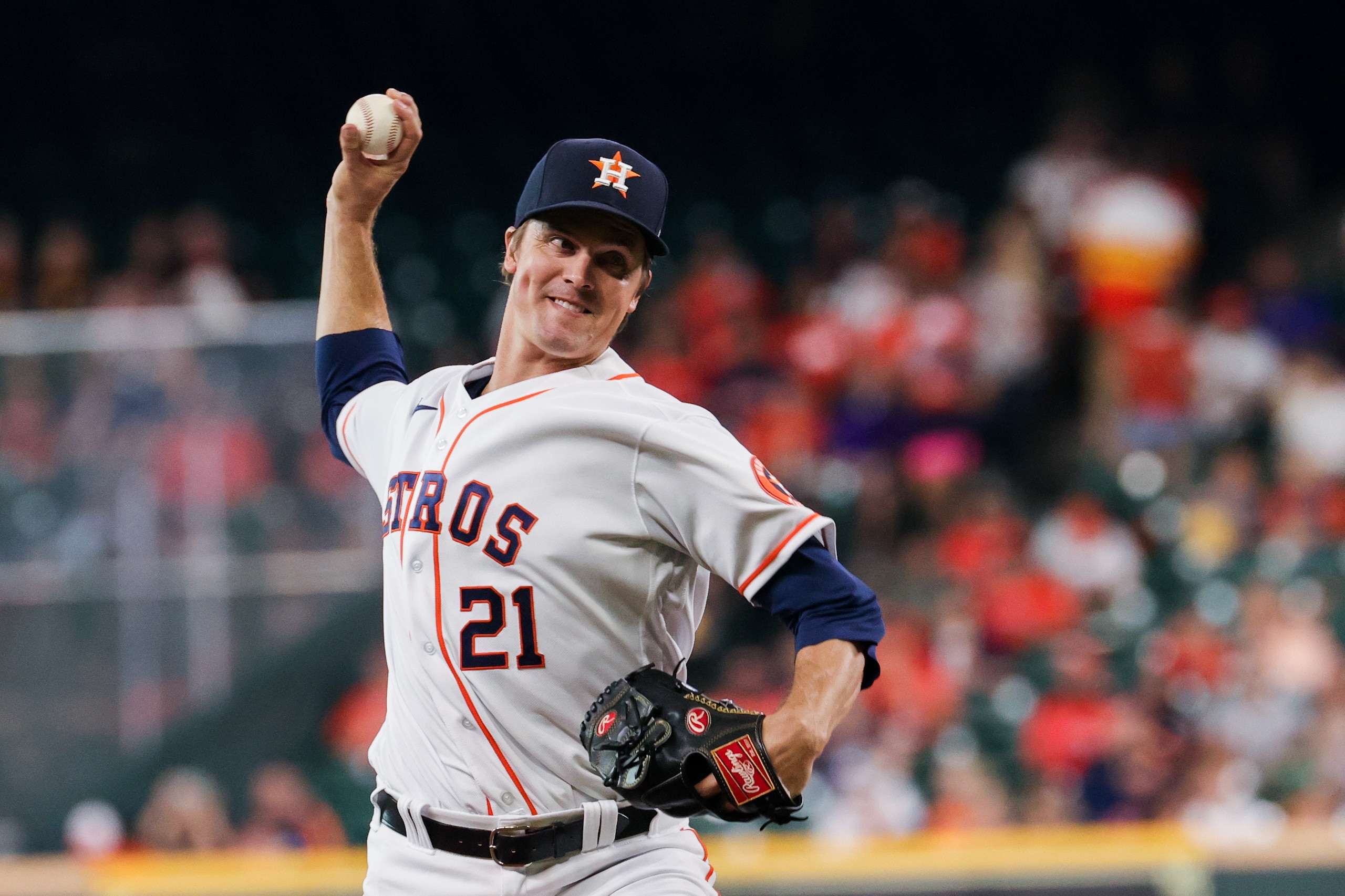
That in and of itself is solid evidence that Zack Greinke, Luis Garcia, Lance McCullers Jr., Jose Urquidy, Jake Odorizzi and Framber Valdez—none of whom has an ERA+ under 100—are simply good at pitching. But since it's there to be pointed out, it should be pointed out that they're good at pitching in a very specific way.
Namely, they stay away from batters regardless of whether a right-handed hitter or a left-handed hitter is at the plate:
- Plate X vs. RHB: 0.29 (4th in MLB)
- Plate X vs. LHB: -0.31 (2nd in MLB)
Because today's standard hitter is looking to generate power by pulling the ball in the air, this approach makes sense in theory. It's also hard to argue with in practice. Astros starters are holding righty batters to a .190 average against pitches on and beyond the outer third of the strike zone. Similarly, they're holding lefty batters to a .168 average on such offerings.
Is there nonetheless room for suspicion that Astros starters will maintain such a low ERA even though they're only 10th among their AL peers in strikeouts per nine innings? Well, sure.
Yet the other impossible-to-ignore element to this equation is that Houston's defense is very, very good. It's leading MLB with 27 outs above average, and its infielders are often in the right place at the right time. When in either a strategic or shifted position, Houston's infield has permitted just a .203 average on ground balls.
Even the Astros' One Flaw Is Coming Around
Through the first few weeks of the regular season, Houston's most noticeable problem was its lack of dependable relief pitching. Even as recently as May 29, Astros relievers had a pedestrian 3.94 ERA and a win probability added in the red.
But ever since the team started its hot streak on May 30, this storyline has evaporated as Houston's pen has put up a 3.24 ERA and moved into the black for WPA.
Nobody is driving this effort harder than ace closer Ryan Pressly, whose last nine appearances have yielded no runs on four hits, one walk and 15 strikeouts. Blake Taylor, Brooks Raley and Ryne Stanek have also been pitching well, while Cristian Javier has settled into a niche as a multi-inning weapon, logging a 2.70 ERA over 16.2 innings over six appearances dating back to May 28.
All told, it takes a microscope to find faults with the Astros right now. They really are playing that well, and the general shape of the American League playoff picture has shifted accordingly.
Per FanGraphs, the Astros opened the season with a 55.9 percent chance of winning the AL West and a 15.8 percent chance of making it to the World Series. Those figures are now at 80.7 percent and 26.5 percent, respectively.
If for no other reason than that they simply had the gall to go through with it, what the Astros did in 2017 still places as one of the most egregious scandals in MLB history. But even if that ensures they'll never be able to play their way into everyone's good graces, by now they ought to have played their way back into everyone's respect.
Stats courtesy of Baseball Reference, FanGraphs and Baseball Savant.

_0.png?w=2560 "Unranked Teams Cause Chaos in Rankings 📊")

.png?w=2560 "Week 8 Winners & Losers 📊")
.jpg?w=2560 "Jonathan Taylor Landing Spots 📍")




