2011 BCS Bowl Games: 8-Team Playoff Version
The BCS did the job it was supposed to do: Match the teams that it considers the top two teams in a title game.
What it does not do, nor has ever done, is provide a level playing field for a fair and balanced (*cough*) determination of title participants among the several contenders that inevitably arise each year as legitimate threats on the field.
This, and this alone, is the main reason it fails in the larger, yet unfulfilled mission of the Football Bowl Subdivision—to implement a truly competitive postseason in which the merits of the several contenders are put to the test on the field in a single-elimination tournament.
The very same year that Divisions II and III were created, 1973, the NCAA was able to establish proper playoffs. And when the Football Championship Subdivision (then called I-AA) was created in 1978, the NCAA, likewise, created a proper playoff.
As a result, there has been neither doubt nor debate about the identity of the champion of those three tiers of college football.
The vested interests in FBS—the bowls themselves—oppose a playoff for a multitude of reasons. All of them are legitimate reasons, but not a single one overrides this one and only fact: There is no, repeat, no official NCAA champion of FBS (formerly Division I-A) football.
There is a BCS "national championship," but it most definitely does not count as a team championship in the NCAA record books. Division I basketball championships are counted, of course. So are FCS, Division II and Division III football championships.
But, the FBS remains a breed apart—idiosyncratic, rather inbred, and anxious to preserve a tradition that has long since been trampled under monetary considerations, while refusing to contemplate a playoff as something unfamiliar and foreign.
Until the BCS is truly seen as what it is—an anti-competitive cartel of corporate-sponsored entities in collusion with a segment of FBS athletic programs to restrict participation in the postseason based not on merit, but on status—we will continue to experience the disgusting amalgam of soap opera, beauty pageant and political straw poll that is the postseason in the top tier of college football.
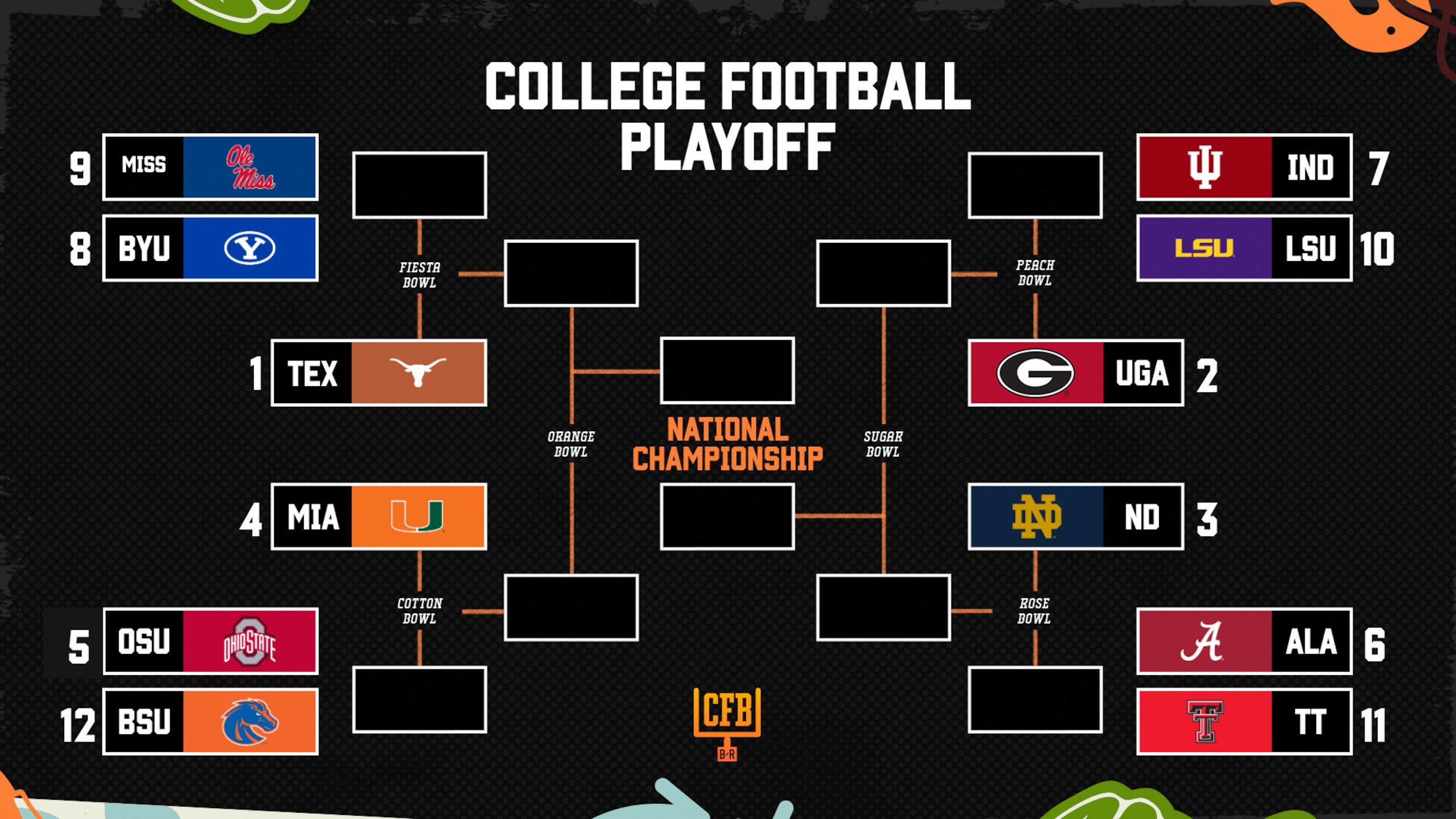
In past articles, I've presented scenarios for eight-team playoffs in each of the previous years of the BCS. My basic template is this: Have the four BCS bowl sites take place on the traditional Jan. 1 (or Jan. 2, as is the case this year), with no other competing bowls on that day. These bowls—Rose, Orange, Sugar and Fiesta—would serve as the quarterfinals.
The four winners would then meet in a "Football Final Four" at a fifth site. I've suggested Cowboys Stadium in Arlington, TX as a possible permanent fifth site where the semifinals and final would take place (Jan. 8 for the semifinals and Jan. 15 for the final).
In that case, the Cotton Bowl game would move back to the old stadium in Dallas, which is still named for the bowl it hosted up through 2009.
The one tweak I will make to the template this year (and which I might possibly apply retroactively to the previous BCS years in a future article) is this: Instead of the six BCS conference champions receiving automatic qualification to the playoff, the six highest ranked conference champions (in the BCS rankings, though ideally an NCAA committee would institute an RPI measure rather than giving inordinate weight to polling) qualify, along with the two highest ranked at-large teams.
Based on that template, here are this year's playoff participants:
(1) LSU Tigers: Sugar Bowl Quarterfinal
1 of 9Back in days of yore, before most of you Bleacher Report readers were born, the polls decided a national champion at the end of the regular season. There weren't even any fancy conference championship games. The bowl games were seen as superfluous.
That began to change in the late 1960s, and by the mid-1970s, both major polls (AP and UPI) chose their respective national champions after the bowl games were complete.
As before, they still sometimes differed in who they named champion. That's what happens when there's no postseason tournament to settle the question once and for all.
This year would be one of those cases where the old system might actually make sense; that is, there is a clear champion of the regular season. You know, what BCS defenders call the season-long playoff. Well, that's over, and there is only one undefeated team: LSU.
But, that would be too easy, and, of course, that wouldn't be the case every year. Hence a postseason... and to give more than one of this year's one-loss teams a shot would be the most fair and balanced way to run it.
Actually, the academic debates about "bodies of work" and "style points" could be thrown out the proverbial window with a postseason tournament.
Alabama or Oklahoma State? Who really knows? Put them in a tournament, and see who comes out on top. For the tournament, though, LSU starts out on top with the No. 1 seed.
(8) Stanford Cardinal: Sugar Bowl Quarterfinal
2 of 9As the second-highest ranked non-conference champion, Stanford would receive one of the two "at-large" berths in the eight-team playoff. Its one glaring loss to Oregon ended up preventing the Cardinal from winning the Pac-12 North.
(Note: if the Pac-12 had done the right thing and put the four California schools in the Pac-12 South along with the two Arizona schools, there would have been a much better conference championship game matchup, at least this year. However, I would argue that would be the case in most years.)
But, its No. 4 BCS ranking and 11-1 record give it a shot at the prize. Barely. And they would have to knock off the LSU Tigers—in New Orleans—to advance.
That's really an indication that the regular season still retains its importance and that every game still counts. There's quite a difference between this matchup and, say, the one in the Rose Bowl quarterfinal.
(2) Oklahoma State Cowboys: Fiesta Bowl Quarterfinal
3 of 9The good news: As the second-highest ranking conference champion, Oklahoma State receives the No. 2 seed and hosts the Fiesta Bowl quarterfinal.
The bad news: Their opponent is the highest ranked non-conference champion. No prizes for guessing who that is.
One thing is for certain. This game will decide on the field, between the two teams themselves (not in the heads of the sportswriters and coaches or the algorithms of the computers), which deserves the chance at the title game.
Of course, the winner would then have to play the winner of No. 3 vs. No. 6 in the semifinal to even reach that title fight with LSU...and that's presuming LSU reaches the title game.
Nothing is certain. That's why the games are played, right?

_0.png?w=2560)
(7) Alabama Crimson Tide: Fiesta Bowl Quarterfinal
4 of 9As the highest ranked non-conference champion, Alabama receives the No. 7 seed and thereby avoids facing LSU in the Sugar Bowl quarterfinal. It does allow for the possibility of meeting LSU in the final, however, if the Tide can win the quarterfinal against Oklahoma State and then the semifinal against the No. 3 vs. No. 6 winner.
Would the Tide fans be miffed at having to travel to Arizona to face Oklahoma State instead of being gifted a place in the title game on a platter? Of course.
Would the players (and let's be honest, the coaches and most neutrals) be drooling at the prospect of proving their worth against the Cowboys head-to-head and settle the debate on the field, where it should be settled?
Damn right they would.
(3) Oregon Ducks: Rose Bowl Quarterfinal
5 of 9Now, this is where the prospect of traditional bowl affiliation becomes sticky. In my scenarios for previous years, I had the Pac-10 (as it was) and the Big "Ten" (*cough*) champions meeting in the Rose Bowl quarterfinal.
But one thing stands in the way: the end of automatic qualification. There is a chance that one, or both, of the conference champions will not be among the six highest ranked conference champions. It's happened for them both in the BCS era (but not in the same year).
And as the end of automatic qualification seems imminent even if the BCS were to continue, it makes sense to "unhook" the affiliation...at least the dual affiliation. Almost every year will see at least one of the two conference champions qualify for an eight-team playoff; in some years (such as this one), both will.
But in most cases, it will be the higher-ranked champion of the two that hosts the Rose Bowl, while the lower-ranked champion is slotted according to seeding and not guaranteed a spot in the Rose Bowl quarterfinal.
So this year, Oregon hosts the Rose Bowl against an opponent making a return trip. But, not the opponent you think...
(6) TCU Horned Frogs: Rose Bowl Quarterfinal
6 of 9TCU got lucky.
Of course, they made their own luck by beating Boise State in Boise (good ol' Getty Images doesn't have pictures of last week's slaughter of UNLV, and I can't say I blame them) and thus becoming Mountain West champions, despite having one more loss than the Broncos.
The Horned Frogs are still ranked more than 10 places below Boise State (BCS ranked No. 18 to BCS ranked No. 7), but Boise State is only the fourth-highest ranked non-champion (behind Alabama, Stanford and Arkansas).
And don't forget, TCU is still ranked higher than Big East champion West Virginia (BCS ranked No. 23).
Where TCU got lucky was with help from former C-USA Conference partner (and now C-USA champion) Southern Mississippi. For their part, the Golden Eagles (BCS ranked No. 21) are also ranked higher than West Virginia. (Sorry, Mountaineers).
USM soundly defeated Houston in the C-USA Conference Championship Game, and so instead of the Cougars having the No. 3 seed and hosting the Orange Bowl against Clemson (Oregon would have been seeded fourth and still hosted the Rose, but against Wisconsin, not TCU), they were knocked out of the playoff scenario altogether.
So, TCU (instead of Wisconsin) gets a return trip to Pasadena and yet another chance to prove they belong with the "big boys" before making the move to the Big (*cough*) "12". Perhaps they should send a freezer trailer full of Ft. Worth's finest steak down I-45 to ease Houston's suffering?
(4) Wisconsin Badgers: Orange Bowl Quarterfinal
7 of 9The good news is that the Badgers get to host a quarterfinal as the No. 4 seed, and host that Orange Bowl quarterfinal against an admittedly less formidable opponent than Oregon.
The bad news is that if they win, they then have to face the No. 1 vs. No. 8 winner in the semifinal.
Granted, it would have been an equally tough road to the title game if Houston had won—if not tougher—as the No. 4 vs. No. 5 matchup would have been between the Badgers and the Oregon Ducks in the Rose Bowl.
That's really the beauty of an eight-team playoff; there are no really easy paths to the title game, except, arguably, for the top-seeded team. And even then, upsets do occur.
All else being equal, the Badgers would probably prefer the Rose Bowl, but I don't think they would be too angry about facing Clemson in a playoff quarterfinal with a chance to advance.
(5) Clemson Tigers: Orange Bowl Quarterfinal
8 of 9Beats a dead-end game against West Virginia, doesn't it?
Some would no doubt consider Arkansas, Boise State, Kansas State and South Carolina to all be better candidates for an eight-team playoff than either TCU or Clemson. I would not necessarily disagree.
But, unless and until conference championship games are seen as money-generating exhibitions rather than legitimate postseason tournaments (mini-BCS title games, if you will), the fiction of the need for such games will remain a necessary evil. But, that's a matter for another article entirely...
None of those four teams mentioned at the start won their conference (for those who were wondering, independents such as Notre Dame would fall into the "two highest-ranked non-champions" in order to qualify).
Clemson did the necessary work to clinch that playoff place by a) winning the ACC title game and b) jumping past TCU in the rankings (if Houston had won, this jump would have been vital).
So congrats, Tigers. Were you to upset the Badgers, you would most likely be facing those other Tigers in the semifinal in Arlington. Barring upsets, of course. But, when do those happen?
Remaining Bowl Matchups: Business as Usual
9 of 9For example:
The Cotton Bowl would still have arguably the most impressive non-playoff (or non-BCS if you're adamant about sticking to that acronym) pairing, with Arkansas (BCS ranked No. 6) facing Kansas State (BCS ranked No. 8) in what should really be an indication of how good the rivalry between the old Big Eight and the old Southwest Conference could have been if their champions had faced off regularly in the Cotton Bowl.
Virginia Tech (BCS ranked No.11) and Michigan (BCS ranked No. 13) would lose their Sugar Bowl matchup and the precious BCS payout that goes with it, and likely be slotted into separate bowls according to conference tie-ins.
Overall, I'd say that those two losing out on a playoff shot is more than understandable, though, as they fall even further down the list of non-champions than those already mentioned.
But virtually all of the other bowls would remain unaffected, and could continue their exercises in irrelevance...just as the NIT continues to plod along, performing its useful function of bottom-feeding.
It's way past time to begin thinking of viable, workable alternatives to the BCS, however. It's had over a dozen years to do its job without damaging the sport as a whole. What appears to be the case is that with each passing year, the sport is rotting from the inside (or the top, if you prefer).
The top tier of college football deserves better.
.jpg?w=2560 "NFL investigating 2 referees for separate viral exchanges")
.jpg?w=2560 "OBJ Calls Out Giants After Release")



.jpg?w=2560 "Another Cryptic Tyreek Post 🤨")