
If Texas Departs, Can the Big 12 Survive?
With all the current talk of conference realignment, only two teams stand out as true power players in the whole discussion: Notre Dame and Texas.
These schools are two of the most financially successful programs in college football.
Notre Dame alone remains of the great independents of the past, supported in large part by its exclusive deal with NBC. With the support of millions of Catholics and Irish nationwide, Notre Dame has been able to succeed without having join up with a conference for college football.
.jpg?w=2560 "AP Poll Top Five Week 9")

.jpg?w=2560)
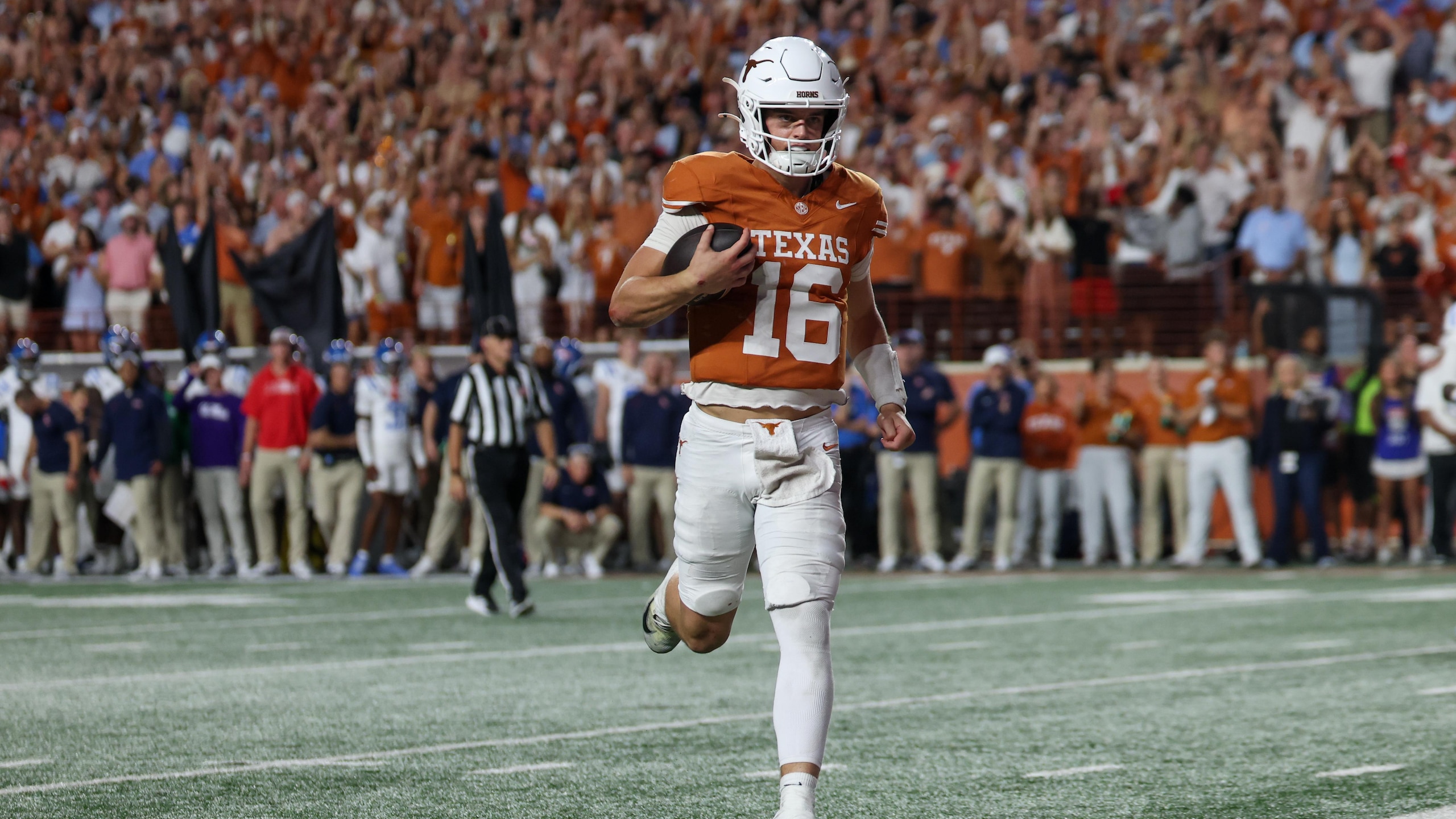
Texas stands out as the other prime target for expansion, and the reasons are perfectly clear. Texas generates more revenue than any other school in the country. It is one of the largest and wealthiest state flagship universities in the country and has one of the largest alumni bases in the country.
The Longhorns also have the support of a large portion of the people in Texas, one of the most populous states in the country. While the university is located in Austin (1.7 million metro area), it can count metro areas such as Dallas-Fort Worth (No. 4 in the nation) and Houston (No. 6 in the nation) as part of its market, as well as the whole rest of the state.
Longhorn apparel is some of the best-selling college gear in the country. Longhorn fans will travel and fill up distant college stadiums.
In short, Texas is a cash cow. It is the driver of revenue for the Big 12 and receives the lion's share of Big 12 TV revenue, which is based upon appearances, not membership like the Big Ten.
In a different era, Texas might be better served by going independent and keeping all its money to itself and making its own TV deals. But that is not going to happen in today's era of conferences and super-conferences.
Could Texas Really Leave?
Texas has long had aspirations of greatness. Long before the formation of the Big 12, Texas explored relationships with the Big Ten and Pac-10. This interest related to much more than money.
The University of Texas views itself as one of the elite universities in America. It has prestige envy. The Longhorn administration wants to be associated with other elite public universities, such as are found in the Big Ten and Pac-10, which is also why Texas rejected the idea of joining the SEC (which Texas A&M had explored and pushed for back in the late 1980s), viewing those universities as substantially academically inferior.
Texas killed the SWC in order to join with the Big 8 teams and took both Texas Tech and Baylor along only due to political pressure. Texas will unlikely bow to such pressure again, especially as those politicians are mostly long gone.
Texas has been mentioned in connection with both the Pac-10 and Big Ten expansions. Either alignment would give Texas a shot at regular trips to the Rose Bowl.
The Big Ten would offer Texas substantially more money than it currently receives but would also result in Texas no longer having such an outside superior financial situation. Texas would immediately dominate the Big Ten and be its premier team.
The Pac-10 currently has the second worst TV deal of the Big Six conferences, just ahead of the Big East. Texas would also be one of the premier teams in the conference, but not the highest prestige team in a conference with USC.
Now, with Texas in the Pac-10, the Pac-10 could suddenly demand and obtain a very good TV deal.
So, for Texas, it really is a matter of desire. Does it really want to leave the Big 12?
Let's Just Assume Texas Actually Leaves
Just for the sake of argument, we can look at what a Texas departure would do to the Big 12.
First, no other team in Texas can command the entire state TV market. A&M has a healthy following but has nowhere near Texas' pull. Tech and Baylor are two small-market teams with limited appeal for TV. Thus, if Texas leaves, the Big 12 cannot replace Texas with any team good enough to even maintain its current TV value.
If Texas leaves in conjunction with other teams, such as Colorado and Missouri, the conference loses its key TV markets out of Texas (St. Louis and Denver) with a weakened presence inside Texas. As such, the Big 12 would have only three significant teams, Nebraska, Oklahoma, and Texas A&M, which would in turn be prime candidates for an expanded SEC.
So, the Big 12 may be left with Baylor, Kansas, Kansas State, Oklahoma State, and Texas Tech. While this would provide an excellent core to a basketball conference, it would be severely lacking in football clout.
The Big 12 could attempt to raid non-BCS conferences but would not likely hold on to BCS status unless the Big 12 convinced the best of the non-automatic qualifying teams to join. Adding schools such as Tulsa, SMU, Houston, Rice, and UTEP would not be enough to give the BCS status.
Getting BYU, Utah, and TCU might be enough to help the Big 12, but why would those schools leave the MWC rather than supporting the MWC grabbing the best of remaining teams? Adding some of the better remaining programs would greatly strength the Mountain West's argument for BCS status.
Overall, Baylor is in the worst possible situation in the event of any serious changes to the Big 12. Baylor lacks the political support to ensure that it can jump on UT's coattails. It will drop down in status equal to SMU or Rice and maybe even find itself with them in a revamped Big 12/Southwest Conference, as an outsider to the entire football system.
In the possibility that the Big 12 only loses the Longhorns, the conference has an outside shot at survival. Nebraska, Oklahoma, and A&M are all name programs with significant following. The Big 12 then could poach a TCU or BYU from the MWC to fill the empty spot. While the resulting conference would be weaker than with the Longhorns, it would still be viable enough to survive and maintain its BCS status.
So, the Big 12 had best hope that it can keep Texas. The Big 12 can survive the loss of Missouri and Colorado. While it could survive the loss of just Texas, such a loss would likely be the harbinger of the demise of the conference, just like the departure of Arkansas signaled the death of the Southwest Conference.
What Can the Big 12 Do to Discourage Texas from Leaving?
Three things, none of which will ultimately prevent Texas from departing for greener pastures, but all of which could make it harder for them to do so.
First, continue to give the Longhorns a disproportionate share of TV revenue. Sure, Texas makes more money than any other team in college football, and the unbalanced revenue system (unlike the Big Ten) really makes the other teams in the conference irate and prevents them from even keeping up with Texas. But if the Big 12 wants to keep the Longhorns, it must pay the price.
Second, expand to 14. We are now in an eat or be eaten world. With the Big Ten and Pac-10 expanding, the Big 12 looks like a big pool of easy targets. Again, Missouri and Colorado could be replaced, but not Texas. So, go ahead and use the name Big 14, which the Big 12 has owned for almost two decades.
Third, start working on the political pressure. Baylor and Texas Tech went along with Texas and Texas A&M to the Big 12 due to political pressure. The ACC added Virginia Tech due to political pressure, although that has turned out much better than Baylor.
Keeping Texas in the Big 12 is very important to Texas Tech, Texas A&M, and Baylor. All three schools have significant political ties, although the players involved are very different from the early 1990s. While it may not be enough this go-around to keep the lesser schools with Texas, the effort must be made.
Conclusion
Ultimately, I think Texas likes its home in the Big 12 South. It has only one major rival in the division, the Sooners, and a bunch of decent teams it can dominate. With or without a division win, it can all but pencil in a BCS bowl berth.
Texas has not finished below No. 12 in the polls since 1999. The Longhorns have never missed a bowl game since the inception of the BCS and have gone to only one minor bowl game, the 2005 Alamo Bowl.
But the Longhorns only have three conference championships since joining the Big 12 and only five berths in the Big 12 title game. As such, the prospect of moving conferences, especially to one with better academics and prestige, may be enough for Texas to drive a stake through the heart of the Big 12.

.jpg?w=2560 "Mahomes Told Teammate to Leave Meeting")
.jpg?w=2560 "Baker Gets Glove From Rays 🧤")

.jpg?w=2560 "NFL investigating Eagles")
.jpg?w=2560 "Updates from EVERY NFL Game 🏈")

.jpg?w=2560 "Steelers Roll Saints in Paris")