How College Football Playoffs Would Improve the Regular Season
 It'll ruin the regular season!
It'll ruin the regular season!
This has been one of the main cries from NCAA football playoff detractors since the idea surfaced.

_0.png?w=2560)
It's a completely illogical claim that has yet to be properly refuted.
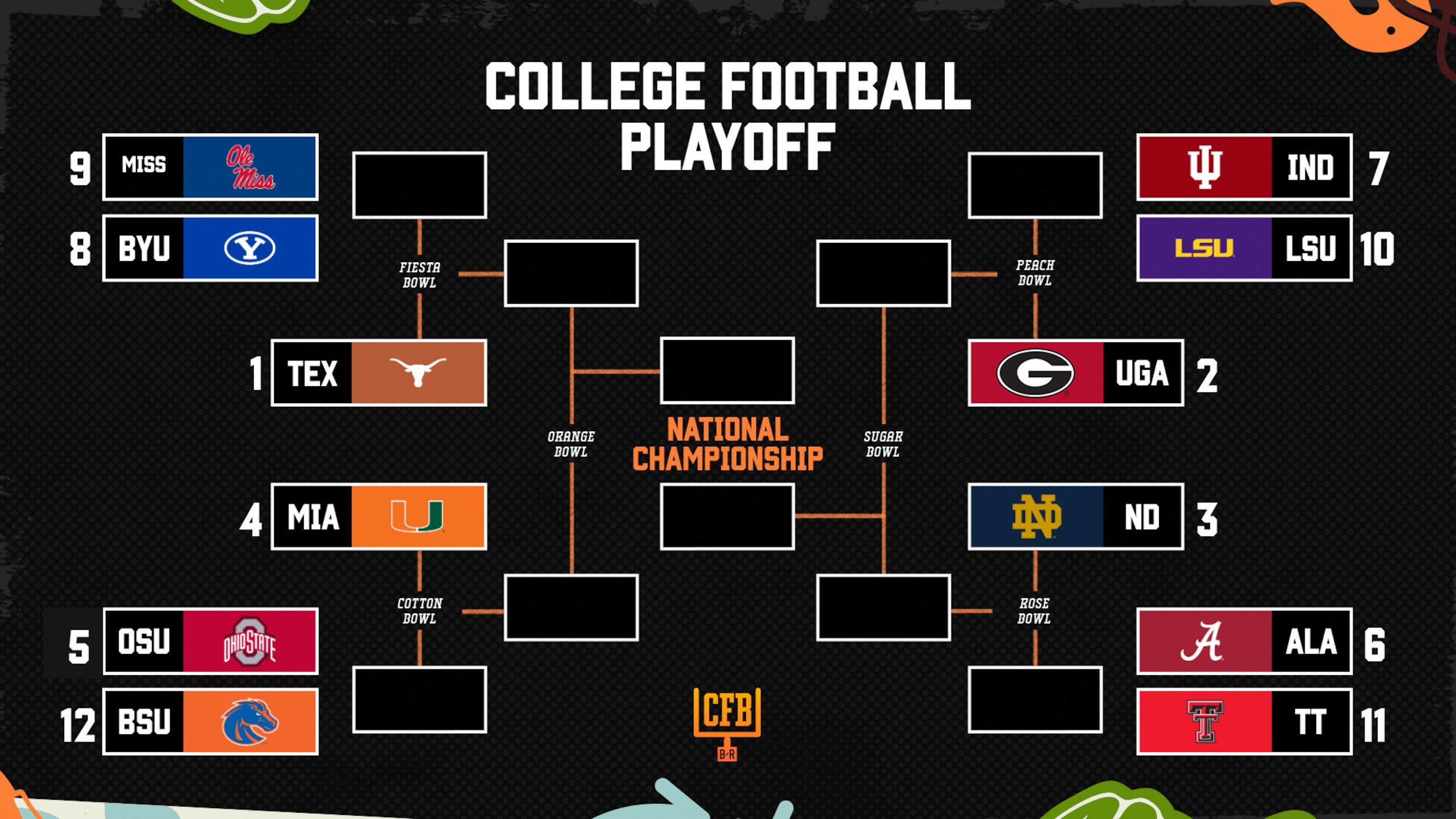
Let's take a look into the future and try to predict what would happen if there were an eight-team playoff instituted in college football...
What we know:
1. Eight teams playing for a national championship instead of two would mean that one loss wouldn't kill a season, as it typically does now.
2. Teams from non-BCS conferences would have a better opportunity to play for the national championship.
3. Human bias and computer unbias would become less important, as the teams being left out of title contention wouldn't be the third- and fourth-ranked teams in the country, but rather the ninth- and tenth-ranked teams.
After last season's Ohio State-Michigan game, playoff haters said the matchup would have lost most of its luster in a playoff system, as the loser wouldn't have been left out of national title contention.
Let's examine the game had an eight-team playoff been put together prior to the 2006 season...
Ohio State and Michigan both came into the game undefeated and ranked No. 1 and 2 in the country, respectively. A loss here knocks the loser (Michigan) to a lower seed in the playoffs, meaning a much tougher matchup in the first round.
Those first round matchups matter greatly in the NFL. It's also extremely important to be a top seed in the NCAA basketball tournament.
The result of the Ohio State-Michigan game would have still mattered, if to a slightly lesser extent.
What seems to be ignored about this game is that it's ONE game. Games like that only come along so often.
That brings me back to my first point.
Consider the nonconference schedules for the AP preseason Top 10...
USC: Idaho, Nebraska, and Notre Dame
LSU: Virginia Tech, Middle Tennessee, Tulane, and Louisiana Tech
West Virginia: Western Michigan, Marshall, Maryland, and East Carolina
Texas: Arkansas State, TCU, Central Florida, and Rice
Michigan: Appalachian State, Oregon, Notre Dame, and Eastern Michigan
Florida: Western Kentucky, Troy, Florida Atlantic, and Florida State
Wisconsin: Washington State, UNLV, and Citadel
Oklahoma: North Texas, Miami, Utah State, and Tulsa
Virginia Tech: East Carolina, LSU, Ohio, and William & Mary
Louisville: Murray State, Middle Tennessee, Kentucky, NC State, and Utah
 I bolded the matchups that could have possibly meant something had those teams panned out, which most of them did not (sorry, I had to throw in Notre Dame).
There's not a lot of bold up there.
My point?
In the current system, many teams base their schedules on the need to go undfeated—by playing nobodies in nonconference matchups.
That's precisely why Ohio State is ranked No. 1 right now, even if many don't believe they deserve to be there.
With a playoff system, perfection becomes a much less important issue. Sure, teams will still pad their schedules with cupcakes—but if one loss doesn't eliminate a team from title contention, playing a big nonconference opponent will be much more inviting.
The money is better, the TV ratings are better, the recruiting becomes easier, and the strength of schedule improves.
That last point is important: A team in a poor conference can play tougher teams in nonconference games and strengthen their chances of being in eighth place at the end of the season.
And if top teams are playing top teams on a weekly basis, does that not improve the regular season?
 The regular season also becomes a bigger deal for teams from non-BCS conferences that go undefeated. We've seen the drawbacks of the current system in the last few years with Boise State and Utah, who went undefeated but weren't given a chance to play for the national title.
This is wrong, and it completely ruins the regular season. In what other sport can a team go undefeated and not have a chance at the championship?
With a playoff system, teams from smaller conferences can go undefeated and have a national title shot. How exactly would this hurt the regular season?
Finally, controversy seems to overshadow the last couple weeks of every college football season. We've seen it happen almost every year since the BCS began, and no one seems to mention how much that detracts from the actual games.
I'd rather be talking about the play on the field than whether or not some stupid system is accurate enough to choose the two best teams.
This season is proving to be completely unpredictable, and the idea that anyone can pick the two top teams out of the chaos is absurd.
How much does it hurt this regular season knowing that the BCS Championship Game will feature two teams basically picked out of a hat?

.jpg?w=2560 "NFL investigating 2 referees for separate viral exchanges")
.jpg?w=2560 "OBJ Calls Out Giants After Release")
.jpg?w=2560 "Report: Chiefs Contact Hill's Agent")
.jpg?w=2560 "Tyreek makes another cryptic post amid Chiefs rumors")