
Throughout the offseason, many reasonable questions about the Ohio State program lingered. Could the Buckeyes seamlessly transition from Urban Meyer to Ryan Day? Dwayne Haskins to Justin Fields? Two new co-defensive coordinators?
Plenty of analysts picked Ohio State to reach the College Football Playoff, but they had to put their trust in the unknown. Four games into the 2019 season, though, the answers have added up to an apparent, familiar conclusion.
Ohio State is every bit the national contender we have come to expect.
.jpg?w=2560 "AP Poll Top Five Week 9")
.jpg?w=2560)
While the opening four-game stretch wasn't stacked with top competition, the Buckeyes controlled each opponent. In recent years, they often showed a few glaring holes that needed to be addressed before Big Ten play.
Not so in 2019.
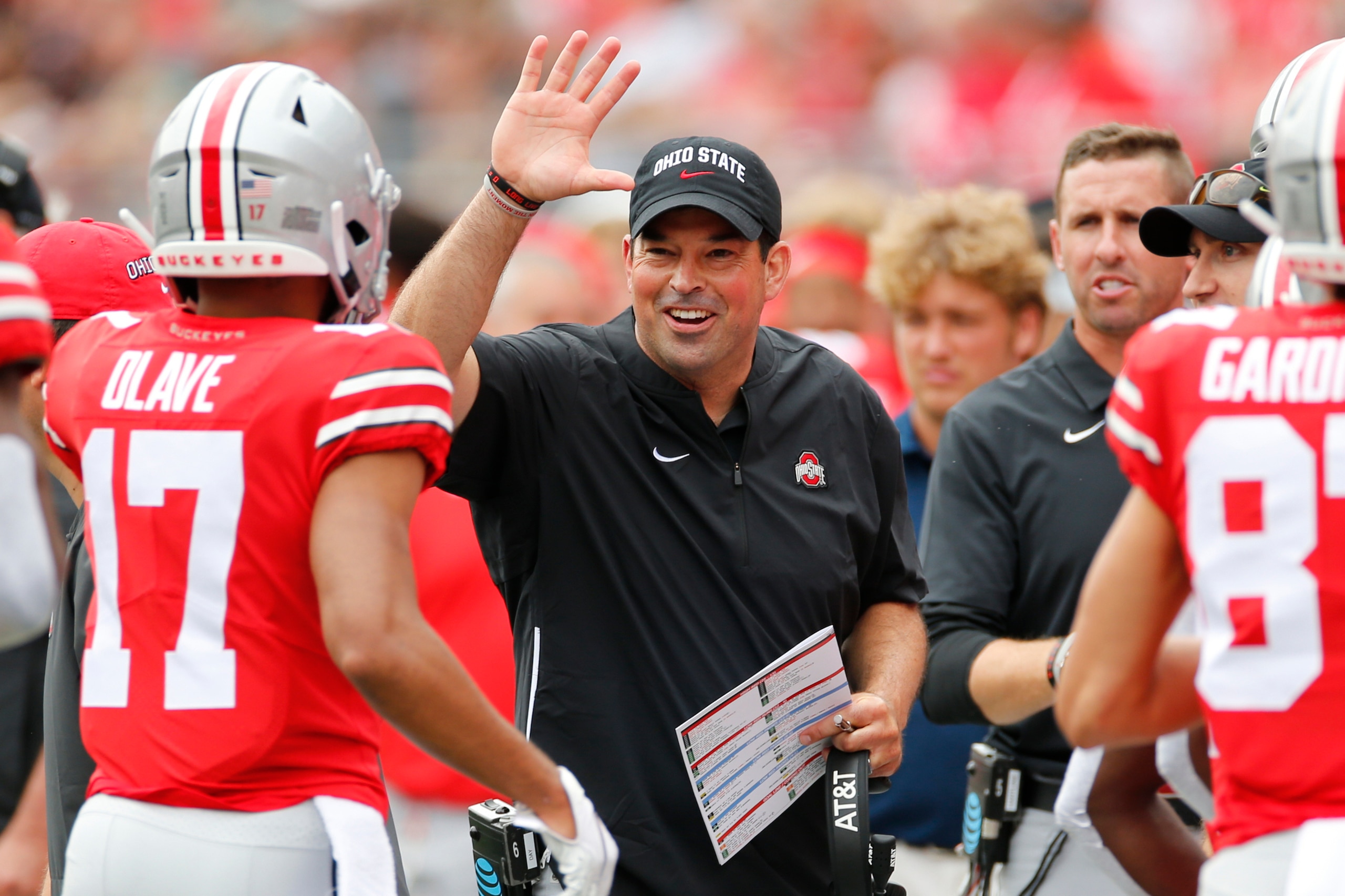
"I am proud to say that I think we're playing hard, we're playing tough, we're executing, it's clean," Day told reporters Tuesday. "There's not a lot of penalties, not a lot of turnovers."
Heading into Week 5, Ohio State ranks third nationally in both points scored (53.5) and points allowed (9.0) per game. The Buckeyes are tied for first in sacks (20), second in yards allowed per play (3.4) and fifth in opponent third-down conversion rate (23.1). They commit only five penalties per game (T-21st) and have four turnovers (T-28th).
Perhaps most notably, the team is thriving in the red zone. The offense has 17 touchdowns in 20 trips―the sixth-best rate in the nation―and has surrendered two touchdowns in 11 defensive possessions. That 18.2 rate leads the FBS.
Yes, the competition level has contributed to the lofty numbers, and future games may reveal a few issues. But the excellence is a reflection of a well-prepared coaching staff.
Although the defensive improvement from 2018 to 2019 is hugely impactful, Fields' performance is unquestionably the key.
The Georgia transfer has settled in quickly, completing 69.5 percent of his passes for 880 yards and 13 touchdowns with zero picks. He's also scampered for 150 yards and six scores, leading the offense to 264.5 passing and 260.0 rushing yards per game.
After the Buckeyes improved to 3-0, Day noted the offense has been more varied in 2019 than in previous years. That, as Bill Rabinowitz of the Columbus Dispatch notes, is despite Fields' inexperience and a testament to his complete skill set.
Fields is still learning as a decision-maker, but he should progress with in-game reps. He's showed tremendous touch and accuracy on downfield shots, and his velocity to all areas of the field is impressive. The Buckeyes also have an evident plan of utilizing his mobility in the red zone with rollouts, designed runs and zone reads.
The versatility of this offense is far beyond what you'd expect with a first-year starter—even for an elite prospect.
Don't simply take our word for it, either.
Wide receivers Binjimen Victor (14 catches, 242 yards, 2 TD), Chris Olave (13/228/4) and K.J. Hill (15/179/3) are all making big contributions. J.K. Dobbins has flourished with 477 rushing yards and five touchdowns behind an improved, though minimally tested, offensive line.
The surrounding talent should help Fields sustain his early performance, even as OSU's level of competition rises. The defense should also continue to excel.
And it starts with Chase Young.
The junior defensive end already has seven sacks and two forced fumbles this season. Young is solidifying himself as an early pick in the 2020 NFL draft and might end up being the highest non-quarterback selected.
Young has earned the spotlight, but Ohio State is loaded around him. Nine players have at least two tackles for loss, including linebacker Malik Harrison, who has seven. Veteran corners Damon Arnette and Jeff Okudah and safety Jordan Fuller highlight one of the nation's best defensive backfields.
After surrendering 5.8 yards per play, 403.4 yards per game and 25.5 points per game―all the worst in program history―last season, the defense has returned to elite form.
Again, a few Big Ten matchups may expose a weakness or two.
The Buckeyes' early troubles with Miami of Ohio's run-pass options (RPOs) and concepts to attack Cover 3 looks are a slight cause for concern. Improved personnel―from Nebraska or Penn State, for example―will provide a tougher test, especially if receivers can attack with seam routes and out-breaking intermediate routes.
Still, the ability to both recognize problems and implement proper solutions mid-game had hampered the Buckeyes in recent years. Even against an overmatched team like Miami (Ohio), quickly adapting to issues is a promising change. Co-coordinators Greg Mattison and Jeff Hafley deserve credit for the early success.
On the offensive side, Fields and Co. haven't taken a metaphorical punch to the face. We cannot be certain how a first-time starter will react to a challenging road environment or the elite defenses that Michigan State and Wisconsin boast.
Yet that doesn't mean confidence shouldn't be high or expectations be tempered.
Ohio State has dominated the teams it's supposed to dominate. The Buckeyes have home-field advantage against MSU, Wisconsin and Penn State, and road trips to Nebraska, Northwestern and Michigan―while not easy―aren't particularly intimidating.
Anything short of a Big Ten title and College Football Playoff appearance would be a disappointment for Day, Fields and the Buckeyes.
All recruiting information via 247Sports. Stats from NCAA.com, cfbstats.com or B/R research. Follow Bleacher Report CFB Writer David Kenyon on Twitter @Kenyon19_BR.



.jpg?w=2560 "Raiders Could Start Mendoza")


.jpg?w=2560 "Rodgers Iced Out on Plane 💎")

.jpg?w=2560 "Packers Safety Slams Refs 🤬")