


Next summer's NBA free-agency class will not match the pomp and circumstance delivered by this year's star-transaction haze. Cap space will be in shorter supply, and the list of available names fails to wow.
Anthony Davis tops the field with ease, but his entry into the open market will be drowning in asterisks. The Los Angeles Lakers wouldn't have mortgaged their future to kingdom come without having an airtight idea of his intentions. His noncommittal stance for 2020-21 rings hollow unless disaster strikes over the next 11 months.
The second-best free agent after him is slated to be...Draymond Green? DeMar DeRozan (player option)? Kyle Lowry? Many of the remaining top names are ticketed for restricted free agency—Jaylen Brown, Buddy Hield, Brandon Ingram, Caris LeVert, etc.—and should be considered relatively, if not completely, unattainable.
That dearth of gettable star power makes identifying next summer's hottest landing spots more difficult than usual. Forecasting the Association's silly season almost one year in advance is always touch-and-go. Too much changes in that span.
This time around, we're dealing with an extra layer of uncertainty. It is noticeably harder to predict which teams will fancy themselves major buyers in a market light on heavy hitters. Plenty will kick the can into 2021, when megastars such as Giannis Antetokounmpo, Paul George (player option), LeBron James (player option), Kawhi Leonard (player option) and others might be available.
But breaking out the crystal ball is fun, so we're going to do it anyway.
Top destinations are determined by considering which potential suitors will appeal to the biggest possible names and have the requisite wiggle room to burn on them. Cap sheets are beyond fluid this far out from free agency, so we'll be making a lot of assumptions. But payrolls are settled enough for us to establish spending-power baselines.
Teams to Watch
1 of 5
Chicago Bulls
The Bulls will have a path to max money if Otto Porter Jr. declines his $28.5 million player option. That's a ton of coin for him to turn down, but he's still just 26, and Chicago gave him a longer leash off the dribble toward the end of last year.
A strong encore might compel him to chase a longer-term bag with a similar average annual value—not unlike Harrison Barnes did this summer.
Dallas Mavericks
Luka Doncic and Kristaps Porzingis need a third co-star. Dallas might be positioned to get them one next year.
Maxing out Porzingis and brokering deals for Dorian Finney-Smith, Maxi Kleber, Boban Marjanovic, Dwight Powell and Delon Wright makes opening the requisite space harder, but not impossible. The Mavericks would be on track for more than $25 million if they offload Tim Hardaway Jr.'s entire 2020-21 salary.
Max money enters the fold if they get rid of Justin Jackson (team option) and their first-rounder. They cannot trade their draft selection until it is no longer a future pick, which gives them a small window to strike a deal before free agency. They'll likely need that first to pawn off THJ anyway.
Dallas' offseason track record doesn't endorse drastic action. This summer's max cap space turned into unspectacular Plan B's. But the Mavericks will up their profile if Doncic and Porzingis play well together. It likewise helps that so many teams will be tabling their shopping sprees for 2021.
Miami Heat
Always consider the Heat a threat in free agency. They turned negative cap space this summer into Jimmy freaking Butler. It cost Josh Richardson, three years of dead-cap money, Hassan Whiteside and a first-round pick to get the job done, and we can't be sure they got that much better.
HOWEVER! They still did it. Maybe they'll pull another star acquisition out of left field again.
Team president Pat Riley was initially targeting next summer to go after two marquee names. Scooping up one a year early should help him reel in the second...if he can dredge up the space to afford it.
Good luck to him. The Heat could ditch all their own free agents and non-guaranteed contracts and use their first-round pick (after the fact) to unload James Johnson's 2020-21 salary (player option), and they'd still be well short of max territory. They'll need a little help from Kelly Olynyk to make up the difference. He has a $13.2 million player option for 2020-21, and that decision, as of now, could go either way.
All of this goes to hell if the Heat cannot deal Johnson (or Dion Waiters)—or, of course, if they trade for Chris Paul.
Toronto Raptors
Slotting the Raptors among the disclaimers has nothing to do with their losing Kawhi Leonard and everything to do with team president Masai Ujiri.
Toronto can carve out more than $74 million in space if it holds off on a Pascal Siakam extension and renounces every other free agent. That's while penciling in a salary for the No. 15 pick (estimated finish) and assuming Stanley Johnson exercises his player option.
Here's the thing: Next summer is not the offseason to have that much scratch. Ujiri knows this, and he's no doubt planning for it. Expect the Raptors to take a more conservative approach unless a stud restricted free agent becomes gettable or Anthony Davis develops the itch to play in Canada.
Atlanta Hawks
2 of 5
Ticketing the Atlanta Hawks for big-time investments next summer is a real risk. Sources told The Athletic's Sam Amick in February that the Hawks were contemplating bold splashes this year, and they ended up punting on brand-name pursuits in favor of leasing out their cap space to unwanted expiring contracts.
"Expiring" is the operative word here. The Hawks have positioned themselves for a bonkers amount of spending power in 2020 without doing any serious lifting.
Conservative projections predict them to sniff double-max territory. Exhibit A: If Jabari Parker picks up his player option and they carry DeAndre' Bembry's free-agent hold, they could still cakewalk their way to $65 million in room while finishing with the No. 5 pick and taking in the Brooklyn Nets' lottery-protected first-rounder.
Holy wow.
Atlanta isn't historically a marquee free-agent destination. That only makes striking next summer an even smarter play. The Hawks won't be trying to pry top-15 stars away from glitzier markets. The 2020 free-agent class is nothing if not littered with plausible options.
Maybe that isn't enough for Atlanta to break open its piggy bank. John Collins will still have a relatively low cap hold in 2021 if he doesn't sign an extension, and the Hawks don't have to worry about windfalls for any of their other players. They can holster their cap space for another year.
Then again, the roster may not let them. Both Collins and Trae Young showed protracted flashes of offensive stardom last season. Kevin Huerter wasn't far behind them.
If they improve, and if even one of De'Andre Hunter or Cam Reddish hits, the Hawks could be knocking on the door of fringe playoff contention. They will have little choice but to move up their timeline with a core that should be an easy sell to outsiders.
New York Knicks
3 of 5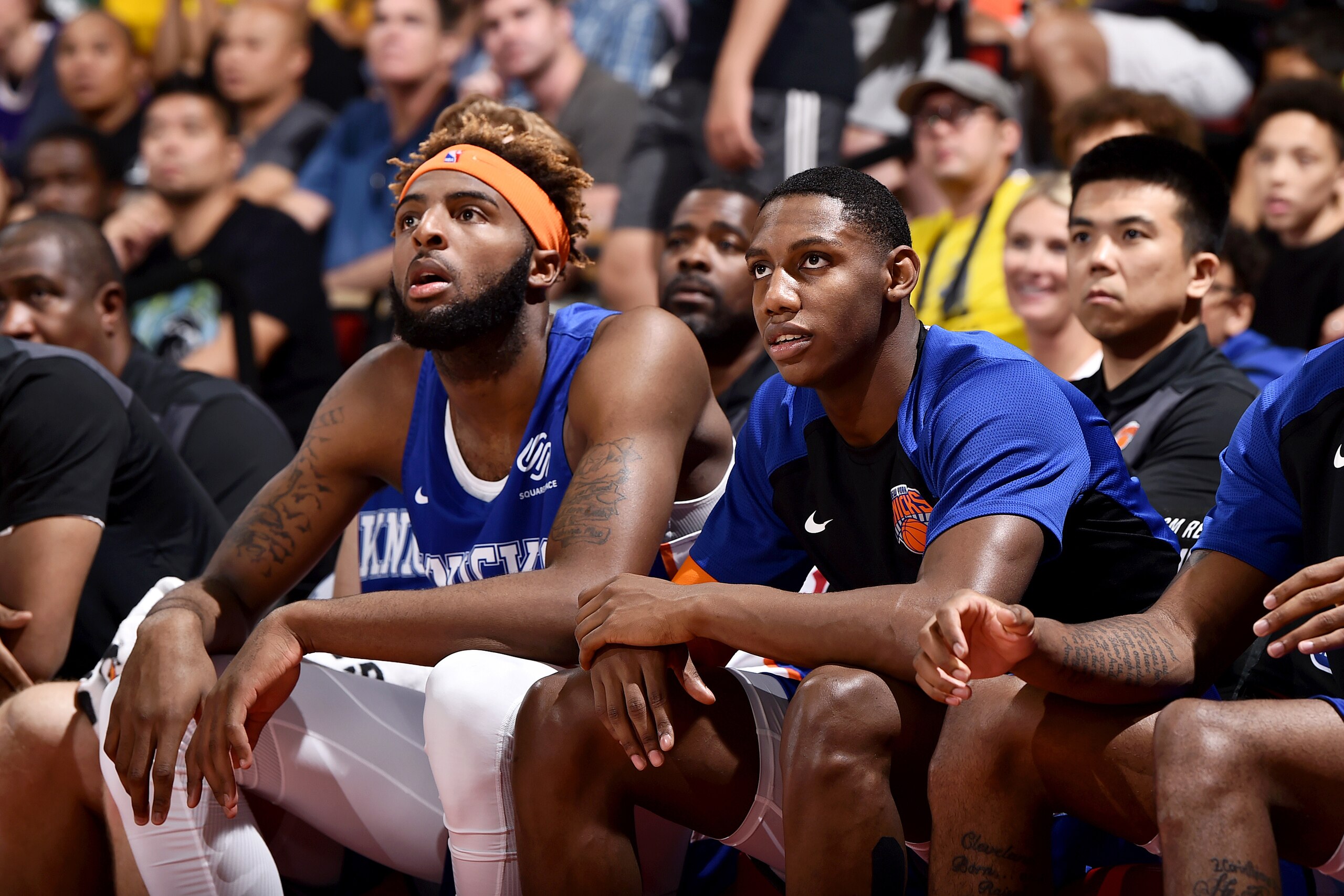
Most signs indicate the New York Knicks will wait for the 2021 free-agency class. They doled out a flurry of two-year deals this summer, and Joakim Noah's dead cap hit is the only guaranteed money on the ledger that offseason—though we can expect them to pick up team options on RJ Barrett, Kevin Knox and Mitchell Robinson while adding more first-round prospects through the draft.
Take a closer look, though, and the Knicks have prepared themselves for both scenarios.
The $4 million partial guarantee in the third season of Julius Randle's contract is telltale, but so is the structure of their two-year pacts. Reggie Bullock, Wayne Ellington, Taj Gibson and Elfrid Payton are guaranteed $1 million apiece in 2020-21, and the latter portion of Bobby Portis' deal is a team option.
Frank Ntilikina also has a club option for the fourth year of his rookie-scale contract. (Knox and Dennis Smith Jr. join him, but they're non-issues.) The Knicks have to make that call early in the season, and it might not be a particularly hard one. He would be owed $6.2 million in 2020-21, and they've tried to trade him before.
Few teams can match the Knicks' flexibility if they go nuclear. Waiving all their non-guarantees except for Mitchell Robinson, declining team options on Ntilikina and Portis and renouncing their other free agents would leave them with more than $50 million in space even if they win the No. 1 pick.
Peddling that much money with a core of Knox, Randle, Robinson, Smith, Barrett and another high draft selection would almost assuredly put the Knicks in contention for the top headliners. Free agents don't care about youth and draft picks, but a few of those kiddies can already play, and New York would remain uniquely positioned to pull off the NBA's next seismic blockbuster.
Whether the market has enough talent to coax the Knicks into action is a separate matter. Wandering eyes from Anthony Davis would pique their attention, but he doesn't feel like a flight risk as of now. Backing up the Brink's truck for DeMar DeRozan or Draymond Green would be decidedly less flashy—and incredibly shortsighted.
Perhaps prowling for restricted free agents is enough for the Knicks. Tendering monster offer sheets to the most notable names either gets them another higher-end youngster or drives up the price tag of a rival's payroll. Worst-case scenario, they can always resort to more one-year placeholders if their cap space gets them nowhere. (Waiting for 2021 is still the more prudent option.)
.jpg?w=2560 "NBA Gambling Charges")


Portland Trail Blazers
4 of 5
The Portland Trail Blazers should appeal to free agents in a vacuum. Damian Lillard seems like someone you'd follow to hell and back dozens of times while actively enjoying the trips.
And yet, the Blazers are barely ever on the periphery of free agency's main stage, even when they're working with cap space—which they haven't been since 2016.
Everything changes next season. The Blazers' books are more malleable than they've been in a while, and they cannot afford to wait for the 2021 class. Lillard's supermax extension kicks in that summer, when both CJ McCollum and Zach Collins will be up for new deals.
Portland will gain cachet among the free-agency ranks by way of urgency. But it'll take some maneuvering to maximize the team's spending power.
Mario Hezonja and Rodney Hood have player options that total about $8 million. Next season probably hasn't gone too great if they pick them up. Neither will be untradeable if they do.
Subtracting Hezonja and Hood from the docket while renouncing every other free agent would arm the Blazers with more than $18 million in space or more depending on where their first-round pick falls. They'd crack the $20 million marker if they punt on taking a rookie.
Traveling such great lengths for sub-max room wouldn't do much in a typical offseason. Next summer is different. Cap space is scant enough that $18 million to $20 million could net a top-seven free agent.
If the Blazers want to enter the Draymond Green sweepstakes, they'll have to look at moving the final two years and $18.1 million in guaranteed money on Jusuf Nurkic's contract—no small ask, emotionally or functionally, when he may not even play next season while recovering from compound fractures in his left leg.
San Antonio Spurs
5 of 5
Losing Marcus Morris to the Knicks doesn't help the San Antonio Spurs' rotation this coming season, but it does give them a line to more cap room in 2020.
Their spending power rests on two issues: DeMar DeRozan's player option and potential contract extensions for Dejounte Murray and Jakob Poeltl. Neither sticking point demands a leap-sized assumption.
DeRozan turns 30 in August and has every incentive to surf the open market for one last gargantuan payday. Even if teams are reluctant to give him near-max money, he's still going to get the bag. The list of alternatives is that thin. He'll be a top-10 available name at worst.
Extensions for Murray, Poeltl or both will threaten the Spurs' flexibility if they see an opportunity to lock them down at bargain rates. It is fair to expect San Antonio to let both situations play out. Murray is working his way back from a torn right ACL, and Poeltl is a reserve big who has yet to average 20 minutes per game.
LaMarcus Aldridge's partial guarantee affords the Spurs a cushion if they extend one of the kids, don't want to waive Trey Lyles ($1 million guaranteed) or refuse to renounce Bryn Forbes' free-agent hold. Paying someone $7 million to leave is a tough pill to swallow, but it saves $17 million compared to Aldridge's 2020-21 salary.
Let's say DeRozan opts out, but the Spurs keep Aldridge, along with holds for Murray and Poeltl. If they waive Lyles and Chimezie Metu, renounce all their other free agents and finish with something like the No. 20 pick, they'd be looking at more than $24 million in space.
That's a lot of money relative to next year's market. And San Antonio would have even more to spend in this scenario if Poeltl signs for less than $11.3 million cap hold.
Sales pitches write themselves from there. The Spurs would have Aldridge, Murray, Poeltl, DeMarre Carroll, Rudy Gay, Keldon Johnson, Patty Mills, Luka Samanic, Lonnie Walker IV, Derrick White and another inbound first-round prospect—not to mention Gregg Popovich, Becky Hammon and Tim Duncan(!) on the sidelines.
Adding more established depth to that already deep cast, which includes two potential stars in Murray and White, would go a long way.
Unless otherwise noted, stats courtesy of NBA.com, Basketball Reference or Cleaning the Glass. Salary and cap-hold information via Basketball Insiders and RealGM.
Dan Favale covers the NBA for Bleacher Report. Follow him on Twitter (@danfavale) and listen to his Hardwood Knocks podcast, co-hosted by Andrew Bailey and Mo Dakhil.



.png?w=2560 "Week 8 Winners & Losers 📊")
.jpg?w=2560 "Aikman Blasts Cowboys WR 🫣")
.jpg?w=2560 "Jonathan Taylor Landing Spots")