
Harrison Barnes and the Worst Signings from NBA Free-Agency Week 1
The free-agency start date is like the NBA's version of Black Friday. The doors get kicked open, owners metaphorically race through with hundreds of millions of dollars burning holes in their expensive pockets, and they buy everything on the shelves.
And just like on Black Friday, sometimes the deal you thought you were getting turns out not to be the bargain you'd anticipated. Six months later, you're staring at the $400 busted 4K flatty on your wall and realize you've been duped.
Similarly, there are teams that got what they thought were "great buys" this summer but, by the time those contracts end, will have the same disenfranchised glaze to their eyeballs as they watch the once-shiny player lose his on-court luster.
These are the contracts that are most doomed to end in despair.
Bonus Slide 1: Kevin Durant, Brooklyn Nets
1 of 7
There is no question that if Kevin Durant wouldn't have blown his Achilles, he would have been worth every penny of his next contract and more besides.
However, he did blow his Achilles, and that will have an impact on the perception of his contract. Not "might." Will.
First, he's not expected to play a game next season. That effectively makes his four-year, $161 million deal with the Brooklyn Nets a three-year, $161 million deal.
Second, since he's not playing for a year, he'll likely show some rust upon his return. It's going to take some time for him to get his basketball legs back. Add to that the fact he'll be 32, and it might not be so easy for him to just slip back into the same form that won him two Finals MVPs. So maybe it's really more like a two-and-a-half-year deal.
He'll also be adapting to a new team and learning his teammates' unique behaviors. That's the case with any new roster but especially with stars who are learning to play together. He does have a legitimate co-star in Kyrie Irving, but it'll take time to develop chemistry.
That combination could push the Nets' championship window to two seasons with Durant, and he'll be 34 for the second of those—not young by any stretch.
If the Nets get a ring out of this pairing, it's worth the money. But there is a lot more risk here than advertised.
Bonus Slide 2: Al Horford, Philadelphia 76ers
2 of 7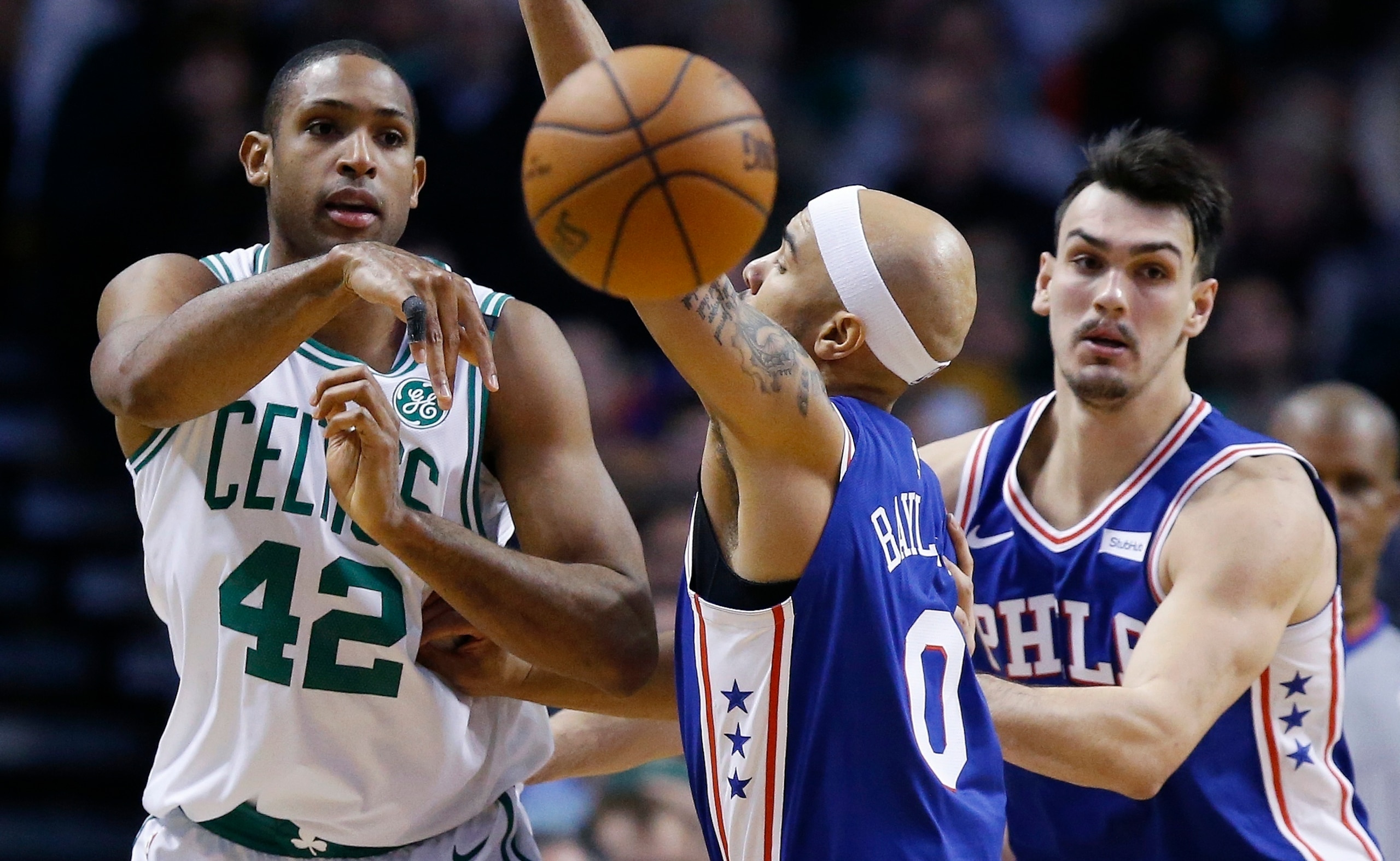
If you can't beat 'em, sign 'em.
According to Basketball Reference, the Philadelphia 76ers faced Al Horford 13 times in the last two years, playoffs and regular season combined. They lost 10 of them. So they decided to bring him on board.
The front end of his four year, $109 million deal, per Spotrac, is pretty palatable. Horford is a terrific fit with his passing (4.2 assists in 2018-19) and three-point shooting (36.0 percent). He is the kind of guy who elevates an offense without commanding the ball. His all-around skills and impact with limited touches are pretty rare.
Last year, he became just the second player in NBA history with a total rebound percentage over 10, an assist percentage over 20 and a true shooting percentage over 60 with a usage percentage below 20. The other was Magic Johnson, who did it twice.
He's the perfect teammate for a team that has bonafide superstars in the making in Ben Simmons and Joel Embiid. They don't need another star; they need the ultimate glue guy, and Horford fits the bill.
The downside here is that Horford's contract is four years, and he'll be going on 37 by the end of it. The 76ers will be in repeater tax territory by then in all likelihood. While all the details are not yet official, between Tobias Harris' $180 million deal, Simmons' $168 million extension and whatever they inevitably pay Joel Embiid to stay, those three contracts alone are going to be in the neighborhood of $120 million per season. Factor in Horford's price of about $27 million annually, and Philadelphia will be paying its four stars approximately $150 million. Before his time's up with the 76ers, don't be surprised if they decide to give someone a draft pick to take Horford off their hands.
Like with Durant and the Nets, it's worth it if they win a championship, but it's a big gamble.
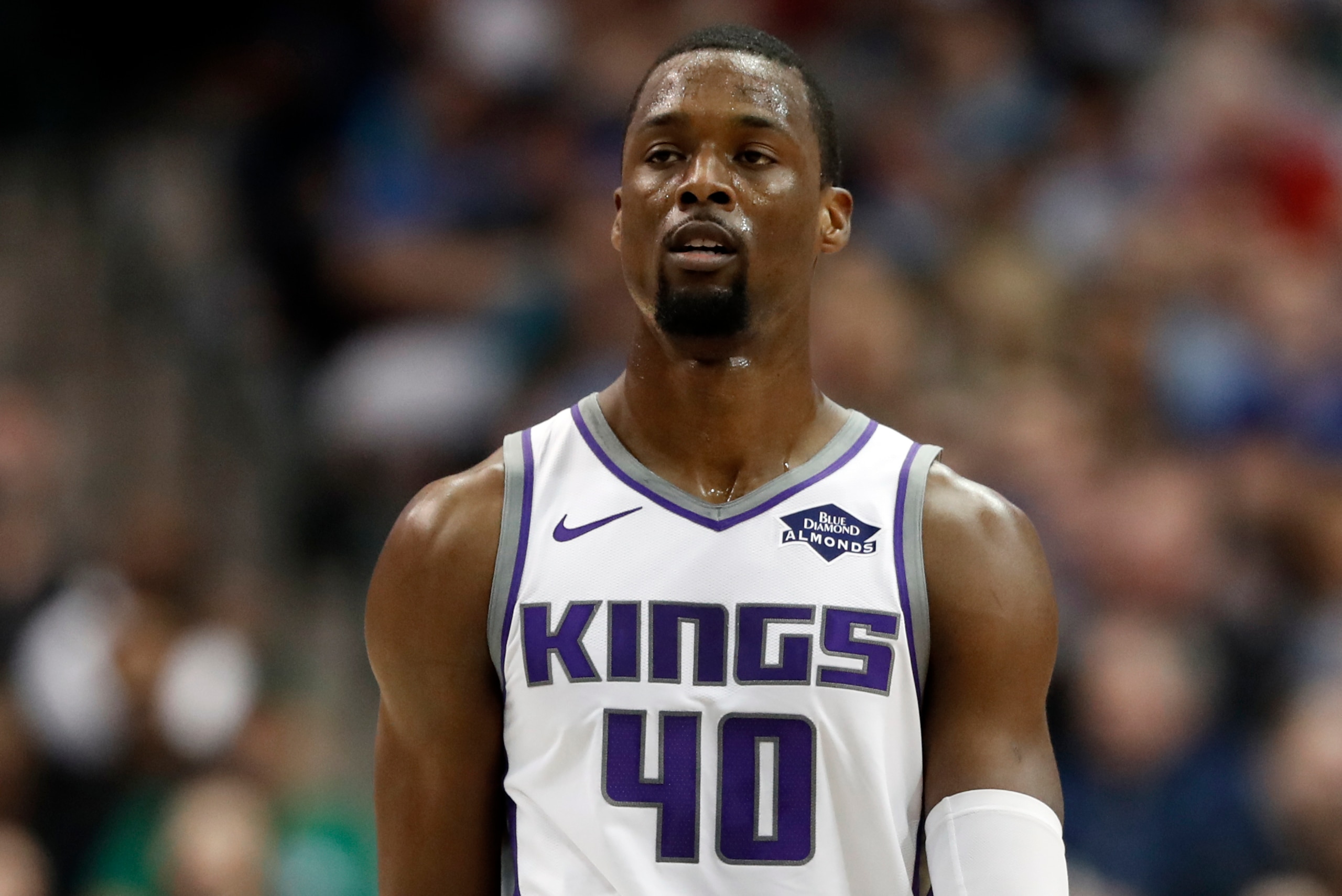
Harrison Barnes, Sacramento Kings
3 of 7
Harrison Barnes has done a fantastic job in his career of figuring out how to get paid lots of money without being very good.
He's not bad. He's just not very good.
When he was with the Golden State Warriors, there was reason to believe there was more to his game, but he was overshadowed by Stephen Curry, Klay Thompson and Draymond Green.
The Dallas Mavericks signed him to a max contract, the last year of which was to be 2019-20, but Barnes— whom the Mavericks traded in the third year to the Sacramento Kings—opted out of it and agreed to a four-year, $85 million deal with his new team. That's in addition to the $83 million he's already made, according to Spotrac.
Barnes has never averaged 20 points in a season.
He's never made an All-Star team.
He's never been named to an All-NBA or All-Defensive team.
He's never finished in the top 10 in any major statistical category.
Last season, based on ESPN's Real Plus-Minus, he was the 166th-best player in the NBA.
He was 164th in player efficiency rating.
Not only that, but his numbers regressed last year and then were even worse after the trade.
And still, he's going to get paid another $85 million over four years to be, at best, average.
It's not that Barnes is a "bad" player. To his credit, he's well-rounded. He makes for a solid rotation player, and there are no glaring weaknesses, which makes him easy to work into most lineups. Being average isn't horrible. It means you're better than half the players in the league.
It's just that the Kings didn't seem to be bidding against anyone, and Barnes is worth nowhere near that much money.



Nikola Vucevic, Orlando Magic
4 of 7
Every offseason, it seems like there is one team put in a terrible position. It's finally back in the playoffs after years of being a lottery team. Its best player is a free agent, and not really worthy of a max contract, but someone is probably going to offer him one anyway.
The team doesn't have the cap money to replace him with anyone worthwhile if it loses him, though, so it's more or less compelled to overspend to keep him. This is the case with the Orlando Magic and Nikola Vucevic this year.
Vooch had the best year of his career last season, averaging 20.8 points, 12.0 rebounds and 3.8 dimes compared to previous career averages of 14.8, 9.8 and 2.2, respectively.
He also only missed two games, a stark contrast to the 102 he missed over the first seven years of his career.
Some people might even call that a contract year, and contract years don't always bode well for the following season.
Is there a chance that he makes good on his four-year, $100 million contract? It's possible, but the more likely scenario is he regresses to the type of injury-prone, slightly above-average player he was before last year.
Trevor Ariza, Sacramento Kings
5 of 7
That the Sacramento Kings threw a two-year, $25 million deal at Trevor Ariza is pretty inexplicable.
He wasn't bad last year, all things considered. He averaged 12.5 points and 5.4 rebounds. His scoring was inefficient, however, as his true shooting percentage was just 53.4.
Nor was he the same player defensively, with a Defensive Real Plus-Minus of minus-1.25, according to ESPN, which ranked 82nd out of 96 small forwards.
Compare that with plus-1.15 in 2017-18 (tied for 14th at his position), his last year with the Houston Rockets.
Age comes at you fast, and for most players, Father Time catches up in their mid-30s. Ariza is 34 and regressing hard.
The odds he lives up to this contract are nil to none, and it would be surprising to see him finish it without getting bought out or stretched.
Bobby Portis, New York Knicks
6 of 7
Bobby Portis never met a shot he didn't like. Unfortunately, he doesn't seem to do much else.
Last season, he had a 24.6 percent usage rate, 8.8 assist percentage and 52.9 percent true shooting percentage. No one who qualified for the scoring title had a higher usage percentage, lower assist percentage and lower true shooting percentage.
In layman's terms, no player jacked up more bad shots instead of passing to a teammate.
In other words, Portis is a ball hog, which I guess is fitting for a former Razorback.
Ah, but at least there's defense, right?
Sure, but Portis finished 76th out of 95 power forwards in DRPM last year at minus-1.96.
That the New York Knicks gave him a two-year, $31 million deal is just so Knicks.
Just to add to the fun, they also acquired Julius Randle and Taj Gibson at power forward.
It is not at all unfathomable that Portis plays his way out of the rotation through his constant chucking and failure to play defense.
Considering his history of a hot temper and the very distinct possibility the Knicks are going to be horrible next season, this might not be a great confluence of circumstances.
What makes this even worse is the Knicks didn't have to pay that much. It might be worth the gamble at half the price, but this was a reach.
Terry Rozier, Charlotte Hornets
7 of 7
Things could not be any rosier for Terry Rozier.
It takes something magical to turn a season as unimpressive as his 2018-19 into the bloated contract he got from the Charlotte Hornets.
He threw up 666 shots last season, and his true shooting percentage was 50.1. Only five players with 500-plus field-goal attempts had a lower true shooting percentage: Cory Joseph, Tyreke Evans, Kris Dunn, Josh Okogie and Avery Bradley.
Evans will be suspended next year. Joseph will be making around $11.7 million, according to Spotrac. Dunn is hauling in $5.3 million. Okogie is making $2.5 million. Bradley has yet to sign.
Rozier is making $18.4 million in the first year of a three-year, $58 million contract.
Cha. Ching.
It's not like Rozier is a noteworthy passer, either. He shelled out just 2.9 assists per game last year and only 4.6 per 36 minutes.
Defense? His DRPM was minus-0.04, 29th out of 100 point guards. Not bad but not enough to make him worth an unseemly amount of money.
It's almost like the Hornets were so committed to getting something back for Kemba Walker that they were willing to shoot themselves in the foot just so they could show they took a bullet.
All stats obtained from Basketball Reference unless otherwise noted.
.jpg?w=2560 "NFL investigating 2 referees for separate viral exchanges")
.jpg?w=2560 "OBJ Calls Out Giants After Release")

.jpg?w=2560 "Another Cryptic Tyreek Post 🤨")