

KAT Is Thriving Without Jimmy Butler, but MIN Must Do More for Its $158M Star
Karl-Anthony Towns has come a long way in the two-and-a-half months since the Minnesota Timberwolves fired president and head coach Tom Thibodeau.
More specifically, he's been on a tear since the NBA All-Star break in February.
Over the span of 14 games, the 23-year-old 7-footer has averaged an impressive 30.9 points, 14.6 rebounds and 3.8 assists.
TOP NEWS

Buzz: Bron Chopper Part of Deal 🚁

Buzz: Knicks' KAT Offer Revealed

MJ Makes Record-Setting Donation 🙌
With Thibodeau's exit and the Jimmy Butler soap opera long since dismantled and shipped to Philadelphia, Towns was left to pick up the pieces of a near-broken team with the mandate to turn things around quickly.
While Towns has made a huge leap forward as the Wolves' franchise player, it hasn't translated into wins. Minnesota (33-41) has played as if its team identity is still unclear, competed with seemingly no passion and lost 10 of its last 14 games.
Mathematically, the Wolves' postseason hopes have been dashed, so they will miss the playoffs for the 14th time in 15 years. With another disappointing, drama-filled campaign in the books, they must look ahead to the summer, when they will have numerous major tasks on their roster-improvement checklist.
Namely, can the Wolves establish a winning culture, surround Towns with enough talent to secure a perennial spot in the postseason and compete for a championship?
More importantly, can Minnesota's front office keep Towns, who signed a five-year, $158 million max extension in September, happy and willing to stay with the team long term? (If he makes any All-NBA team this season, his extension will become a supermax, ballooning to nearly $190 million over those same five years.)
"Culture and everything, that takes time," Towns told Bleacher Report. "We haven't had time to have some stability to have a proper culture or establish what we're known for or build an identity. So we'll see how this summer is and start from there."
It goes without saying, but the Wolves don't want the same kind of debacle that the New Orleans Pelicans have on their hands with their now-disgruntled franchise player, Anthony Davis.
For his part, Towns does have the right attitude while playing in games that, at this point, have no meaning.
"What I can definitely say is with all the trials and tribulations and challenges we've gone through, this team has stayed together, so that's a great thing," Towns said. "Ryan [Saunders] has done a great job of keeping us together when things have gone really well and times when things have gone really bad. I said it before, I have tremendous, tremendous respect and faith in Ryan as our leader, and I'll say it until the day I die."
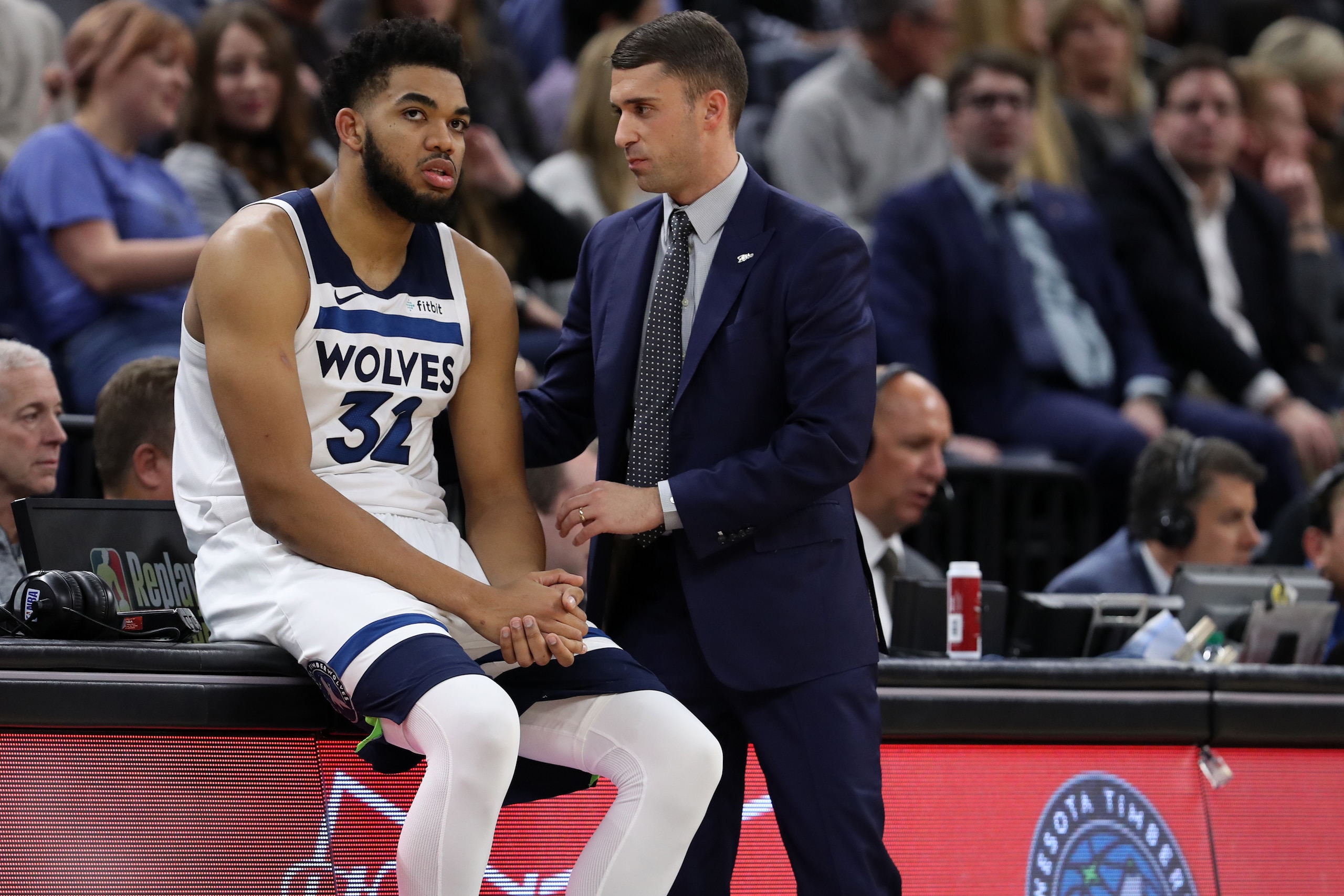
It bodes well that Towns is forging a bond with neophyte skipper Saunders, who, at the age of 32, is the youngest head coach in the league.
Before stepping into the role vacated by Thibodeau on Jan. 6, Saunders, the son of late coaching legend Flip Saunders, had been an assistant coach for Minnesota since 2014. Before that, he was an assistant coach for the Washington Wizards for five seasons (two-plus under his father). With the Wizards, according to NBA.com's Kyle Ratke, he learned how to understand the perspective of players and communicate with them from fellow assistant Sam Cassell.
The Wolves front office gave Saunders the top job on the bench on an interim basis, but Marc Stein of the New York Times recently reported the team is interested in retaining him, despite his 14-20 record since taking the helm.
Saunders' future in Minnesota is based on both the buy-in from his two-time All-Star center and his strong relationship with him. Additionally, he's had to navigate a string of injuries to key players such as Derrick Rose, Jeff Teague and Robert Covington.
Should he maintain his post, he'll need to establish the kind of relationship that his father had with future Hall of Famer Kevin Garnett.
"KAT and I, we have a good relationship, and it's one based on mutual respect, I feel," Saunders said. "KAT knows that I'll listen to things he has to say or his input on things, but he also knows that I'll coach him as hard as anybody, or harder than anybody, just because I think that's what's going to make him better.
"In terms of relationships, the one between my father and KG was a special one, and if KAT and I can get close to that or in the realm of that relationship, that would be a success."
Whether Towns and the younger Saunders can replicate the bond between the Big Ticket and the elder Saunders remains to be seen, but the coach is confident that the 2015-16 Rookie of the Year's connection to the city he suits up for every night is genuine and long-lasting.
"I think KAT would be the first one to tell you that he does love Minnesota, and he loves the love that he gets there," Saunders said. "I think that gives him more of a purpose on things. For all of our guys, we just want them to continue to get better and better each day, and KAT's no different."
Towns has improved as a leader, becoming more vocal on the floor. He's also been more consistent. He now sports a diverse offensive repertoire. He's improved his inside-out offense and his jumper in the mid-range and long distance. Since Feb. 25, he's shooting 48.2 percent from behind the arc (he shot 38.9 percent from three in his 57 games prior).
And as great as his recent numbers have been, they were already jumping off the stat sheet before the break, which is why he got the nod for the 2019 All-Star Game in Charlotte, North Carolina.
This year's selection was special, though, because of everything he'd gone through. He was overcome with emotion when he found out he made the team.
"One thing I rested on philosophy-wise was you have moments of impact in life where you can point to those moments and say, 'Hey, that's when something changed for me.'" Saunders said. "And I think that he'd say that that was one of those for him because he got through some tough times and he saw his perseverance and his willingness just to stick with everything see him through it all."
Towns' vulnerability has also helped him make inroads with his teammates.
"I've been very impressed with his leadership," forward Andrew Wiggins said. "He's dominant. On the court, he can get whatever he wants, when he wants. And he's one of the best shooters in the league for a big man and one of the best shooters in general."
His competition has taken notice. Houston Rockets center Clint Capela agrees that Towns' versatility in stretching the floor is key for a big man in a freedom-of-movement league.
"That three-point shot helps him a lot," Capela said. "Bigs that like to stay to the rim like [Rudy] Gobert have to come up, and when he fakes a shot and drives, it's tough to stop because when the big goes out to contest the three, who else is going to block his drive to the rim? Not many people can do what he does, so credit to him.
"He's elite, even in his first year, he dominated every night, and that's what's tough in this league: to do what he does every night. I know he's special because he's been playing well consistently since he came into the league."
Towns' resurgence is no small feat given the dysfunction he faced earlier this season, but hard work, he says, has always been his "calling card."
"I suppose this is a little facet of my life. I've been through a lot more to get to this point as a man," Towns said. "Professionally, I work tremendously hard on my game. I know what I put into the gym into my craft every single day, so I'm not worried what other people have to say or what people behind keyboards or writing with pen and paper say. I could care less what they have to say.
"I'm the one touching the basketball every single day, and I've actually touched it in my life, so I'm going to go out there and do what I know I can do. And I'm going to do it to the best of my ability every single night, regardless of what people say. If I can look myself in the mirror every single night and say I played as hard as I possibly can and gave it everything I had that night, then I go to sleep pretty well."
The ascendance of the 2015 No. 1 overall pick could also be linked to the incentive language in his contract, which dictates that he can earn roughly an additional $32 million if he gets voted Defensive Player of the Year, MVP or makes one of the three All-NBA teams.
The Wolves won't be playing after April 10, but that won't keep the University of Kentucky product from going all out until then to secure the bag.
Minnesota is 12th in offensive efficiency (110.5 points per 100 possessions), 24th in defensive efficiency (111.8 points allowed per 100 possessions) and tied for 13th in rebounding percentage (50.1), which means the Timberwolves aren't the league's bottom feeders, but they aren't great either.
One of the biggest reasons for that is the halted production of Wiggins. He hasn't developed into the player the Wolves hoped for when they acquired him in a three-team trade that saw them send Kevin Love to the Cleveland Cavaliers in 2014.
The former Kansas Jayhawk's best season was 2016-17, when he averaged 23.6 points per contest while shooting 45.2 percent from the field (35.6 from three). This year, he's down to 17.7 points per outing while shooting a career-worst 40.4 percent from the field (33.2 percent from deep).
Towns needs a dependable No. 2 man to take some of the heat off him, and Wiggins has regressed in his fifth season. If the Canadian-born wingman can be more aggressive in 2019-20—the second campaign of his five-year, $147.7 million extension—take more high-percentage shots instead of settling for bad jumpers and get back to taking defenders to the basket for layups and dunks, he might be worth the continued investment.
As for Covington, the jury is still out. Because of a lingering ankle injury, he has yet to play for Saunders after joining the Timberwolves in a November trade. But before being sidelined, he was averaging a career-high 14.5 points per contest on 43.3 percent shooting from the floor (37.2 percent from three) in Minnesota.
The former Sixer and three-and-D specialist was named to the NBA All-Defensive First Team last season; if he returns with his signature defensive intensity and nails the outside shot with consistency, he'll be a valuable complementary piece alongside Towns.
On the whole, for things to get better, Minnesota will have to add more three-point shooters. Towns is not the same type of player as Giannis Antetokounmpo, but the Wolves will have to employ a similar strategy as the Milwaukee Bucks.
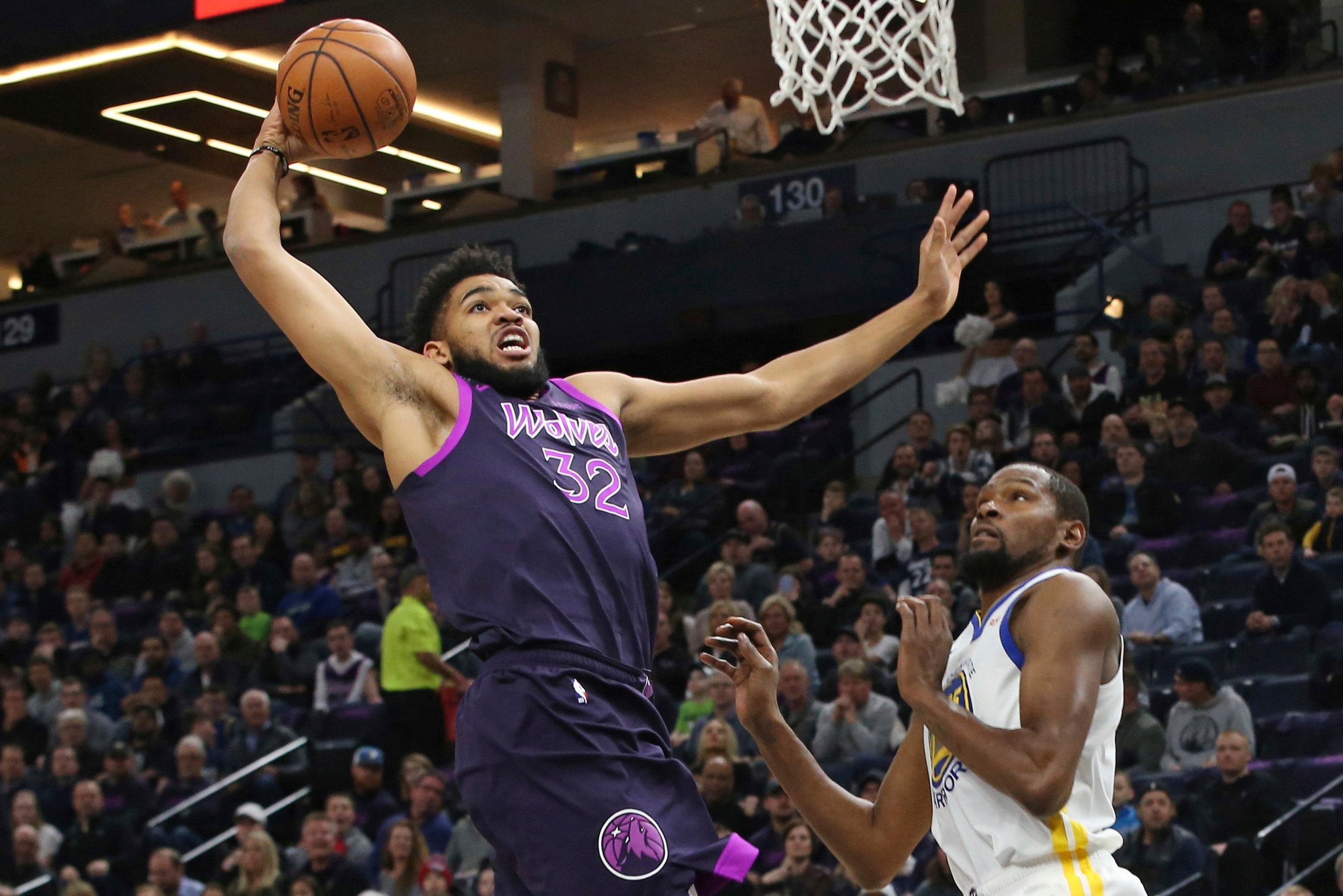
To say that the Bucks seismically altered their offense this season with the advent of three-point shooting is no exaggeration. They attempt 38.0 threes per game and make 13.5 of them. The Houston Rockets are the only team that shoots or connects on more.
This campaign, Minnesota is the sixth-worst team in three-point attempts (28.6 per game) and seventh-worst in made three pointers (10.0 per game).
To maximize Towns' talents, the Wolves will need to add sufficient deep-ball threats to their offensive schematics next year.
Shake-ups and injuries have plagued Minnesota in 2018-19 for sure, but there has been one bright spot: Derrick Rose. The 2010-11 MVP was averaging 18 points (48.2 percent from the field) and 4.3 assists per contest before being ruled out for the season last week with right-elbow soreness.
Before landing with the Wolves, Rose was contemplating retirement. But after finding new life in Minnesota, he's been an inspiration to his teammates, especially Towns.
"I try to tap into his knowledge of winning games and being on one of the best teams in the Chicago Bulls at the time," Towns said. "I want to know how they did it, how their culture was built, how they played, how they acted, how they treated each other, how they approached the game. There's a lot more that goes into Derrick Rose than just the skill set he possessed, that was blessed to him by God.
"I want to know how that experience was and how can I garner wins and garner playoff appearances and possibly a championship through his experiences. We're very blessed to have Derrick. He's a one-of-a-kind player and a one-of-a-kind teammate. It's awesome. I know he hates me saying this, but it's true. You get to play with one of the best point guards of all time, and you get to call him a teammate and tell your kids, 'I played with Derrick Rose.' They don't care about Papa Towns; they care about Uncle Rose, so it's going to be pretty cool to tell them that."
Minnesota will have to recalibrate this summer and focus on making Towns happy as the cornerstone of the franchise by building a team that gives him the best chance of winning. Listening to how he speaks about Saunders and Rose would be wise but also how he speaks about himself.
"Being the franchise player, it's a lot of responsibility," Towns said. "I love the game. I love what I do, and I'm just trying to utilize every single ounce of myself for the betterment of my team and my organization. So I understand what comes with it, and I'm more than willing to take that load on my shoulders."
Saunders has seen signs that Towns is making the leap.
"The credit goes to him on that [becoming a better leader]," Saunders said. "We just try to put guys in position as a team. I think his teammates have helped him a lot. He's had a great focus. He's been a more willing asker of questions. He's asking more about reads. He's asking more about things like that."
Unless otherwise indicated, all stats courtesy of Basketball Reference or NBA.com.
Maurice Bobb covers the NBA for Bleacher Report. Follow Maurice on Twitter, @ReeseReport.



.jpg?w=2560 "Love's Body Already 'Tired'")
.jpg?w=2560 "2 NFL Officials Suspended")
.jpg?w=2560 "Mahomes' Wife Trolls Kubiak 💀")
