Ranking NBA's Top 5 Rookie Power Forwards Entering 2018-19
Two of the top five picks from the 2018 NBA draft will spend time playing power forward this season.
Who will the other productive rookies 4s be? The position was relatively shallow in this particular class, though a few power forwards seem poised to surprise and outperform their draft positions.
We'll also see one interchangeable big who'll finally make his mark after missing his true rookie year in 2017-18.
The following five youngsters should be ready to make an immediate impact based on their tools, skill level, opportunity and how they fared in the Las Vegas Summer League.
They're ranked on how they'll perform this season, not on their long-term potential.
5. Omari Spellman, Atlanta Hawks
1 of 5
From unexpected early entrant to 2018 first-rounder, Omari Spellman is in position to surprise again—this time by cracking the Atlanta Hawks' rotation as a rookie.
He only played one season at Villanova after redshirting in 2016-17. But Spellman ultimately checked the right boxes for a big in today's NBA, having shot 43.3 percent from three and averaged 1.5 blocks in 28.1 minutes.
Listed at 6'9", 253 pounds with a 7'2" wingspan, Spellman could even spend time at center, but his ability to stretch the floor and potentially guard in space should also work from the 4, where he'll have more opportunities to log minutes behind John Collins.
For 2018-19, Spellman's main draw will be his shooting, having ranked in the 99th percentile out of spot-ups and 94th percentile on jump shots in college. He has a confident, convincing release (35 made contested jumpers to 24 made uncontested). But in summer league, he also flashed more wiggle off the dribble in terms of attacking closeouts and making plays on the move.
Atlanta's coaching staff will emphasize improving his body and conditioning. Spellman had the second-highest body fat percentage at the combine, and he finished in the bottom seven in lane agility, the shuttle run and sprinting.
It's likely he struggles scoring inside the arc or contributing on days when his three-ball is off.
Still, assuming the Hawks will be playing for the lottery and the development of their young prospects, the 30th overall pick should see the floor next season. When on it, Spellman is bound to have his moments as a shot-maker who can put it on the floor, slide his feet and protect the rim off the ball.
4. Keita Bates-Diop, Minnesota Timberwolves
2 of 5
In one of the more surprising developments on draft night, Keita Bates-Diop fell to No. 48, leading to his rookie peers voting him as the class' biggest steal.
He'll have the chance to prove it in Minnesota. At some point this year, Bates-Diop should receive his chance to give the lineup a pop of scoring from the 4, considering the team's other two power forwards are Taj Gibson and Anthony Tolliver.
Last year's Big Ten Player of the Year had an encouraging summer league, finishing with averages of 14.8 points, 7.4 rebounds, 1.4 threes, 1.6 steals and 1.2 blocks through five games.
He'll work mostly off the ball for the Wolves as a shooter who can stretch the floor, attack closeouts and score off the dribble. Last season at Ohio State, he made 1.9 triples a game, and out of spot-ups, he converted 14 of 23 drives to the basket and eight of 12 runners.
Bates-Diop, 223 pounds with a 7'3 ¼" wingspan, should also be an asset defensively with his size, length and mobility. He'll guard both forward spots for Minnesota depending on matchups, though the Wolves coaching staff will want to emphasize staying consistently locked in.
He isn't the most explosive athlete, which can result in a tougher, inefficient shot selection. And his jumper remains relatively erratic. But he'll be moving from featured No. 1 option at Ohio State to supporting cast member in a rotation that includes multiple star-level players.
As a role player, Bates-Diop should still add shot-making, other forms of complementary scoring and some defensive versatility off Minnesota's bench. It's just more likely to come later in the season.
3. Harry Giles, Sacramento Kings
3 of 5
Harry Giles will play his rookie season in 2018-19 after he was held out all of last year to rest his surgically repaired knees.
He'd missed his senior season in high school for a torn ACL and then played just 11.5 minutes per game as a one-and-done freshman at Duke. His future seemed up in the air. The perceived upside began to fade. Now, the arrow is pointing back upward following summer league, where he averaged 10.1 points and 6.6 rebounds in 24.6 minutes through seven games.
He's likely to play both frontcourt positions in Sacramento, but in a vacuum, Giles is a power forward based on his frame, defensive mobility and developing perimeter skill set. The Kings may ultimately be inclined to play him more frequently at the 4 (and move Skal Labissiere to center) to avoid the fragile Giles having to bang with the Western Conference's powerful anchors.
Though always known for his above-the-rim finishing, offensive rebounding and post moves—areas of his game we'll continue to see moving forward—Giles flashed persuasive shooting touch in July, even though only two of his eight three-point attempts fell. His shot mechanics and fluidity appeared smooth, and depending on who he's paired with up front, Giles could see opportunities as a spot-up shooter and pick-and-pop weapon.
Otherwise, he'll do most of his damage around the paint by tapping into his tools, athleticism and motor.
It will likely take time for him to get back up to speed defensively, though he'll still show off his lateral quickness and determination when sucked into an isolation possession.
Overall, expectations can't be too high for Giles, given how little he's played over the past few years. He's still regaining explosiveness in his legs and confidence in his game. And even when healthy, he was on the raw side skill-wise.
However, as long as his knees hold up and Sacramento gives him a chance, Giles will stay aggressive and active. He'll give the Kings enough sporadic scoring spurts and rebounding to finish as a top-five rookie power forward from a class that's weak at the 4 position.



2. Marvin Bagley, Sacramento Kings
4 of 5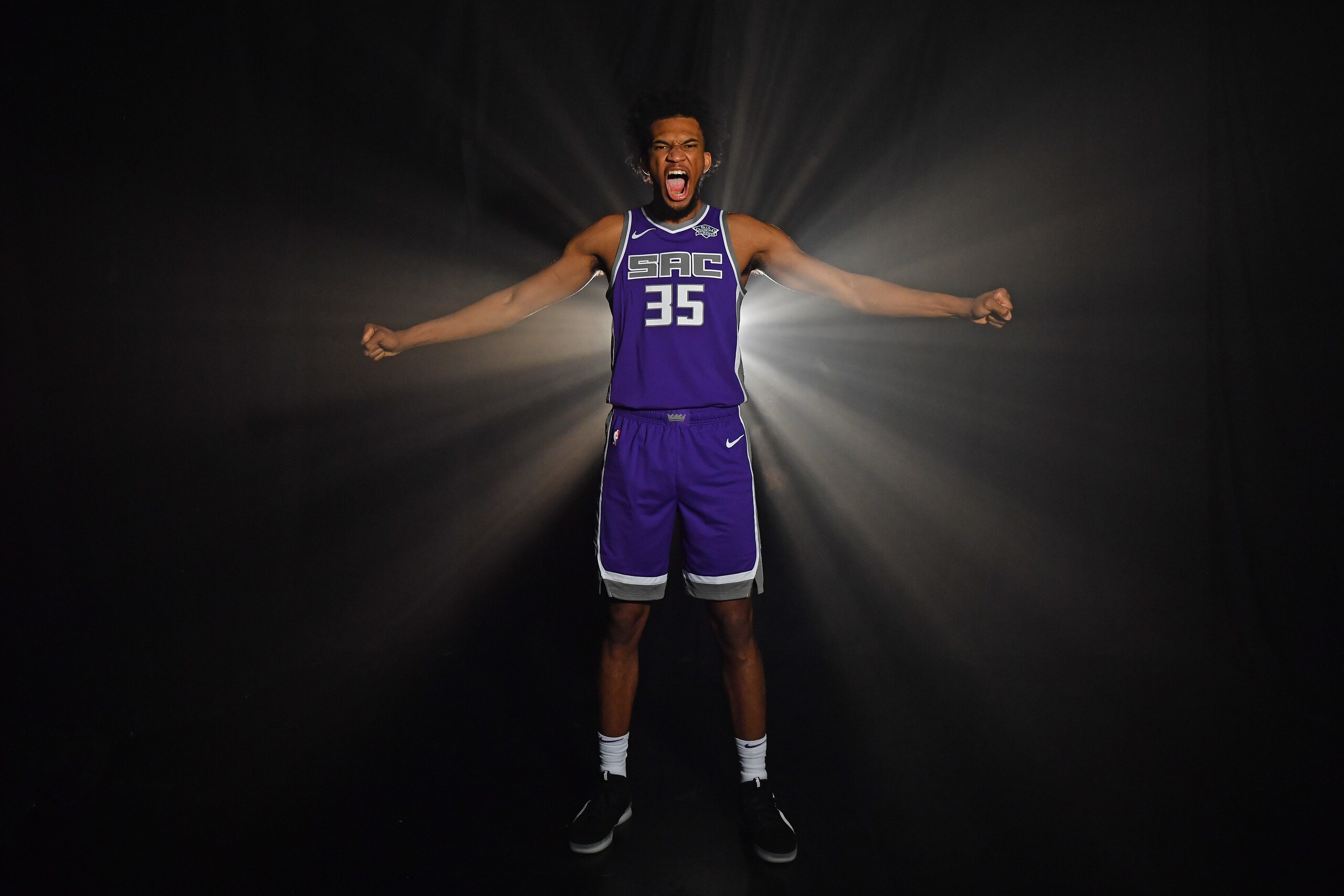
There are advantages and disadvantages to playing Marvin Bagley at power forward, but based on the Sacramento Kings' roster, the No. 2 overall pick should be the starter at the 4 alongside Willie Cauley-Stein.
As long as Bagley is given a full-time role, his quickness, bounce and motor should translate to easy baskets and rebounds.
In 33 games at Duke, he converted 146 field goals at the rim, where he shot 73.4 percent, ranking in the 96th percentile. He finished in the 97th percentile on basket cuts and 87th percentile on putbacks. Bagley gets off the floor extremely fast, which, combined with his explosive leaping, should continue leading to routine dunks and unguardable lay-ins.
In the half court, he's most effective in the post (24.3 percent offense last year), where he shot 53.8 percent using an array of moves, including jump hooks and spins.
Playing off Cauley-Stein, however, he'll spend time around the perimeter, where he's flashed glimpses of potential but also a lower skill level.
On the positive side, Bagley should be able to make the occasional open jumper when set, having hit 23 threes in college. And when given space, he demonstrates enough body and ball control to use a dribble, attack and score off one foot.
However, after making just one of 10 three-point attempts during summer league, it appears the NBA's three-point line may be too far for comfort in 2018-19. And he made just one jump shot off the dribble at Duke.
It's also reasonable to assume he'll have trouble making certain defensive reads and containing dribble penetration (especially against small-ball 4s). These were issues he experienced at Duke that seem unlikely to be corrected over the next year.
Still, he's only 19 years old, and he possesses elite-level athleticism and a versatile skill package from the paint out to the arc. With an expected starter's workload, Bagley should rack up his fair share of double-doubles and finish as the No. 2 rookie power forward next season.
1. Jaren Jackson Jr., Memphis Grizzlies
5 of 5
Praised for his interchangeability up front, Jaren Jackson Jr. may need to work from the 4 to see the most reps with Marc Gasol locked in at center. And the rookie's shooting and defensive versatility suggest he can succeed at power forward.
After making 38 threes (2.0 per 40 minutes) at a 39.6 percent clip at Michigan State, Jackson helped validate those NCAA numbers by knocking down 14 of 28 triples during summer league. Despite an unorthodox pushing motion, his shot appears controlled and capable of carrying over to the NBA's arc.
He also converted 22 of 30 post-ups as a freshman, even though his back-to-the-basket game remains basic.
Otherwise, Jackson could struggle to create shots in the half court. He'll lean mostly on spot-up shooting and finishing as a rookie, though flashes of face-up moves and spins off the dribble should point to an expanding repertoire and untapped offensive upside.
Regardless, he'll make his mark for the Grizzlies on defense, where his 7'5 ¼" wingspan, mobility and anticipation translate to valued switchability and spectacular playmaking at the basket.
Among NBA bigs, only Hassan Whiteside left college with a block rate higher than Jackson's 14.3 percent, per Sports-Reference.com. And he did it playing mostly power forward at Michigan State. Along with his terrific timing and tools for shot-blocking, he also shows strong lateral quickness, allowing him to guard smaller players around the perimeter.
Bagley could outscore him next season in a larger role, but Jackson should ultimately be more effective for his team with the ability to stretch the floor, protect the rim and defend multiple positions.
Stats courtesy of Synergy Sports

.jpg?w=2560 "2 NFL Officials Suspended")

.jpg?w=2560 "Mahomes' Wife Trolls Kubiak 💀")
.jpg?w=2560 "Love's Body Already 'Tired'")