


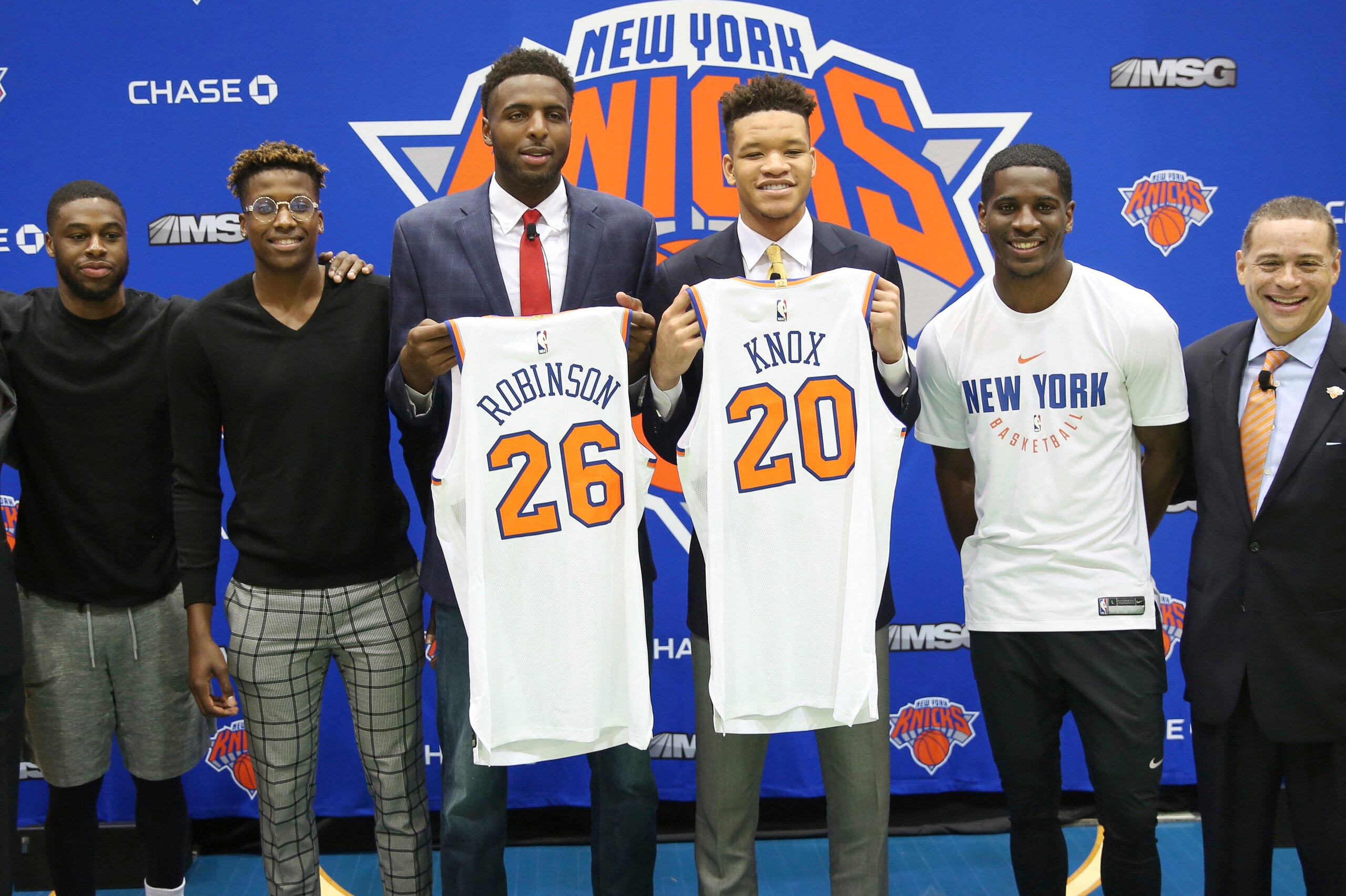
The New York Knicks' selection of Kevin Knox with the No. 9 pick in the 2018 NBA draft sent mixed emotions throughout the Barclays Center and the Twitterverse, when really, on the most fundamental level, they nailed this decision.
Investing in an 18-year-old implies a certain patience and process previous Big Apple regimes generally bypassed. The Phil Jackson era included gambling on Kristaps Porzingis and Frank Ntilikina, known projects, but this feels different. It feels genuine. The Knicks have not (yet) gone on to burn valuable cap space or tried to juggle an immediate window they don't have alongside an underserved emphasis on the future.
Knox, now 19, will need time—perhaps even more than Michael Porter Jr., the prospect many initially called for New York to draft, and his twice surgically repaired back. His summer-league performance was peppered with moments worth their viral hype, but Knox won't take the regular season by comparable, everyday storm.
Or maybe he will. No one knows. The Knicks have the flexibility to find out. That matters more than anything else. They've committed to a developmental phase just by taking Knox, and Porzingis' recovery from a torn left ACL affords them even more room to experiment with the league's third-youngest player. (Knox has birthday seniority over only Los Angeles Lakers rookie Isaac Bonga and Memphis Grizzlies newbie Jaren Jackson Jr.)
The trick for the Knicks is to capitalize on Knox's time without Porzingis in a way that prepares him for an eventual partnership with the 23-year-old skyscraper.
Turning Knox Loose Without KP

Gauging the depths of Knox's from-scratch scoring should supersede just about anything else the Knicks do to begin the regular season. They don't have to worry about propping up Porzingis' usage, which opens the door for them to futz with their pecking order.
No one else on the roster is worth featuring over Knox. Tim Hardaway Jr. is a known commodity. His off-the-bounce game has its limitations. New York will not luck into a surprise building block by treating him as a lifeline.
Trey Burke led the team in usage after the All-Star break and figures to be the primary ball-handler. That's fine. He still isn't someone the Knicks should build their offense around. He turns 26 in November and is playing out a contract year. Neither of those things ideally aligns with the Knicks' window. And they don't have to place him atop their chain of command to find out if he's a keeper.
Mario Hezonja and Ntilikina need reps, but neither should commandeer the offense. Enes Kanter and Courtney Lee are not part of the bigger picture. Please, for your own well-being, let go of the Emmanuel Mudiay optimism.
Knox should have relatively free rein until—or rather, unless—Porzingis makes his season debut. It will never be easier to turn him loose off the dribble, and head coach David Fizdale's desired approach fits that brand of autonomy.
"I want to establish a top-ranked defense, a fast defense, a disruptive defense, a versatile defense, a loud defense, that sparks offense and gets us into the open court," he said at his introductory presser in May, per NorthJersey.com's Chris Iseman. "And once we do have to settle in, play a really free-flowing open-space offense that has everybody getting involved in sharing the basketball."
Green-lighting anyone who finishes a defensive possession to push the ball is part and parcel of this attacking style. The summer Knicks tested Knox's handle in transition. The regular-season Knicks should, too:

Leaning on Knox in half-court situations will be a more deliberate process—a methodical sacrifice. He's not an especially ball-dominant player. He led Kentucky in points per game and field-goal attempts per 40 minutes, but he rarely strayed far from straight-line drives and off-ball reads. More than 53 percent of his buckets at the rim, along with 91.2 percent of his three-pointers, came off assists, according to Hoop-Math.com.
The Knicks may only need Knox to dabble in self-creation long term. Porzingis will take up his throne again, even if not until 2019-20, and running the offense through Burke, Hardaway and even Ntilikina will come more naturally.
Second and third fiddles must still be able to fend for themselves, though. Knox flashed an occasional flair for half-court shot creation during summer league—including more advanced on-ball footwork when clear paths to the basket weren't available:

Empowering him to make similar plays against regular-season defenses demands an iron stomach. Knox's 21.3 points per game in Vegas came on 35.3 percent shooting. The Knicks offense will endure growing pains with him as a quasi-focal point.
They'll have to get over it. Knox put down 45.1 percent of his dribble jumpers at Kentucky, per Bleacher Report's Jonathan Wasserman, and made higher-IQ passes as the go-to option in summer league. If he's a potential hub, the Knicks need to find out now.
Simulating Life with KP, Part I: Positionless Lineups
Fizdale is among the mounting number of head coaches who are raging against the shackles that are positions. He has refused to place specific labels on his guards and isn't about to bristle at the surplus of "bigs" populating New York's depth chart.
"I got a crush on wingspan," he said, per The Athletic's Mike Vorkunov.
Knox fits neatly into Fizdale's admiration for undefined length. His sub-7-foot wingspan isn't exceptional if he's being groomed as a big, but the Knicks used him like a 2-3 during summer league rather than a 4-5.
Chances are they'll stick with this model. Knox needs to get some spin at the 4; his face-up speed is too much of mismatch. But the Knicks will call upon him to plug wing minutes when Porzingis is healthy. They have no choice.
Porzingis has spent most of his career at the 4, and Mitchell Robinson isn't a throwaway prospect. New York's end game will include playing both with Knox. Regularly deploying him up front to start 2018-19 would only delay a shake-up that has to take place once Porzingis rejoins the rotation.
Simulating these triple-tower arrangements will be tough in the interim. Kanter and Luke Kornet are one-position bigs. Slotting either one alongside Robinson would be weird. Hezonja and Lance Thomas work, but their offensive skill sets push Knox toward big-man duties.
Noah Vonleh's addition would loom large if he makes the opening-night roster. Playing him up front with Robinson (or even Kanter) would invite Knox to continue attacking on offense like a wing. Granted, that job description then complicates his role on defense. He can be inattentive off the ball and hasn't showcased the tools beyond his length to pester primary ball-handlers in space. But he's not any better suited to jostle with 4s and 5s.
Stronger bigs will overpower him, and he doesn't have a great nose for protecting the rim from standstill or roving positions. His physical profile will go further versus perimeter types for now, and since he'll be saddled with those assignments beside Porzingis anyway, the Knicks might as well make sure a lion's share of his time comes against them from the jump.
Simulating Life With KP, Part II: Offensive Fit

Transitioning to life alongside Porzingis shouldn't be much of an issue for Knox. His offense came in all shapes and sizes at Kentucky:
From his NBA.com draft profile:
"Almost half of his shot attempts in the half court were catch and shoot jumpers with another significant portion of his attempts coming on pull-ups or floaters. Doesn't get a ton of elevation on his jump shot, but has promising mechanics. Accuracy was pretty consistent when he was given space. Made midrange shots off of pindowns at a strong rate. Attempted some tough, contested shots as he tried to lift Kentucky's offense when it got stagnant in the half court. Still has some room to tighten up his mechanics. Scored 0.983 points per jump shot in the half court [62nd percentile] posting almost identical efficiency numbers off the catch and off of one or two dribbles."
Generating a more consistent three-point stroke is a must. Knox shot 34.1 percent on 5.6 long-range attempts per 40 minutes and is OK at getting to his spots in transition, but he has to exhibit more patience in the half-court when working away from the ball. He's so used to attacking that he will duck inside the arc to catch passes or automatically dribble into a floater or mid-range jumper.
That energy has value. So, too, does waiting for plays to unfold. Habitually dipping inside the three-point line will see Knox too often sharing the same airspace as Porzingis and, potentially, the other big on the floor. New York needs to get him firing more threes off screens and spending additional time orbiting drives from the corners:

Knox's quick floaters will get him by while his outside game comes along. He's more than comfortable flipping them up off the catch. His massive strides even turn dribble floaters into off-ball plays.
It only takes Knox a step or two to reach his sweet spots when going downhill, so he can steer clear of the initial action from a distance for longer periods. Ball-handlers get extra breathing room, and he isn't forced to operate from purely idle stances. Most of his floaters at Kentucky typified this thinking; he seldom used more than two dribbles to get his floaters off:
Knox will be even better equipped to coexist with Porzingis if the Knicks continue to let him initiate pick-and-rolls. He struggles to make the right reads when facing double-teams and when his screeners don't create enough separation, but his handle is smooth enough to run elementary actions—particularly when he's not dribbling into collapsing traffic:

Using Knox as the triggerman with Porzingis as the diver or popper shouldn't take much time to perfect. Knox whipped more than a few gnarly passes in summer league, breaking from his score-first character with pleasant frequency, and the 7'3" Porzingis' combination of size and range simplifies the decision-making process for every ball-handler.
"Insert Porzingis as the screener into the pick-and-roll, and the possibilities are endless—and possibly devastating for defenses," The Ringer's Kevin O'Connor wrote. "Porzingis can roll and finish with finesse inside, pop for three, or pop and then attack a closeout. Knox could potentially score from anywhere."
Reversing these roles is something the Knicks should kick around from time to time. The 6'9", 212-pound Knox has the size to be used as a screener and enough range to both dive and pop. Porzingis isn't as fluid when working off the dribble, but he looked more at home last season with the ball in his hands from face-up positions.
This raises an interesting point: The Knicks cannot maximize Knox's role next to Porzingis if the latter doesn't improve as a table-setter. That isn't a given. They almost never have Porzingis jump-start pick-and-rolls, and he's always been a dicey passer when dribbling into double-teams or getting harassed in the post.
Fifty-two players have posted a usage rate north of 25 through at least 75 appearances over the past two seasons. Porzingis ranks dead last in assists per 36 minutes. Among 253 players to make 100 or more drives last season, his pass percentage (8.3) placed 252nd.
This all might be a symptom of New York's talent deficit around Porzingis. It could speak to inbuilt void. It could be a matter of inexperience. It could be a combination of everything. Either way, Porzingis needs to feed Knox for spot-up floaters and, invariably, three-pointers and grow into an inverted pick-and-roll initiator.
If he does, and if Knox remains on the functional path he started in summer league, the Knicks just might find they have two legitimate cornerstones.
Unless otherwise noted, stats courtesy of NBA.com or Basketball Reference. Salary and cap-hold information via Basketball Insiders and RealGM.
Dan Favale covers the NBA for Bleacher Report. Follow him on Twitter (@danfavale) and listen to his Hardwood Knocks podcast, co-hosted by B/R's Andrew Bailey.
.jpg?w=2560 "Grading SmackDown 🔠")
.jpg?w=2560 "Aiyuk Slammed by Ex-Teammates 😬")

.jpg?w=2560 "Report: Eagles to Sign Cowboys QB")
.jpg?w=2560 "Caleb Reposts Hype Video 🥶")