


There are 440 pitchers in Major League Baseball with no more than two wins and no more than six saves thus far in 2018. They are neither ace starters nor shutdown closers. They are the Everypitcher.
Except, of course, for the guy who's allowing the lowest OPS of any left-hander ever and striking out batters at a higher rate than any pitcher ever (minimum 30 innings).
If you haven't already, meet Josh Hader.
TOP NEWS

Live World Series Game 2 Highlights 🎬
Miz Trades Cards With Kid 🥹

MLB Commissioner Defends Salary Cap
The 24-year-old lefty has been working out of the Milwaukee Brewers bullpen since last June. And one swing and miss at a time, he's rapidly progressed from an intriguing oddity into a likely All-Star with a growing reputation as MLB's best relief pitcher.
All Hader has done in 2018 is rack up a 1.13 ERA and, as noted above, overwhelm hitters to the tune of 18 strikeouts per nine innings and a microscopic .363 OPS allowed. He typically dominates them in bunches, as he's squeezed 40 innings out of just 25 appearances.
Hader wasn't necessarily destined for a role like this. He was starting games for the Triple-A Colorado Springs Sky Sox as recently as last June, at which time he was still rated as a top pitching prospect.
But with a 5.37 ERA and a rate of 5.4 walks per nine innings to his name, what Baseball America had written about him was ringing true: "Hader has front-line starter's stuff but must improve his changeup and control to reach his ceiling."
Instead, the Brewers made the call to promote Hader as a reliever.
And like Andrew Miller before him, he didn't resist his team's attempt to turn him into a new-age fireman who's ready, willing and able to get as many outs as needed whenever they're needed. He authored a fitting preamble to what he's done in 2018: a 2.08 ERA over 47.2 innings in 35 appearances.
"A big key to Josh is that he's open to what's best for the team," Brewers general manager David Stearns told ESPN's Bradford Doolittle in May. "He came up here and adapted to that [middle relief] role very well, and he enjoys that role. If tomorrow we asked him to go back to starter, he'd do that and enjoy that role. He's a guy who really will take to any task."
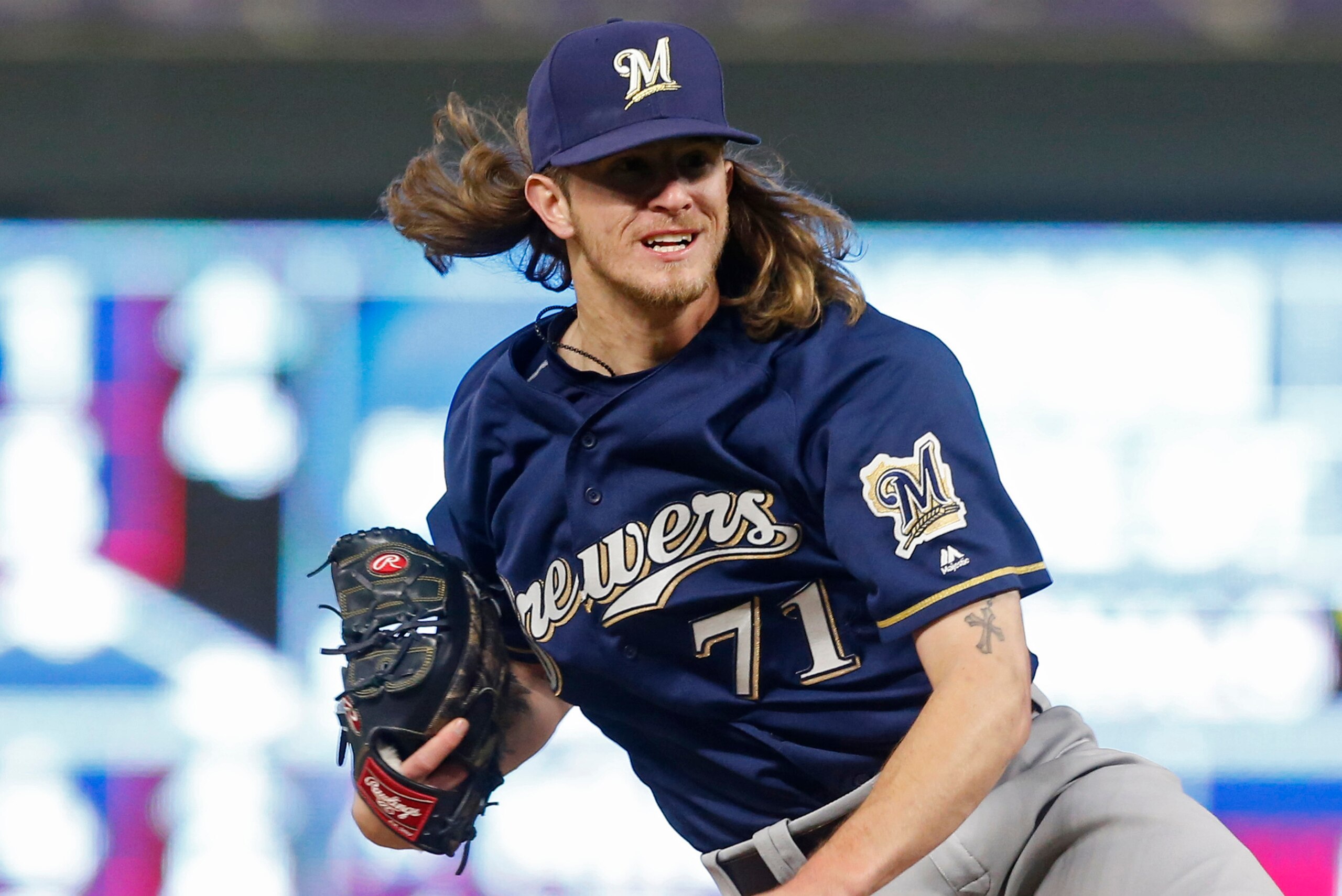
It doesn't take 20-20 vision to see that Hader deserves the success he's found in his sophomore season.
His historic strikeout rate is backed up by a contact rate of 59.2 percent, the lowest of any pitcher with at least 30 innings. And what balls have been put in play against him have averaged just 84.9 mph in exit velocity, well below the MLB standard of 88.1 mph.
This isn't happening because Hader is the hardest thrower. Statcast clocks his average fastball at 94.1 mph, which is barely in the top 100 among all pitchers who've thrown at least 400 heaters.
The average velocity of Hader's slider (81.6 mph) also fails to impress. And while its average spin rate of 2,562 RPM is good, it's also far from elite.
And yet, it's no accident that Hader's stuff plays up well enough to produce results like...well, like his.
For starters, he has a herky-jerky delivery and a violent release. These make it tough for the hitter to track the ball, which promptly explodes out of his hand.
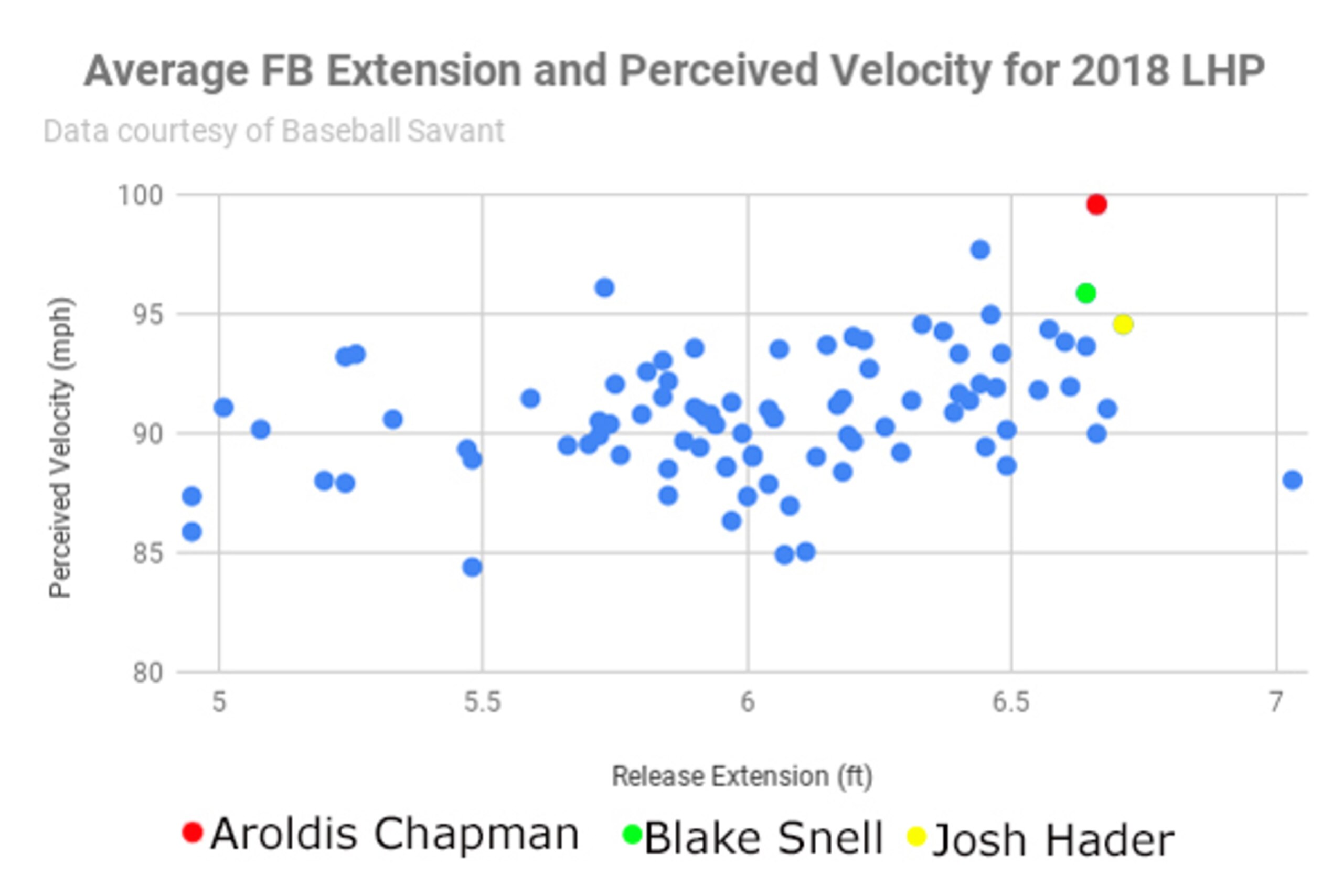
Hader also gets the most of his 6'3", 185-pound frame. He averages 6.7 feet of extension when he throws his four-seam fastball, and that helps his perceived velocity outpace his actual velocity: 94.6 mph to 94.1 mph.
There aren't many southpaws who are capable of that kind of relationship between their extension and their perceived velocity. Hader is basically the next step down from Aroldis Chapman and Blake Snell:
"He has a really good stride, so the ball gets on you," teammate Christian Yelich, who faced Hader as a member of the Miami Marlins, told Doolittle. "You don't face a lot of guys like that, and it's a really tough at-bat."
Hence the MLB-best 21.8 percent swing-and-miss rate that Hader is getting on his four-seamer, not to mention the frequency with which he's experienced late swings followed by boisterous cheers:
But while Hader's fastball may be his main attraction, his slider is no slouch.
He's gotten whiffs on 29 percent of those throws. That's good for sixth among all pitchers who've thrown at least 100 sliders.
Measurements be damned, the pitch itself is quite good. Here, take Odubel Herrera's word for it:
What really separates Hader's slider from the pack, though, is how he's able to disguise it as his fastball.
Anyone who cares to play around with Baseball Prospectus' leaderboards might stumble across one that shows Hader leading all qualified pitchers in a metric called "PreMax." This stat measures "the perceived distance between the pitches as seen from the batter's viewing angle."
Put simply, PreMax shows which pitchers can make different throws look like the same pitch right up until they reach the hitting zone.
It sounds complicated in writing, but it makes sense when you see it. And thanks to Rob Friedman, pitch GIF extraordinaire, you can see Hader do it with his fastball and slider right here:
Notice how those two pitches follow the same path right up until the last second? That makes Hader's slider something like an ambush weapon. By the time hitters see what it is, it's typically already too late.
Most relievers are blunt instruments. Hader is more like an artist. There's his raw talent, and then there are his instincts for how to use it to create something.
For now, the difference between him and other artists is that he's immune to criticism. He received an opportunity to become a special sort of pitcher, and he's seized on it to become a reliever unlike any other.
Ultimately, his tale should be writ large in the record books.
Stats courtesy of Baseball Reference, FanGraphs, Baseball Savant and Baseball Prospectus.





.png?w=2560 "Week 8 Winners & Losers 📊")





.jpg?w=2560 "Jonathan Taylor Landing Spots")