

Can Saquon Barkley Possibly Succeed as a Rookie?
Saquon Barkley will make his Giants debut at rookie camp on Friday and Saturday. Here are a few bold predictions about what will happen:
• We will hear that he looks great. Or "sharp," because that's the word us media types tend to use to describe rookies running around in compression shorts during noncontact practices.
• He will "say all the right things."


.jpg?w=2560 "Cardinals Giants Football")
• Head coach Pat Shurmur and others will tell us how excited they are about what Barkley brings to the Giants.
Rookie camp, after all, is a glorified debutante ball for a No. 2 overall pick like Barkley. It's a chance to make a positive first impression and set the tone for a successful rookie season.
But what will a successful rookie season mean for Saquon Barkley, who comes at an extremely high cost—the Giants reportedly shunned trade offers for the second overall pick, according to Ryan Dunleavy of NJ Advance Media—and with stratospheric expectations?
That's easy, you say. A successful rookie season for a running back is all about the numbers.
Barkley can succeed by gaining about 1,300 yards from scrimmage, scoring a dozen touchdowns and adding around 50 catches. That production will win some games and also silence those Moneyballers that Giants general manager Dave Gettleman mocks by typing on his imaginary laptop, right?
Did you spot our trap with those numbers?
Those were Trent Richardson's statistics from his rookie season, when he gained 1,317 yards from scrimmage in 2012 (950 rushing, 367 receiving), caught 51 passes and scored 12 total touchdowns. Richardson started regressing badly late in that season, was traded early the next year and hasn't taken an NFL regular-season snap since 2014. Now he's an all-time bust and a cautionary tale about drafting running backs too high.
Richardson averaged just 3.6 yards per carry as a rookie, a sign that his raw totals weren't what they seemed to be. So, how about this as the definition of a successful rookie season: 1,300 scrimmage yards, some receiving value, double-digit touchdowns and 4.8 yards per carry? That's a high-impact rookie season, isn't it?
Those numbers come from Todd Gurley's rookie year in 2015. Gurley, who the Rams selected at No. 10 overall that year, is no bust; heck, he was the Associated Press Offensive Player of the Year last season. But Gurley followed up his strong rookie season with a disappointing 885 rushing yards, 3.2 yards per carry and six touchdowns in 2016.
Gurley was a casualty of Jeff Fisher's coaching malpractice, of course. His career rebounded as soon as Sean McVay arrived and installed an offense that wasn't 20 years out of date. But that's the problem with young running backs, even supremely talented ones: They're such products of their environment that it's hard to distinguish their success (or failure) from the team's accomplishments.
If the Giants eschewed trade offers and passed on everyone from Bradley Chubb to Sam Darnold so they could select a running back whose production bobs up and down with the tides, is that selection successful? Keep in mind that Barkley will be coached by Shurmur, the same guy who wore Richardson down to the nub, not a McVay-like wunderkind.
Perhaps we need to project some unequivocally exceptional statistics for Barkley's successful rookie season: try nearly 2,000 scrimmage yards, 5.1 yards per carry and 16 touchdowns to take the Giants from worst to first in the division. Anyone want to argue with a rookie season like that?
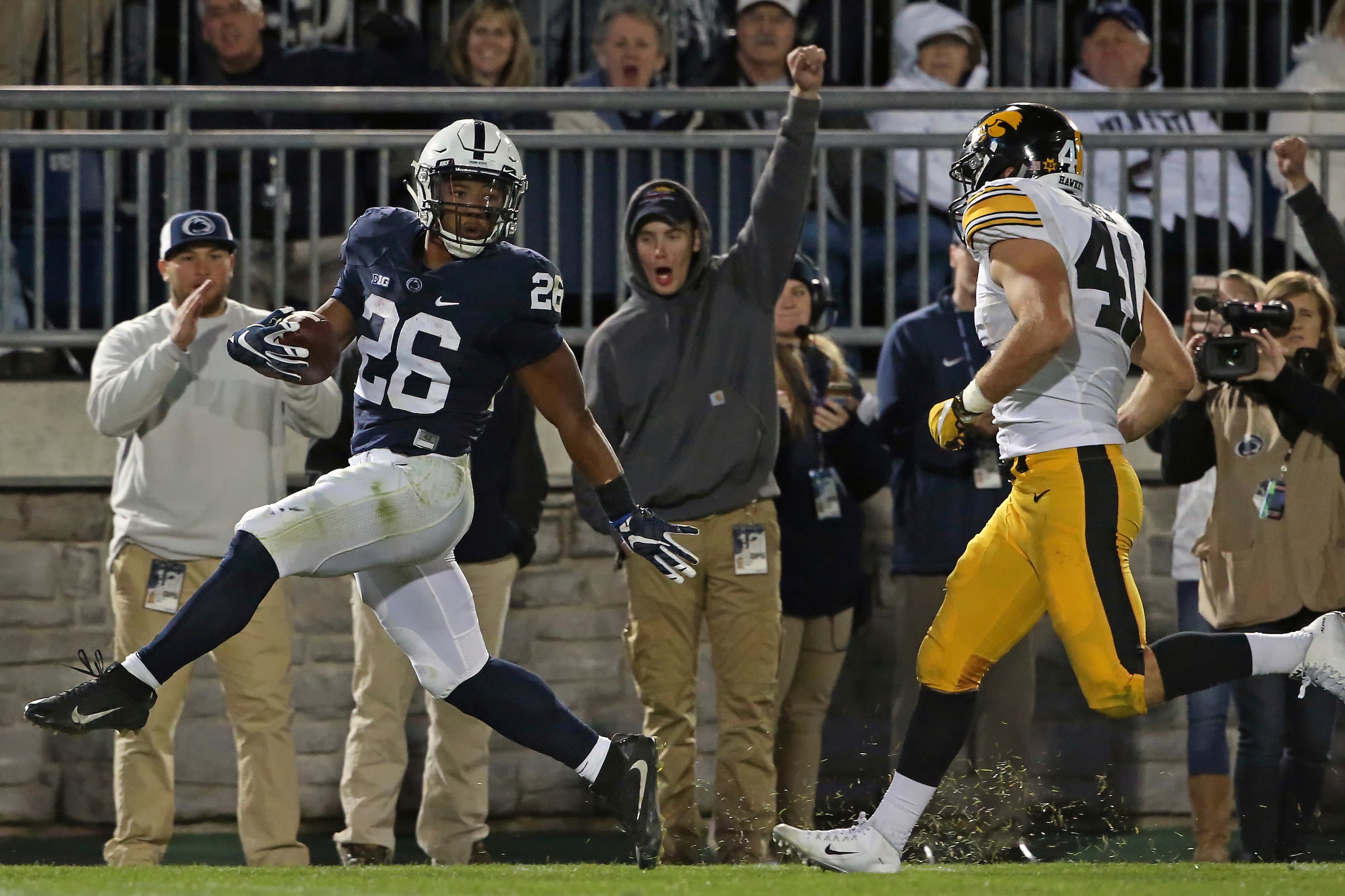
Those are rounded-off versions Ezekiel Elliott's 2016 rookie stats. And we can extend the Elliott-Barkley metaphor even further: Perhaps Kyle Lauletta will be the Dak Prescott to Eli Manning's Tony Romo, the team's work-in-progress offensive line will somehow morph into the Plowboys and the Giants will become the current Cowboys but with a more reliable running back, fewer cap headaches and, oh yeah, Odell Beckham Jr.
Maybe that's a bit lofty.
On behalf of the analytics community, I'll find the middle ground. I hereby state that if Barkley rushes for 1,600 yards and helps the Giants build a sustainable plan for the post-Eli future, then his rookie season should be deemed successful.
But anything less will bring the yeah, but or um, actually treatment. And not just from the archbishops of Moneyball.
Drafting a running back high in the first round isn't risky merely because it violates some theorem in a mathematics textbook. The problem is that many of the most important variables that determine a running back's value to his team have nothing to do with his size, 40 time, college production or scouting report.
The market availability of talent is one of those variables. Even old-school guys like Gettleman know instinctively that quarterbacks are precious, edge-rushers and left tackles are always in short supply and capable running backs (as well as guards, safeties, etc.) are much easier to draft in later rounds or find on the discount free-agent rack.
Fans don't have to look hard for examples. Last year's fourth overall pick, Leonard Fournette had a strong rookie year (1,040 rushing yards, 10 total touchdowns), but third-rounders Kareem Hunt and Alvin Kamara both outgained him in terms of yards from scrimmage and total touchdowns.
Most seasons bring similar examples. Barkley could rush for 1,000 yards but have less of an impact on his team than Ronald Jones, Derrius Guice, Royce Freeman and/or some unexpected sleepers.
That isn't necessarily the Giants' problem. After all, Jared Goff isn't considered a failure because Carson Wentz was more successful as a rookie or because Prescott is a better cap value.
But there's another major variable at play, one Gettleman and the Giants either miscalculated or chose not to consider: the team's realistic needs and goals.
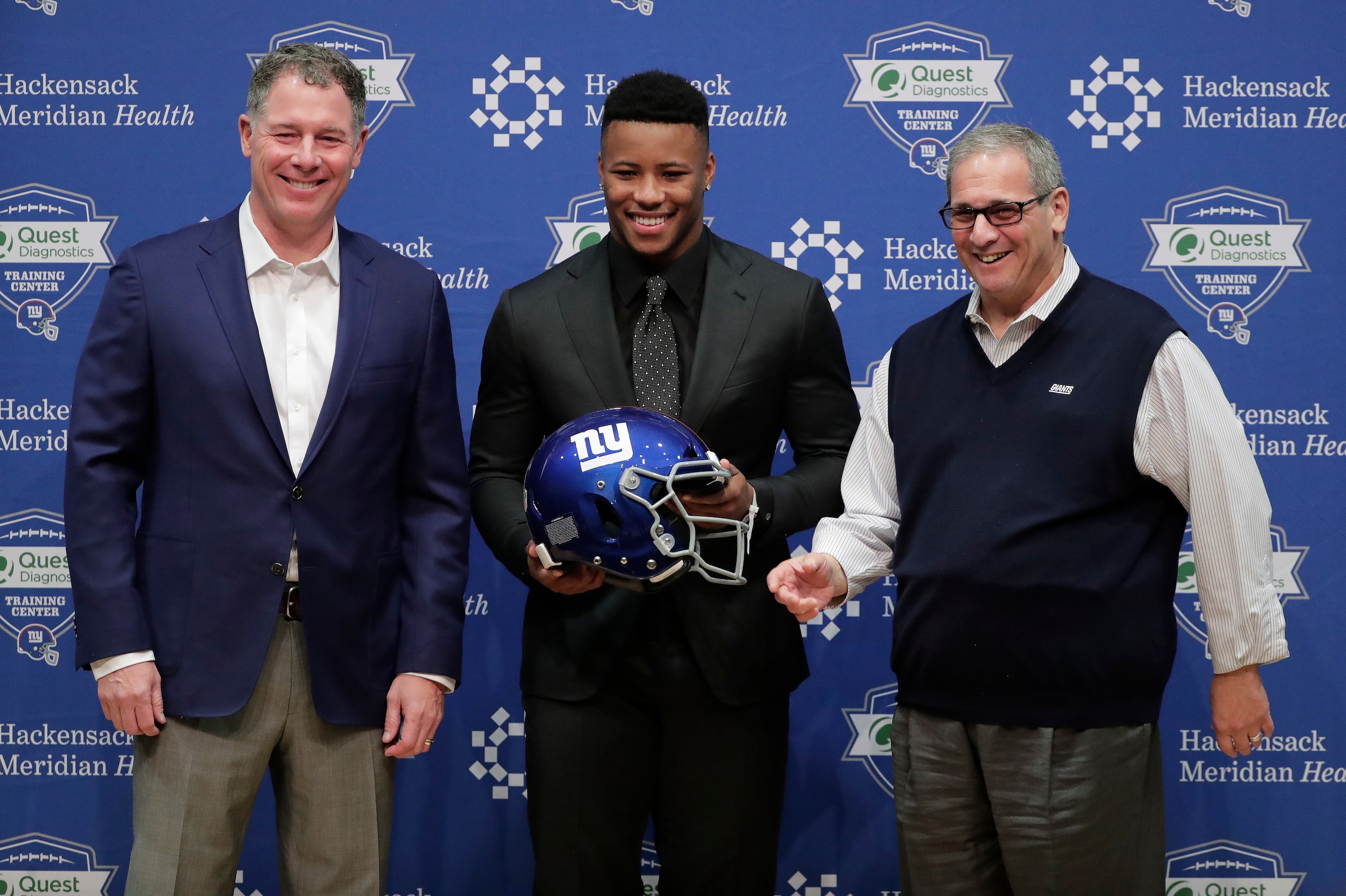
Running backs are terrible long-term building blocks because their careers are short and their production is unstable. Draft a running back while your team is rebuilding, and he's likely to be worn out by the time the other pieces are in place, especially if he's expected to take pressure off a rookie or aging quarterback by running between the tackles 25 times per game.
That's the risk the Giants are taking: that Barkley's great years will line up with their rebuilding years, and that he will be nearly toast by the time the team is ready to contend again.
The nightmare scenario for the Giants would be for Barkley to have some high-carry 1,000-yard rookie season that bumps the team's record up to around .500, props Eli up for a year and woos the Giants into thinking the Super Bowl is just another move or two away. Then, by the end of 2019, Barkley is trudging along at 3.4 yards per carry while Lauletta and Davis Webb battle for the starting quarterback job on a last-place team.
Short-term success for Barkley might be a bad thing for the Giants. That's what those analytics types who Gettleman mocks are trying to warn him about.
The long-term success of the Barkley selection has nothing to do with how many yards he runs for. It comes down to whether the Giants hit on other selections like Will Hernandez, Lorenzo Carter and Lauletta. If their rebuilding and succession plans at other positions pay off, they'll be able to make the most of Barkley's peak years. If not, they splurged on a luxury when they needed to invest in necessities.
It will take a few years to determine whether Barkley is a success story.
For now, all he can do is look sharp.
Mike Tanier covers the NFL for Bleacher Report. Follow him on Twitter: @MikeTanier.
.jpg?w=2560 "Jets Dolphins Football")
.jpg?w=2560 "Ward Nearly Walks Out of Presser ▶️")
