Biggest Takeaways from Washington Redskins' Preseason Week 1 Loss
Some tough lessons were learned by the Washington Redskins during their 23-3 loss to the Baltimore Ravens in the first week of preseason last Thursday.
The Redskins learned their offensive line isn't displaying the kind of cohesion expected from what should be one of the better units on the team in 2017. Crumbling pass protection saw multiple quarterbacks sacked, while feeble blocking also doomed the running game.
Speaking of the rushing attack, a work in progress is the polite appraisal of the Burgundy and Gold's efforts on the ground in Baltimore. Balance is needed on offense this season, but it will demand more from rotational backs such as fourth-round rookie Samaje Perine.
Things looked more solid defensively at least, courtesy of a stout showing from the line, particularly in the middle, where forgotten veteran Phil Taylor Sr. offered a reminder of his talent.
Unfortunately, the progress of the line came as the edge-rushing rotation was thinned further by an injury to Trent Murphy. His absence this season will test defensive coordinator Greg Manusky's ability to creatively juggle his reduced options on the outside.
Read on for a full breakdown of the biggest takeaways from Washington's first preseason outing in 2017.
Blitz Pickup a Potentially Fatal Weakness
1 of 6
It had to concern head coach Jay Gruden to see how easily his O-line crumbled in the face of the Ravens' blitz. Baltimore's D' waltzed through non-existent blitz pickups to register three sacks, countless other hits and ceaseless pressure.
Maybe Gruden shouldn't have been too surprised, though. After all, identifying and reacting to blitz pressure has been a problem all through training camp, per Michael Phillips of the Richmond Times-Dispatch.
Phillips believes it's no biggie, given how most teams won't attack the pass-happy Redskins with as many pressures as Baltimore did, nor as many as Manusky unleashed at camp.
Yet it's too easy to dismiss the line's struggles against the blitz as just typical preseason bumps in the road. Instead, the Redskins should be mightily concerned by their problems up front.
For one thing, Washington resides in an NFC East where the New York Giants own a fearsome defense. It's a unit directed by Steve Spagnuolo, a coordinator adept at designing and calling chic pressure concepts to wreck an offense.
Spags and Big Blue aren't the only blitz-happy crew on the schedule. The Redskins face the Los Angeles Rams and Wade Phillips' pressure-crazed version of the 3-4 in Week 2 of the regular season.
Meanwhile, Bob Sutton's Kansas City Chiefs defense won't be shy about bringing the blitz in Week 4. Nor will Mike Zimmer's Minnesota Vikings, lovers of double A-gap pressure, in Week 10.
Then there's the Arizona Cardinals, who visit FedExField in Week 15. No team in football has enjoyed blitzing more than the Cards since Bruce Arians became head coach in 2013.
Perhaps more troubling than the pitfalls of the schedule is Washington line coach Bill Callahan's recent history against the blitz. A noted blocking guru, and for good reason, Callahan's fronts have often dominated in the running game but struggled dealing with the blitz.
Redskins fans should know all about this dichotomy. Think back to Week 8 of the 2014 season when Jim Haslett's array of blitzes helped Washington score a shock road win over the Dallas Cowboys by overwhelming Callahan's line on Monday Night Football.
Don't be lulled into dismissing preseason form. Washington's struggle to deal with the blitz could be a problem serious enough to derail any playoff hopes.
Running Game Still Searching for Steps Forward
2 of 6
Rushing for just 39 yards from 18 attempts looked depressingly familiar from the Redskins on Thursday. This team still can't run the ball with any conviction.
There is a lack of consistency in blocking, running and play-calling at the heart of the problem. Each of these issues keeps Washington's rushing attack stuck in neutral.
Gruden is a pass-first coach, who often treats the run as an afterthought. It means runs are sporadically mixed into play sequences, denying backs the chance to establish rhythm.
So it proved in Baltimore, as five different runners carried the ball, with nobody getting more than the six attempts Perine managed.
Sadly, Perine couldn't make the most of the sort-of lion's share of the workload. The former Oklahoma workhorse showed little acceleration and lost a fumble.
Perine and the rest of the backfield weren't helped by issues up front. ESPN.com's John Keim detailed how one missed assignment wrecked a running play:
"On the first run by Rob Kelley, the hole was there. Niles Paul, aligned as a fullback, got to his man several yards off the line of scrimmage and a hole was available—but left tackle Trent Williams quickly lost his matchup with Terrell Suggs, who tackled Kelley. The running back hesitated a bit—he’s trying to show more patience, allowing holes to develop. But the problem was Williams missing his block. He’s a Pro Bowl tackle; it’s safe to assume he’ll make a lot more than he misses."
Unfortunately, Keim's critique of left tackle Trent Williams was just one example of a litany of breakdowns in the trenches. Too often, Washington's O-line, one ostensibly built on size and power, failed to generate a meaningful push on the Ravens' front seven.
Admittedly, Baltimore boasts one of the meaner defensive fronts in the NFL. Yet the Redskins have spent three seasons trying to build their own bully of a line offensively.
Running the football successfully is as much about a state of mind as its execution. The Redskins must show a greater commitment to keeping the ball on the ground, along with more toughness knocking open holes.
Ryan Grant Highlights Promise of Fringe Wide Receivers
3 of 6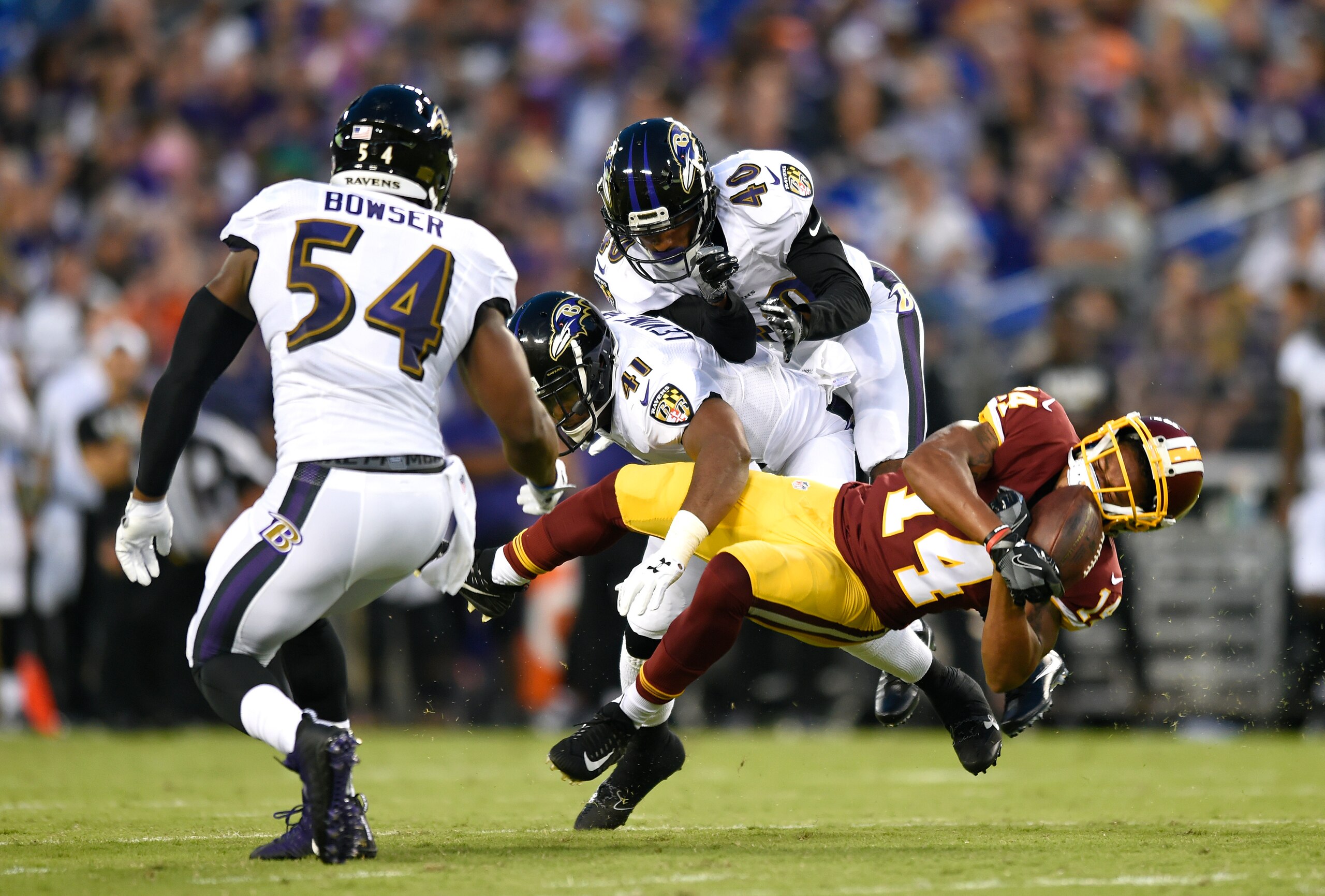
It was only one catch, just a sole grab for 20 yards, but the play did enough to showcase the promise of more to come from Ryan Grant in this year's passing game.
The fifth-round pick from 2014 went up to snag the ball between a crowd of defenders, took a thump and hung on. It was exactly the kind of toughness and efficiency over the middle Grant has often promised, but has seldom been given enough chances to deliver.
Yet 2017 is the perfect season for Grant to finally make his mark. The timing is right because of the changes in Washington's receiving corps.
Pierre Garcon and DeSean Jackson are gone, while Terrelle Pryor Sr. has arrived to be the new primary target. Jamison Crowder and Josh Doctson will also have to carry the load, but the field is open behind the Redskins' three main targets.
It means there's a great opportunity for Grant, whom Gruden has already dubbed Washington's "most consistent" wideout this offseason, to contribute.
Grant's gutsy play in Baltimore did his chances no harm, but he was far from the only fringe wideout to impress.
Sixth-round draft pick Robert Davis showed off his size and speed combination to reel in a 31-yard catch. Meanwhile, veteran Brian Quick led the team with three catches for 20 yards.
Davis and Quick have the inside track to catching Gruden's eye thanks to the head coach's fondness for big receivers.
Gruden made his preference clear earlier this offseason, per Gerald Huggins of USA Today Sport's Redskins Wire:
"I like big receivers personally, but I also like little ones like Jamison [Crowder], but I think it’s a great advantage to have. When you have 6-foot-5, 6-foot-3 with a guy that has a 40-inch vertical then you throw Crowder in there with a great change of direction. I like Maurice Harris and I like Ryan Grant who is not real big but has decent size. Having the luxury of having some big guys, some quick guys and some great guys who run routes like Maurice and Ryan Grant, I think we have great options. Now we add Quick who is another big guy so the options are there for him."
Quick fits the bill for what his coach wants at 6'3" and 218 pounds, as does 6'3", 217-pounder Davis.
It's likely the pass-fond Redskins will carry six wide receivers into the season proper. Grant, Davis and Quick have all made a solid start to convincing coaches they should be included in the final rotation.
.jpg?w=2560 "Texans Titans Football")
Pass-Rush Rotation Looks Thin After Trent Murphy Injury
4 of 6
The Redskins had arguably one of the deepest edge-rushing rotations in the NFL entering preseason. However, two injuries later and Washington's resources on the outside suddenly look thin.
The most serious injury is the torn ACL ruling Murphy out for the season, per NFL Network's Ian Rapoport. It means the Redskins have lost a player already set to miss four games through suspension.
More pertinently, Washington will be without a highly versatile pass-rusher who came into his own during his third season in the pros. Murphy logged a career-high nine sacks during 2016 and emerged as an invaluable situational weapon who could be rushed from multiple positions.
Moving Murphy around allowed the Redskins to disguise their pressure looks pre-snap. His absence will test Manusky's ability to get creative.
It will also put the onus on the team's remaining edge-rushers, a group beset by question marks. The primary question is can Junior Galette finally get and stay healthy after two seasons lost to Achilles injuries?
Frankly, the omens don't look good after Galette missed the preseason opener with a hamstring issue, per ESPN's Dianna Russini. The problem may have been a minor one, and the Redskins are smart to play it safe, but one more injury speaks to the problem Galette has had trying to see the field for the Burgundy and Gold since arriving in 2015.
Manusky and Washington need to rely on the 29-year-old for pressure this season. Without Galette, inconsistent third-year pro Preston Smith or rookie Ryan Anderson will be thrust uncertainly into the spotlight.
Without more from other members of the rotation, the Redskins will once again be heavily reliant on Ryan Kerrigan to carry the burden for the pass rush. No. 91 is good, but being a marked man by opposing offenses will slow him down sooner rather than later.
If they lose another edge-rusher to injury, the Redskins would be wise to consider plucking an ageing sack-specialist off the veteran market.
Mario Williams, Trent Cole or Dwight Freeney, anyone?
Ryan Anderson Making a Strong Case to Start
5 of 6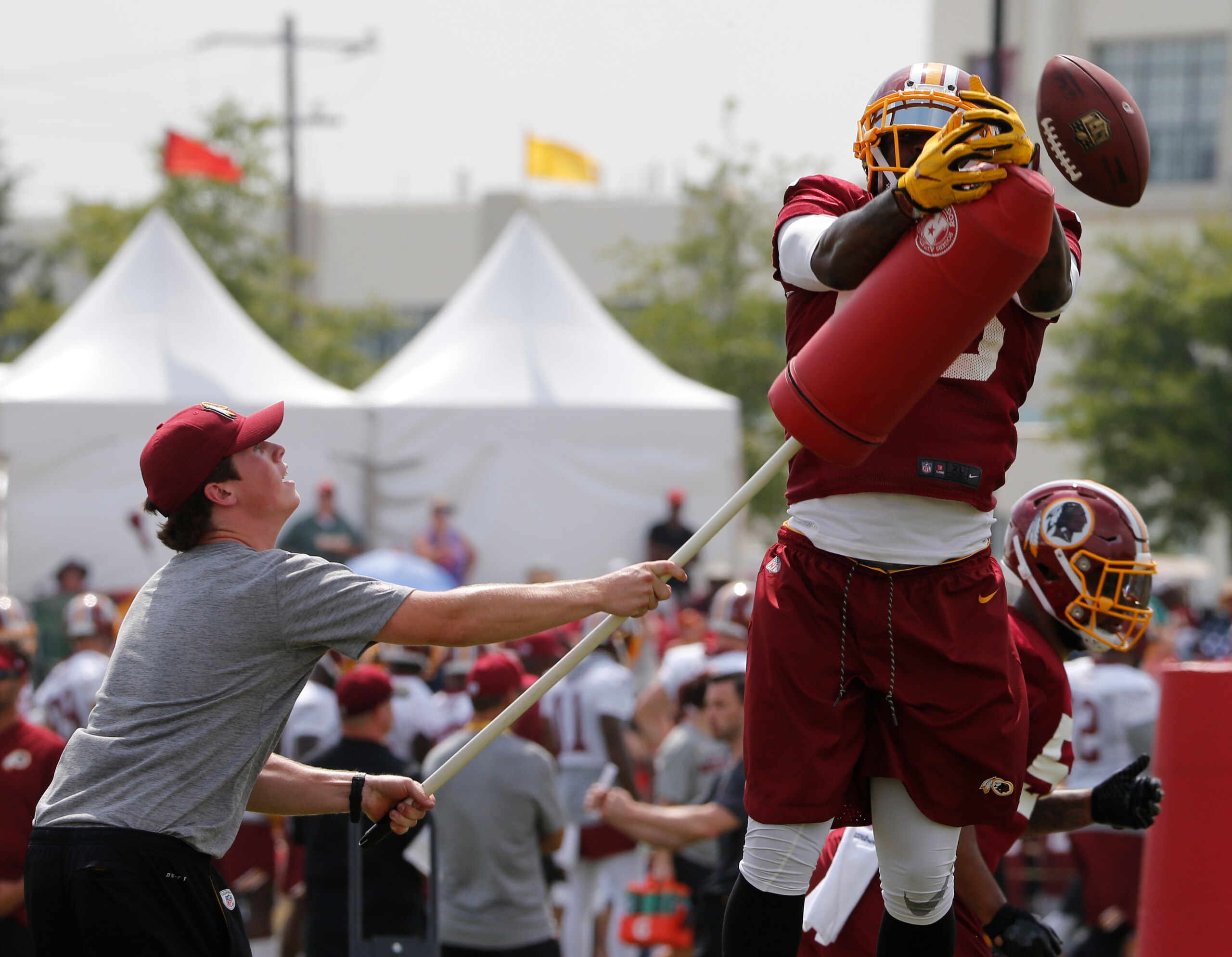
Things will look a lot better at outside linebacker if Anderson continues making progress. Washington's second-round pick has been turning heads this offseason and continued his upward curve against the Ravens.
Specifically, former Alabama standout Anderson displayed the core attributes any true 3-4 outside linebacker must possess.
In particular, a talent for setting the edge was obvious in Baltimore, according to ESPN's Keim:
"Anderson showed that he knows how to set an edge, which is what he's done throughout camp as well. He rushed from a three-point stance on both sides of the line; he also rushed standing up from the inside. But what he did best was get upfield fast to take on lead blockers. He did so one time, not just occupying two blockers but driving one back. That forced the back to run wider, and that enabled speedy Zach Brown to tackle him for no gain. A nice play by Brown set up by Anderson."
Keim's lengthy description perfectly encapsulates Anderson's fit for the Redskins' base schemes. Setting and owning the edge is essential in stopping the run for 3-4 teams. It's the best way to funnel runners back inside to the big man in the middle.
Anderson's refusal to be reach blocked can also help string plays laterally, giving both inside linebackers and force players from the secondary the chance to keep runners from turning upfield.
The note about taking on lead blockers, as well as holding a double team, also speaks to Anderson's affinity with the demands of a 3-4. This is a scheme requiring members of the front seven to do the unfashionable, dirty work in the trenches to allow others to make the splash plays.
Being a splash player doesn't appear to be in Anderson's repertoire, yet it doesn't have to be. Instead, he can be the lunchpale type who quietly does the important jobs and rarely leaves the field.
A linebacker in Anderson's mold will let the Redskins show their base schemes, which are supposed to be based on moving pieces and greater flexibility, more often in 2017.
Phil Taylor Emerging from the Crowd at Nose Tackle
6 of 6
The Redskins signed Terrell McClain and Stacy McGee in free agency to vie for snaps at nose tackle. They also have unheralded candidates such as Ziggy Hood, Joey Mbu, A.J. Francis and Ondre Pipkins.
However, the man seemingly making the job his own this offseason is Taylor. The almost forgotten 29-year-old former first-round pick of the Cleveland Browns is healthy again and showing off his talent for dominating the interior.
Taylor was at his immovable best against the Ravens. He filled the middle, wore down blockers and snuffed out the run. Most pleasing was the way Taylor displayed some nifty move skills to belie his massive 6'3", 343-pound frame.
Both qualities were obvious on one particular running play that went nowhere for the Ravens, per Nora Princiotti of the Washington Times: "On Thursday in Baltimore, he showed mobility, too, snagging Ravens running back Terrance West, an old friend from Cleveland, by the legs to stuff him on what would have been a touchdown run (West did eventually score on the same drive)."
Princiotti also noted how "the Redskins have honed in" on Taylor as their de facto starter over center. It's a huge show of confidence in a gifted man mountain who hasn't played since 2014.
Taylor's myriad of injury woes have made it easy to forget about his talent. Yet the ex-Baylor linchpin is a natural building block in the middle.
By putting a healthy Taylor at the heart of their D-line, the Redskins can go a long way to improving on last season's 23rd ranking against the run. He can be the type of 0-technique who makes everyone else on the front seven better.
Taylor will still face competition from Mbu, McGee and Co., but he has three more preseason games to prove he can stay healthy and still be a starter in this league.
The Redskins hardly showed their playoff potential in Baltimore, but there was still as much cause for optimism as negativity. While the state of the running game and pass protection remain concerning, the front seven looks formidable thanks to the encouraging progress of both rookie and veteran contributors.
.jpg?w=2560 "Broncos Chargers Football")
.jpg?w=2560 "Cardinals Giants Football")