


LOS ANGELES — Stroll through UCLA's sun-kissed campus and you'll find all kinds of reminders of the man who built one of college basketball's greatest programs a half century ago.
His famous maxims—"The best way to improve a team is to improve yourself," "Winning takes talent, to repeat takes character," "Make each day your masterpiece"—line the concourse inside Pauley Pavilion. His bronze, bespectacled likeness stands guard right outside. You'll catch his name draped across the student gym and his face at the local Trader Joe's.

TOP NEWS

J-Dub Suffers Gruesome Injury
Contenders starting to separate themselves after Week 7
.jpg?w=2560 "Rams Raiders Football")
Raiders Could Start Mendoza
But nowhere could you see John Wooden's legacy acted out more vividly this season than on the court that bears his and his wife Nell's name at Pauley.
It's Lonzo Ball dropping dimes like Walt Hazzard and hitting funky jumpers like Keith (now Jamaal) Wilkes. It's T.J. Leaf with a soft touch like Lew Alcindor (now Kareem Abdul-Jabbar) and Thomas Welsh all kneecaps and elbows like Bill Walton. It's Bryce Alford sinking shots like Gail Goodrich, Isaac Hamilton and Aaron Holiday getting buckets like Lucius Allen and Mike Warren, and Ike Anigbogu grabbing rebounds like Sidney Wicks and Curtis Rowe.
It's fun, fast, pass-happy hoops, not unlike what the Wizard brought to Westwood from Terre Haute, Indiana—but now with a shot clock, a three-point line and the ability to weaponize them both.

Any great UCLA story begins at a national championship. With 11 teams that have survived March Madness (the most in Division I), there's not much need to celebrate the "almosts" and the "maybes" and the "coulda-woulda-shouldas."
As much as this year's Bruins have done to reignite excitement around the program, they won't enter the annals of UCLA lore unless they're the last squad standing in April.
The NCAA tournament selection committee deemed this team worthy of a No. 3 seed. The best may be yet to come for a club that, in pace and style, fits the school tradition, with updates drawn from today's faster, more spacious style of play.
"[The Wooden teams] would fast-break whenever there was an opportunity," said Dick Enberg, who did play-by-play for the UCLA men's basketball team from 1966-67 through 1977-78, "but this is really, get down there and get a three launched as quickly as they can."
This bunch of basketball bombardiers has been launching from long range since the summer. In August, the Bruins spent 10 days an ocean away from L.A., taking their new roster for a test drive against three pro teams in Australia.
The freshmen were equal parts fabulous and in progress. Ball shot 25 percent from the floor, but he showed a flair for making plays all over the floor. Leaf dropped a team-high 21 points in his debut, then tallied 13 over the final two games combined. Anigbogu logged one double-double and flirted with another, but he would miss the first five games of the NCAA season in November while recovering from October knee surgery.
That trio—Ball and Leaf, in particular—seemed to infuse the survivors of last season's sub-.500 finish with new life and new range. Alford and Hamilton, both returning seniors, scored in double figures at every stop. Holiday's first taste of life as a sixth man resulted in 17 points and 10 trips to the free-throw line in Brisbane.
Across those three games, the Bruins drained 30 three-pointers, attempted more than a third of their shots from beyond the arc and cranked up the tempo beyond where it had ever been during Steve Alford's three previous seasons—or during Ben Howland's 10 before his, for that matter.
| 2003-04 | Howland | 67.2 | 245th | 11-17 |
| 2004-05 | Howland | 71.8 | 53rd | 18-11 |
| 2005-06 | Howland | 64.8 | 300th | 32-7 |
| 2006-07 | Howland | 66.1 | 263rd | 30-6 |
| 2007-08 | Howland | 67.3 | 220th | 35-4 |
| 2008-09 | Howland | 67.5 | 193rd | 26-9 |
| 2009-10 | Howland | 67.3 | 248th | 14-18 |
| 2010-11 | Howland | 68.6 | 161st | 23-11 |
| 2011-12 | Howland | 66.2 | 205th | 19-14 |
| 2012-13 | Howland | 69.4 | 35th | 25-10 |
| 2013-14 | Alford | 69.9 | 37th | 28-9 |
| 2014-15 | Alford | 66.6 | 89th | 22-14 |
| 2015-16 | Alford | 71.1 | 73rd | 15-17 |
| 2016 (Australia) | Alford | 73.9 | N/A | 2-1 |
| 2016-17 | Alford | 72.9 | 13th | 29-3 |
The old and the new mixed well off the court, too. Absent cellphone service, the players had no choice but to get comfortable with each other.
"We had practices in July, we had a five-day minicamp in July, had a five-day minicamp in August. Then we take a two-week trip," Alford recalled. "It allowed these guys to really bond and blend and get to know one another before we got going in October, and I think that really helped."
Against stateside competition, UCLA has clocked in at 73.2 possessions per game—the 15th-fastest pace in the nation. They also shoot the ninth-highest percentage from three and lead all of college basketball in assists and points per game.
It's tough to tell how many possessions Wooden's teams typically squeezed into 40 minutes without poring over reels upon reels of old game film. Back in the 1960s and '70s, when UCLA won 10 titles in 12 years, box scores barely tracked shot attempts, let alone the offensive rebounds and turnovers needed to calculate pace.
But the sparse stats we do have back up the tale of the tape: That even without the benefit of basketball's modern offensive conveniences, those Bruins piled up plenty of points during their tournament runs.
The only group to go all the way since Wooden retired—the 1995 squad coached by Jim Harrick and led on the court by a speedy point guard named Tyus Edney—did so by following a similarly prestissimo-paced blueprint.
"I remember people liked that about us," said Edney, who now serves as UCLA's director of basketball operations. "And I think that's what they like also about this team."
| 1964 | Wooden | 4 | 89.8 | 43.3% | 3 |
| 1965 | Wooden | 4 | 101.8 | 50.2% | 4 |
| 1967 | Wooden | 4 | 85.3 | 52.1% | 1 |
| 1968 | Wooden | 4 | 81.0 | 47.2% | 1 |
| 1969 | Wooden | 4 | 80.0 | 52.8% | 2 |
| 1970 | Wooden | 4 | 90.5 | 49.5% | 2 |
| 1971 | Wooden | 4 | 71.0 | 43.9% | 1 |
| 1972 | Wooden | 4 | 85.0 | 48.4% | 2 |
| 1973 | Wooden | 4 | 77.3 | 55.4% | 1 |
| 1975 | Wooden | 5 | 85.2 | 47.5% | 2 |
| 1995 | Harrick | 6 | 86.3 | 52.3% | 2 |
Howland nearly broke that mold. He headed west from the University of Pittsburgh in 2003, equipped with a grinding, Big East style that seemed the antithesis of all that had defined UCLA's style under Wooden.
Except, Howland's teams won...until they didn't. Three straight Final Fours gave way to two tournament wins in five years.
In 2013, out went Howland and in came Alford. To many, he seemed an odd fit. He lacked a clear connection to the region and had coached squads at Iowa and New Mexico whose designs didn't jibe with the frenetic vibe athletic director Dan Guerrero had described.
"Steve is the perfect fit for UCLA," Guerrero said, per Bruin Nation. "He is part of the storied history of the game of college basketball and understands the tradition and uniqueness of UCLA. Yet he also connects with a new generation of players and brings an up-tempo and team-oriented brand of basketball to Westwood."
| 2001-02 | Iowa | 69.8 | 165th |
| 2002-03 | Iowa | 69.2 | 205th |
| 2003-04 | Iowa | 71.4 | 86th |
| 2004-05 | Iowa | 70.4 | 103rd |
| 2005-06 | Iowa | 67.6 | 216th |
| 2006-07 | Iowa | 68.2 | 177th |
| 2007-08 | New Mexico | 67.6 | 205th |
| 2008-09 | New Mexico | 68.6 | 148th |
| 2009-10 | New Mexico | 70.1 | 121st |
| 2010-11 | New Mexico | 68.2 | 179th |
| 2011-12 | New Mexico | 67.2 | 148th |
| 2012-13 | New Mexico | 65.1 | 219th |
USC head coach Andy Enfield, who jumped from Florida Gulf Coast the same year Alford left Albuquerque, told his players in practice that "If you want to play slow, go to UCLA," per the San Jose Mercury News' Jeff Faraudo.
A blowout win over the Trojans the following January suggested otherwise.
Alford's roots forecasted a faster future. As a coach's son in Martinsville, Indiana, he grew up playing in the same gym where Wooden honed the game that would make him a Basketball Hall of Famer as a player before he hung his first banner as a coach. As an All-American at Indiana University under legendary head coach Bobby Knight, Alford led a high-scoring Hoosiers squad to the 1987 NCAA tournament title—the first played with a three-point line.
"We did not hang our hat at the defensive end," Alford said. "Coach Knight would go crazy about that because of that, but we were an offensive-minded team."

It took time to bring those kinds of fireworks back to UCLA. First, Alford had to switch gears on Howland's recruits—some suited to running and gunning (Norman Powell, Zach LaVine), some not so much (Kyle Anderson, Tony Parker). Then, he had to bring in his own.
"We're recruiting speed," Alford said. "We're recruiting guys that can make shots and have an IQ that can play the game at a fast tempo just because that's what we like. That's what we'd like to coach."
During his time at New Mexico, he built relationships with high school and AAU coaches in UCLA's usual territory. Once in Westwood, he convinced Hamilton to stay close to home rather than head to Texas-El Paso, summoned Welsh a few miles west from Loyola High School and convinced Holiday to follow in his siblings Jrue and Lauren's footsteps.
All the while, Alford lured players across state lines—his son, Bryce, from New Mexico, Hungarian big man Gyorgy Goloman from a prep school in Florida.
"There are a lot of guys that want to be part of something like this," Alford said, "because it's fun and you're doing it at an elite place. You're doing it at the best brand in college basketball."
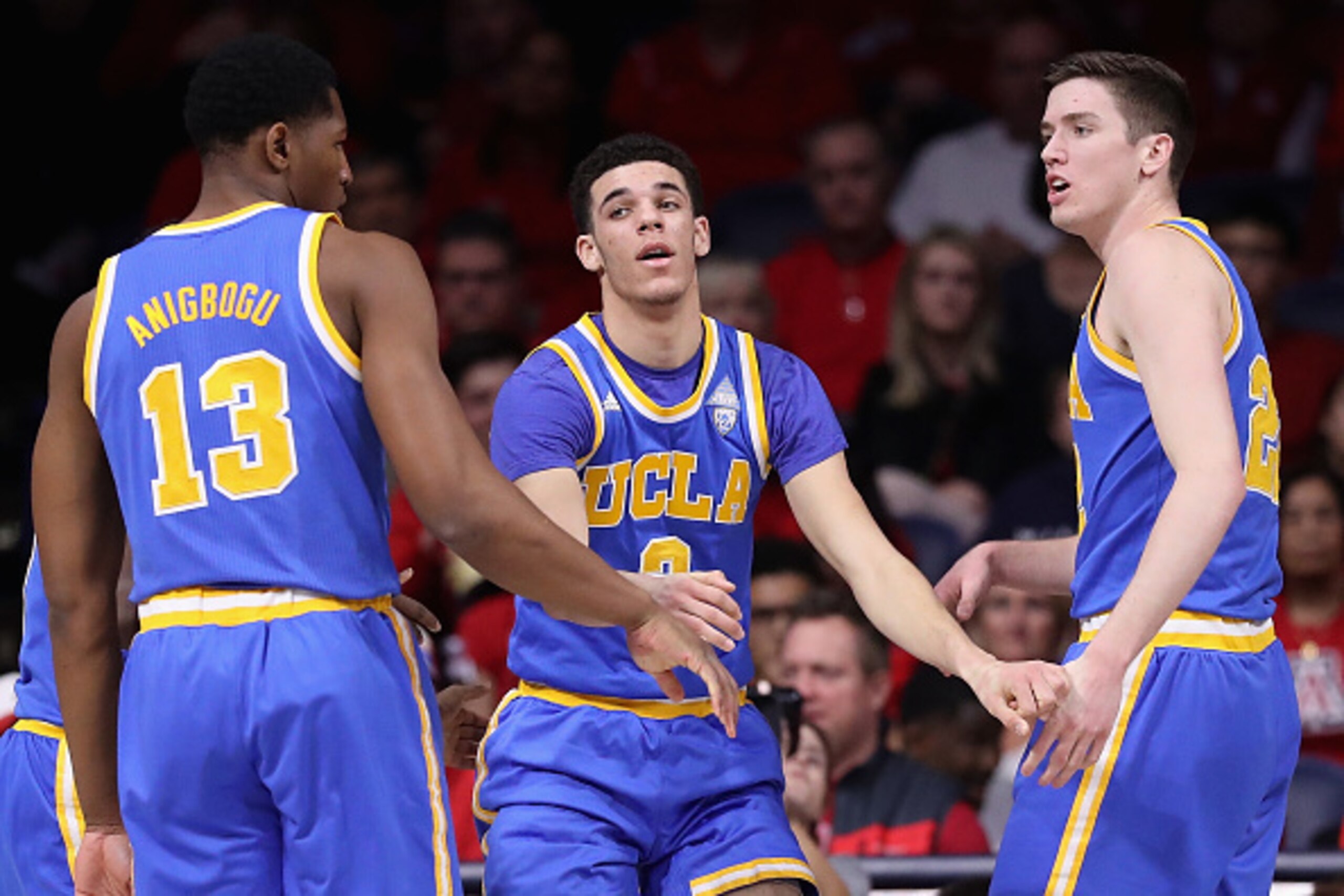
It wasn't until this year, though, that Alford struck gold with a local three-man class that was gifted in all the ways UCLA needed it to be. Leaf, from El Cajon, could run the floor and score all over it. Anigbogu, from Corona, gave the Bruins muscle up front on both ends.
Tying it all together, like the rug in The Dude's Venice apartment, was Ball. The 6'6" point guard from Chino Hills jumped at the opportunity to pilot Alford's program with fleet feet, fancy passes and a will to win.
"That's the reason I came," Ball said. "Coach Alford said, 'Run the offense for me,' so we have a good team to do it."
Nearly two years ago, the NCAA lopped five seconds off what had been a 35-second shot clock. By then, the Bruins were already practicing with a 24-second timer like the pros.
"We don't use the shot clock a whole lot," Bryce Alford quipped.
| 0-10 seconds after rebound | 19.8% | 3rd | 54.7% | 152nd |
| 11-30 seconds after rebound | 19.2% | 299th | 60.6% | 1st |
| 0-10 seconds after opponent score | 6.4% | 82nd | 61.6% | 27th |
| 11-30 seconds after opponent score | 36.2% | 307th | 55.3% | 13th |
| 0-10 seconds after steal | 7.3% | 91st | 74.8% | 12th |
| 11-30 seconds after steal | 1.4% | 343rd | 70.4% | 2nd |
As many points as these Bruins can pile up in the blink of an eye, with ball movement to please Wooden's ghost and outside shooting to suit the new school, they won't go far in March unless their defense catches up to their offense.
"We know we can score with all the teams in the country," Holiday said, "so it's really just [about] being tough on the defensive end."
Most season-long stats peg UCLA as a subpar squad on that side. But recent results paint a portrait of steady improvement.
The Bruins finished February a perfect 7-0, without giving up 80 points or more in a game or losing the rebounding battle. Along the way, they avenged all three of their defeats to Oregon, Arizona and USC. They started off March strong with sound wins over the Washington schools—holding the Huskies and Cougars under 70 points apiece—before eking out a second win over the Trojans in the Pac-12 tournament and stumbling against the Wildcats in the conference semifinals.
"February sets up March," Alford stressed, to his players and reporters, time and time again. And better defense will set up UCLA's offense to explode in transition, where the team has thrived.
| Transition | 33.5% | 9th | 29.4% | 8th | 60.4% | 42nd |
As Ball—not father LaVar, but eldest son-turned-All-American Lonzo—predicted at a practice in early January, "Once we all lock in, play for one another on the defensive end the way we play for one another on offense, we'll be a scary team."
And maybe, just maybe, one worthy of Wooden's legacy.
All quotes obtained firsthand unless otherwise noted. All stats courtesy of KenPom.com, Hoop-Math.com, Sports-Reference.com and ESPN.com unless otherwise noted.
Josh Martin covers the NBA for Bleacher Report. Follow him on Twitter, Instagram and Facebook, and listen to his Hollywood Hoops podcast with B/R Lakers lead writer Eric Pincus.



.jpg?w=2560 "Rodgers Iced Out on Plane 💎")

.jpg?w=2560 "🚨 Week 8 AP Top 25 Poll")