

Midseason Player Grades for Each Houston Rockets Player
Houston Rockets fans are about to get that feeling proud parents have when their kid brings home a better report card than they could have possibly expected.
That’s because they are a better team than anyone expected.
As I noted for FanRag Sports: "NumberFire had the Rockets winning 40.4 games. FiveThirtyEight.com had them at 45. ESPN’s Mark Stein had them going 41-41. The larger ESPN panel had them doing a bit better at 45. CBS’s experts had them winning 43, with James Herbert going with 47. Bleacher Report’s Adam Fromal said 38. The range for wins ran from 38 to 47, with around 42 being the average."
They are 31-10 at the halfway point of the season
Chicago was expected to contend for a bottom-tier playoff spot. Instead, it is emerging as a legitimate challenger for the title.
That doesn’t happen without magnificent player contributions. I’m inclined to give every player an A, but there are still a few warts that need to be removed. Still, if the scoring seems a tad positive in parts, it’s because it’s hard to find much negative, particularly with the rotation players.
I ranked the Rockets by Basketball-Reference.com’s win shares because their contributions seemed apt—what with them doing so much of winning. The basis for the grades is performance vs. preseason expectations and roles.
Deep Reserves
1 of 7
15. Bobby Brown, PG
Bobby Brown is on the team because he’s James Harden’s friend. Even he knows it, as he told Calvin Watkins of ESPN.com:
"He (Harden) has trust in me as far as my game, he knows the type of person I am. I’m a team guy. It’s just our overall camaraderie together -- me, him and Trevor [Ariza]. We’re all like best friends because we’re all from L.A. We know how to take care of each other, take criticism from each other, tell them what they don’t want to hear, and they can live with it. It means a lot coming from the best point guard/2-guard in the league.”
"
The 32-year-old Brown has played 29 minutes and scored five points. Apart from his relationship to Harden and Ariza, he has demonstrated no tangible on-court value.
Grade: Incomplete
14. Tyler Ennis, PG
The Rockets traded Michael Beasley for Ennis in search of point guard depth on Sept. 22. He has not panned out well, and coach Mike D’Antoni has virtually dropped him from the rotation. Ennis has only played 56 minutes since Patrick Beverley made his season debut on Nov. 17, with his only extended playing time (18 minutes) coming in a blowout over the Dallas Mavericks Dec. 27.
There is a good reason he’s out of the rotation. Even his per-36-minute numbers are weak (10.9 points, 5.8 assists and 3.4 rebounds). His efficiency (39.3 field-goal percentage, 43.8 effective-field-goal percentage and 44.5 percent true shooting percentage) aren’t any better.
Grade: D-
13. Kyle Wiltjer, PF
The Rockets’ history is to utilize their D-League franchise, the Rio Grande Valley Vipers, to develop first-year players. Kyle Wiltjer, one of two rookies on the roster, has been no exception.
The undrafted 24-year-old power forward out of Gonzaga has played 29 NBA minutes, scoring 10 points and grabbing seven boards, but he’s spent most of his time with the Vipers. He’s averaging 19.7 points, 6.5 rebounds and 1.7 assists through 10 games there.
In the most Rocket-relevant stat, he’s shooting 38.7 percent on an insane 9.3 three-point attempts per game. That will put some stretch in your 4!
Grade: B
12. Chinanu Onuaku, C
Chinanu Onuaku, the Rockets’ first-round pick this season, has also spent the majority of his time in Rio Grande Valley. However, he has ridden Houston’s bench when starting center Clint Capela has been injured.
Onuaku has totaled 10 minutes, six points and three rebounds for the mothership. For the Vipers, he’s notching averages of 11.8 points. 10.5 boards and 1.4 blocks in 27.5 minutes per game. His 2.0 Defensive Box Plus-Minus bodes well.
Grade: B
11. K.J. McDaniels, SG
The Rockets traded for K.J. McDaniels in 2015, sending Isaiah Canaan and a 2015 second-round pick in exchange. They gave him a three-year, $10 million contract the following summer.
And they have barely played him.
McDaniels has logged a total of 455 minutes in the nearly two years since Houtson traded for him. He is an electric playmaker, stout defender and awful shooter (40.0 percent field-goal percentage, 28.6 three-point percentage). Apparently, the latter is what matters most.
It looked as if he could crack the rotation during the preseason, but he has fallen almost completely out of it as of late. He has six healthy “DNPs” in his last seven games and only 44 minutes since Beverley’s debut. When he has played, his 8.2 player efficiency rating (PER) is a career low.
It is up to the player to earn playing time; McDaniels is clearly not proving what he needs to in practice, and that's for multiple Rockets coaches now.
Grade: D+
Bench Rotation
2 of 7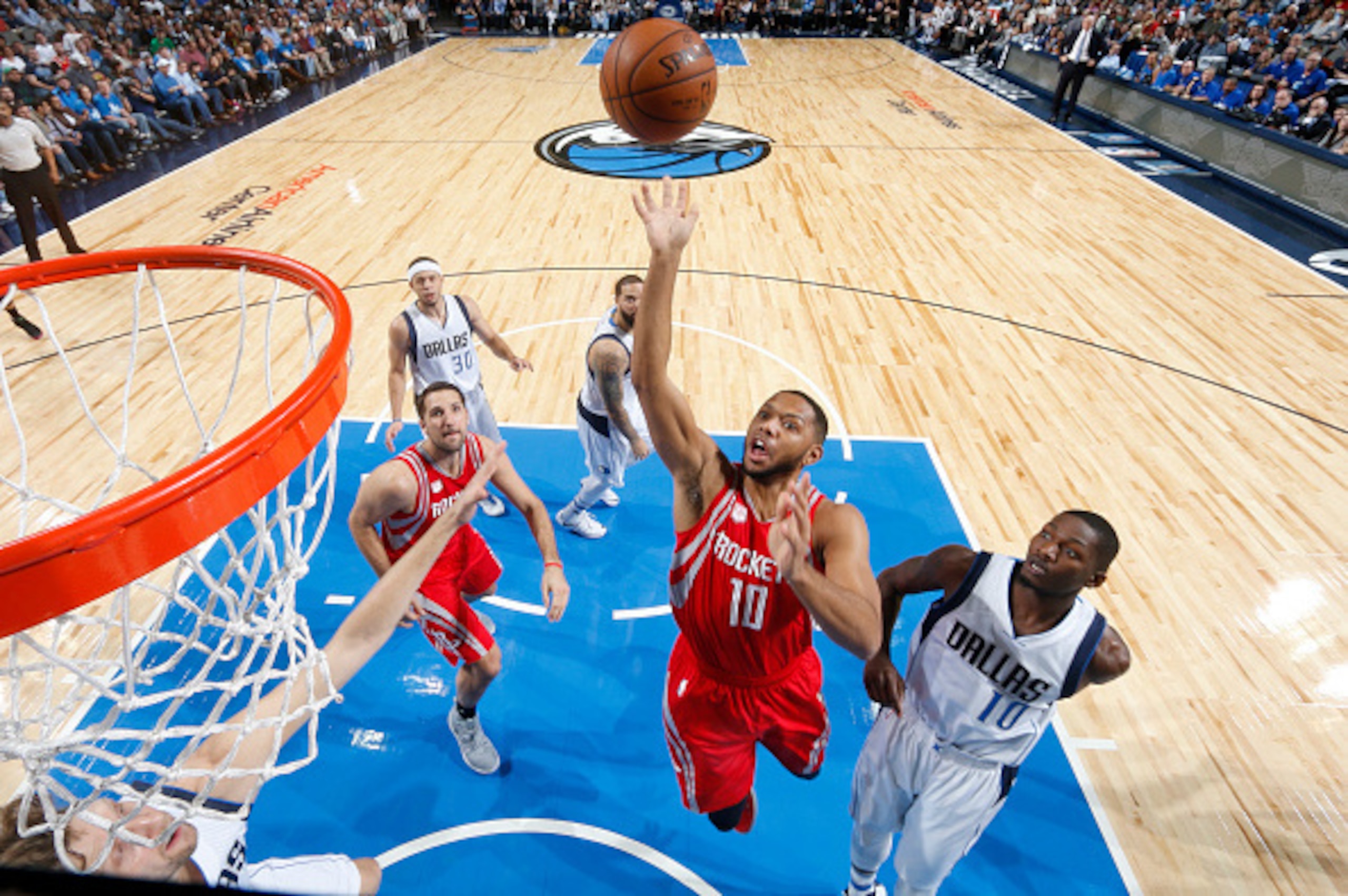
10. Corey Brewer, SG/SF
Corey Brewer still occasionally has flashes of competence, but even that is being gracious. He is in decline, and this is a guy whose apex was “contributing role player.” His 8.1 PER is a career low.
He’ll still give you the occasional transition bucket or smart cut to the rim, but his lack of range (23.1 percent from deep) and waning defense (30th percentile according to Synergy Sports Technology) don’t offset the few contributions he makes.
Grade: C-
9. Nene, C
Houston knew what it was getting when it inked Nene to a $2.9 million contract this summer: low-post scoring and very little rim protection. That’s exactly what he's given, averaging 1.297 points around the basket (not post ups), good for 82nd percentile and 69.4 percent of his offense.
However, when he’s the closest defender on the play, opponents are shooting 10.7 percentage points better than their season averages, according to NBA.com. Wings and guards dunk on him with aplomb as he’s too slow-footed to cover them.
Grade: C
8. Sam Dekker, SF/PF
The Rockets’ player development is something people need to talk about more often, because they do it extremely well. Case in point: Sam Dekker.
Dekker had a difficult first year, overcoming a painful injury. But he's been all over the place since then—in a good way—as he told FanRag’s David Ramil:
"The energy I bring can be contagious. I come in, try and run the floor, get stops, makes some scrappy plays. When you have guys on your team like James [Harden] and Eric [Gordon] that can get hot at any moment, they don’t need me to particularly put up a lot of shots. With the way I play, those points will come, open shots will come, it’s just a matter of me knocking them down and being ready. They want me to play good defense, bring energy and be a spark for us and I think I’ve done a pretty good job of that.
"
Dekker is averaging 6.6 points and 4.4 rebounds per game. He has a solid (for a player with his experience) 55.4 true shooting percentage. His PER is a palatable 14.1, and he's a rapidly developing role player who had to overcome a significant injury his rookie season.
Grade: B+
7. Montrezl Harrell, PF/C
Exhibit B of the Rockets’ player development is Montrezl Harrell, who has used Capela’s injury to show his incredible value. Since the starting center went down with a broken fibula on Dec. 17, Harrell has blossomed, averaging 13.6 points and 4.4 boards in 25.8 minutes.
His efficiency has been superb: He is now only 19 makes shy of qualifying for the official leaderboard in field-goal percentage. Once on it, his 66.2 percent will put him second, only 0.7 percent behind league-leader DeAndre Jordan.
His strength in finishing through contact is a huge plus. He has 25 and-1s according to NBAMiner.com, good for 11th in the NBA. The incredible thing about that is—when you factor in his high field-goal percentage—12.1 percent of his attempts result in and-1 opportunities. By comparison, league leader DeMarcus Cousins makes the bucket and draws the foul on just 5.1 percent of his shots.
Harrell is a 6’8” power forward playing center, so that gives you an idea of his strength.
Grade: A
6. Eric Gordon, SG
Raise your hand if you thought Eric Gordon (3.7 threes per game) would be challenging Stephen Curry (3.8) for the league lead in three-pointers per game?
In fact, Gordon's 145 long-range are already his career high for a season. And he’s shooting 41.1 percent.
He has been the perfect complement to Harden, knocking down 41 percent of his threes when the next MVP (yeah, I went there, but more on that later) passes him the ball.
He’s also the primary scorer when Harden sits. NBAWowy.com shows that when Harden is on the bench, Gordon has scored 321 points in 400 minutes (28.9 per 36 minutes). His usage percentage is 33.6, and his true shooting percentage is 60.4. As a result, the Rockets’ net rating is plus-7.2 when Harden sits and Gordon plays. This is monumental for a team that collapsed in recent years when Harden sat.
Gordon should be the runaway favorite for Sixth Man of the Year and has exceeded the wildest expectations.
Grade: A
5. Clint Capela, C
3 of 7
Capela is technically fifth in the order here because he has the fewest total win shares, mostly due to the fibula fracture the has sidelined him the last 13 games.
Don’t let that distract from his value.
The Rockets’ starting five is essentially James Harden surrounded by four perfectly suited pieces, each with his own role. There is Harden, and there are essentially five players (including Gordon) tied for second.
Capela has emerged in the starting center role this year, answering concerns over how much defense Houston lost with Dwight Howard’s departure. Capela has done so by ranking in the 83rd percentile in points per play against compared with Howard’s 84th percentile last year.
Capela’s agility combined with quick hands and feet make him an outstanding rim protector (opponents are minus-6.5 percentage points around the rim) and able against the perimeter (62nd percentile versus the ball-handler as a big on the pick-and-roll).
He isn’t a “go-to” scorer, but he’s dependable in the right situations, shooting 64.0 percent on the season with most of his buckets (130 out of 151) coming at the cylinder. He has reliable hands and tends to catch everything tossed in his direction when he’s in the air. His 44 completed alley-oops are a testament to that.
Grade: B+

4. Patrick Beverley, PG
4 of 7
Patrick Beverley has gradually carved out an entirely new field at the point guard position—a kind of three-and-D 1, who can play off a primary shot creator who is something other than the “point guard.”
The Milwaukee Bucks signed Matthew Dellavedova to do just that with Giannis Antetokounmpo. The Chicago Bulls would love to have someone like that to play next to Jimmy Butler. The Cleveland Cavaliers have essentially that (minus the defense but with a little more playmaking) in Kyrie Irving.
Having Beverley lets Harden—the best creator and decision-maker the Rockets have (and arguably in the NBA)—work his magic. You simply cannot say enough about this value, which exceeds his 9.0 points and 4.4 assists per game (though the 6.2 rebounds for a player 6’1” or shorter is second-best in the three-point era.)
Beverley's tenacious defense, three-point shooting (40.0 percent), ubiquitous rebounding presence and pinpoint passing as a secondary ball-handler are all understated by his traditional box-score stats. His 2.23 Real Plus-Minus at ESPN.com does him justice, however, ranking ninth out of the league’s 85 point guards.
The Rockets are also 22-5 in games he’s played and 9-5 during games he’s missed.
Grade: A
3. Ryan Anderson, PF
5 of 7
The buzz on Ryan Anderson coming into the season (and over his entire career) was the man can shoot, but he can’t play defense. It was understandable if you were concerned about both he and Harden in the same starting lineup.
That hasn’t been the case.
On Dec. 23, the Rockets played the Memphis Grizzlies and tried using Anderson defending the 5. Jonathan Feigen of the Houston Chronicle reported:
"The Rockets did send double-team help in the low blocks, but for most of the game, Anderson defended Gasol alone, holding him to 5 of 14 shooting and 16 points.
"I thought it was great," Rockets coach Mike D'Antoni said of Anderson's defense. "He battled as hard as you can battle on both ends of the floor. He was excellent."
"
That’s not to say Anderson doesn’t have defensive issues, but he’s not as great a liability as some expected. His 0.92 points per possession against ranks in the 44th percentile.
More importantly, his scoring range stretches the court like super-elastic Silly Putty, particularly in combination with Gordon. Curry (65), Gordon (57) and Anderson (41) are the top three in shots made from 26-plus feet. Forcing defenders to come out that far is a big part of why the Houston offense is so hard to stop.
The Rockets’ offensive rating is 114.0 and their net rating is 12.0 in the 553 minutes Anderson, Gordon and Harden have been on the court.
Grade: B
2. Trevor Ariza, SF
6 of 7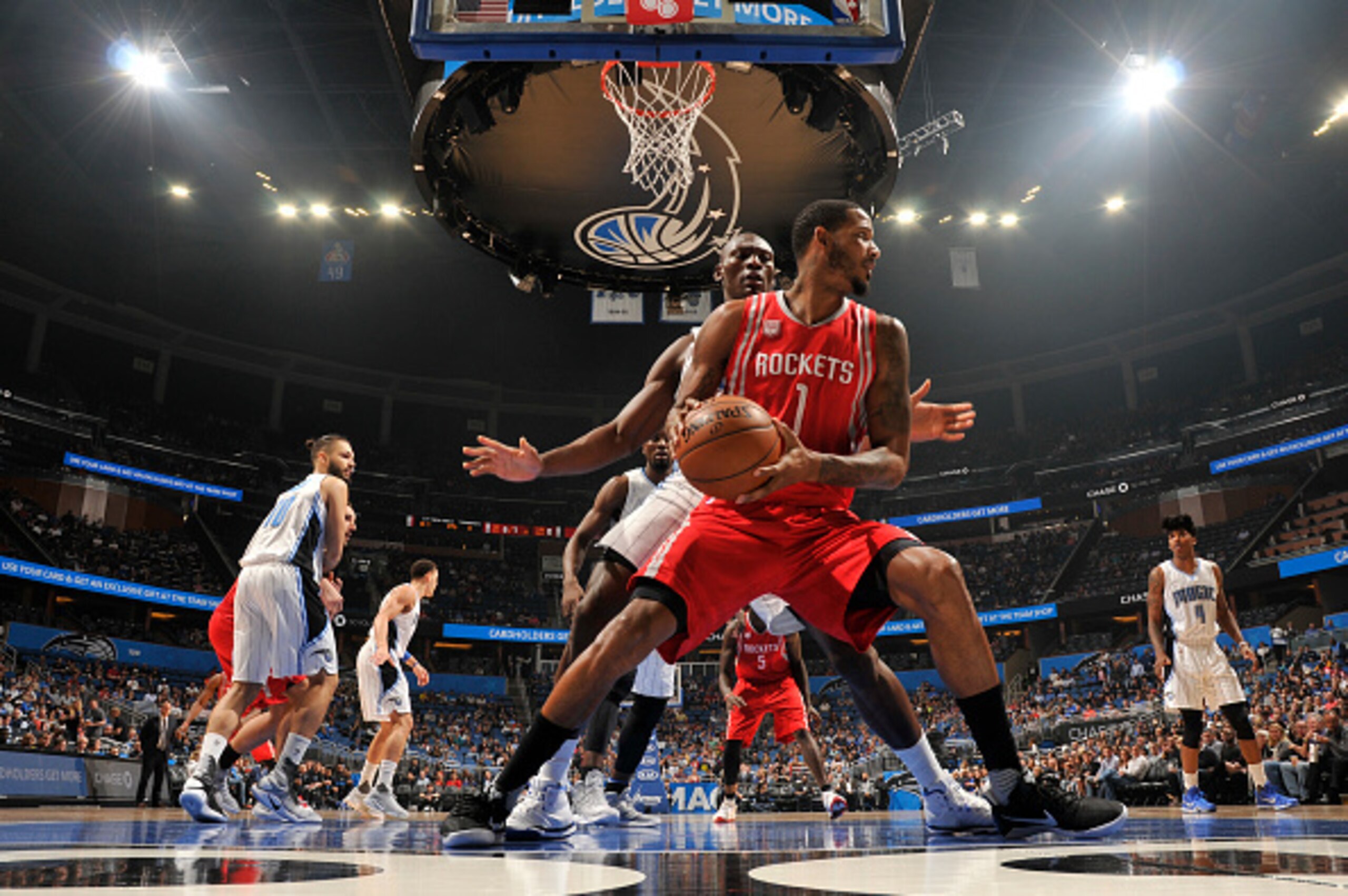
Ariza’s nickname has become “A-Threesa” in Houston, but it should be Mr. Reliable. He’s missed just one game during his Clutch City tenure, and only Mason Plumlee (Portland Trail Blazers, Brooklyn Nets) has a better attendance record since the start of the 2014-15 season.
Ariza is the team's best wing defender and an offensive presence. He has a plus-2.23 ORPM, a plus-1.84 DRPM; his 4.07 RPM is sixth-best among small forwards. He’s especially contributed to the Rockets’ record-shredding three-point rate, making 113 of 297 attempts—compare with Klay Thompson, 113-of-295 through Jan 11.
He earns the second spot in theses rankings because his 3.1 win shares are second on the team. And his endurance, defense and reliability are conveyed in those win shares.
Ariza's role is glue, and right now he might be the best glue guy in the league. He told Bleacher Report's Maurice Bobb as much on New Year's Eve: "Whatever is needed or whatever we lack, I try to be, whatever that may be. I just try to make plays when needed and pick up the loose ends."
D'Antoni agreed:
""He does everything," D'Antoni said. "He's just got a great game for us in the sense that he hits threes, he's smart defensively, he's all over the place, he's one of the best in steals. There's just so many areas. He can play forward, he can play 3, he can guard 1s, he can guard 2s.
"
Grade: B+
1. James Harden, PG
7 of 7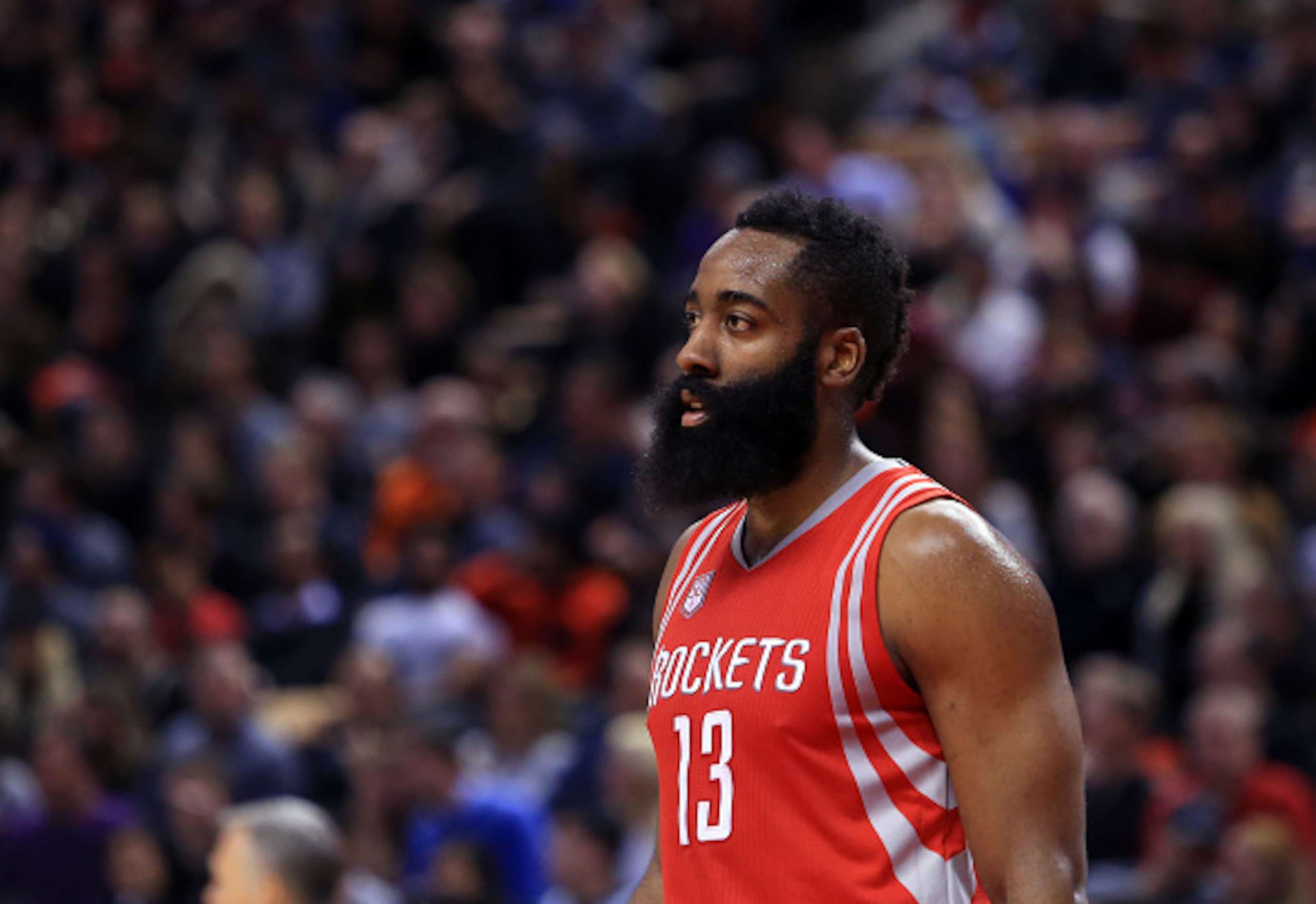
James Harden is gaining separation as the front-runner for MVP. He is first in Sekou Smith’s rankings at NBA.com, AJ Neuharth-Keusch’s at USA Today, Tom Ziller’s at SB Nation and my own at BBall Breakdown.
The same basic underlying logic is consistent in all of those: Harden’s efficiency is what puts him over the top. He has 1,174 points, and that’s come on 937 true shooting attempts (including field goals and free throws) according to NBAWowy.com, .
The NBA’s tracking data shows his passing has created 1,176 points on 914 attempts (potential assists). Not including his 40 free-throw assists (as we don’t know the precise number of points scored or free throws attempted), that means the Rockets' true shooting percentage on Harden’s shots or potential assists is a combined 63.4 percent.
It helps that he is in a better system now that D’Antoni is coaching. But Carmelo Anthony and Kobe Bryant were also isolation-prone players who ran that same system and failed miserably.
Harden doesn’t fight it; he works it.
That’s why he may even be running it better than Steve Nash did.
I have become increasingly enamored with the concept of "fungible stats." By that I mean some stats are going to be gotten, regardless of who is on the court. A team has to use possessions, so someone has to take shots, get rebounds, pass the ball, etc. A good chunk of those stats is fungible.
Not all stats are fungible, though, and great players create opportunities out of voids; they generate points out of broken plays. They turn average players into good players and good players into elite players by generating opportunities for their teammates that no one else could.
LeBron James has done that his entire career. So has Chris Paul. Now we’re seeing James Harden do it in Houston.
Maybe it’s Harden nutmegging a defender with a bounce pass so perfect that the receiver barely has to touch the ball to guide it into the rim. Or maybe it's him leading a mate with the subtlest eye glance for an alley-oop. There's also snatching a board and hitting a cherry-picker with a perfect outlet pass in stride for an easy layup, or dipping into his bottomless bag of tricks to draw a foul behind the arc, even when the defender knows that’s what’s happening,
Harden turns empty possessions into points that otherwise would have come up empty.
The “un-fungibility” of his greatness is impossible to measure, but it’s possible to see—and it really is his best argument for being MVP.
Grade: A+
.jpg?w=2560 "49ers LB Suspended for Headbutt")
.jpg?w=2560 "Buzz: MHJ Hired Agents for Trade")
.jpg?w=2560 "AD Trolls Bears WR on IG 😂")
.jpg?w=2560 "Report: Steelers WR to Miss 'Weeks'")