

3 Players Who Still Have to Step Up for the Cleveland Cavaliers
With just a pair of losses in their first 11 games, there hasn't been much to complain about for the Cleveland Cavaliers. The Big Three are living up to their mantra, Channing Frye has been an absolute sniper off the bench and Iman Shumpert is enjoying a bounce-back season as well.
Even the team's most recent drop—a 103-93 loss Wednesday night to the Indiana Pacers—came with the asterisk that both LeBron James and J.R. Smith were merely witnesses, as they sat that one out.
Playing relatively relaxed and confident in the early going, some players have stumbled out of the gate, however. For Cleveland to reach its maximum potential, the following three need to regain, or simply step up, their respective games.
TOP NEWS

Pic of LeBron's Helicopter Commute 🚁
Jokić Pops Out at CU Game 🦬

NBA Power Rankings Entering Preseason 🔢
No. 3: Jordan McRae, SG

Jordan McRae entered 2016-17 bubbling with potential. The 25-year-old swingman added 10 pounds of muscle over an offseason where he led the Cavs' summer-league team with 24.3 points per game.
Throughout the preseason, head coach Tyronn Lue kept feeding McRae minutes in the hopes he could develop into a backup point guard to help offset the losses of Mo Williams (retirement) and Matthew Dellavedova (free agency).
McRae ended up leading the Cavs in preseason scoring with 14 points a night.
Fast-forward three weeks, and McRae now finds himself regularly riding the pine, unable to break into Lue's veteran rotation. Even without a true backup point guard, Lue has gone with Shumpert and his questionable ball-handling skills in relief to Kyrie Irving.
In 9.3 minutes per game over six contests, McRae is averaging just 2.2 points on 23.8 percent shooting from the field, dead last on the Cavaliers. Scoring was supposed to be the calling card for this former NBA D-League standout, as he doesn't offer much in terms of passing or rebounding. Even per 36 minutes of play, McRae is posting just 8.4 points, 1.9 rebounds, 1.9 assists, 0.6 steals and 0.6 blocks.
Now, no one expected him to steal minutes from any of Cleveland's regular backcourt members, but even with Smith missing the past three games with a sore right ankle, McRae has failed to make an impression. This is bad news for Cleveland's front office, which was shopping McRae and the contract of Williams for backup point guard help shortly before the start of the regular season, per Joe Vardon of Cleveland.com.
With Smith missing time and the reserve floor general position wide-open, now may be McRae's best chance to make an impression with the team, if it's not too late.
No. 2: J.R. Smith, SG

This has nothing to do with Smith's ankle issue that's caused him to miss three of Cleveland's 11 games, but rather his uninspiring play before that.
That's not to say Smith has been bad (he hasn't). On most nights, he's the Cavaliers' best perimeter defender and continues to grow on that end.
Offensively, however, he's still searching for a consistent stroke, perhaps hobbled by missed training camp and preseason time. Smith was absent from all organized team activities before agreeing to a new four-year, $57 million contract on Oct. 14.
Cleveland's best returning outside threat at 40.0 percent from deep a year ago, Smith's three-point shooting has dipped to 36.4 percent—just sixth on the team. He's hitting on 21.4 percent of his two-pointers, down from 43.8 percent last season.
This shooting plunge has resulted in a scoring drop as well. While his 12.4 points per game were the best of any non-Big Three member a year ago, Smith's 10.5 now ranks behind Frye's 12.2.
A large part of Smith's success at this stage of his career is predicated not just on the three-ball, but catch-and-shooting in particular. Last year, he shot 42.9 percent on those opportunities, good for 12th overall in the NBA (minimum three attempts). This year, he's down to 39.7 percent on such shots, a fall to 31st in the league.
Now, Smith has been a notoriously slow starter throughout his 13-year career. Before the All-Star break, he's averaged 12.3 points on 36.6 percent shooting from three. After? His career numbers jump to 14.5 points on 38.7 percent.
It's certainly no time to panic on Smith. Not yet.
No. 1: Mike Dunleavy, SF
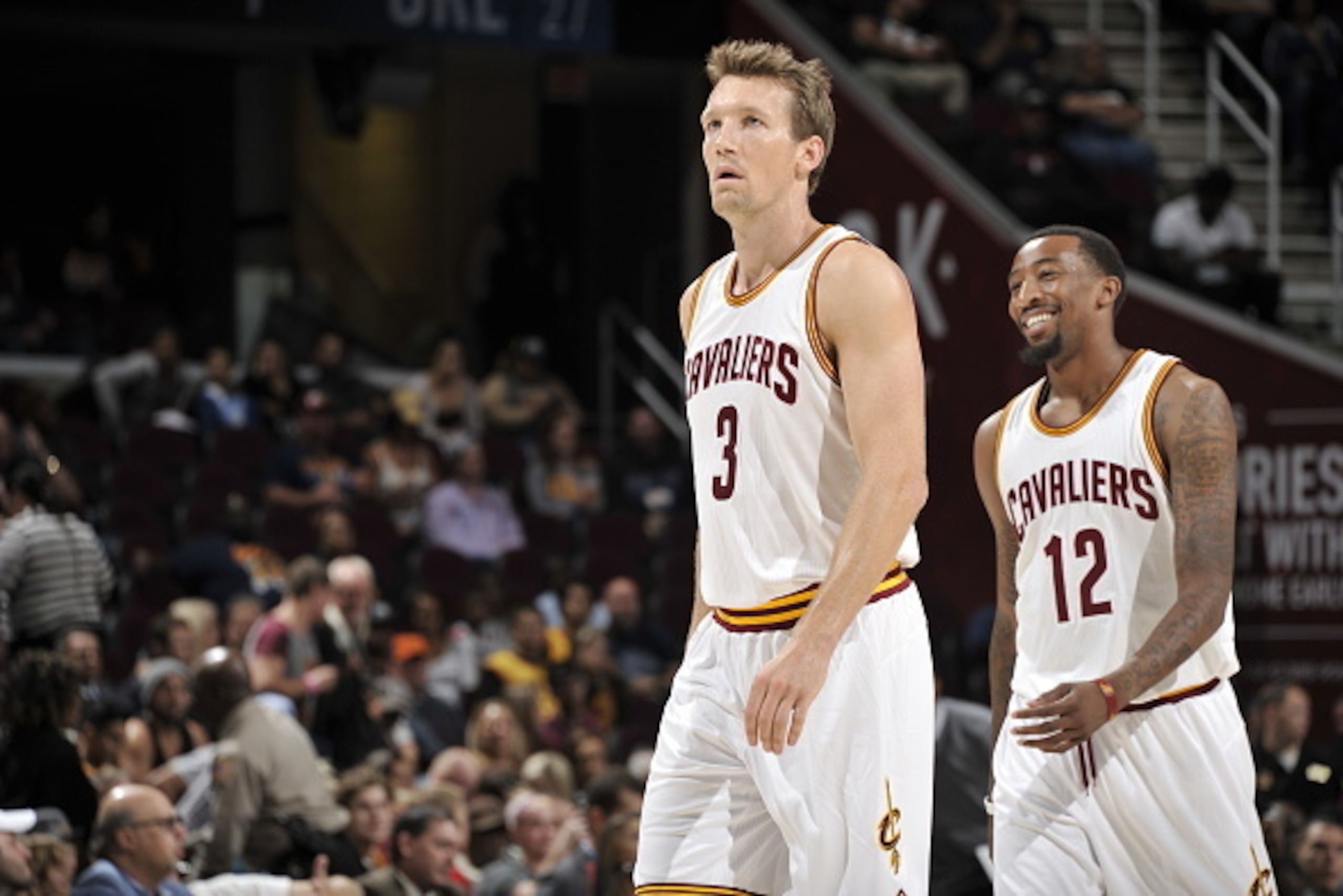
The Cavaliers' biggest offseason acquisition, Dunleavy has yet to fully diffuse his talents into the team. Now 36, he's averaging career lows in points (4.2), field-goal percentage (34.1 percent) and three-point shooting (28.6 percent) in 16.5 minutes off the bench.
Despite the early struggles, Lue is committed to his 15-year veteran.
"He’s a great shooter and always has been over his career," Lue said. "He’s missed some shots, and you know, you come from playing 32, 34 minutes a game and being a starter, and now you’re coming off the bench where you’re playing 16 minutes a game. It’s tough to find your rhythm. We know he’s a great shooter. When he’s open, we want him to take those open shots. We’re going to continue to play him and get him into a good rhythm."
At this point in his career, Dunleavy is little more than a floor-spacer. If his shots aren't falling, his value to the team takes a drastic hit. Age has to be a concern too, although he hasn't shown any big-picture signs of slowing down. From 2012 to 2016, Dunleavy connected on 40.3 percent of his three-pointers, well above his career mark of 37.5 percent.
As Lue mentioned, this is a major shift in role for Dunleavy, going from a starting spot to sporadic minutes off the bench. The adjustment will take time, although receiving pinpoint passes over and over again from James should help ease the transition.
Greg Swartz is the Cleveland Cavaliers Lead Writer for Bleacher Report. Follow him on Twitter @CavsGregBR.
Stats via Basketball-Reference.com and NBA.com and are accurate as of Wednesday. All quotes obtained firsthand unless otherwise noted.

.jpg?w=2560 "OBJ Calls Out Giants After Release")

.jpg?w=2560 "Rap: Lions, LaPorta End Contract Talks")

.jpg?w=2560 "Report: Baker May Miss Up to 6 Weeks")