

Unpicking Bayern Munich's Problems at the Back That Could Cost Them Dear
"We defend as a team" is what you hear from most footballers these days. If that is true, then everyone from Robert Lewandowski down to Manuel Neuer in the Bayern Munich squad needs to be looking at what they are doing wrong.
TSG Hoffenheim's goal in Saturday's 1-1 draw at the Allianz Arena cost Bayern two points, but it also meant Carlo Ancelotti's men have conceded at least once in eight of their last nine competitive outings.
Admittedly, there is no need to push the panic button given the reigning Bundesliga champions have let in just six goals in 10 Bundesliga games this season, the best defensive record in the German top flight. Borussia Dortmund, by contrast, have shipped 12.
TOP NEWS

Sullivan, Hall Lead USMNT to Big Win 💥
Int'l Break Goals and Highlights 🔥
.jpg?w=2560 "Titans Giants Football")
OBJ Calls Out Giants After Release
Still, for Neuer to have to pick the ball out of his net with that frequency does set some alarm bells ringing when you consider the stratospheric ambitions Bayern harbour.
At the same stage last season, Pep Guardiola's side had conceded just four goals (and scored 33, nine more than this term). The season before that, three. To be fair to Ancelotti, in his first season, Guardiola's goals-for/against record read 22:6 after 10 games, but the Manchester City manager had two points more than his successor.
What is going wrong?
There may not have been a huge influx of players during the last transfer window, but the arrival of Mats Hummels from Dortmund was nonetheless significant.
Hummels started his career at Bayern and also plays alongside Jerome Boateng and Manuel Neuer for Germany, which can only be a good thing in terms of settling into not only the club but also a back four that is expected to provide the most solid of platforms for a push on three fronts.

But the constant chopping and changing of the back line has not helped the new arrival and consequently Bayern's solidity. Much has been made of the Traum Abwehr (Dream Defence) with Hummels and Boateng at the heart of it.
"Hummels and Boateng complement each other very well," FIFA World Cup winner and former Germany international centre-back Jurgen Kohler told Kicker.
Indeed, Boateng seems even to have adopted some of the silkier aspects of his partner's game in recent months, but the draw with Hoffenheim was only the second game they have started together in the Bundesliga. Consequently, Bayern have not had much benefit from their previous experience, leaving Hummels to adapt to other players' styles.
That period of adaptation cost Bayern two points in early October, when Cologne's equaliser in the 1-1 draw was scored by an Anthony Modeste who, though in form, was helped out when Hummels and Javi Martinez allowed him to squeeze his big frame between them.
No doubt, given time, Hummels and Boateng will flourish as a duo at club level, which will—ominously for the rest of the world—also benefit Germany.
"It's not as if we've been playing together since only yesterday, but I think it will get better and better," Boateng pointed out to the DFB's official website. "It is of course different when you only see each other in the national team from time to time."
There is one caveat, however: Can Boateng keep fit?
Hummels has another facet of play to get used to. The way Xabi Alonso, Thiago Alcantara and Arturo Vidal show for the ball when Hummels wants to play it out from the back will no doubt differ from the way Julian Weigl, Ilkay Gundogan and Co. did for Dortmund. As it is a key part of Hummels' and Bayern's game to start their attacks from the back, that connection will understandably take time to build too.
Taking a wider view of the defence, Ancelotti has only been able to field what many would describe as his first-choice back four—Lahm, Hummels, Boateng and David Alaba—once from kick-off in the Bundesliga this season. Ironically, that was in the collective nosedive against Eintracht Frankfurt, a game that ended in a 2-2 draw and provoked the ire of Karl-Heinz Rummenigge, the Bayern CEO, over the team's attitude.
Injuries, notably to Boateng, the advancing years of Lahm and the strain of playing every three days—the Hoffenheim match was Bayern's 18th this season—mean turnover is inevitable. Saturday's game was their 10th in the German top flight season and was notable for a 10th different starting lineup. That is no different to the way Guardiola handled Bayern's squad during his three-year tenure, but it does not lend itself to stability and therefore solidity.
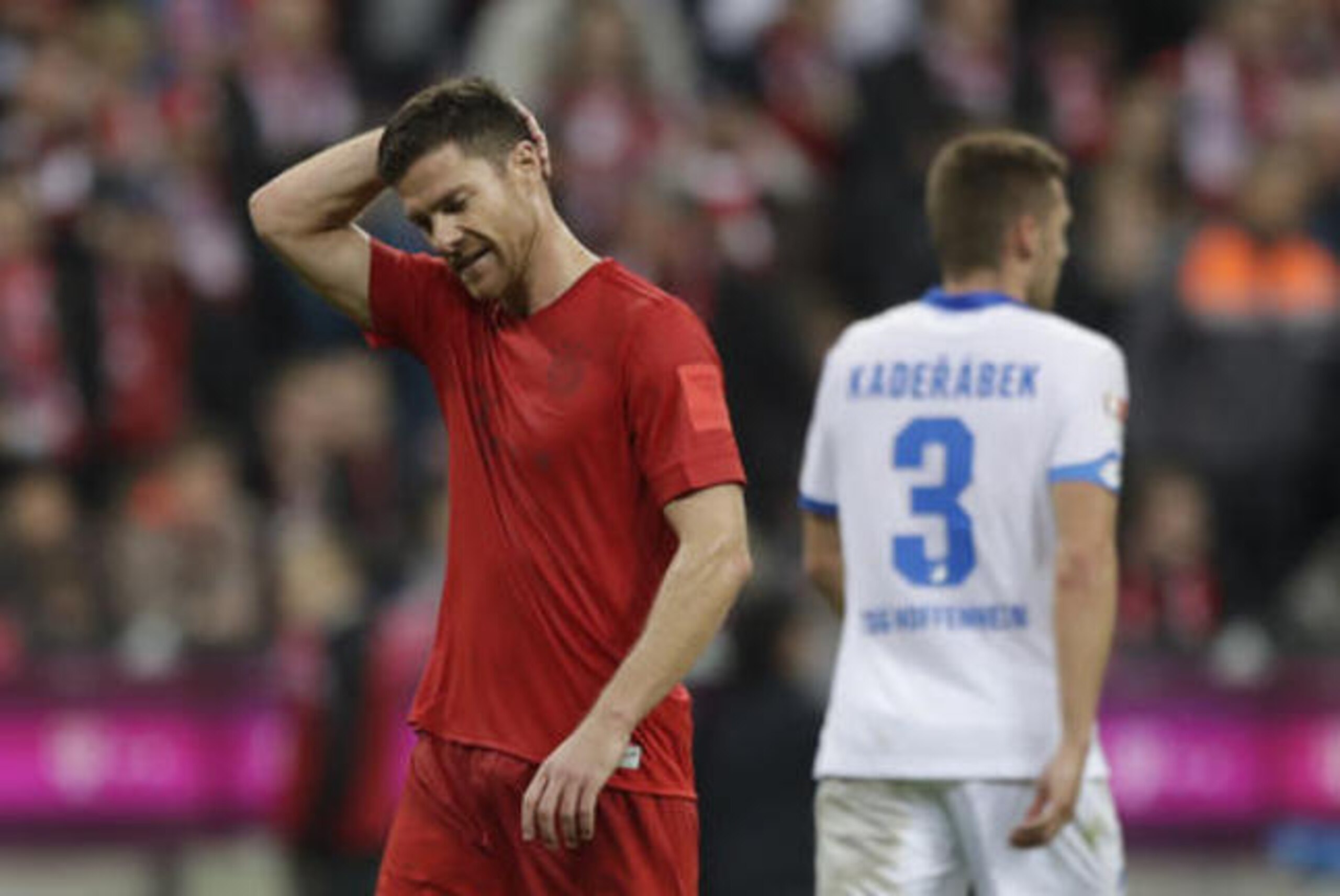
The key problem, however, remains Ancelotti's formation and choice of midfield. In Guardiola's 4-2-3-1 or 4-1-4-1, the defence always had a man in front of them tasked primarily with protection. With the newly installed 4-3-3, that is not the case. Alonso, the deepest lying of the midfield three, not only has to defend but also provide support through the middle of the pitch going forward. That means he has to push up, often into the final third.
That has left Bayern open to counter-attacks and the defenders to fend for themselves. Indeed, with Ancelotti's system requiring the full-backs to provide width going forward, it has often meant just three or even two defenders are in position to do their jobs when Bayern lose the ball.
Dario Lezcano's goal for FC Ingolstadt in Bayern's 3-1 win came on the counter-attack. PSV Eindhoven's sublime goal from Luciano Narsingh in their 4-1 UEFA Champions League loss was a counter-attack par excellence. Yes, they were goals scored in losing efforts, but better teams would not have found themselves so far behind.
Sandro Wagner was a handful of centimetres away from turning in a cross after a Hoffenheim counter-attack in the dying minutes of Saturday's game that would have given Julian Nagelsmann's men a famous win.
More than just the tactics, though, there is also something too passive about Bayern's defending. Once again, the midfield is largely to blame.
Where were they when Kerem Demirbay swept in a magnificent shot from just outside the box for Hoffenheim? It was a magnificent, defence-splitting ball from Kevin Vogt that really made the opportunity, but one member of the midfield should have been tracking Demirbay's run.
They were also caught spectating when FC Augsburg struck in their 3-1 defeat to the Bundesliga champions in late October—that goal saw three Bayern players up against three opponents inside their own penalty area with a number of Bayern men watching on.
Better teams than those Bayern will face in the Bundesliga will have taken note.

.jpg?w=2560 "Rap: Lions, LaPorta End Contract Talks")

.jpg?w=2560 "Report: Baker May Miss Up to 6 Weeks")
