8 Times Sports Were a Beautiful Distraction from Life
Despite the emotional connections fans make with their favorite teams, sports is really about entertainment, except for those rare times when the games and events provide a beautiful, much-needed distraction from life.
Those moments almost always occur after a tragedy, and they manage to do two seemingly opposing things: They unite us even as we’re cheering for separate teams.
Only sports can do that.
And that’s why sports matter.
The sports moments on this list all occurred during or after a tragic event and gave us all a breather, relief from the harsh realities of life that can’t be measured in wins and losses.
They remind us that we’re not wired to just brood and wallow in darkness, that we need human connections during the worst of times, and sports sometimes allows us to feel as if it’s the best of times.
And because this is not a ranking of best or most important, there are no honorable mentions.
President Bush Throws Out First Pitch at Yankee Stadium After 9/11 Attack
1 of 8Love them or hate them, the New York Yankees were never more a symbol of America than on the evening of Oct. 30, 2001, when President George W. Bush visited historic Yankee Stadium to throw out the first pitch in Game 3 of the 2001 World Series.
In the ESPN 30 for 30 short film First Pitch, Bush revealed that, during warm-ups, he told star Yankees shortstop Derek Jeter that he was nervous.
Jeter assured the president that he would only get jeered if his throw bounced in the dirt, which gave Bush all the motivation he needed.
History will show that Bush took the mound with the swagger of a man who wouldn’t be denied.
And he threw that first pitch like a genuine boss, with velocity, placement and power that generated thunderous applause among the Yankees faithful.
Calling it the most important first pitch in baseball history would be too mild.
Bush’s throw was a reaffirmation of strength and courage, which would sorely be needed in the challenging years to come.
Bobby Murcer's Home Run After the Death of Thurman Munson
2 of 8Perhaps only true diehard Yankees fans remember Thurman Munson, and that's a shame, because like Roberto Clemente for the Pittsburgh Pirates, Munson embodied everything that made the late 1970s Yankees teams so iconic.
Munson, the Yankees catcher, was the heart and soul of the team, and his tragic death in a plane crash on Aug. 2, 1979, robbed the team of its captain, leader and emotional talisman.
Munson's funeral was scheduled for Aug. 6, but the Yankees also had a game that same night.
Owner George Steinbrenner flew the entire team and staff to Canton, Ohio, where Munson's best friend Bobby Murcer delivered a heartrending eulogy, as Richard Sandomir later detailed for the New York Times.
The team then flew back to New York in time to play the Baltimore Orioles that night at Yankee Stadium.
Yankees manager Billy Martin did not want Murcer to play that night, but Murcer felt that he had to take the field to honor his beloved teammate.
And that's when fate met opportunity to create one of the greatest moments in Yankees history.
Murcer drove in all five runs in the Yankees' 5-4 victory, but none was more dramatic than when he came up to bat in the bottom of the ninth inning with his team trailing 4-3 and Willie Randolph and Bucky Dent on base.
Murcer lined a drive into left field that brought in the two winning runs, and the stadium exploded in rapture.
It was a movie moment that was real, and in the resulting euphoria it was as if Munson had never died and everything was the way it should have been.
The verbose but eloquent Howard Cosell summed it up by saying, "Emotion won the game."
According to Sandomir, Murcer delivered the bat he used that night to Munson's widow. By all accounts, that bat was never used again.
Big Papi’s 'This Is Our F---ing City' After Boston Bombings
3 of 8Video contains profanity.
Even Yankees fans like David Ortiz, so that should tell you all you need to know about the impact this big, gregarious baseball legend has had on the game.
But there was no more powerful or emotional statement Ortiz made during his illustrious career than the impassioned speech he delivered after the horrific bombings at the Boston Marathon on April 15, 2013.
As fans filed into Fenway Park five days after the tragedy, they were still trying to make sense of the assault on their city.
Ortiz simmered for days, angry at the way his beloved city was destroyed and feeling that he needed to do something to quell the fear and darkness that had gripped so many hearts.
So when he stood in the middle of the diamond, clutching a microphone in his left hand, the crowd quieted, sensing something momentous was at hand.
“All right, Boston,” Ortiz said. “This jersey that we wear today, it doesn’t say ‘Red Sox.’ It says ‘Boston.’ We want to thank you, Mayor Merino, Gov. Patrick, the whole police department for the great job that they did this past week. This is our f--king city, and nobody’s going to dictate our freedom. Stay strong. Thank you.”
Had Ortiz literally dropped the microphone, no one would have cared, because the roar of approval, laughter and pride that this speech elicited was epic.
Scott Lauber of ESPN.com called it Ortiz’s greatest moment as a baseball player, a capper to a Hall of Fame career that will not soon be forgotten.
Oh…the Red Sox won the game that day, and the 2013 World Series.

.jpg?w=2560)
Dee Gordon Hits Home Run Dedicated to Jose Fernandez
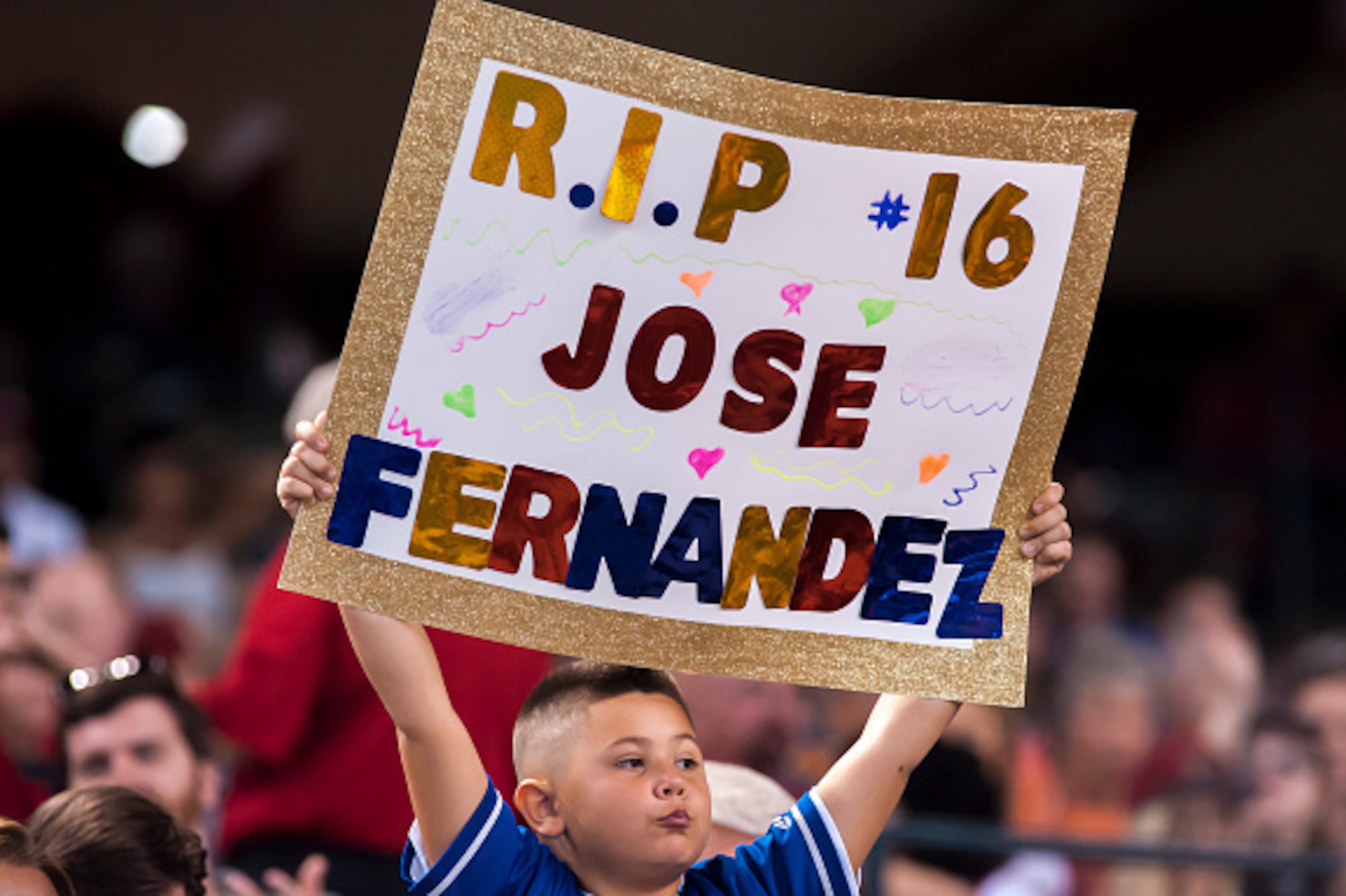
4 of 8By unanimous acclimation, Jose Fernandez, the outstanding pitcher for the Miami Marlins, was a gold-standard human being who lifted the spirits of everyone he met.
That's why it's no surprise that in the wake of Fernandez's tragic death from a boating accident on Sept. 25, 2016, dozens of MLB players paid tribute to the pitcher's legacy, many of them by hanging his jersey on their dugout wall.
But one of the most heartfelt and powerful moments related to Fernandez's passing was what Marlins infielder Dee Gordon was able to do the day after his beloved teammate died.
After an emotional pregame ceremony to honor Fernandez, the Marlins took the field against the New York Mets to play a game with heavy hearts.
In the bottom of the first inning, Gordon came up to bat.
Instead of taking his spot as a left-handed hitter, Gordon reversed position and took the first pitch as a right-hander, which was his way of honoring Fernandez, who batted right and was a fairly good hitter.
After taking his usual side of the plate, Gordon mashed a 2-0 fastball into the stands, triggering huge cheers that changed the mood of the crowd, hushed by the solemnity of the pregame tribute.
The solo home run was the first that Gordon had hit all season, and if you believe in divine intervention something special occurred in that moment.
Gordon, who like all the Marlins players was wearing Fernandez's No. 16 jersey, jogged around the bases and collapsed into the arms of his teammates in the dugout.
No words were spoken.
None were needed.
Tyler Kepner of the New York Times referred to Gordon's home run as a great example of how sports has the power to create uplifting moments.
Sports had once again given voice to a collective need to feel good after something terrible had happened.
New Orleans Saints' First Home Game After Hurricane Katrina
5 of 8On Aug. 23, 2005, Hurricane Katrina devastated New Orleans and changed the narrative of that city forever.
In addition to the tragedy of lives lost, properties damaged and the burden of rebuilding, the city's cherished New Orleans Saints were forced to play all home games of the 2005-06 NFL season away from the fabled Superdome.
Then on Sept. 25, 2006, the Superdome was finally ready for its unveiling, and more than a year after the tragic events brought about by the hurricane, the Saints took the field once again.
It wasn't just cathartic, it was transformative.
The Superdome had been the shelter for more than 30,000 people who had fled the storm. Coming back to a rebuilt mecca of football frenzy was the final confirmation that, despite immense losses, the city could never be permanently broken.
The opponent that day was the Atlanta Falcons but, really, the enemy was the flood, and the vagaries of fate and fortune that had conspired to mete out such punishment to one of America's most beloved cities.
And after special teams ace Steve Gleason blocked a punt that Curtis Deloach returned for a touchdown, the crowd's eruption had very little do with winning.
Instead, it was a defiant middle finger to a would-be conqueror that had failed to break their spirit.
In a ranking of greatest moments in Monday Night Football history, ESPN slotted this game as No. 5 on its list, a testament to how much the Saints' triumphant return meant to the city.
Super Bowl XXV Is Played During the First Gulf War
6 of 8President George H.W. Bush came on the air on the night of Jan. 16, 1991, and declared that U.S. forces were engaged in hostile conflict with Iraqi soldiers in Kuwait.
The Persian Gulf War had begun.
And despite what most Americans saw as overwhelming military superiority, the nation was still at war, and it cast a pall over just about everything, including sports.
What made things worse was that Super Bowl XXV between the Buffalo Bills and the New York Giants was scheduled to take place 11 days later in Tampa, Florida.
The NFL briefly considered postponing the game, but that idea was quickly shelved.
But no one was quite sure how to handle the biggest annual sporting event in the country when American soldiers were fighting and dying overseas.
Then Whitney Houston happened.
In what is widely acknowledged as the greatest rendition of the national anthem at any public gathering, Houston set the tone for the day by using her voice as an instrument of hope and power.
ESPN's Page 2 listed Super Bowl XXV as one of the most significant moments in sports and war, and an Army doctor in Kuwait who watched the game said that it provided much-needed distraction from Scud missiles and the harsh reality of the war.
1989 World Series Game 3 After Bay Area Earthquake
7 of 8
On Oct. 17, 1989, just minutes before the start of Game 3 of the World Series between the San Francisco Giants and the Oakland A's, a 6.9-magnitude earthquake struck the Bay Area.
The tremblor dislodged upper sections of Candlestick Park and knocked out all power.
Baseball Commissioner Fay Vincent called off the game in the interest of public safety, and stunned players rushed home to be with their families.
In the aftermath, no one was sure that the World Series wouldn't be postponed indefinitely or called off.
This was a tragedy that hit especially hard for all the players involved, because it happened at home, where they had roots in the community.
But just 10 days later, the World Series resumed.
Things had changed.
The crowd was raucous and emotional, cheering both teams with equal fervor, acknowledging that this was a moment for human connection, not rivalry.
In a recounting of that Game 3, Tim Keown of ESPN, who was at Candlestick Park that day, said the most memorable moment of the entire World Series occurred during pregame ceremonies, when the cast of the popular musical revue Beach Blanket Babylon led the crowd, the players and even the reporters in a rendition of the song, "San Francisco."
It was a communal outpouring of sadness and hope and it gave everyone the proper perspective, in that while baseball was indeed "just a game," it did have the power to unite and distract and offer a small measure of comfort.
Mike Piazza’s Post-9/11 Home Run
8 of 8The New York Mets came to a packed and emotional Shea Stadium after the Sept. 11, 2001, terrorist attacks had staggered the city into a standing eight count.
No one was really sure what baseball meant anymore, but the Mets and the Atlanta Braves stood tall and decided that doing what they knew best was their strongest response to the tragedy.
The often-polarizing Mets catcher, Mike Piazza, found himself in the middle of a fateful moment on that special Sept. 21, 2001, night when he came up to bat in the bottom of the eighth inning with the Mets trailing by two runs.
Harnessing the emotions of that night was a tall order, but Piazza managed to steel his nerves and hit one of the most important home runs in MLB history.
Piazza’s dinger not only gave the Mets a 3-2 lead they would never relinquish, it gave the crowd a cathartic moment that expressed their sorrow, hope and belief that things would be OK.
Mark Townsend of Yahoo Sports called it the seminal moment of Piazza’s career, and a moment that helped begin the healing process for all Americans.


.jpg?w=2560 "Viral Rams Coach Vid 🖕")

.jpg?w=2560 "Injury-stricken Seahawks signing veteran RB")
