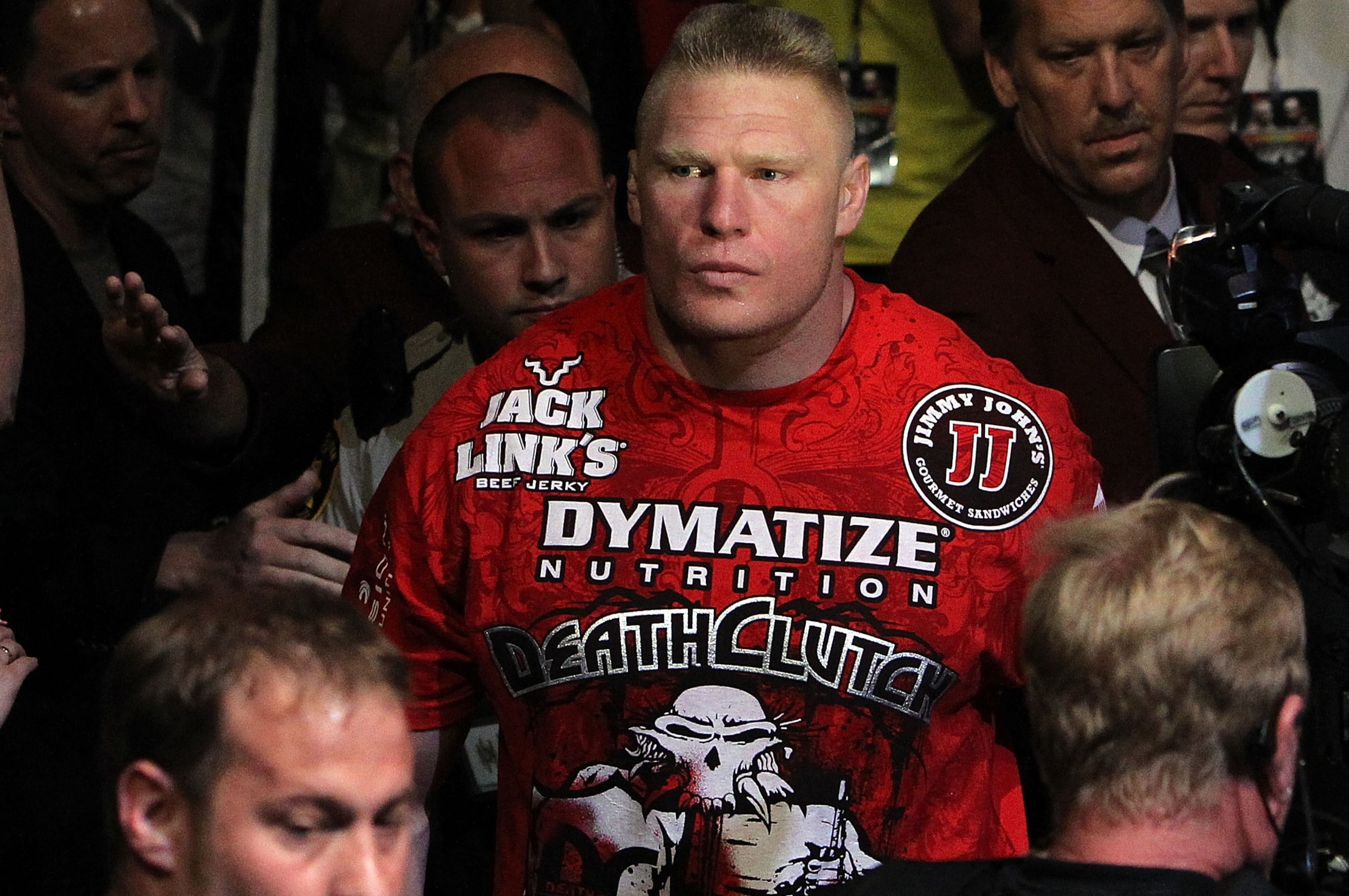

From WWE to UFC: 10 Moments That Made Brock Lesnar the Beast Incarnate
Brock Lesnar has been in the spotlight for 14 years now. He's won championships, he's broken streaks, he's conquered opponents, he's dominated foes and he's battled back from adversity. Now, after four memorable years in the WWE, he is set to return to the Octagon at UFC 200 to face veteran slugger Mark Hunt.
With that in mind, it's worth taking a look at Lesnar's greatest hits over the years. To commemorate the occasion, the Bleacher Report MMA crew is coming together with the Bleacher Report WWE team for a special piece about the Beast's best moments, both in the ring and in the cage.
So what are those moments? And what made them so special? Read on and find out!
Brock Lesnar’s Aura Arrives Prior to Fame
1 of 10On the day before WrestleMania 18, a group of corporate sponsors and lucky fans found themselves eating hors d’oeuvres and sharing a room as they waited for the promised attractions to materialize. Some in-ring talent was going to stop in, shake a few hands, take a few photos, sign a few autographs.
At the time, I was working for WWE, taking a diversion to work for their publishing team after starting my career as a sports writer. I had seen athletes up close. Football studs, basketball stars, juiced baseball players; big dudes. These WWE wrestlers had that kind of size. Still, by this time, I’d worked for the company long enough that I felt a bit indifferent by them. Seen one giant, seem ‘em all.
And then Lesnar walked into the room. I’d already heard of him; his signing had been a big deal in the company. But I’d never seen him. It was like taking in a natural wonder. He was huge; he was dangerous; he had presence.
The moment was magnetic; the whole room wheeled around to figure out who he was or who he was going to be. He wasn’t anyone we knew, but he was definitely somebody.
I couldn’t tell you what other wrestlers took part in that meet-and-greet. I do know that there were other, more established ones, but it was Lesnar who had the room riveted, staring at him as if he was preparing to hand out every last dollar Vince McMahon had ever earned.
He debuted two nights later on Raw, and he was off to the races, a real-life Hulk tossing huge men around like unwanted toys. WWE would never be the same. UFC would never be the same. That magnetic presence that was the foundation of his pay-per-view success? It wasn’t there on Day 1. It was there before it.
The Botch
2 of 10"Human" is not a word that gets tossed around much when discussing the mayor of Suplex City, the Beast Incarnate Brock Lesnar. He hardly seems a mortal man at all, all rippling muscles and dastardly sneers, a teenage boy's idea of masculine perfection. Everywhere he's ever gone, Lesnar has conquered. The NCAA. The WWE. The UFC. If there are limits to his excellence, we've yet to find them.
That a man like Brock Lesnar's most memorable moment in a wrestling ring was, objectively, one of abject failure, is a little ironic. His reputation and character are built around his indestructibility and his physical gifts. But the match we'll always remember is the one time he looked all too human.
WrestleMania XIX was Lesnar's first—and the promotion wanted to provide a singular moment to remember. He had the best possible opponent in fellow amateur standout Kurt Angle, a man who could make even a broomstick look good as his own body was giving out after years of wear and tear.
The agent for the match, John Laurinaitis, created the perfect finish as well, a daring stunt that would separate him from every big man who had ever stepped into the ring. Lesnar, who topped the scales at around 300 pounds at the time, was supposed to hurl himself off the top rope in an inverted somersault, crashing into Angle to finish what was expected to be a classic match.
The problem? Lesnar hadn't done the finishing move Laurinaitis craved, the Shooting Star Press, for more than a year. Though he successfully nailed it in a practice session on some crash mats, in the ring it was a different story. This was no dry run—literally.
After a hard-hitting match with Angle, who gave it his all in his last bout before neck surgery, the top rope was soaked with sweat. Lesnar's foot slipped and he under-rotated, cracking his head on the mat. What happened next, he wrote in his book, Death Clutch, he can recall only with the aid of a video reference:
"I crashed in spectacular fashion, and gave myself a massive concussion. I damn near broke my neck. I still had enough sense left to know that I had to win, but I don't remember finishing the match. I did finish, which meant I was the champion again, but I sure don't remember it. Not at all.
"
In some ways the botched finish ruined the match. It will never top any list of all-time classics. But, as Angle told me, there are a lot of technically great matches no one remembers a week later. This bout, he says, no one will ever forget.
"Thank God he got up and was able to finish the match," he said. "I think landing on his head helped in a strange way. If that hadn't happened, would you be asking about it more than 10 years later?"
On His Way out the Door
3 of 10
As the winter months of 2003 approached, Lesnar should have been on top of the world. His first year with professional wrestling culminated with a second heavyweight championship. The first 10 months of the year had seen him dominate the SmackDown brand, working Angle in a series of outstanding wrestling matches and thriving as both a heel and babyface. The unquestionable face of WWE for the foreseeable future, one of the biggest stars in his field and a millionaire, he should have been content.
But he was not.
As Lesnar revealed on ESPN’s SportsCenter in 2016, he was taking a steady cocktail of vodka and pills to help get him through the long days of travel, media and personal appearances that he despised. His passion for the world of sports entertainment was nonexistent, and it began to show in his work.
Once one of the most startlingly great young wrestlers in the industry, he began sleepwalking his way through performances. The spark that was once evident in his matches had dulled.
By the time February 2004 rolled around, it was obvious that Lesnar was holding the title for the surging Eddie Guerrero, who was inarguably the most popular star on SmackDown. At No Way Out, the Superstar known to millions as Latino Heat realized his childhood dream and captured the heavyweight title that had eluded him throughout his Hall of Fame career.
Lesnar, on the other hand, continued his descent into mediocrity.
In the weeks that followed, he did his part in the lethargic build to what should have been a dream match against Goldberg. It was just days from that epic encounter at WrestleMania XX when news broke that would shake the wrestling world.
After WWE Creative and management had spent the better part of two years developing Lesnar into the type of star who could carry the promotion for the next decade, putting him over Hulk Hogan and The Rock as clean as can be, the former amateur wrestler out of the University of Minnesota was calling it quits, opting to focus his attention on a professional football career with the National Football League’s Minnesota Vikings.
The match against Goldberg, in front of seething fans in New York, became a farce. Fans booed both men, merciless in their criticisms of the Superstars for tucking tail and running after the spectacular. Lesnar, far away from the glitz and glam that came from being anointed the industry’s next big thing, was unceremoniously defeated, then dismissed courtesy of a Stone Cold Stunner by guest referee Steve Austin.
Lesnar failed to make the Vikings and turned down an opportunity to compete for a squad in Europe, something he revealed in the same ESPN interview.
Lesnar’s story is unlike so many other post-wrestling ones, though. Sure, he experienced a downfall that could have resulted in his status as a footnote, an answer to a trivia question. Instead, his determination to be great and to provide a comfortable living for him and his family carried him into the world of mixed martial arts and UFC.
You know the rest.
One-of-a-Kind Athleticism
4 of 10
Athleticism is a rare commodity in MMA, and athleticism at any division over 170 pounds? Well, that's pretty much a dry well. While fans often struggle with the idea, the vast majority of true athletes end up playing "real" sports. The ones with sticks and balls. The ones where people actually make good money.
It took a perfect storm of misfortune for Lesnar to wind up in the UFC, and when he actually began competing, the difference between an "MMA athlete" and a "world-class athlete" such as Lesnar was painfully clear. The greatest example of this came at UFC 87, when Lesnar faced Pride FC staple Heath Herring.
Immediately after the opening bell, Lesnar threw a flying knee that would've spanned the entirety of one of the UFC's small cages. It missed badly but was followed with a straight right that landed hard and sent the veteran tumbling back as though he were hit by a truck. From there, Lesnar literally pounced onto Herring in what has accurately been labeled as a scene from a National Geographic documentary.
All that in the first 10 seconds! And all that to a man who checked in at 6'4", 251 pounds!
The rest of the fight was no different. He plowed through takedowns. He held Herring's arms down to the mat in order to set up ground-and-pound. He stopped Herring's transitions by simply shoving him back where he wanted. His own transitions were done with a quickness and explosiveness that still result in double-takes.
The fight was a 15-minutelong message to the entire MMA universe. Lesnar is bigger than your favorite fighter. He is stronger. He is faster. He is better.
Brock Lesnar Mauls Randy Couture to Become UFC Heavyweight Champion
5 of 10
It was celebrity that pushed Lesnar into a UFC heavyweight championship match so soon. As a mixed martial artist, he was not ready. How could he be? At the time, he’d been competing professionally for just over a year. Yet after his first UFC win, the company brass was so giddy with excitement about cashing in on his fame that it could not stop itself from booking him for the belt.
If you had blacked out their names and looked solely at resumes, the fight would have looked ridiculous on paper. An inexperienced rookie against a decorated champ with well over 20 bouts? Nonsense. But there we were in November 2008, Lesnar vs. Randy Couture.
The crazy thing about it was that there was a sense of eventuality to the whole thing. Even though we knew Lesnar shouldn’t win, we knew he probably would. The betting line reflected that, per Odds Shark; Lesnar opened as an underdog but quickly drew money in his direction.
In retrospect, it made plenty of sense. How was Couture going to hurt him? At his best, Lesnar was a next-level human.
There was a moment in the fight where Couture hooked his left leg inside of Lesnar’s left leg and tried to take Lesnar’s back. It’s a common transition attempt, but Lesnar simply reached down and yanked Couture’s foot free and his body down to the mat. For a second, it looked as if he was going to tear it off like a chicken wing.
Another time, Couture was digging low for a takedown, and after defending it with his dead weight for a time, Lesnar sunk in an underhook and tossed Couture away like a toddler.
Say what you will about Lesnar’s dislike for being hit, but when he was the one being offensive, he was downright terrifying. With about two minutes left in the second, Lesnar landed a straight right behind the ear that put Couture down. What followed was a massacre, 36 machine-gun strikes in the next 13 seconds, putting Couture’s final title reign to rest.
In the moment, it was the kind of electric spectacle that only MMA can provide. Beyond that, it was an incredible athletic achievement. Barely one year into his pro career, Lesnar had proved himself to be much more than a carnival sideshow. He was even more than the main attraction. He was the whole damn circus.
Ruffling Feathers and Annihilating Frank Mir at UFC 100
6 of 10(Warning: NSFW language in the above video.)
Each and every time Lesnar sets foot in an arena it's an event. But save his appearances at WrestleMania, there hasn't been a bigger show involving Lesnar than UFC 100.
The card was designed to be a blockbuster, and Lesnar had more than a little help in drawing a crowd with Georges St-Pierre in the co-main event spot, a coaches' fight from The Ultimate Fighter Season 9 in Michael Bisping vs. Dan Henderson and rising names such as Jim Miller, Dong-Hyun Kim and Jon Jones all appearing on the preliminary card.
Still, entering the event, the focus was entirely on the heavyweight title unification bout—and straight-up grudge match—between Lesnar and Frank Mir.
Mir and Lesnar had faced off a year-and-a-half prior at UFC 81, but the outcome had a bit of controversy. Officially, the fight ended with Lesnar tapping to a leglock at 1:30 of Round 1. Unofficially, Lesnar was beating the paste out of Mir before notoriously terrible referee Steve Mazzagatti broke up the action for dubious reasons and gave Mir a second chance at victory.
The loss clearly grated on Lesnar, but Mir's smack talk grated on him even more, and when he had his chance at revenge, he made the most of it.
The fight was Lesnar at his absolute best. He took Mir down repeatedly—and with little difficulty. He handled Mir's tricky submission game by pressing his weight down to the point where Mir couldn't get the space to work for a choke or lock. Lesnar set up ground-and-pound by snaking his arm behind Mir's head and into his armpit, prying his shoulder to the point where he couldn't defend.
He drew the stoppage via punches at 1:48 of Round 2. It was at this point that the real show began.
Lesnar stomped around. He flipped off the crowd. He got in a semi-conscious Mir's face. He screamed at the camera. He shoved back arena officials. He got a microphone from Joe Rogan. He took another shot at Mir. He said he was possibly going to "get on top of" his wife. He endorsed Coors Light (because Bud Light, the UFC's official, sponsor wouldn't pay him).
The fight, and its aftermath, was the perfect summation of Lesnar's UFC run. It was brutal. It was deeply divisive among fans. And above all else, it was an amazing spectacle.
Taking a Beating from Shane Carwin and Winning Anyway
7 of 10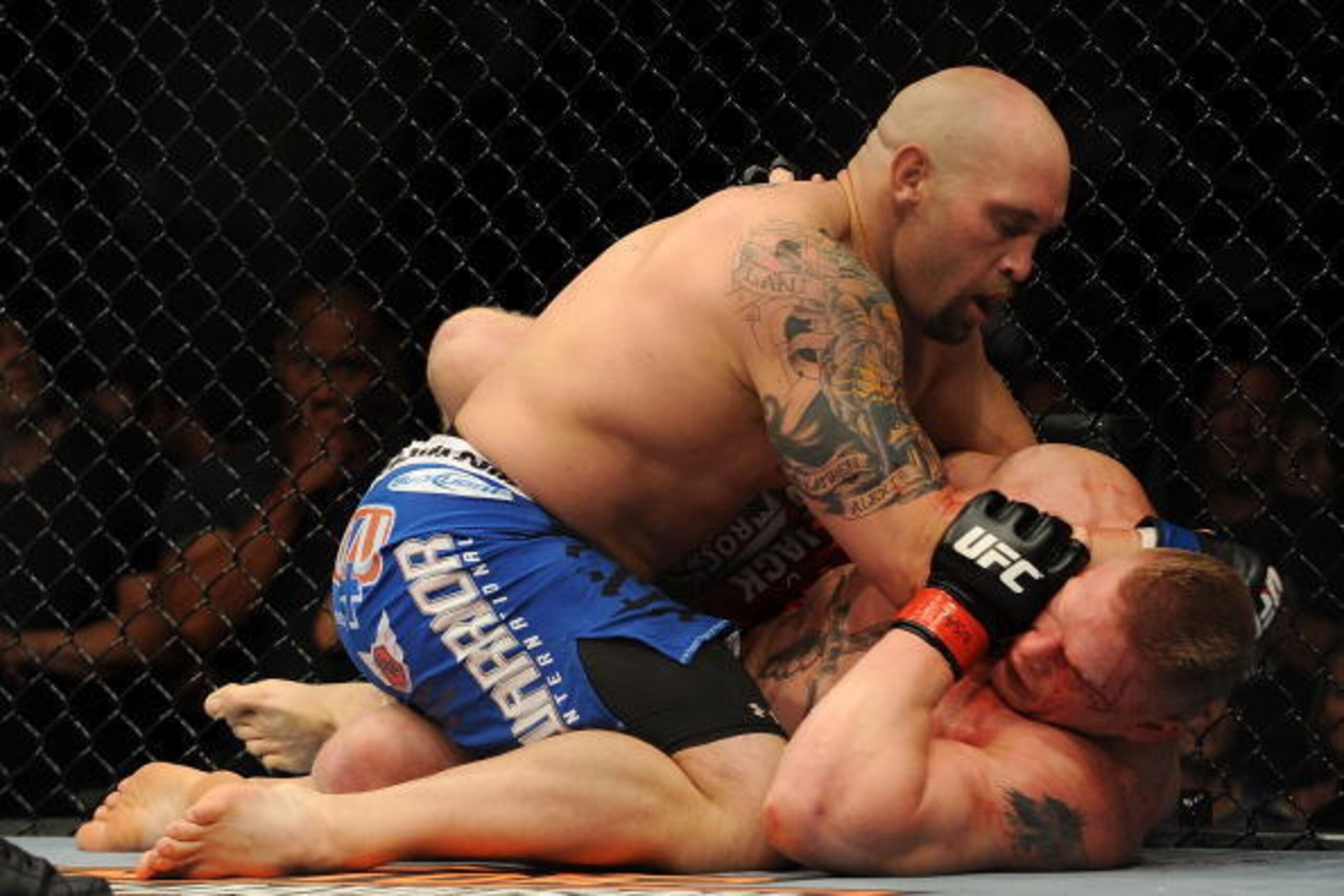
Mixed martial arts eternally navigates a narrow beam dividing sport and spectacle.
The concept is a basic, almost primeval, struggle between two individuals. But delivered with WWE-style wrapping—flashing lights, bombastic commentary, the iconic Octagon—its simplicity is obscured so greatly that oftentimes events feel more like movies than reality.
Back in 2010, the UFC hosted a heavyweight title unification bout between interim champion Shane Carwin and champion Lesnar. While the fight offered various forms of intrigue, one underlying theme encapsulated the sport’s identity crisis.
You had Carwin, a bruising wrestler who employed a simple strategy: punch, punch, punch, then win. The effectiveness of the approach was spectacular—he entered the bout 12-0, having never left Round 1—but Carwin’s persona was ordinary. He was grounded, humble. Just a man fighting in a cage. Lesnar was the antithesis of this.
Lesnar had jumped from the WWE, where he played a character in a scripted show. He brought with him a carefully cultivated persona designed to grab attention, sometimes good but usually bad. He was more like a video game villain than a cage fighter.
The dichotomy between fighter and showman played out as one might expect, in the first round of their title match. Carwin, the no-nonsense fighter, obliterated Lesnar, smashing him over and over with powerful punches that no man had ever found the fortitude to weather. At once, it seemed clear that Lesnar, a written character famous for playing make-believe, lacked the innate ability to survive against such a storm. Only a true fighter could handle such adversity.
The fight could have been stopped on three or four occasions, but Lesnar defended himself just enough to make it through the mauling. He gathered himself like a fighter, shook off the damage and fatigue and came out for Round 2, quickly submitting his exhausted opponent.
The performance was a revelation. Not because it proved Lesnar could hang with top-flight competition—that was made clear after victories over Mir and Couture, if not previously by his gaudy collegiate wrestling credentials—but because it corrected a widely held misconception. It turned out that Lesnar was not a showman in the veneer of a fighter but rather a fighter in the veneer of a showman.
The Triumphant Return to the WWE
8 of 10After suffering back-to-back defeats at the hands of Cain Velasquez and Alistair Overeem, anyone else’s stock would have fallen dramatically. He lost his title and was then liver-kicked out of the company. It could have ruined his mystique, but the WWE Universe was ready for his return.
The previous night, at WrestleMania 28, John Cena lost to The Rock in the main event. Cena came out on Raw to congratulate The Rock, but the news of Lesnar’s return had already entered the ether. Fans were chanting his name and had signs welcoming him back. Everyone seemingly knew what the end to the show was going to be, and they couldn’t wait.
Cena gave his promo and asked The Rock to come out to shake his hand. What he got instead was a beast.
Lesnar’s music hit, and the crowd erupted in one of the loudest pops anyone will hear. It only got louder when he appeared on stage. The reaction spoke to the enigma that is Brock Lesnar. Crowd shots showed grown men jumping up and down with their buddies as they couldn’t contain their excitement for his return.
The former UFC and WWE heavyweight champion entered the ring and extended his hand to Cena. When the face of the WWE obliged, he was snatched up like a sack of flour and dropped with the F-5. The crowd lifted the roof off the arena with its roar. Cena lay beneath Brock as the show went off the air.
Michael Cole’s commentary would be as accurate as anything he had ever uttered before, “The landscape…the complexion of the WWE has been drastically changed.” The WWE would find that out in the coming year as Lesnar made his triumphant return to the squared circle.
The 1 in 21-1
9 of 10
The Undertaker was 21-0 at WrestleMania. It was a streak that could never be duplicated, and despite how many times The Deadman seemed to be facing his greatest threat, he always came out on top. It was obvious the streak was only going to end when he retired. Everyone knew it.
But then Lesnar took him down and everything changed.
This singular moment in time represents perhaps the most compelling evidence that McMahon fully trusts The Beast Incarnate. If Undertaker’s streak had to end, it must happen at the hands of someone who could not only use it as a springboard to bigger things, it also had to be someone who could bear the weight of it without buckling.
Brock’s shoulders are broad indeed.
Lesnar was the only man who could pull this off and deal with the tremendous criticism that would surely follow. Brock is about business, and whether he wanted to pin Taker is irrelevant; he did it, and he wore it like a badge of honor because he could.
Fans hated him for taking the streak away, but it didn’t matter. Lesnar’s prizefighting reputation gave him all the protection he needed to deflect any hate. If it did bother him on a personal level, he never showed it on WWE programming, because once he’s on camera, he’s on.
WWE doesn’t want warm and fuzzy from Lesnar; it wants ice-cold destruction, and that’s what he delivers.
Of all the WWE records that have ever been broken and of all the championships that have ever been won, nothing compares to beating The Undertaker’s streak at WrestleMania. Only one man in professional wrestling history can ever lay claim to that lasting legacy, and his name is Brock Lesnar.
Conquering John Cena, Reclaiming the WWE World Heavyweight Championship
10 of 10Brock Lesnar wore a half-snarl, half-smile, sweat dripping from his reddened face, as he lifted a weary Cena off the mat. The Beast Incarnate then dropped the WWE champion to the canvas, issuing a barrage of German suplexes.
The crowd began counting the suplexes aloud. Lesnar hit the move 16 times, Cena's shoulder blades smacking the mat again and again.
WWE fans were simply not used to seeing this happen; Cena did not get dominated.
The story that Lesnar and Cena told in the ring in SummerSlam 2014's main event was of one titan dismantling another. And it wouldn't have worked with anyone other than Lesnar.
The script may call for a wrestler to control a matchup and play the role of monster, but the audience doesn't always buy it. Lesnar's aura made that narrative believable on that August night in Los Angeles. It didn't just feel like he was beating down WWE's top star, but that he was devouring him whole for all the world to see.
There was no Rocky Balboa-like comeback from Cena this time. Instead, Lesnar rag-dolled him until finally hitting an F-5 to claim his fourth WWE world title.
Lesnar vs. Cena was one of the most entertaining one-sided matches of all time, a deviation from the standard back-and-forth pattern of headline bouts that hooked the crowd from the first blow thrown.
The Beast Incarnate made the wrestling equivalent of a blowout a work of violent theater.
Asking Lesnar to steamroll a man who so rarely lost was a sign of how WWE viewed the powerhouse. In a world of larger-than-life warriors, Lesnar was the largest, the predator sitting atop the food chain.



.png?w=2560 "Week 8 Winners & Losers 📊")
.jpg?w=2560 "Malik Beasley Negotiating Plea Deal (AP)")
.jpg?w=2560 "Jonathan Taylor Landing Spots")
