2016 NBA Mock Draft: 1st-Round Predictions After Lottery Results
Trust the process. That's the mantra the Philadelphia 76ers touted for nearly three full years before dumping the process overboard, pushing general manager Sam Hinkie out of power and revamping their front office.
Well, the process paid off Tuesday night.
The odds finally turned out to be in the Sixers' favor at the 2016 NBA draft lottery, as they won the third No. 1 overall selection in franchise history. The Los Angeles Lakers came in at No. 2, and the Boston Celtics rounded out the three picks determined by the drawing. The results were as chalk-heavy as you could get, with none of the teams outside the top three jumping up.
TOP NEWS

Trades That Should've Happened During NBA Offseason 🏀

'Over-Under' Predictions for Every NBA Team's Record 🔮
Harper Seen as Spurs' No. 2
Regular-season records determined the remaining order of June 23's draft. The Phoenix Suns and Minnesota Timberwolves round out the top five. Although the lottery drawing only picks the top three, its results will have a massive impact on the futures of this year's top prospects.
With that in mind, let's take a look at a full first-round mock draft now that the order is decided.
Mock Draft
| 1 | Philadelphia 76ers | Ben Simmons | F | LSU |
| 2 | Los Angeles Lakers | Brandon Ingram | SF | Duke |
| 3 | Boston Celtics | Dragan Bender | PF | Croatia |
| 4 | Phoenix Suns | Henry Ellenson | PF/C | Marquette |
| 5 | Minnesota Timberwolves | Jamal Murray | PG | Kentucky |
| 6 | New Orleans Pelicans | Buddy Hield | SG | Oklahoma |
| 7 | Denver Nuggets | Jaylen Brown | SG/SF | California |
| 8 | Sacramento Kings | Kris Dunn | PG | Providence |
| 9 | Toronto Raptors | Skal Labissiere | PF/C | Kentucky |
| 10 | Milwaukee Bucks | Jakob Poeltl | C | Utah |
| 11 | Orlando Magic | Denzel Valentine | SG/SF | Michigan State |
| 12 | Utah Jazz | Domantas Sabonis | PF/C | Gonzaga |
| 13 | Phoenix Suns | Furkan Korkmaz | SG | Turkey |
| 14 | Chicago Bulls | Wade Baldwin IV | PG | Vanderbilt |
| 15 | Denver Nuggets | Marquese Chriss | PF | Washington |
| 16 | Boston Celtics | Malachi Richardson | SG | Syracuse |
| 17 | Memphis Grizzlies | Malik Beasley | SG | Florida State |
| 18 | Detroit Pistons | Deyonta Davis | PF | Michigan State |
| 19 | Denver Nuggets | Tyler Ulis | PG | Kentucky |
| 20 | Indiana Pacers | Demetrius Jackson | PG | Notre Dame |
| 21 | Atlanta Hawks | Dejounte Murray | SG | Washington |
| 22 | Charlotte Hornets | Diamond Stone | C | Maryland |
| 23 | Boston Celtics | Thon Maker | PF/C | Australia |
| 24 | Philadelphia 76ers | DeAndre' Bembry | SG/SF | Saint Joseph's |
| 25 | Los Angeles Clippers | Taurean Prince | SF | Baylor |
| 26 | Philadelphia 76ers | Cheick Diallo | PF | Kansas |
| 27 | Toronto Raptors | Timothe Luwawu | SG | France |
| 28 | Phoenix Suns | Ivica Zubac | C | Bosnia |
| 29 | San Antonio Spurs | Malcolm Brogdon | SG | Virginia |
| 30 | Golden State Warriors | Stephen Zimmerman | PF/C | UNLV |
Lottery Breakdown
1. Philadelphia 76ers: Ben Simmons, SF/PF, LSU
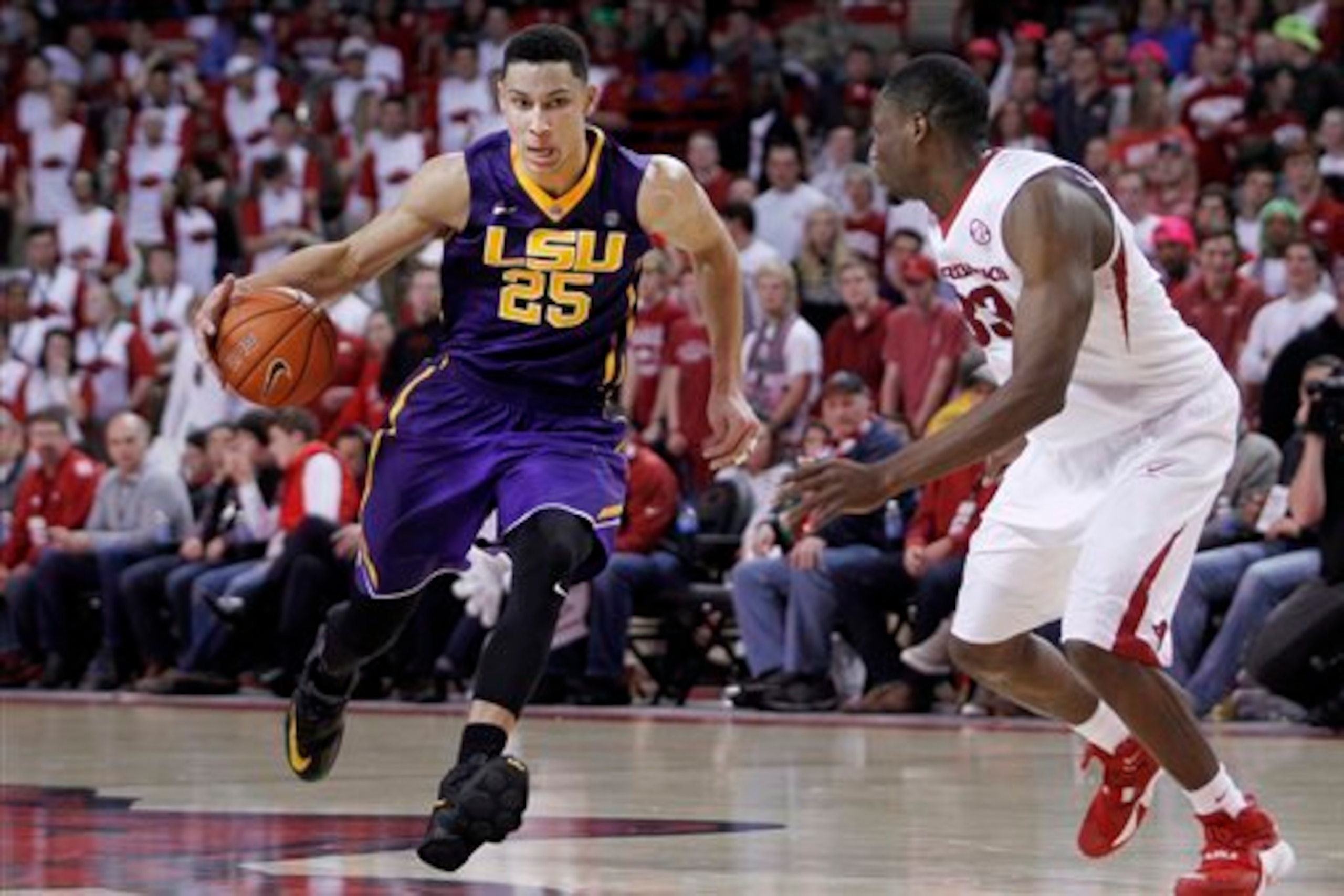
The debate between Ben Simmons and Duke's Brandon Ingram isn't just narrative. There was a real chance, depending on which team won the lottery, the prohibitive No. 1 favorite would have dropped to No. 2.
That's likely out the window now.
Simmons is the better prospect, has the higher ceiling and is a clean fit with the Sixers' bare roster. His playmaking skills will make things vastly easier on the wing, and there's enough infrastructure to allow him enough shooting to develop at his own pace. There will be times when spacing may get a little cramped with Simmons at the 3, but the kid has generational talent.
Simmons is 6'10", handles the ball like a point guard, has an off-the-charts basketball IQ and found a way to put up big numbers at LSU despite a broken jumper. Don't get me wrong—the ability to shoot a basketball is huge. Simmons is going to need to find a comfort zone (even if it's only out to 18-20 feet) and start knocking down shots.
This is the moment Sixers fans have been waiting for. No need to overthink it.
2. Los Angeles Lakers: Brandon Ingram, SF, Duke
As far as consolation prizes go, Ingram's a heck of a reward for finishing in second place. It's been Ingram and Simmons battling for the top spot for months now, and there's a legit argument that the Duke product is better for today's game.
Ingram's the closest thing we've seen to Kevin Durant since Durant himself. He's a lanky (6'9", 196 lbs), freakish scorer with a polished offensive game that's ready for the NBA right now. Defense is going to be a work in progress, but Ingram's going to be an All-Star on the back of his pure offensive brilliance.
He is already a 40 percent shooter from deep, flashed a promising willingness as a secondary facilitator and rebounded well for a guy with a Gumby build. Like Durant, Ingram will need to work on creating his own shot and adding strength to hit his stride.
That said, high-fives are all around in Los Angeles right now. The Lakers got to keep their pick and got another potential star to pair with D'Angelo Russell.
3. Boston Celtics: Dragan Bender, PF, Croatia
Bender's going to spend the next month or so generating Kristaps Porzingis comparisons. That's not fair. Porzingis was a better, more polished prospect. Bender is closer to what we thought Porzingis might be as a rookie—a little slow to develop, in need of real NBA seasoning—than the Porzingod reality.
But the two share similar traits. Bender is a slender (7'1", 225 lbs), versatile forward who can stretch beyond the three-point arc, handle the ball in the open court and not look like stiff from an athletic standpoint. His experience is limited playing at a high level for Maccabi Tel Aviv, and the Celts will have to understand he won't turn 19 until November.
This is a project pick. Like all projects, the ceiling is high, and the floor is low. It's also a gamble Boston can afford to take. Brad Stevens already put his makeshift roster into perennial playoff status, and the Celtics could be major players on the free-agent market this summer.
Bender could wind up being the best player in this draft. At the least, he's the best roll of the dice as Boston looks to land a superstar. (Don't be surprised if Boston floats this pick in trade offers, though.)
4. Phoenix Suns: Henry Ellenson, PF/C, Marquette
Perhaps no top-10 pick was more dependent on the lottery than Ellenson. Things just needed to break his way. The Suns, Timberwolves and Pelicans have long been his most likely fits, as they each have a need for a stretch big man.
As it stands, Ellenson hit the jackpot. Phoenix will be hoping Bender falls in its direction come draft night, but its roster composition may wind up forcing GM Ryan McDonough to take a risk on Ellenson here. The Suns need a stretch 4 after trading a disgruntled Markieff Morris; Ellenson's the best one remaining.
Ellenson was the most anonymous elite prospect in the country last season. He spent his time putting up solid numbers on a forgettable Marquette team, struggling to shoulder the entire load amid a poor supporting cast. If we're going to excuse his disappointing shooting numbers (he hit just 28.8 percent of his threes), it begins with pointing fingers elsewhere.
Ellenson has a good, consistent stroke for a big, and measuring at just under 7'0" at the combine will help convince teams he can play center. There's a bit of Kevin Love Lite to his game. He's excellent in the low post, more athletic than his build would have you assume and even Lovian in his blase approach to defense.
5. Minnesota Timberwolves: Jamal Murray, PG/SG, Kentucky
Murray's done an excellent job of convincing teams there is a Big Three in this class rather than a Big Two. You're not going to find many evaluators with bad things to say about him. He's a lights-out shooter, handles the ball far better than he ever got a chance to at Kentucky and has a promising in-between game.
A word like "tweener," which used to be a death sentence, is now a benefit. Murray is capable of playing either the 1 or the 2, which makes him a promising modern-day prospect given the fluidity of the positions. Providence's Kris Dunn is probably a more NBA-ready prospect at point heading into next season, but at 19, Murray's almost three full years younger.
Minnesota's young core can afford to wait for Murray to acclimate into being a full-time point guard. Ricky Rubio is still in the fold despite trade rumors around the deadline and his salary looks great under the NBA's new cap structure.
As a rookie, Murray should fit in fine as an off-ball option who works in as a backup behind Rubio. If Murray and Zach LaVine can develop together, that's a freakishly talented, long backcourt of the future.
6. New Orleans Pelicans: Buddy Hield, SG, Oklahoma
Hield's resume speaks for itself. He set the world on fire last season at Oklahoma, averaging 25 points a night and gunning like Stephen Curry on his way to a Final Four berth. There were even some Oklahoma blogs asking if he could go No. 1 overall.
The answer? Of course not. This was always a two-horse race between Ingram and Simmons, and the Hield hype has died down a bit. Teams have come down from the March Madness high and have begun to see Hield for what he is.
The good news is that's a good NBA player. The bad news is that Hield is unlikely to yield superstardom. He's best utilized as a second or third player over the long term, allowing his team to take advantage of his shooting and athleticism while atoning for his at-times lackadaisical defense.
The Pelicans are a strong fit in that regard. They already have a core of talented young players led by Anthony Davis. One of the biggest missing pieces is a go-to scorer who can stretch the floor, especially with Eric Gordon set to hit free agency. Hield can fill that role and should be ready to contribute immediately for a team looking to return to playoff contention.
7. Denver Nuggets: Jaylen Brown, SG/SF, Cal
Teams are scared of Brown. Frightened, even. He lasted just a single disappointing season at Cal, failing to show an NBA skill set to go with his NBA body. While he looked the part from a physical standpoint, Brown shot 29.4 percent from three and consistently struggled to create his own shot.
Making matters worse: Brown appeared to get a big fat F in the interview portion of the combine.
"He was the worst interview we had this week," one NBA GM told ESPN.com's Chad Ford. "By far, the worst interview. I know he hasn't hired an agent yet, but he was arrogant and didn't show a real feel for the game when we asked him basketball questions. He hurt himself more than anyone here."
There is a legit chance he falls out of the top 10. But unless Nuggets want to take a risk on Michigan State's Denzel Valentine or Anadolu Efes Istanbul's Furkan Korkmaz, Brown's the best fit. He fills a need out on the wing and has the potential to develop into a lockdown perimeter defender. Denver already showed a willingness to take a risk on a high-upside non-shooter last year in Emmanuel Mudiay and is the likeliest top-10 fit for Brown right now.
8. Sacramento Kings: Kris Dunn, PG, Providence
Dunn is the best prototypical point guard in this class. He might be the best point guard period, depending whether you believe Murray can become a full-time 1. The Providence product has spent the last four seasons building up every aspect of his game, and he'll compete with Hield to be the first senior off the board.
His veteran plug-and-play presence is what Sacramento needs next season. Rajon Rondo's going to look to cash in on free agency, and Dunn may be ready to step in as a Day 1 starter. Dunn's an excellent slasher who will look way better in the NBA's drive-and-kick game, worked hard to develop a passable long-range jumper and has the athleticism to be a good defender.
The injuries that hampered his freshman and sophomore seasons have only allowed Dunn to grow into a surefire top-10 pick. Four-year guys tend to get downgraded a bit in the evaluation process, but this class isn't strong enough for Dunn to slip past here.
9. Toronto Raptors: Skal Labissiere, PF/C, Kentucky
The Raptors are stuck in a difficult spot here. Their biggest long-term need is at the power forward spot, and they'll likely be choosing between Labissiere and Washington's Marquese Chriss.
Labissiere has legit superstar potential. If we rewound a year and high schoolers were allowed to enter the draft, the debate would have been between him and Simmons—not Ingram and Simmons. For much of his high school career, Labissiere battled for the coveted top ranking in his class. Simmons wound up becoming the consensus pick, but 247Sports' composite rankings graded them equally.
One lost season at Kentucky later, and no one's quite sure what to make of him. He averaged 6.6 points and 3.1 rebounds, getting inconsistent playing time and becoming perhaps the most criticized player on the roster. John Calipari admitted he coached Skal incorrectly at first, but teams are fairly frightened he could bust out.
Chriss was more productive in his lone season at Washington, but he's still a question mark. He's an athletic freak who projects as a good defender. He also needs a ton of work offensively and in the basketball IQ department, and he doesn't quite have Skal's ceiling.
It's a 50-50 tossup here. Skal should have the edge because he has the skill set to impress in workouts.
10. Milwaukee Bucks: Jakob Poeltl, C, Utah
The Bucks are committed to Giannis Antetokounmpo as their point guard next season, so let's trickle down to their next-biggest need. Greg Monroe's signing was a disappointment nearly everyone saw coming, and it wouldn't be a shock if Milwaukee floated his short-term contract on the trade market.
Poeltl doesn't present the same problems as Monroe. He's fleet-footed for a 7-footer. While head coach Jason Kidd probably shouldn't have him blitzing out on pick-and-rolls, he can be far more aggressive than he was with the ground-bound Monroe. Poeltl also stretches out in the mid-range and could help unclog some of the spacing that's already tight given Milwaukee's roster construction.
There's not a better fit for either side on the board.
11. Orlando Magic: Denzel Valentine, SG/SF, Michigan State
Rob Hennigan made his intentions apparent this offseason when he cleared out Channing Frye and Tobias Harris for essentially nothing. The Orlando GM expects to be a major player on this summer's free-agent market and wants to start competing soon.
Valentine best fits the mold among players who should be available at No. 11. The Michigan State product spent four years working into one of college basketball's best all-around players under Spartans head coach Tom Izzo. For all the praise Hield got for his senior breakout, it was Valentine who won the AP's National Player of the Year Award.
Former Spartan Draymond Green has been vocally supportive of Valentine, and it's easy to see why when you compare the similarities in their games. Both play much bigger than they are. Valentine grabbed rebounds at a power forward's rate and assisted like a point guard while scoring 19.2 points and shooting 44.4 percent from three. He's built like a guard but could slot right into the 3 spot Harris left vacant.
12. Utah Jazz: Domantas Sabonis, PF/C, Gonzaga
There may be no team more likely to trade out of this spot than Utah. The last thing these Jazz need is another young player who is going to top out as merely good. Their roster runs 10-deep with legit NBA rotation players and doesn't have a single star. Gordon Hayward, Rudy Gobert, Derrick Favors and Rodney Hood are all great complementary pieces waiting one guy to put them over the edge.
No player available at No. 12 is going to be that guy. The Jazz should look long and hard at making a move or maybe even stashing a guy overseas.
If Utah stays put, Sabonis is a decent consolation prize. He can fit either at the 4 or the 5 and provides some of the same back-to-the-basket skills as Favors. Taking a backup in the lottery isn't an ideal outcome for anyone, but Utah doesn't have much of a choice elsewhere. Going point guard again would be a repudiation of the Dante Exum pick as he recovers from knee surgery.
13. Phoenix Suns: Furkan Korkmaz, SG, Turkey
The Suns have three first-round picks, so they can afford to be a little experimental here. Korkmaz and 2015 first-round pick Devin Booker play the same position, but they present dynamic-duo potential at one of the league's shallowest positions.
The Turkish shooting guard spreads the floor, handles better than most 2s and made huge strides as an 18-year-old this season with Anadolu Efes. Given the improvement Booker made as a ball-handler this past season, the Suns could even run him together with Korkmaz down the line.
That can't be comforting to current starters Brandon Knight and Eric Bledsoe, but Phoenix could have the NBA's most exciting young backcourt in this scenario.
14. Chicago Bulls: Wade Baldwin IV, PG, Vanderbilt
Another year, another hole at backup point guard in Chicago. Bringing Aaron Brooks back for a second go-around proved to be a mistake, as he saw a marked dip in quality of play on offense while remaining a defensive liability.
Baldwin's stock is back on the rise after confirming what scouts thought all season long: Dude's an athletic freak. He measured at 6'4" in shoes and has a 6'11 ¼" wingspan, making him long for a point guard. Add a 38-inch vertical and solid quickness in the agility drills, and Baldwin seems firmly back in the top 20 after slipping a bit during Vanderbilt's regular season.
At the least, Baldwin will give the Bulls a decent Derrick Rose facsimile in the event their starting point guard goes down yet again.
Follow Tyler Conway (@jtylerconway) on Twitter.
All measurements via the NBA combine's official listing unless otherwise linked.


.jpg?w=2560 "Weather Channel Trolls Texans-Titans 💀")