

NBA All-Injury Team, Playoff Edition: How Teams Can Survive Their Fallen Stars

If you're a fan of healthy impact players, the 2016 NBA playoffs are not for you.
Injuries are part of the game, and there are always absences we're left to lament during high-stakes postseason pushes. But there have been more recent bumps and bruises and breaks and sprains than usual this year—at least that's how it seems.
Instead of pouting over this springtime misfortune, refreshing our Twitter feeds in search of encouraging updates that aren't coming, it makes more sense to look on the bright side: We can now build an All-Injured Playoff Team.

Selections will be limited to six high-impact players—five starters and a sixth man—all of whom hail from active playoff squads. In order to prevent terminal cases of the sadz, we will offer ways for every team to survive the untimely exits of these key contributors.
Backcourt: Chris Paul, Los Angeles Clippers
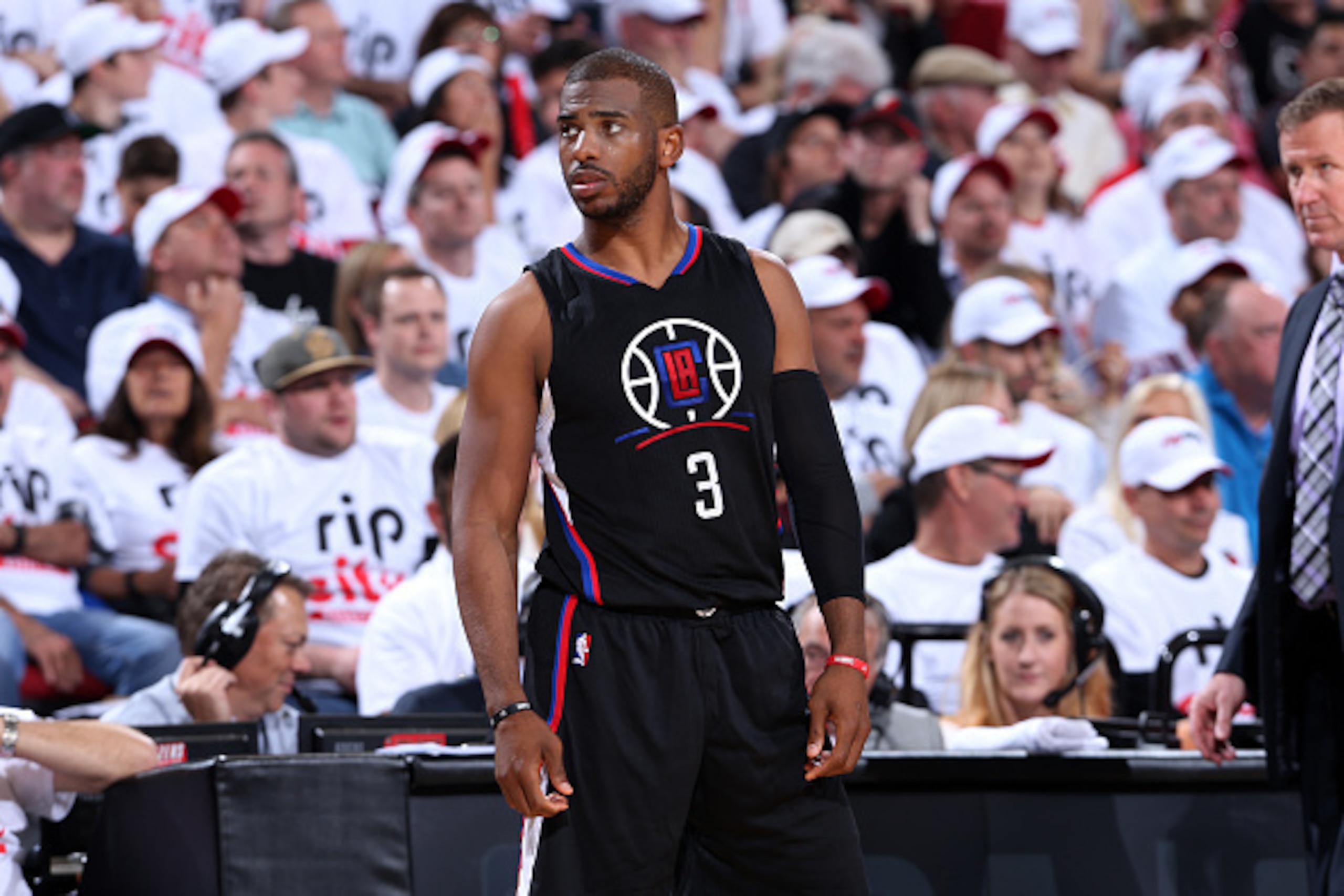
Chris Paul is the one player the Los Angeles Clippers cannot afford to lose. They have lost him anyway.
The offensive engine that could is expected to miss the rest of the playoffs after undergoing surgery on his right hand, reported by Rowan Kavner of the Clippers' official site. If he returns at all, it will be long after the first round is over, when the Clippers are in the middle of a now-improbably deep postseason push.
There is only marginal hope Paul's running mates will be able to function without him. Austin Rivers will start in his stead, and the combination of him, Jamal Crawford and Pablo Prigioni isn't enough to make up the playmaking deficit.
The Clippers saw their assist rates and and overall field-goal percentage plummet per 48 minutes whenever Paul took a seat during the regular season, according to B/R Insights. They were incapable of pumping in points at an NBA level, and their offensive rating plunged accordingly.
Only Stephen Curry proved more irreplaceable to his team's offense than any of the postseason's remaining starting point guards:
Down 3-2 after Wednesday's 108-98 loss, sans Paul, the Clippers must find better production from the right committees rather than one individual player. Two of their four most used playoff lineups leading into Game 5 against the Portland Trail Blazers didn't include him. But just one showed any statistical promise.
No clear solution presents itself when sifting through Los Angeles' regular-season combinations either. Most of the five-man units that don't feature Blake Griffin, who is also done for the playoffs as he recovers from a recurring left quad injury, per Kavner, or Paul are demonstrative negatives. But the subset of Crawford, Wesley Johnson, DeAndre Jordan, Prigioni and Rivers gives head coach Doc Rivers a place to start.
Those five were a plus-14.6 points per 100 possessions, posting above-average offensive and defensive ratings, through 41 minutes of action together. That's not a huge sample, but this was one of the Clippers' 20 most-used groups during the regular season.
Size gets completely abandoned for offensive versatility in this scenario, and that's fine. Crawford and Rivers can attack defenses off the dribble, Johnson and Prigioni will circle the three-point line and Jordan retains his role as a hard screen-setter and explosive roll man.
Using Johnson as a small-ball 4 would leave the Clippers vulnerable defensively long term. But they are short on defensive depth overall. Creating offensive mismatches is their best chance at survival without Paul.
Backcourt: Stephen Curry, Golden State Warriors
Most teams wouldn't be able to soldier on without Curry through at least two weeks of postseason basketball as he recovers from a sprained right MCL. But the Golden State Warriors aren't most teams. They have the depth and firepower to successfully plow past this projected stretch.
Now that the Rockets are in the rearview mirror after the Dubs sealed Game 5 and the series, 114-81, that doesn't mean it's going to be easy. At all.
Between his scoring and the buckets he generated off assists in the regular season, Curry represents more than 45 points of total offense per game. He is the most valuable player on the best team in NBA history. Pushing forward without him will be a huge adjustment—especially on offense.
Golden State hits threes at respectable clips sans Curry, but its long-distance looks are limited overall. The offense drilled 15.3 triples per 48 minutes when he was on the floor during the regular season compared to 8.1 when he sat, according to B/R Insights.
Bleacher Report's Grant Hughes recently addressed the heart of this problem and its solution:
"Houston has had success at times denying [Klay] Thompson the ball altogether, effectively daring the other four Warriors to generate offense themselves. Because [Shaun] Livingston and Andre Iguodala, two players who figure to do much of the ball-handling with Curry sidelined, can more safely be ignored off the ball, the Dubs can't simply put the rock in Thompson's hands to foil all of those denial attempts. Doing that would likely strand Livingston or Iguodala on the perimeter, where defenses could happily leave them and help elsewhere.
So, expect Thompson to be on the move. A lot.
"
Having Draymond Green to blitz interior defenses and Thompson to run off screens is a luxury that will allow the Warriors offense to tread water. Make no mistake, though: Defense is now their calling card.
Last season's team, consisting of this exact nucleus, led the NBA in points allowed per 100 possessions. And while they regressed this year, the Warriors still finished in the top six of defensive efficiency.
Unable to wage consistent three-point barrages of their own, chasing rival shooters off the arc becomes paramount. Livingston will need to check opposing point men, while a combination of Harrison Barnes, Green, Iguodala and Thompson fly around elsewhere, jumping passing lanes and implementing timely traps.
Injuries to Clippers superstars and the general inexperience of an upstart Blazers squad will aid the Warriors' performance looking ahead to the second round. But they'll still have to forge a postseason identity without Curry—however impermanent it needs to be—to retain their status as Western Conference favorites.
Frontcourt: Michael Kidd-Gilchrist, Charlotte Hornets
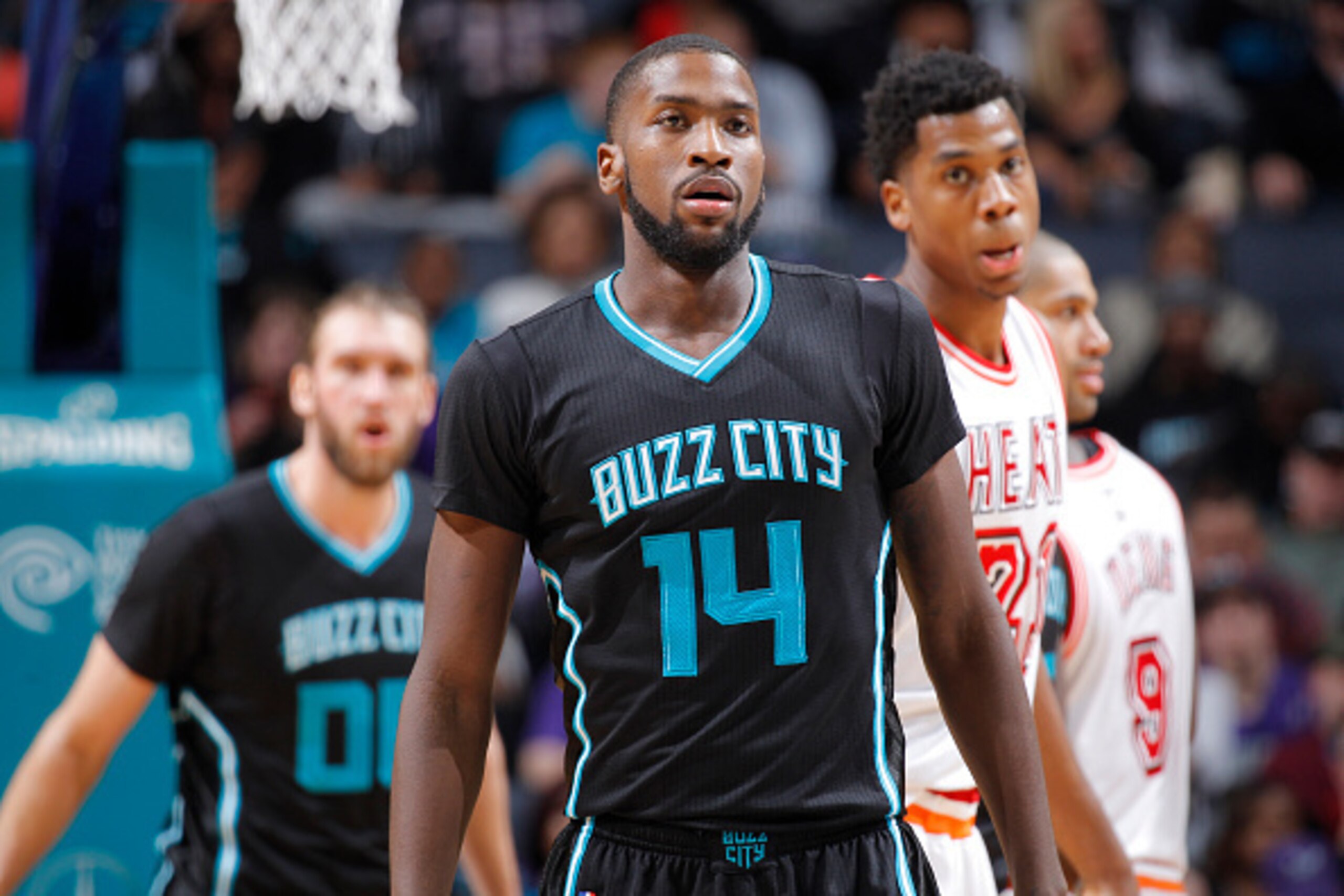
Nicolas Batum initially filled this spot. But then he declared himself ready to rock following foot and ankle injuries, per Rick Bonnell of the Charlotte Observer.
Charlotte Hornets head coach Steve Clifford was naturally thrilled:
And though Batum only scored eight points, he logged 25 minutes and hit a big shot during the Hornets' thrilling 90-88 Game 5 win Wednesday. Almost 12 percent of his regular-season passes resulted in points, the best rate of anyone on the team, according to B/R Insights.
The Hornets need that vision and selflessness moving forward. (Their Game 4 win over the Miami Heat saw them dish out just 10 assists on 30 made shots sans Batum.) Still, he doesn't solve all of Charlotte's problems. Batum can cover the opposition's toughest wings at full strength, but there's no guarantee his ankle is up to that task.
This is where the Hornets start to miss Michael Kidd-Gilchrist. He surprised everyone by making his season debut on Jan. 29. Not seven full games later, he was lost for the year to a second shoulder surgery.
Opponents shot nearly seven percentage points below their season average against Kidd-Gilchrist in the 205 minutes he spent on the hardwood. The Hornets were an absurd plus-15.2 points per 100 possessions with him as well.
Small samples can be misleading, but if nothing else, Kidd-Gilchrist is an extra defensive body Charlotte could have thrown on shooting guards, small forwards and power forwards. His absence will continue to be felt—more so if Batum isn't himself.
Courtney Lee and Marvin Williams, who is seeing extensive time at small forward in the postseason, will need to step up in the meantime. Charlotte's perimeter defense stands to be the difference between an early exit and deep slog.
Frontcourt: Blake Griffin, Los Angeles Clippers
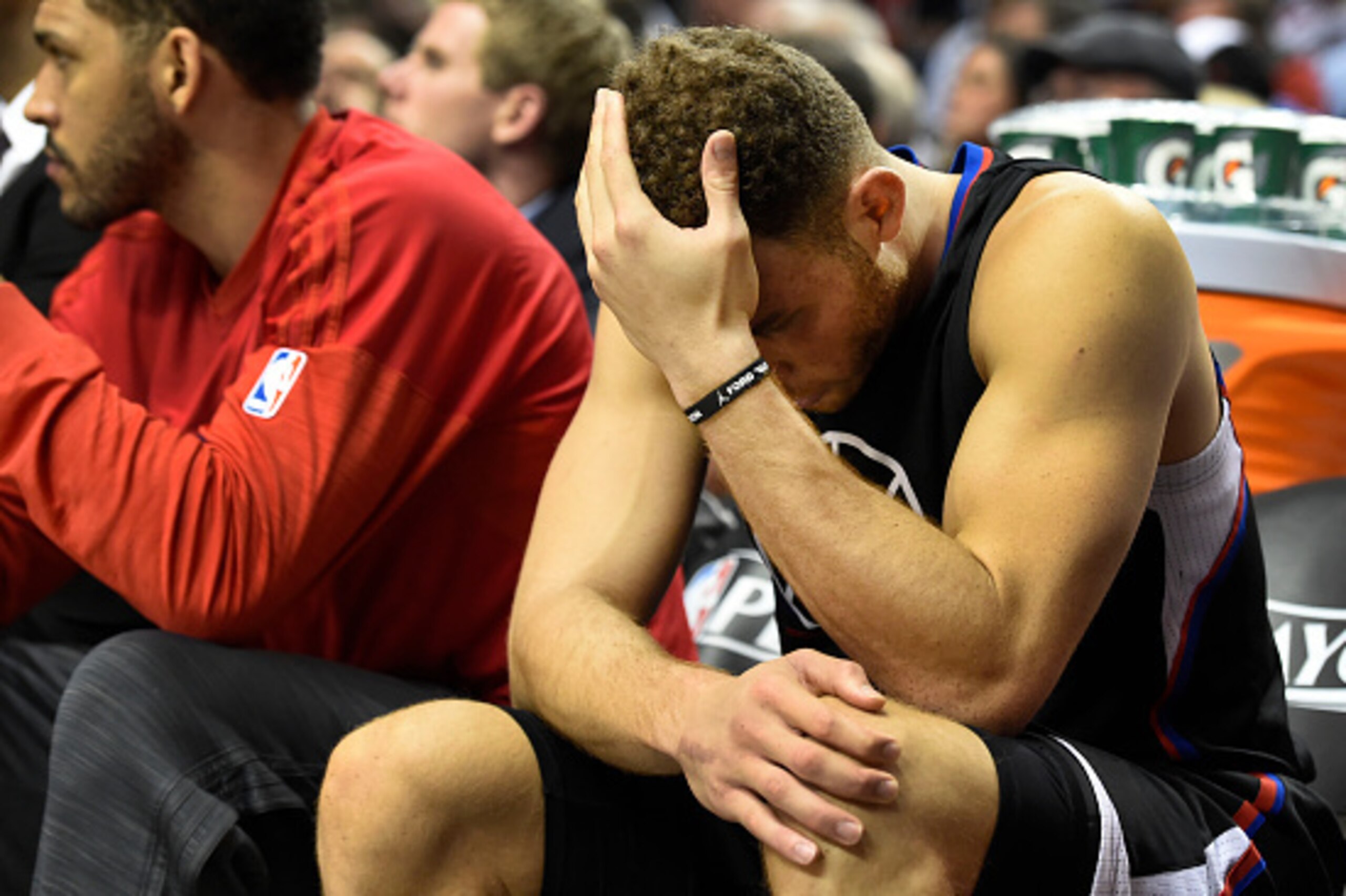
Fighting on without Paul would be exponentially easier with a healthy Griffin.
So much for that. The power forward is done for the year after re-aggravating a left quad injury that dogged him for much of the regular season.
His playmaking and scoring will be missed tremendously. The Clippers were only a slight plus with him on the floor through four postseason tilts, but he was a member of their best three-man playoff unit that logged at least 15 total minutes, per B/R Insights. He, J.J. Redick and Paul were a plus-4.5 points per game in 98 minutes of total action.
Fortunately, the Clips have experience covering up Griffin's absence. He missed 47 regular-season games, during which time they unlocked a spacier version of their offense.
Deploying Green, Johnson, Luc Mbah a Moute or Paul Pierce as a power forward with three ball-handlers, Jordan and/or shooters around them, would allow pick-and-rolls and drive-and-kicks to no end. Those sets won't be nearly as effective without Paul piloting the offense, but they could force defenses to rotate and switch assignments regularly, increasing Los Angeles' number of high-percentage opportunities.
The Clippers actually kinda tried this in their Game 5 loss Wednesday, but Pierce/Johnson combined for five points on 1-5 shooting. Mbah Moute was a DNP. Green had 17 points though, so the trick is finding one or two of these guys to actually get consistent for at least two more games. (Easier said than done, I know.)
It helps that Johnson and Mbah a Moute are defensive upgrades over Griffin. They have better defensive ratings in the early going of the postseason and are more apt when defending the three-ball—a necessity at the power forward position in today's league:
There is a zero percent chance the Clippers are more dangerous without Griffin. Let's make that clear. Unlike the case of Paul, though, there is an effective blueprint to functioning without him.
Frontcourt: Chris Bosh, Miami Heat

Chris Bosh, truthfully, may no longer fit into the Miami Heat's game plan now that coach Erik Spoelstra uses one-in, four-out lineups around Hassan Whiteside.
Bosh can stroke threes, but Luol Deng, Joe Johnson and Justise Winslow offer plenty of upside at the 4 spot. They are bigger threats to exploit slower power forwards off the bounce, and not one of them needs any touches inside the elbows.
Whiteside can roam the paint more freely when they're his frontcourt partners. Spoelstra would have to stagger his minutes with Bosh's to maintain the current offensive model—the one that fueled a top-six offense on the back end of the All-Star break:
| Before All-Star Break | 101.4 | 24 | 100.6 | 6 | 0.8 | 11 |
| After All-Star Break | 109.0 | 6 | 103.2 | 8 | 5.8 | 6 |
That Bosh, an All-Star, could do more harm than good is an unsettling notion. It's also a legitimate one. It seems to explain why the Heat have yet to provide clarification on his indefinite sabbatical despite his insistence that he's fine, per Brian Windhorst of ESPN.com.
At the same time, there is value in Bosh's size and instant offense. The Hornets used big lineups to erase the Heat's 2-0 series lead, outscoring them inside the paint 96-58 through Games 3 and 4. Whiteside is the more intimidating rim protector, but Bosh, as a power forward or center, is better equipped to provide help defense on Kemba Walker and Jeremy Lin drives.
And the Heat wouldn't lose anything offensively by swapping him in for Whiteside.
Bosh is an above-average pick-and-roll finisher, a better post scorer and, per B/R Insights, tied Dwyane Wade for the team lead in 30-point games during the regular season (three) despite making just 53 appearances.
But failing a surprise return, the Heat won't get a chance to integrate him into their reinvented offense. So they need to keep with the plan while finding more help for Whiteside around the iron.
Though they crowd the ball to force turnovers and eliminate long-range looks, leaving Whiteside as the last line of defense won't work against expert drivers. Playing one of Deng, Johnson or Winslow further in, as a lane-crasher, would allow them to deter dribble penetration without compromising their spacing on the offensive end.
6th Man: Avery Bradley, Boston Celtics

Avery Bradley remains on the shelf with a hamstring injury, which is a worst-case scenario for the Boston Celtics.
They got bogged down by a lack of spacing as it was, and Bradley is their most dependable shooter. Their three-point efficiency, unimpressive overall, drops by more than seven percentage points when he's not on the hardwood.
Isaiah Thomas in particular struggles when Bradley isn't drawing defenders outside the paint. His shooting percentages implode without that outside threat, and Celtics coach Brad Stevens has needed to get funky with his clipboard to offset the difference, as Zach Lowe explained for ESPN.com:
"With Bradley out and Kelly Olynyk limited, the Celtics face borderline fatal spacing strangulation whenever Isaiah Thomas has the ball. Starting in the second half of Game 2, and especially in Game 3, Stevens loosened things by having Thomas spend more time scampering around without the ball as a mini-shooting guard. That has included a lot of split-style actions like this, where Thomas and a teammate come together, dance around each other, and burst apart in unpredictable patterns.
"
Manufacturing space by banking on abrupt one-on-one separation can only work for so long. The Celtics will need lineups that actually spread defenses to fully neutralize Bradley's absence.
Surrounding Jae Crowder at the 4 and Jonas Jerebko at the 5 with Marcus Smart, Thomas and Evan Turner is probably Boston's best bet until Olynyk can play at more than a quarter-speed. This lineup includes three above-average shooters (Crowder, Jerebko, Thomas) and a wild card in Smart, who is, against all reason, chucking threes in volume while flirting with a 38 percent success rate.
These five have yet to see 20 minutes of total postseason action together, and they're collectively shooting worse than 34 percent from downtown. But they have the chops to hang defensively and rank in the top five of plus-minus among every Celtics playoff unit.
Stats courtesy of Basketball-Reference.com and NBA.com.
Dan Favale covers the NBA for Bleacher Report. Follow him on Twitter, @danfavale.

.jpg?w=2560 "Chiefs, Steelers Eye WR Trades")





