
An Inside Look at the Uncertain Future of Texas Football
There is no more hallowed ground in college football than that of the Rose Bowl. Nestled snuggly underneath the San Gabriel Mountains, the historic landmark is home to some of the sport’s greatest triumphs—and most memorable defeats.
It has been almost a full decade since one of the most well-known of those games, the 2006 Rose Bowl, took place in the venue that so richly warrants such outings. To this day, Texas’ epic victory over the USC Trojans remains the most-watched title game ever and is a mainstay at the top of every list of the greatest college football games ever played.
TOP NEWS
Top Overreactions after Week 5 of CFB Season 😧

Updated CFP Bracket Projections 🔮

Latest CFB AP poll rankings
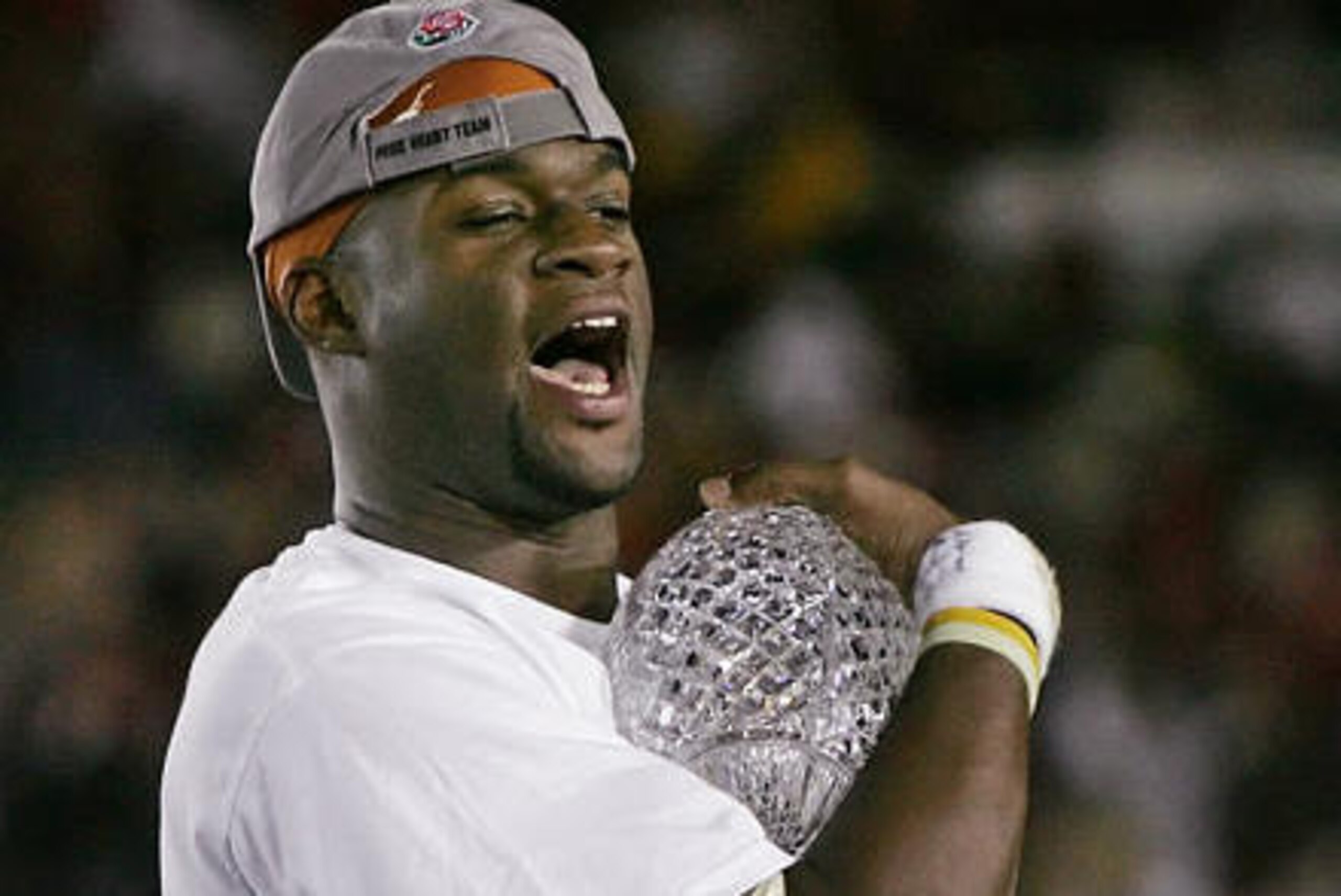
As the confetti fell to the floor of the Rose Bowl on the night of January 4, 2006 and the Longhorns celebrated their first national football title in 35 years, many believed the program had not only put an end to a USC dynasty, but started one of its own. Ten-win seasons and top-ranked recruiting classes had become the norm under former head coach Mack Brown at that point. Title ring in hand, life was good and trending better in Austin, Texas.
But that was 10 years ago. As some Texans have discovered in the decade since, college football is a fickle beast.
Just four years after Vince Young’s gallant sprint into the Rose Bowl’s south end zone, the Horns saw their fortunes reversed on the other end of the same historic locale. On January 7, 2010, in a split-second play, Alabama defensive lineman Marcell Dareus dug his helmet into Colt McCoy’s shoulder pads, knocking down the Texas quarterback. By extension, he also knocked the Longhorns out of the 2010 BCS National Championship Game.
Texas football simply has never been the same since. Ten years after Mack Brown's only national title, Texas finds itself faced with yet another long offseason and an identity crisis of the highest order.
“It’s been horribly frustrating. You saw the writing on the wall when you go 5-7 in 2010. You generally don’t just turn things around. We delayed the inevitable (in firing Brown), and it turned into a Bobby Bowden situation where the guy stayed too long and set us back,” one booster told Bleacher Report. “In past years, especially when Mack couldn’t beat Bob Stoops, it was always, ‘Well, we were one win away.’ Nobody sees it that way now.”
Former Texas athletic director DeLoss Dodds famously quipped years ago that the Longhorns didn’t just want to keep up with the Joneses—they were the Joneses. While that sentiment still exists deep down in the hearts and minds of many at the school, the reality is Forbes’ most valuable college football team is light-years from being able to compete with the Alabamas and Clemsons of the world on the field.
Try telling somebody that back in 2005.
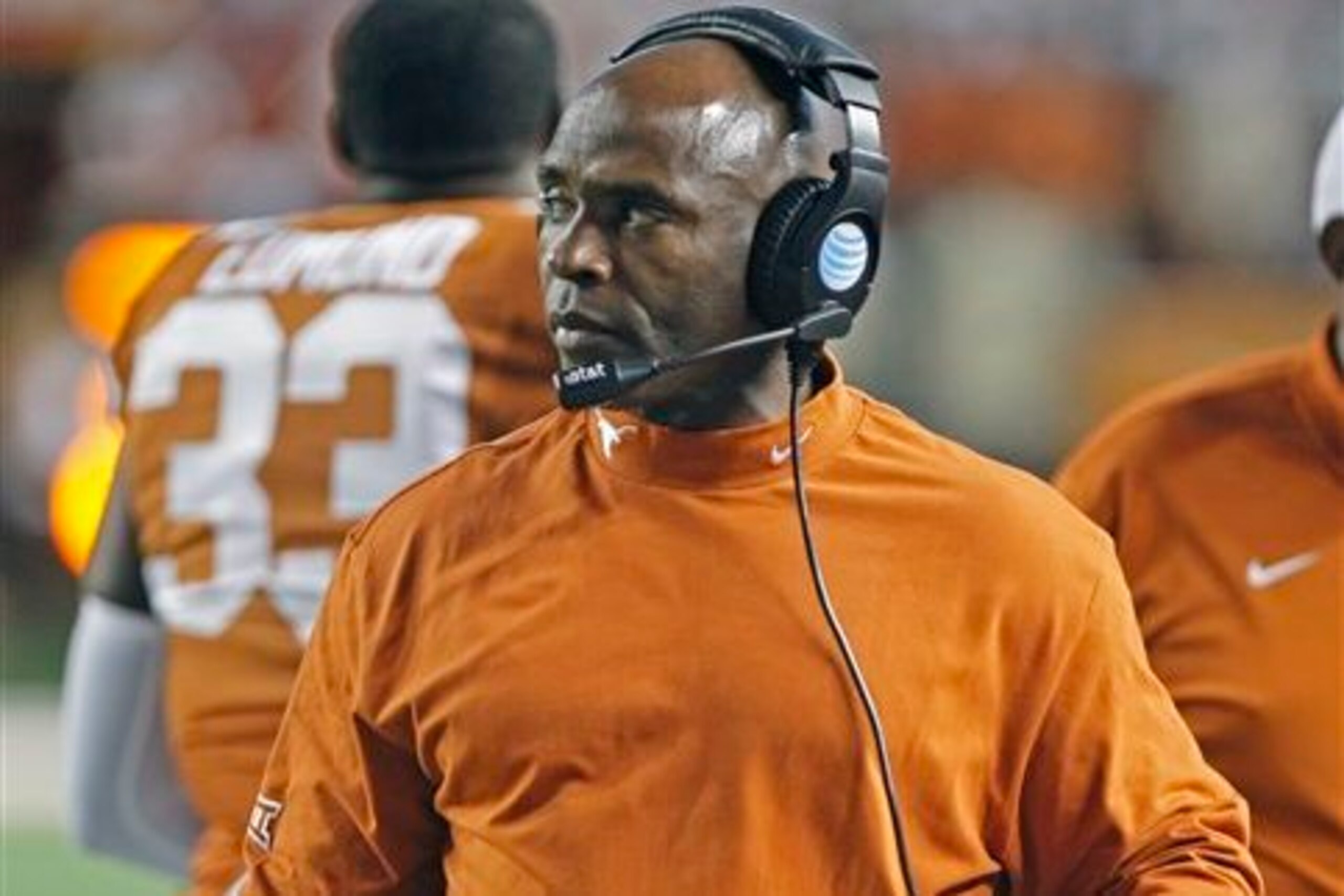
2015 was a rough year in Austin. The Longhorns went 5-7, fired AD Steve Patterson, demoted and dismissed offensive coordinator Shawn Watson, lost four games by 18 or more points and missed out on a bowl game for only the third time in 20 years.
To add insult to injury, Oklahoma won the Big 12 and a berth in the College Football Playoff. And traditional Lone Star State doormats, Baylor and TCU, spent most of the season in the Top 10.
Longhorns head coach Charlie Strong's two-year reign has led to a bewildering 11-14 record and plenty of questions around the Forty Acres. Is Strong really the right guy to turn things around? Is there another McCoy or Young ready to take over at quarterback? Why is Texas ranked behind Mississippi State and Maryland in the 247Sports recruiting rankings?
More than anything, many fans and boosters just want to know when the Joneses will start driving the Cadillac around again.
The Issue with the Jimmys and Joes
Four months after moving to Austin and taking over one of the top programs in the country, Charlie Strong was put in an awkward position.
The 2014 NFL draft was well underway in New York City, and Strong watched on television with millions of others as three of his former Louisville players were taken in the first round, including quarterback Teddy Bridgewater. It was cause for celebration for the incoming staff, which had recently concluded its first set of spring practices with the Longhorns.
It’s typically the case that a program’s sports information office will make a big deal about a new coach’s development of players at his old school. By the time the draft had wrapped up, however, it had become shockingly clear that the program would have little else to promote.
That draft in 2014 snapped the Longhorns’ 77-year streak of producing an NFL draft pick, a loud and clear microcosm of the program’s issues at the time. Not even Big 12 Defensive Player of the Year Jackson Jeffcoat heard his name called that weekend, allowing Texas to be lumped in with Kansas, Illinois and Northwestern as the teams without a player selected.

Strong is no doubt where the buck stops when it comes to the football team’s ultimate record on the field, but the situation he is in, as evidenced by that swing and miss in the 2014 draft, is not entirely his doing. As a matter of fact, cracks in the foundation of the program started appearing before Strong had even started his tenure at Louisville.
Roster turnover has been a recurring news item ever since the new staff strolled into Austin. Seven players were dismissed before the Longhorns had even played a down under their new coach. All of those players came from Brown’s final few recruiting classes, which were highly ranked by pundits at the time but failed to live up to expectations.
In fact, of Brown’s final set of recruits from just three years ago, only six are still on the UT roster, and no more than two of those are expected to see significant action or start during the upcoming 2016 season.
“I really don’t,” Brown told the San Antonio Express-News' Tim Griffin regarding whether he feels responsible for the team's talent base this year. “I think if that was the case, our first year, we would have had to give all the credit to John Mackovic. So, to me, that’s happens when you change. Change is very unique. Sometimes it works great immediately. Sometimes it takes a while. Last year, it didn’t work. There were suspensions, changes, injuries and transfers.”
Perhaps most noticeable has been the failure to land a quality signal-caller. After a seven-year stretch in which two historically great college quarterbacks manned the position, the Longhorns—centrally located in an area where high school quarterbacks grow on trees—have had a revolving door under center ever since McCoy’s shoulder went limp against Alabama.
Combined with the misses from previous recruiting classes, the situation on offense has gone south in a hurry for a team that once was a regular in most major statistical categories.
“Texas barely shows up on our master list of prospects to scout this year,” one AFC executive told NFL Media's Lance Zierlein about this year’s team. “Vince Lombardi couldn't do anything with the guys they have on offense."

Likewise, who wasn’t playing in burnt orange became a running joke around college football. Both Robert Griffin III and Johnny Manziel returned to the Lone Star State toting a Heisman Trophy—only they didn’t win the award playing in Austin. They did so in Waco, Texas and College Station, Texas, respectively.
Add to this shifts in the Big 12 and the departure of Texas A&M to the Southeastern Conference, and the landscape has changed significantly across the state almost overnight. Long gone are the days when there was one indisputable program at the top of the recruiting rankings and the Horns had a top-five recruiting class locked up two years before national signing day.
“Not too long ago, if you were the best player in the state, there was no question where you were going, it was UT, or maybe A&M. You’re not seeing that anymore,” said one high school coach in the Houston area. “It has been pretty unbelievable to go from where every kid dreams of being a Longhorn to now, where kids prefer Baylor or TCU over Texas.”
“With any program, football is driven with quarterbacks. You look at the great ones, they’re driven by a good quarterback and a good defense. It’s been tough in Austin at being consistent at quarterback,” added Joey McGuire, who has won multiple state titles at Cedar Hill High and turned down a spot on Strong’s staff after last season. “If they can develop the quarterbacks they have, that will make a big difference.”
That’s the expectation going forward with the current situation. Jerrod Heard has shown promise at quarterback, despite being thrown into the fire midseason in 2015. Backup QB Tyrone Swoopes appears to have found his niche in a special package that utilizes his size and running ability. Neither has been mistaken for the second coming of Vince Young, but the recent change in coordinators could benefit both enormously.
Add to that pair wideout John Burt, who has turned into a big-play threat with every touch and led the team in receiving as a true freshman. Offensive linemen Connor Williams and Patrick Vahe each garnered several Freshman All-American honors for their play, and running backs D’Onta Foreman and Chris Warren were both underclassmen.
That doesn't even include linebacker Malik Jefferson, who appears destined to become a first-round draft pick down the road.
The Savior Is Here, You Just Don’t Know Him Yet
If you don't know the name Sterlin Gilbert, now is the time to learn.
After a much-publicized search, the former Tulsa co-offensive coordinator was brought on as the Longhorns' new offensive coordinator. A former high school coach in the state who has just four seasons as a full-time college coach on his resume, the even-keeled Gilbert has risen through the ranks to his current position for a reason.
His task is simple but daunting: Rebuild the Texas offense from scratch, aligning the flagship college program with the offense that many of the state’s high schools run, and channel the principles Art Briles used to turn Houston and Baylor into title contenders.
Gilbert initially connected with Briles back in 2003, when the latter first took over the Cougars, scoring a non-paying gig at one of their first summer camps. The two-week stint by the former Angelo State star turned into a graduate assistant offer the following year and the chance to learn from Briles, current Tulsa head coach Philip Montgomery and several others.
“Everybody knows what GAs make—or don’t make—but all I wanted to was get around those guys,” Gilbert told Bleacher Report in a phone interview. “I knew they were men of high character and I was just excited to be in that circle and to learn from them.”
A successful quarterback in high school and college who had grown up throwing the ball around in an era when that wasn’t quite commonplace in Texas, the exposure to Briles’ spread out of the shotgun was slightly different from the one-tailback, one-tight-end, three-wide look Gilbert had been used to operating in during prior stops.
The end result is a unique take on offense that will debut next season on the big stage at home against Notre Dame. While some may expect a carbon copy of what they're running in Waco, that won’t exactly be the case in Austin under Gilbert, no matter what personnel is taking the field.
“We want to spread it out, throw the ball around and have some fun. Also, it’s having a good run game to go along with that,” he said. “When you say the word spread, people think you throw it nine out of 10 times. That’s not necessarily the case with us. We try to get around 50-50 or 60-40 to try and make things balanced.”
Though he did not call plays last season at Tulsa, Gilbert does have play-calling experience from his time at both Bowling Green and Eastern Illinois. His time in the Land of Lincoln is particularly notable, as the Panthers led all of FCS in yards and points in 2013 and finished in the top 10 in both categories the year prior. Not to mention his quarterback, Jimmy Garoppolo, won the Walter Payton Award (FCS version of the Heisman Trophy) and was drafted in the second round by the New England Patriots.
The situation Gilbert inherits on the Forty Acres is a different animal altogether, however, and not just because it’s a major step up from his prior coaching stops.
Texas averaged just 26.4 points per game this year, despite playing seven defenses ranked 80th or worse in points allowed. While there is still a sense that 2016 may bring more of the same, there is at least a palpable feeling that things will be better offensively for the Longhorns for the first time under Strong, thanks mostly to the hire of Gilbert and offensive line coach Matt Mattox.
Multiple high school coaches around the state praised the values and work ethic that Strong has brought to the program, the latter a sharp contrast to the days of Mack Brown. Many noted that while the relationship between those around the state and the Longhorns’ current head coach started out a little rocky, things have gradually gotten better as he has adapted to how things are run in a football-mad region.
“When Coach Strong first got the job, I was at the regional meeting where he spoke to a bunch of high school coaches. I honestly didn’t feel that he quite embraced us and Texas high school football,” said one high school coach. “I think he’s starting to understand that relationship now. That may be the missing piece. If Texas wins, that’s a big win for Texas high school coaches.”
Some coaches pointed out that Strong, who has done the majority of his recruiting as an assistant and head coach in the state of Florida, may have simply taken a little while to adjust to exactly how the recruiting game is structured in the state.
“If you’re recruiting Texas, it’s a lot different than other states. You’re not talking to an insurance salesman who coaches the high school, you’re not talking to an uncle who doesn’t have to have a degree to go and coach,” added Cedar Hill’s McGuire. “These aren’t volunteers. In the state of Texas, if you’re in the schools, you’re a full-time employee as a coach. It’s a different dynamic than most states.
“Coach Strong will continue to build his program. He is an incredible man, and I think he can get it turned around. I think Sterlin will be a big part of that.”
Publicly and privately, it was not lost on those around the state that a former Texas high school coach would be taking the reins as offensive coordinator, either. That includes the man himself.
“Guys like Todd Dodge (at North Texas) and Art Briles really opened the doors for us Texas high school coaches. I remember seeing it and, as a young coach, it was something that was ingrained in my mind of something I wanted to was coach in college,” Gilbert remarked on his path to his new position from the days of being a lowly assistant at Springtown High northwest of Fort Worth. “In the last two years especially, it’s been a bit of a trend for guys to dip into the high school ranks in Texas and grab some really quality coaches. For the Texas high school football coaches, and I count myself as one since that’s the core of me, I think it’s huge.”
Politics and the Good Ol' Boys Club
The elephant in the room in Austin is what kind of latitude Strong, Gilbert and the rest of the staff will have to turn things around.
It is not just the record that has rankled fans and boosters. It is the way the team has lost the past two seasons that has contributed to thoughts of regime change sooner rather than later. Few powerhouses can stomach even one 5-7 season. Even fewer can tolerate half of a coach’s 14 losses coming by three touchdowns or more.
To say the seat will be hot for Strong in 2016 is an understatement.
There is already a vocal faction of boosters who have made it known they want a complete reset from the disastrous Patterson era. Calls this offseason for a new head coach were not limited to message boards and social media. They were also voiced behind the scenes, according to those with knowledge of the situation.
While more levelheaded boosters have bought into talk of another year of patience, the wait-and-see attitude with which some have approached the situation in Austin may not last through another mediocre campaign on the gridiron.
Such ambiguity surrounding the future of Texas football was part of the reason why UT President Greg Fenves and new athletic director Mike Perrin boarded a private plane earlier in the month with Strong to seal the deal on hiring Gilbert as offensive coordinator. Though cash outlays are of little concern at a program like the Longhorns, it speaks to the triumvirate’s commitment that they helped push through a pair of three-year deals for two young coaches totaling $1.4 million per season.
“That was huge,” said Gilbert of meeting with the school’s brass at his home prior to taking the job. “It just showed their commitment to the University of Texas, Coach Strong and the football program. It said it all when those guys showed up about their total commitment to making this thing work.”
Indeed, both Fenves and Perrin have flown in the face of popular public opinion by doing what they can publicly and privately to rally support for the embattled program. Neither one has been in power long (Fenves took over in June; Perrin in the middle of September), but they appear to be firmly in charge, making their own decisions and doing what they can to mend fences. Not every major supporter is all in, but patience heading into 2016 is the message most are receiving.
“The phrase is ‘optics’ nowadays. Is it the fact that it’s only been two years and that’s not enough time or it’s not fair? You do get the sense that Charlie is already gone after next year,” said one source close to the administration. “At the same time, I think there is a lot of deference going on to the president right now, who doesn’t want to make a change and wants stability in the program. There are a lot of other issues going on at the university right now.
“Football is important, but it’s not the headache [Fenves] wants right now. There is a tension there with boosters where if you only get six, seven wins next year that you may see a Civil War in Austin over the direction of the program.”
Disagreements among boosters at a major school are common, but few situations involve the kind of money, power and egos that are rife behind the scenes in a state as big as Texas. Complicating matters is the fact that the two centers of power in the state—Dallas and Houston—typically have conflicting interests when it comes to what happens with the university and the football team in particular. The push and pull between those in the two cities alone can sometimes swing as fast as the cars moving up and down Interstate 45.
Moreover, this is simply a critical time in Austin away from the field.
There are still lingering effects being felt on the Forty Acres from a years-long battle between political forces in the Statehouse, former president Bill Powers and the UT Board of Regents. Fenves himself has been knee-deep in the details of getting the Dell Medical School built, and the university is embroiled in a lawsuit regarding its admissions standards that has gone all the way to the U.S. Supreme Court.
There are also a handful of upcoming capital projects in athletics, most notably the potential for a new basketball arena, that will require both shrewd planning and plenty of fundraising.
Perrin, a lawyer with no administrative experience in college athletics before this fall, has agreed to a contract that will keep him in Austin until 2018. His reputation in various circles prior to his appointment was outstanding, even among those that did not know him personally. His swift work in helping secure a record renewal of the school’s Nike contract (at a whopping $250 million over 15 years) as his first major order of business seems to have won over the rest of the folks who were previously on the fence about their new athletic director.
A three-year letterman for the Longhorns defense, Perrin understands a thing or two about the program and what it takes to turn things around. He saw up close in the late 1960s how famed coach Darrell Royal changed offensive styles and took Texas from a spell of mediocrity to a national championship.
"Whether that will happen here, who knows?" Perrin told the Houston Chronicle's David Barron this week. "This is such a different time frame. Students are used to instant gratification. They are instant celebrities in high school with Twitter and selfies.
"It's a totally different thing, but I believe having seen how things can shift … I know what can happen."
Will Charlie Strong be able to turn 11-14 into 41-11 over the next few years? Given the resources at a school like Texas and some of the coaching jobs on his resume prior to coming to Austin, nobody is quite putting it past him. Still, it could take a minimum of nine wins in 2016 to convince those who sit in the box seats that things are trending in the right direction.
There are some quality, young pieces already clad in burnt orange and a handful of encouraging signs that the worst of the program’s days are behind it. Those who have more than a short-term memory know that all the optimism in the world may not translate to actual results on the field.
College football is a volatile sport in which a program’s trajectory can be derailed with just one snap.
Ten years after reaching the high-water mark of a national championship, Texas knows that all too well as it looks toward an uncertain future.
Bryan Fischer is a national college football columnist for Bleacher Report. You can follow him on Twitter at @BryanDFischer.
_0.png?w=2560)


.jpg?w=2560 "Grading WWE Raw 🔠")


.jpg?w=2560 "Viral Rams Coach Vid 🖕")


