

Why I Voted for Christian McCaffrey to Win 2015 Heisman Trophy
The week after the regular season concludes and all the conference championship trophies are handed out, the college football world descends upon New York City for a week full of festivities.
It’s a fantastic time to celebrate the sport we all love, and the highlight is always on Saturday night, when the Heisman Trophy is handed out to the nation’s most outstanding college football player.
As many saw on ESPN, Alabama running back Derrick Henry received the 81st edition of the trophy.
TOP NEWS

Updated CFP Bracket Projections 🔮

Latest CFB AP poll rankings
Top Overreactions after Week 5 of CFB Season 😧
The Heisman Trust noted 929 ballots were handed out this year to vote for the award. It's an undeniably high number, but one that is filled with former winners, media members and one vote based on the results of fan voting. As has been the case for the past several years, I was once again honored to cast my vote for who I thought deserved the award.
Like many of my peers, I believed as many as a half-dozen players could make the claim that they were the most outstanding in college football this season. It was simply that kind of year. Since there was no landslide winner like Marcus Mariota or Cam Newton, who was such an obvious choice, voters had to parse through a number of astonishing efforts put forth on the football field.

Look at who wasn’t even in New York as a finalist to understand what an incredibly deep field it was.
Though LSU running back Leonard Fournette looked like the prohibitive favorite to win the award back in September and October, he became somewhat of an afterthought by the time voting came around. Florida State’s Dalvin Cook was hampered by injuries but still managed to finish sixth in the country in rushing on just 211 carries—over 100 fewer than either Christian McCaffrey or Derrick Henry.
Defensively, one could make an argument for Ohio State defensive end Joey Bosa, Penn State defensive lineman Carl Nassib, Alabama linebacker Reggie Ragland or even Oregon’s DeForest Buckner. While it’s hard for defensive players to even be seriously considered for the award (sadly, I might add), each could have garnered quite a few votes had it not been a year like this one.
Then there was the case of Navy quarterback Keenan Reynolds, who was the focus of a massive Midshipmen public-relations push (even family friends in the Navy were emailing me to vote for Reynolds). I think a lot of the sentiment regarding the triple-option quarterback making it to the Heisman ceremony was due in part as a career achievement recognition—which is not what the Heisman is for—as a result of him setting the FBS record for career rushing touchdowns.
That career mark aside, I did find Reynolds to have an outstanding season in nearly leading Navy to the American Athletic title game in the team’s first season in the league. It would have been fantastic to see him helicopter from the Army/Navy game in Philadelphia to the ceremony, but alas, he did not make the cut as a finalist.
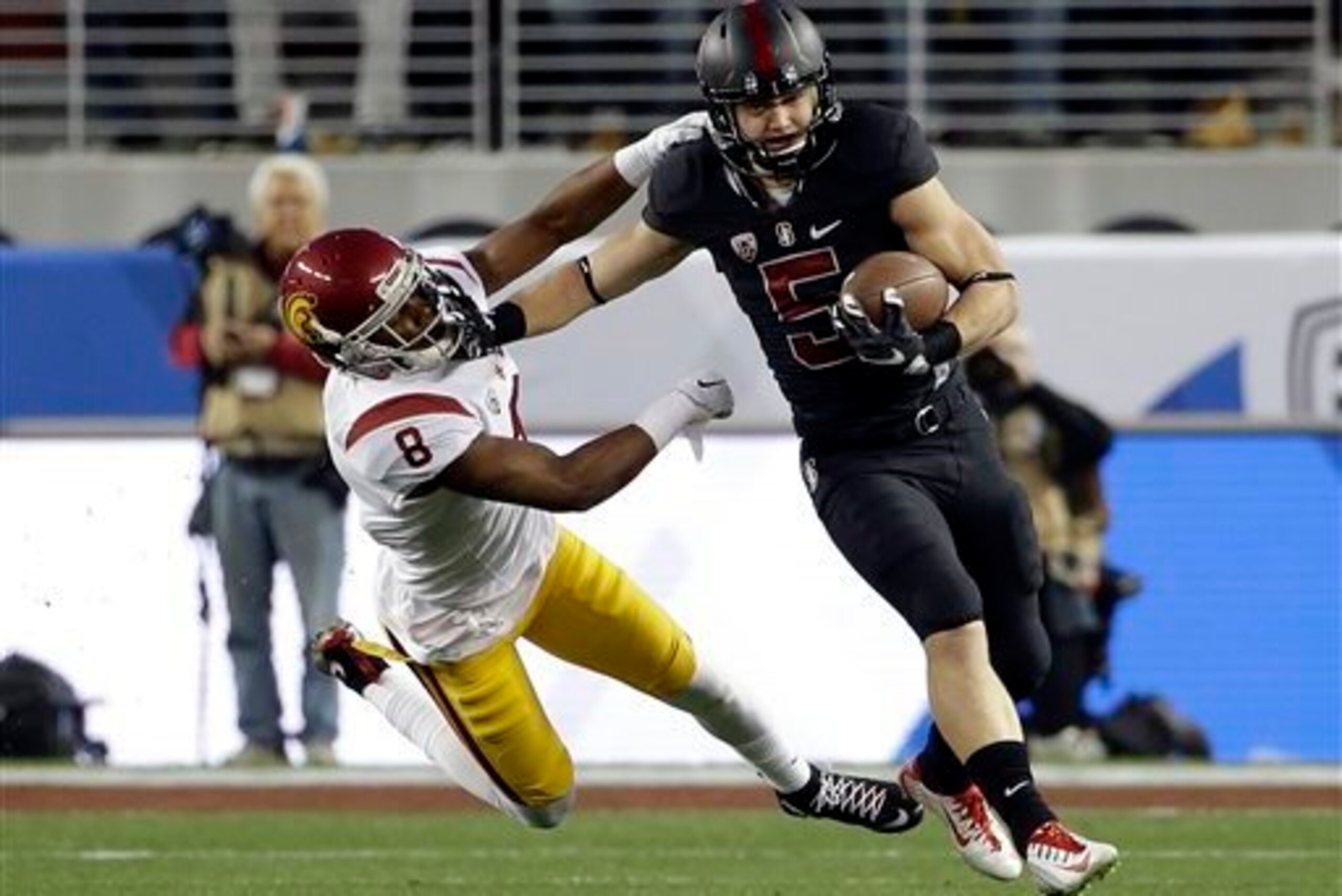
For those who do not know, you are presented with three options when filling out your ballot. While you felt like there should have been 10 spots to fill in players' names this season, you only get three. When presented the opportunity, I cast my first-place vote for Stanford running back Christian McCaffrey as the most outstanding player in the country.
There will surely be more than a few snarky comments cast my way on social media from those in the South as a result but, in my mind, it was hard to rationalize the other candidates ahead of McCaffrey.
Simply as a running back, his 319 carries for 1,847 yards and eight scores stacked up favorably with past Heisman winners, including a better average per rush than USC’s Marcus Allen in 1981, and he racked up over 150 more rushing yards than Archie Griffin in either of his two Heisman-winning seasons. McCaffrey had more total yardage on the ground than the last running back to win the award, Mark Ingram, too.
That’s astonishing company historically, to say nothing of his peers this season.
But what McCaffrey did in addition to his primary duties really enhanced his profile in my mind. He caught 41 passes for 540 yards (and four scores) this season, threw for two touchdowns and returned kicks for 1,042 yards and a score, making him a true all-purpose threat.
McCaffrey would have been a finalist for the Heisman simply because of what he was able to do on the ground as Stanford’s top rushing threat. Because of what he also did through the air and on special teams, he deserved to take home the trophy.
Put another way, no person in college football history has racked up more yardage in a single season than McCaffrey. Ever. He broke Barry Sanders’ single-season FBS record for all-purpose yardage (3,250).
While Sanders was often rested in the fourth quarter, had a greater share of rushing yards and hit the mark in two fewer games, McCaffrey bested Sanders’ mark in fewer touches. Sanders' record stood for 27 years, as it took a special player and a special season like McCaffrey had to finally break it.
More than anything, McCaffrey saved his best for last. On the biggest stage of the season, at the Pac-12 Championship Game, he racked up 461 all-purpose yards. Highlighting his ability to embarrass the USC defense in every way possible, he found the end zone via a rushing touchdown, receiving touchdown and a touchdown pass.
Had McCaffrey been putting up his numbers in a Trojans uniform instead of the Cardinal one, he would have been a shoo-in for the Heisman. Had he not played the vast majority of his games after 10 p.m. on the East Coast, he also would have been a shoo-in. Instead, he found himself in one of the closest votes in years with his fellow finalists.

The eventual winner, Henry, was in second place on my ballot, not just because he nearly hit the 2,000-yard mark in the punishing SEC but because of his ability to, at times, simply demoralize opponents when running the football.
The massive back broke Hershel Walker’s 34-year-old record for rushing yards in the nation’s premiere conference and was the biggest reason why Alabama finds itself in the College Football Playoff once again despite subpar play at quarterback.
He was, without a doubt, one of the country's most outstanding football players this season. But he was simply a tick behind McCaffrey in my mind.
Like the vast majority of voters who put the two running backs atop their ballot in some order, I struggled with who should be the third name. Florida State running back Cook was given plenty of consideration and Clemson’s Deshaun Watson was the best team's best player. In the end, I decided to go with Oklahoma signal-caller Baker Mayfield.
I had the chance to see him several times in person this season, and each time I was impressed with his ability to make the clutch throw when needed.
He did all the little things a quarterback needs to do in order to be successful and delivered several "wow" moments each game. His numbers were similar to Watson’s despite playing in one fewer game and sitting out the second half more. As much as anything, his ability to take Oklahoma from afterthought in its own conference to become perhaps the best team playing at the end of the year was both remarkable and truly outstanding.
It was tough this year to fill out a Heisman ballot, certainly the most difficult thing I have ever done in several years of voting. You would get no arguments from me if you advocated for Henry, McCaffrey, Watson, Mayfield or somebody else equally deserving.
There’s only one winner, however, so congratulations to Henry on a well-earned trophy and the fitting title of the nation's most outstanding college football player.
Bryan Fischer is a national college football columnist for Bleacher Report. You can follow him on Twitter at @BryanDFischer.
_0.png?w=2560)


.jpg?w=2560 "Grading WWE Raw 🔠")



.jpg?w=2560 "2 NFL Officials Suspended")

.jpg?w=2560 "Viral Rams Coach Vid 🖕")