

Why the Texas OC Vacancy Is the Most High Risk-High Reward Job Still Available
For head coach Charlie Strong, finding an offensive coordinator who can schematically put the Texas offense in a position to succeed isn't the hard part. The hard part is selling job security for more than a year.
Reportedly, Tulsa co-offensive coordinator and quarterbacks/wide receivers coach Sterlin Gilbert is willing to take that risk. Bobby Burton of 247Sports reported Thursday Gilbert "agreed to become Texas' offensive coordinator."
Texas, however, has not made an official announcement yet, and there are still reports that Gilbert will stay at Tulsa, according to ESPN.com's Gerry Hamilton. Still, it's easy to see why the Art Briles coaching tree is so coveted. And no one put it better than Briles himself, per ESPN.com's Joe Schad:
TOP NEWS
.jpg?w=2560 "AP Poll Top Five Week 9")
🚨 Week 8 AP Top 25 Poll

CFB Overreactions After Week 8 🧐
.png?w=2560)
B/R's CFB Playoff Bracket Predictions 🔮
Whether Gilbert is the guy or not, the larger point about the Longhorns moving into Year 3 of the Strong era remains the same. Strong is a defensive guy at heart, but the path to winning the Big 12 lies on offense. It has for some time. In short, Strong needs to get this hire right. His job likely depends upon it. As a result, so does everyone else's job. That creates a tremendous amount of risk.
For one, the track record for emergency hires hasn't always been great in recent years. Doug Nussmeier (Alabama to Michigan) and Kurt Roper (Duke to Florida) are examples of offensive coordinators brought in to revitalize one side of the ball. Both were part of fired coaching staffs after one season.
That's a lot of pressure to put on one assistant coach. Keep in mind, too, Nussmeier and Roper had plenty of play-calling experience. As B/R colleague Bryan Fischer noted, Strong's two targets (Gilbert and TCU's Sonny Cumbie) didn't call plays this past year:
The margin for error is small here. In 2015, Texas ranked 78th in points per drive, per BCFToys.com. (Tulsa, for the record, was 50th.) Though the Longhorns showed the ability to move the ball at times, there would also be long stretches in which they shut down entirely.
The offense has talented young players, though. The top two leading rushers, D'Onta Foreman and Chris Warren III, were a sophomore and a freshman, respectively. John Burt, the leading receiver, was a freshman. Quarterback Jerrod Heard was a redshirt freshman. Additionally, Texas has a redshirt freshman quarterback in Kai Locksley and an incoming freshman in 4-star quarterback Shane Buechele.
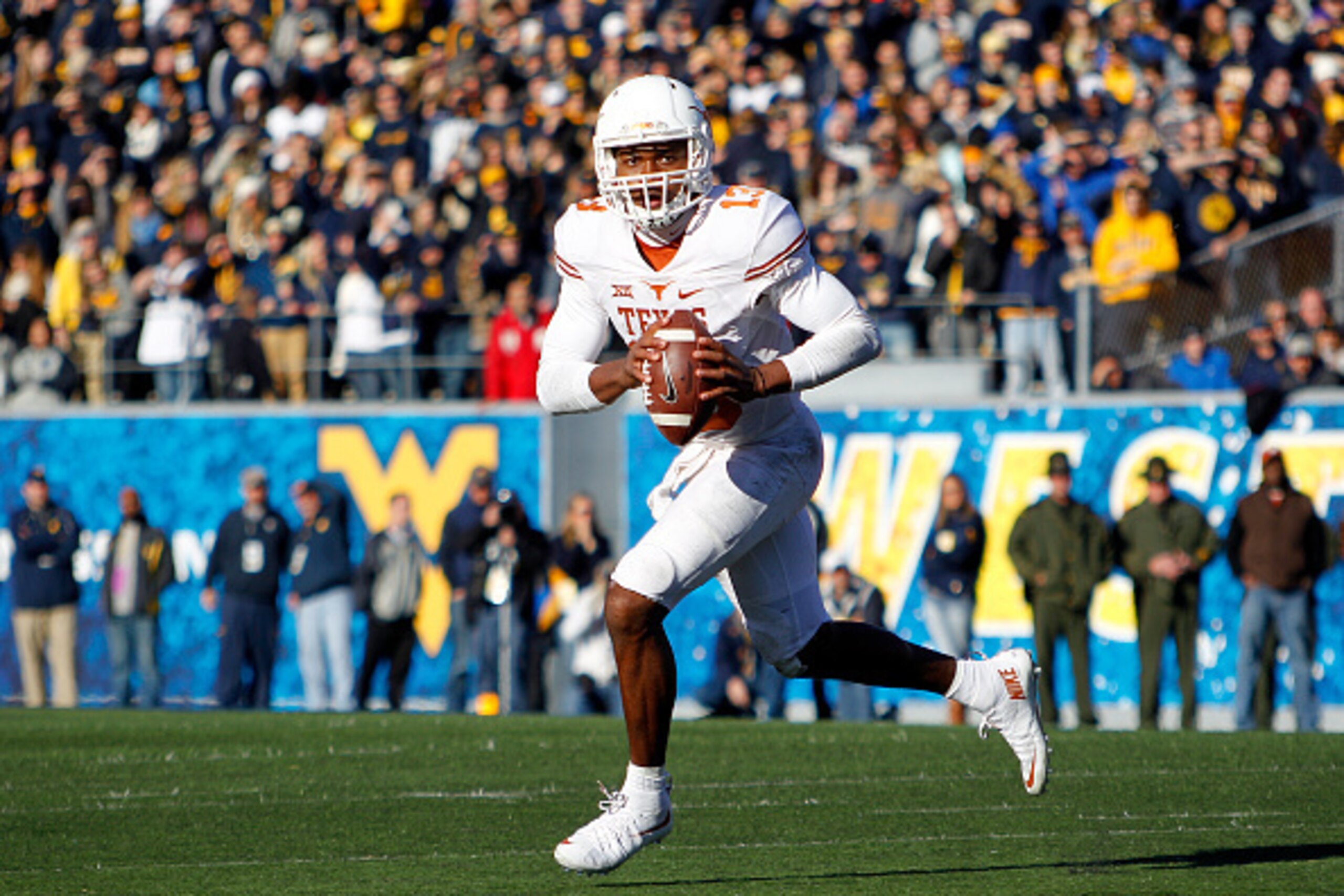
Therein lies the reward. If the new offensive coordinator comes in and turns around the offense with results similar to Doug Meacham and Sonny Cumbie at TCU, he'll be a savior. Texas could finally be "back." Plus, turn this offense around and the new OC could be in line to advance his own career as a head coach.
But those are big-picture goals. An instant turnaround on offense might be needed if for no other reason than the defense remains a work in progress. The Longhorns were historically bad on that side of the ball in 2015 by allowing more yards than any other unit in program history.
There are certainly signs that the defense will improve, however. Freshman linebacker Malik Jefferson was named the Defensive Freshman of the Year by Big 12 conference coaches. Multiple other defensive players were awarded Big 12 honorable mention spots. Still, it could be a year or two before this defense resembles the one Strong had in 2014.
Until then, an improved offense could do wonders. Yes, 2015 was a disaster for the Longhorns, but the difference between a 5-7 Texas and an 8-4 Texas was seven points. In two of Texas' three losses (to Cal and Texas Tech), the Horns scored at least 40 points. In other words, defense cost Texas more than offense, even though offense has been the more longstanding liability under Strong.
Looking ahead to next season, does 8-4 save Strong's job and buy him at least one more year? Probably, yes.
Of course, in a perfect world, Strong would get four years, maybe five, to rebuild Texas.
There are two different kinds of rebuilds, you see. There's the one in which the pieces (i.e., players, perhaps some key existing assistant coaches) are already generally in place. Then, it's up to the new coach to get those players to adjust to new systems and fill in the gaps with his recruits.
Then there's the kind Texas is undergoing with Strong. The second-year head coach has taken the program down to the studs by changing the internal culture of the program. He removed several players who didn't fall in line in Year 1 and then played numerous freshmen and sophomores in Year 2. Couple that with more attrition—center Jake Raulerson, a possible starter next season, announced this week he was transferring as a grad student—and the setbacks have been myriad.
This type of rebuild doesn't take a month. Or a year. Or even two years. As Mike Finger of the San Antonio Express-News noted, Strong was behind the proverbial chains to begin with:
But the reality is Strong won't get four or five years if he doesn't show considerable improvement on offense in 2016—not when Houston coach Tom Herman is hanging out a few hours down the road, waiting to take the job of his lifetime.
So it's up to Gilbert, or whomever comes in, to almost single-handedly turn the corner of the program. To that, we say good luck. Succeed and you'll be part of one of the great turnarounds in college football. Fail and you're looking for a new job.
Ben Kercheval is a lead writer for college football. All quotes cited unless obtained firsthand. All stats courtesy of cfbstats.com unless noted otherwise.

.jpg?w=2560)


.jpg?w=2560 "Raiders Could Start Mendoza")


.jpg?w=2560 "Ugly Jets Scoring Stat 😳")
.jpg?w=2560 "Rodgers Iced Out on Plane 💎")
