

What's Wrong with Anthony Davis and the Pelicans to Start 2015-16 NBA Season?
It was the best of times, it was the worst of times for Anthony Davis and the New Orleans Pelicans.
The worst, because getting swept by the Golden State Warriors in his first playoffs series probably stunk. The best, because the Brow put on a clinic against the eventual champions, particularly in Game 4.
His jumpers? Wet. His face-up drives? Quick and decisive. His post-ups? Spin-tastic.
TOP NEWS

LeBron's Special Helicopter Deal

MJ Makes Record-Setting Donation 🙌
Shams: KAT, Hart Could Be Trade Names
Davis did everything he could, short of dousing Stephen Curry with a bucket of bayou water, to keep the Pelicans within striking distance. He finished that night with 36 points on 14-of-20 shooting, 11 rebounds, an assist and three blocks in just over 40 minutes of action. It wasn't enough to stave off a 109-98 defeat, but it did start many around the NBA, including SB Nation's Oleh Kosel, salivating over his potential:
"Anthony Davis has truly started down the path of one of the most complete AND efficient scorers that may ever grace the NBA playoff landscape. His athleticism allows him to score easily around the rim. If you foul him, he's probably going to make both free throws. And his range? It's knocking on the door of Dirk Nowitzki at the ripe age of 22.
"
The Pelicans' decision to replace the old-school Monty Williams on the bench with the innovative Alvin Gentry over the summer only added to the anticipation. So did the work Davis put in during the offseason to extend his shooting range and bulk up his wiry 6'10" frame.
Naturally, then, Davis would spend opening night of the 2015-16 season dominating practically the same Golden State squad he saw in the spring...right?
The result was similar (a double-digit defeat), as was Davis' shot total (20). Other than that, it was a tale of two very different games.
His jumpers? Tentative, contested and often off the dribble.
His drives? Slow to develop, even slower to produce.
His post-ups? Crowded in the middle, with a heavy lean toward the baseline.
Of the first 16 shots Davis took, 15 went wanting. He finished the night 4-of-20 from the field—one of the worst shooting nights of his pro career—with nearly as many turnovers (five) as rebounds (six).
As shockingly subpar as that performance was for Davis, his subsequent struggles have been even more troubling. His counting stats (20.8 points, 10 rebounds, 1.8 assists, three blocks) aren't all that different, but he's missing the mark far more often (37.9 percent shooting from the field) and turning the ball over (three per game) more than twice as often as he did last season.
In turn, the Pelicans are suffering too. According to NBA.com, they're one of two teams, along with the Brooklyn Nets, languishing among the bottom five in both offensive and defensive efficiency.
Both squads have yet to scratch in the win column. But Brooklyn, at least, has the benefit of playing in the East, where a slow start can merely be a bump in the road to the postseason. Out West, any extended blip, even one in October and November, can doom a team to the lottery.
Just ask the Oklahoma City Thunder, who started the 2014-15 campaign at 3-12 amidst the absences of Kevin Durant and Russell Westbrook before losing the eighth seed on a season-series tiebreaker to...New Orleans.
So what's plaguing these Pelicans? Why can't they seem to soar, after finally taking flight last season?
Like last year's OKC squad, New Orleans has been plagued with more injuries than Joel Edgerton's rendition of Ramses. The Pelicans opened their season in Oakland without their starting center (Omer Asik), their top playmaker (Tyreke Evans), their most reliable wing shooter (Quincy Pondexter) and their backup point guard (Norris Cole).
The last of those may seem trivial, until you consider that Jrue Holiday, the starter at the 1, has been on a minutes restriction while he works his way back from another leg injury suffered in 2014-15.
That lengthy injury report has taken a toll on the entire team, but on no single player more than Davis.
Without Asik, he has to spend more time at center, where, despite his offseason workout plan (presumably based on Kanye's), he remains somewhat undersized. Without Pondexter, the Pelicans are short a sharpshooter who can draw defenders away from Davis.
"AD needs space," said Holiday after New Orleans' 103-94 loss to the Orlando Magic (via Pelicans.com's Jim Eichenhofer). "Every time he touches the ball, he’s going to have at least three guys on him."
With Holiday hindered and Cole in recovery, the Brow has to become more of a playmaker—a role in which his skills are still under construction.
"I've just got to find the [open] guy, try to make the right play, which I'm trying to do," Davis said (via Pelicans.com). "Then it's on the guys to knock down the shots. Once they do that, then [the defense] can't double- and triple-team as much, because we have guys who can shoot the ball."
On that count, Davis is correct. Even without Pondexter, the Pelicans can (or should) stretch opposing defenses with a slew of capable shooters.
But the biggest blow of all to both the Brow and New Orleans has less to do with space and more with who else is (or isn't) using it to attack the basket. For better or worse, Evans is probably the best on-ball playmaker in the Pelicans' pod. Last season, the Memphis product finished a close second on the team in usage, behind Davis, and an even closer second in assists per game, behind Holiday.
Of all the Pelicans, though, Evans was far and away the most aggressive when it came to attacking the basket off the dribble. According to NBA.com, he ranked second in the entire league in drives per game in 2014-15:
| Tyreke Evans | 11.8 | 2nd | 57.6% | 30.1% |
| Jrue Holiday | 8.4 | 17th | 64.7% | 34.4% |
| Eric Gordon | 5.1 | 52nd | 60.9% | 25.6% |
| Norris Cole | 4.4 | 69th | 39.1% | 45.2% |
Evans' passing and driving both had a particularly profound effect on Davis. According to Kirk Goldsberry, writing for the now-defunct Grantland, a quarter of Davis' shots in 2014-15 came off passes from Evans, and he converted a whopping 58 percent of them.
Even when Evans was out for his own offense, he was putting Davis in position to produce and juicing New Orleans' offense. As Goldsberry explained:
"Almost three-quarters of his close-range attempts resulted in either a bucket or a fresh 24 via an offensive board. Remember, possessions that begin with offensive rebounds are extremely valuable (1.22 points per possession leaguewide), so guys who create those possessions at abnormal rates should be identified as valued, albeit unconventional, playmakers.
As a drive-happy wing with a mediocre jumper, Evans is about as unconventional as they come. He led the NBA in Kobe Assists last season, thanks in large part to human Hoover vacuums Davis and Omer Asik.
"
Evans might not have had such a heavy hand in the Pelicans offense had Holiday stayed healthy. What's clear, though, is that his absence—along with those of Asik, Pondexter, Cole and now Kendrick Perkins—is dragging down Davis' performance and, in turn, the Pelicans' overall attack.
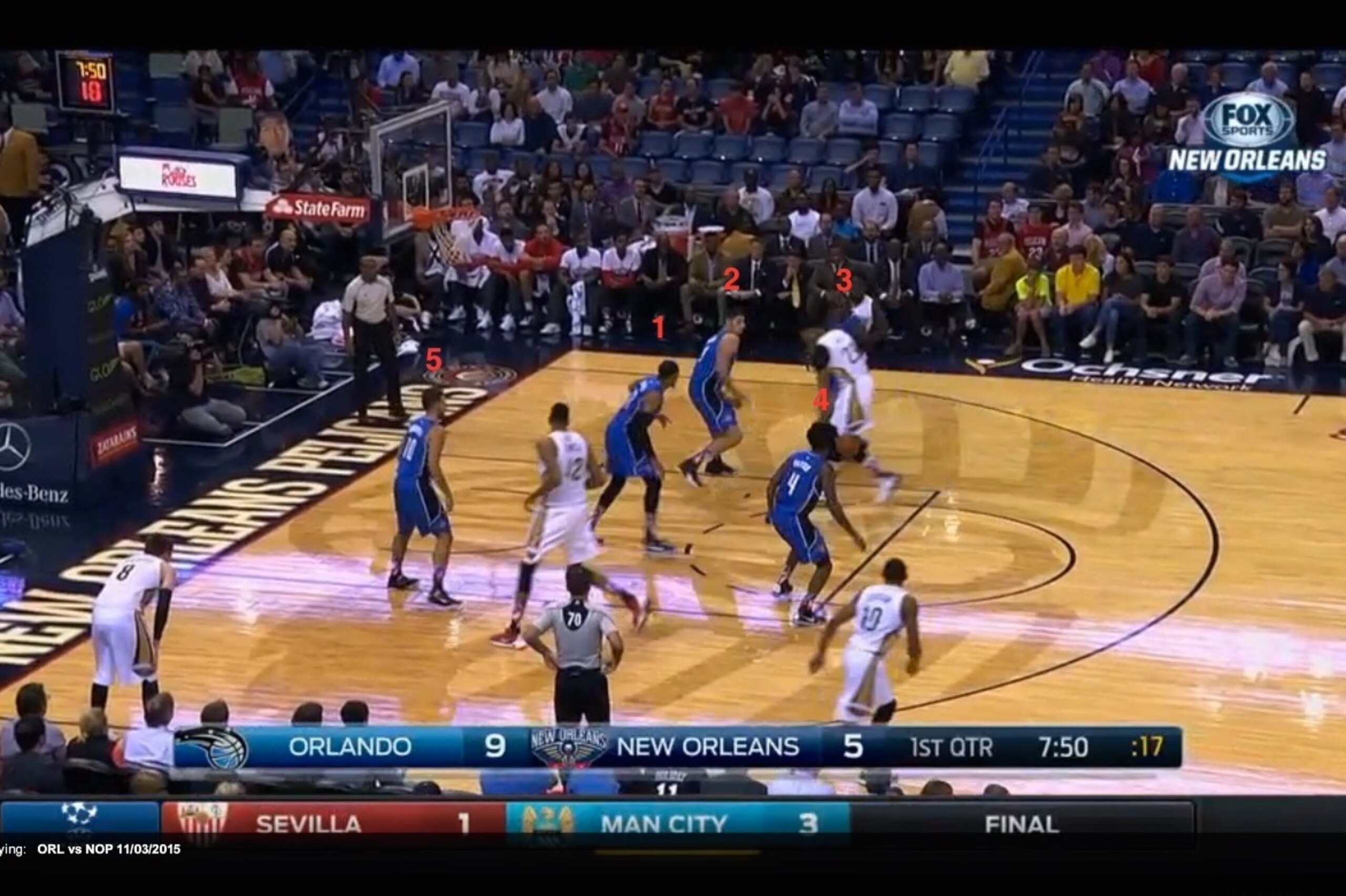
The Magic, for one, were free to smother Davis like crawfish in a boil. They tracked his every move and double- and triple-teamed him in a concerted effort to keep the ball out of his hands. Here, the Pelicans manage to get a post-up on the left block, but for Alexis Ajinca, not for Davis:
New Orleans clearly wanted to put Davis in position to score, but the shot clock is only so long, and there's only so much the team could do with Orlando's defense breathing down the Brow's neck.
The same thing happens on this possession. The Pelicans try to set up Davis for a score but are only able to do so after an offensive rebound. Even then, the look Davis gets is a difficult one:
Anytime New Orleans so much as thought about finding Davis, Orlando had multiple defenders ready to disrupt, like on this pick-and-roll that resulted in a turnover:
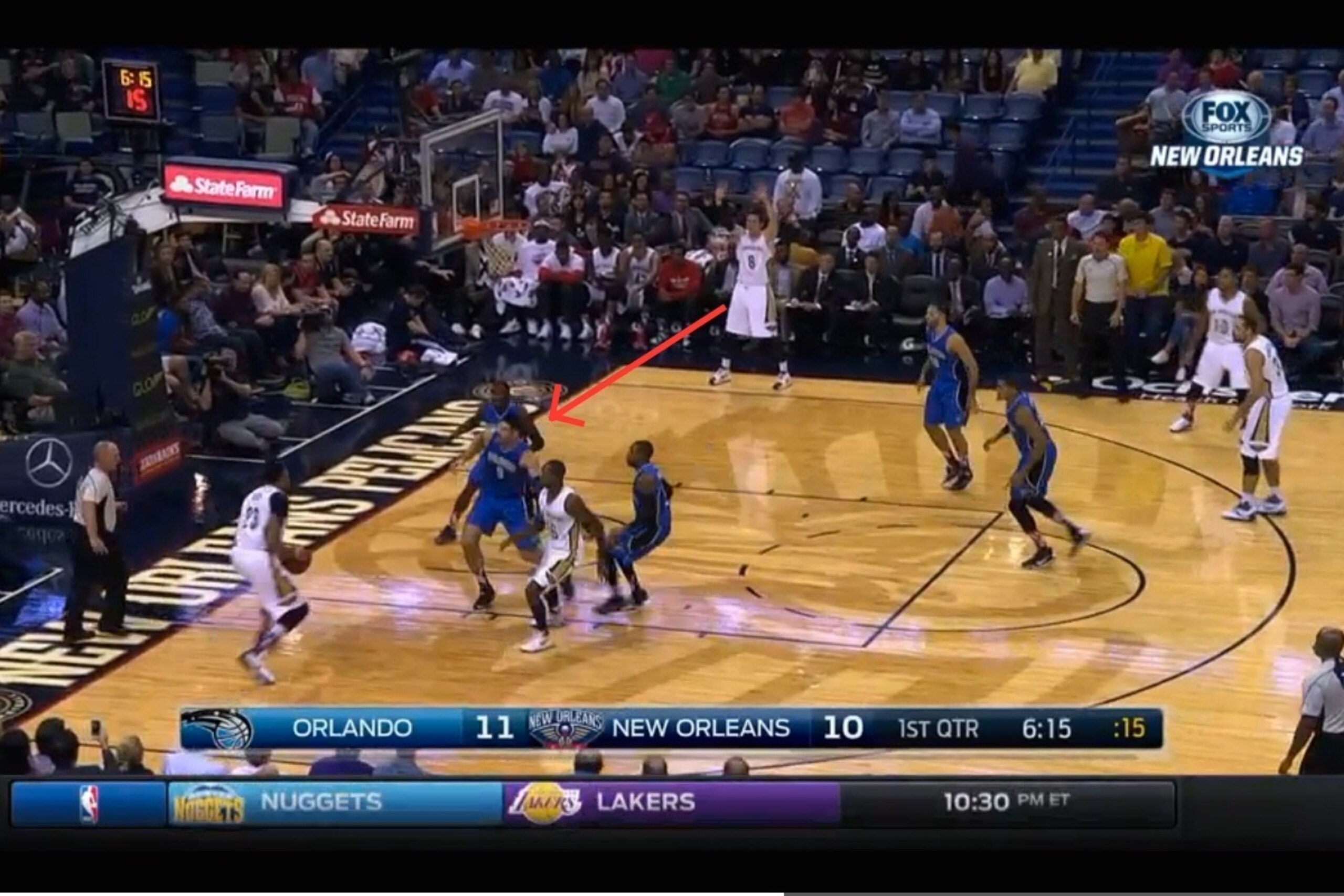
The few times the Pelicans were able to sneak the rock into Davis' mitts, his options were less than ideal. Time and again, the Magic cheated off their marks to gum up the middle of the floor and force Davis into tough baseline looks:
Davis can make things happen from those parts of the court, but not when there are two or three sets of arms squeezing him into a box:
And not when the opposition doesn't mind abandoning Luke Babbitt in the corner to cut a potential baseline drive into a contested jumper:
Davis finished the game with a mere 12 attempts, eight of which were jump shots and only three of which went through the net. That performance fit an early pattern for the Brow, of extra defensive attention leading to fewer shots inside and more in the mid-range.
The result? An abysmal 37.9 percent shooting from the field so far for the Brow.
Eventually, Pelicans opponents will have to think twice about ditching their defensive assignments. Evans hopes to be back in the lineup in about a month, per USA Today's Sam Amick. Asik should be back soon, assuming the discomfort in his calf abates. According to the Advocate's Brett Dawson, the team expects Pondexter to return from offseason knee surgery before November is through.
By the time Cole comes back from his high ankle sprain, Holiday could be close to capable of playing 30-35 minutes. As for Perkins, his pectoral problems won't be so impactful upon Asik's return.
Having a healthy roster figures to make a massive difference for the Pelicans and open things up a bit for Davis. But the Brow can't count on cleaner looks and less defensive attention, regardless of who his running mates are. Barring the arrival of another superstar in the Crescent City, slowing down Davis will be the first, second, third and perhaps even fourth item on every foe's game plan. As Gentry explained on Pelicans.com:
"You've got to understand that as long as he's out there, if we throw him the ball in the post, (the defense is) going to double him. That's what we're going to see and now we've got to figure out a way to play out of that, because I don't think there's anybody that’s just going to play him straight up (with a single defender). So he's going to get doubled and triple-teamed... He's going to see it most of the year. We've got to figure out how we can still get him involved in the offense and still have an offensive flow, without having the ball stick and become an isolation team.
"
That should change in time. Gentry's fast-paced, pass-happy offense is as new to Davis as it is to everyone else in New Orleans. Once the Pelicans' weapons get a chance to play together again, they won't likely have much trouble putting the ball in the basket. They scored at a top-10 clip last season, when Williams had his guys playing at a snail's pace.
New Orleans' bigger problems may well come on the defensive end. The Pelicans skated by with a bottom-10 defense last season, and they won't improve on that performance until assistant coach Darren Erman can impart his principles upon a healthy roster.
Davis will have to adjust to the new scheme as well. The Pelicans plan to use him less as a standalone shot-blocker and more as a perimeter pest.
"I think most of the teams now really feel like that stretch 4 or that hybrid 4, whatever you want to call him, a guy who can space the floor, that becomes a really valuable asset on the offensive end now," Gentry said (via Sporting News' Sean Deveney). "A guy like AD has to develop a sense of guarding guys who can get out on the perimeter and also guys who can put the ball on the floor some."
Doing so effectively will require more out of Davis, in terms of effort and execution, than he's shown thus far.
The Pelicans can ill afford any such lapses from here on out, regardless of who's available. In a Western Conference that's deep on title contenders and even deeper on quality veteran teams, even the slightest slip-up this early in the season could cost them dearly down the road.
They should know. New Orleans snuck into the 2015 postseason by the hair on Davis' chinny chin chin.
But after failing to win a single game therein, the Pelicans probably want to do more than just get in. Taking that all-important next step will be difficult for New Orleans.
It'll be nigh on impossible without better health and better effort from Davis on down, during the best of times, the worst of times and every time in between.
Josh Martin covers the NBA for Bleacher Report. Follow him on Twitter.

.jpg?w=2560 "Grading WWE Raw 🔠")

.jpg?w=2560 "Bijan's INSANE 1st Half 🤩")
.jpg?w=2560 "Viral Rams Coach Vid 🖕")
.jpg?w=2560 "Injury-stricken Seahawks signing veteran RB")

.jpg?w=2560 "2 NFL Officials Suspended")