

Despite Record, Minnesota Vikings Need More from Teddy Bridgewater
At 5-2, the Minnesota Vikings are in position to challenge for a playoff spot.
It's rare air for this franchise. Over the past three seasons, Minnesota has twice won seven games or fewer. Not only have the Vikings surpassed their recent standards, they are also one of just 11 teams this season with a winning record and one of only eight to have won at least five games.
Minnesota was expected to be here, but the path it took was anything but comfortable.

.jpg?w=2560 "Falcons Saints Football")
.jpg?w=2560 "Rams Eagles Football")
In Week 1, an extremely limited San Francisco 49ers team thoroughly dominated the Vikings on both sides of the ball. The offense scored just three points, while the defense allowed Carlos Hyde and Colin Kaepernick to put up 20. San Francisco has scored 20 or more points just twice in seven games since.
A big reason for the Vikings' relatively high expectations entering the season was their quarterback and running back combination. Adrian Peterson was returning after missing almost all of the 2014 season because of a suspension, and Teddy Bridgewater was expected to make a leap in his second season.
Peterson has been solid in his return to the field, but he's no longer one of the best running backs in the NFL. He is more reliant on his offensive line than ever:
Although Peterson is averaging 4.5 yards per carry, the Vikings running game as a whole has proved to be inefficient. According to Football Outsiders' DVOA metric, which measures efficiency, the Vikings had the 25th-best running game in the NFL through Week 7.
What is pulling Peterson's average up are his three 40-plus-yard runs this season.
It's clear he is effective when given space to work, but his offensive line can't consistently give him space, and he's less capable of creating yards after contact now. When Peterson last played the majority of a season, in 2013, he had three 40-plus-yard runs in 14 games (and 139 more carries).
Peterson misses Phil Loadholt and John Sullivan, the Vikings' two most talented offensive linemen, who are both out for the season. Loadholt in particular offered Peterson a presence to run behind. Those injuries have limited the running game to the point that the Vikings can't rely on it to carry their offense.
So far this season, they have been unable to rely on Bridgewater to carry the offense, either.
The quarterback hasn't played as poorly as his production suggests, but his inconsistency has been more notable this year than it was during his rookie season. It's unfair to put all the blame on him because the Vikings haven't given him talented receivers or a viable offensive line to play behind.
In short, Minnesota expected Bridgewater to carry its passing game this season. It expected him to play well under pressure and elevate the play of his offensive linemen.
At this stage of his career, it was always going to be a big ask. When Loadholt and Sullivan went down, it became an unprecedented one.
The Vikings invested their offseason capital on the defensive side of the ball. All of their picks in the first three rounds of the draft were spent on defenders. Offensively, they added the unreliable and limited Mike Wallace in a cheap trade with Miami and spent a fifth-round pick on Stefon Diggs.
Diggs is now the team's best receiver. He is a decent but unspectacular player. Wallace is the team's second-best receiver. His limitations are obvious, but he had opened the season playing consistently within that limited skill set. Over recent weeks, his unreliability catching the ball has shown up.
In short, the Vikings have built their team's short-term identity around their defensive prowess. As a result, Bridgewater doesn't have to score as many points to win games, but he has to elevate less-talented teammates to run an effective offense.
To this point in the season, he has done that to a degree but not as much as the Vikings will need him to. A soft schedule has helped Minnesota remain on course despite such limited offensive output.
Over the first eight weeks of the season, the Vikings have beaten the 1-7 Detroit Lions twice and the 2-6 San Diego Chargers, 3-5 Kansas City Chiefs and 2-5 Chicago Bears once. Those teams have a combined record of 8-23. Over the next four weeks, the Vikings will face four opponents who are a combined 20-9.
Against the St. Louis Rams, Oakland Raiders, Green Bay Packers and Atlanta Falcons, Bridgewater will be under even more pressure to elevate his teammates.
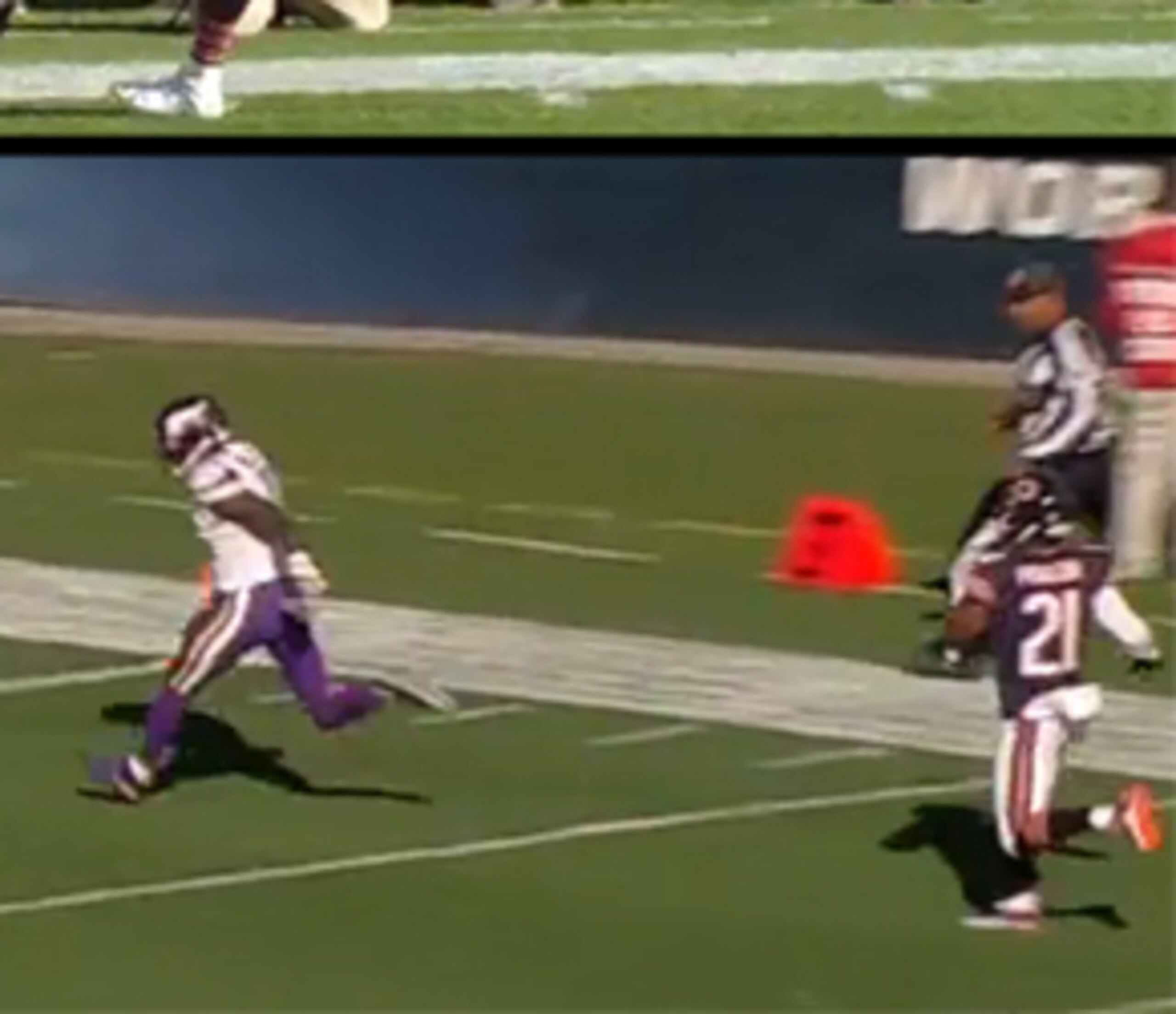
Even when Bridgewater was at his very best last season, he wasn't an impressive thrower to vertical routes. Those issues have carried over to this season, despite his 45.8 percent accuracy rating on deep passes, according to Pro Football Focus.
This inaccuracy was highlighted against the Bears on Sunday when Bridgewater twice missed Wallace on what could have been long touchdowns.
His first miss was just out of Wallace's reach, while the second was a much worse throw after Wallace had created a huge amount of separation. Although Wallace was open on both plays, it should be noted he wasn't certain to catch either pass after an accurate throw.
Wallace had two drops on accurate passes from Bridgewater at other points in this game.
Not being able to push the ball downfield didn't limit Bridgewater's production as much over the second half of last season because he excelled throwing short and intermediate routes. Bridgewater has still flashed his ability on these plays this year—but on a less regular basis.

Against the Bears, Bridgewater completed 17-of-30 passes for 187 yards and one touchdown with one interception. His interception came late in the second quarter on a 3rd-and-10 play, and it was one of the worst interceptions he has thrown in his career.
The Bears came out with one deep safety to the wide side of the field behind two cornerbacks who were aligned in press coverage underneath.

Because it's 3rd-and-10, Bridgewater wants to push the ball downfield unless his shallow crossing route is wide open. It isn't. He is given a rare clean pocket to work from as he reads the two receivers to his left. The slot receiver is running a post route as the outside receiver runs a deep in route.
At this point of the play, it should be clear to Bridgewater that Stefon Diggs isn't an option.
Diggs is the outside receiver running inside. He was working against a cornerback who had established inside position from the beginning of the play and stayed inside throughout the route. The defender has a deep safety waiting over the top, so Diggs is essentially double covered.
After recognizing that Diggs isn't an option, Bridgewater has a couple other outlets. He can check the ball down to the crossing route and hope the receiver breaks a tackle to get a first down, he can hold it to try to extend the play or he can locate the slot receiver running the post route.

Although Bridgewater had time in the pocket initially, he needed to use that time to allow his receivers to run their routes downfield. That meant he was put under pressure by an incoming pass-rusher.
It wouldn't have been an easy throw, but Bridgewater's best option here was to reset his feet and push the ball downfield to his post route.
Bridgewater would have had to read the positioning of the other safety, a very difficult action, but this is where he is supposed to excel. Instead of finding the open man or adjusting in the pocket, the quarterback locked on to Diggs and forced the pass.

It's difficult to understand Bridgewater's thought process on this play. He threw the ball too late to be expecting Kyle Fuller to drop into zone in Cover 2, and a perfect pass wouldn't have even thrown the receiver open because of the type of coverage the defense was playing.
Making this kind of throw is a mind-boggling mistake. The kind of mistake that hasn't been associated with Bridgewater at any point through college or the early stages of his NFL career.
Great arm strength has never been a selling point for Bridgewater. He has relied on disciplined mechanics, touch and accuracy to consistently moved the ball to different areas of the field. That discipline and control of the ball has helped him be consistent whether he's throwing against pressure or from a clean pocket.
His accuracy has been less consistent this season because of his looser mechanics. Many quarterbacks who are hit regularly early in their careers develop looser mechanics because they rush to get rid of the ball. As a rookie, Bridgewater showed clean mechanics against pressure over and over again.
In 2014, Bridgewater was pressured on 39.9 percent of his dropbacks, according to Pro Football Focus. So far this season, he is one of only two quarterbacks in the league to be pressured on at least 45 percent of his dropbacks. The third-highest pressure rate is more than 3 percent lower, while only four quarterbacks have been pressured on more than 40 percent of their dropbacks.
Asking a quarterback to be effective under constant duress without quality receiving options isn't an ideal situation, but it's the one the Vikings find themselves in.
What will comfort Minnesota is the play of its receivers late against the Bears. When Bridgewater and the offense needed to score, Diggs and Charles Johnson made impressive plays on relatively poorly thrown passes to gain important first downs.

On this play, the Bears get a free rusher up the middle. Bridgewater releases the ball before the rusher arrives, but he turns his shoulders to protect his body as he does so. His pass is therefore late, floated and too far infield.
Fortunately for the quarterback, Diggs was able to recognize the flight of the ball early and reach up to pull it out of the air.
Diggs made a good play, but Bridgewater's pass was reliant on the cornerback misreading the play and being too aggressive. The cornerback ran toward where he expected the ball to go, where it should have gone, so he took himself out of the play.

On the next drive, Bridgewater heaved the ball downfield. His pass drifted aimlessly toward a waiting safety as Johnson was running down the sideline. Fortunately for the quarterback, Johnson was able to recognize the flight of the ball early and cut back infield.
The receiver extended fully and pulled the ball down before the defender could touch it.
While Diggs has made impressive plays since being plugged into the offense a few weeks ago, Johnson has dealt with injuries and been ineffective for most of the year. This was the lone big play he has made to bail his quarterback out this year.
Expecting Diggs and Johnson to bail out their quarterback often is unrealistic. For the Vikings to be more effective in the passing game, they will need the opposite to happen.
Bridgewater is one of the most talented quarterbacks to enter the NFL in recent seasons. He showed off his poise and awareness as a rookie last season, but he hasn't been able to transcend his supporting cast to this point of the season.
The Vikings have some players around him who could elevate their play in the coming weeks, but it's Bridgewater who will be forced to push this offense into position to make the playoffs.
.jpg?w=2560 "Texans-Mixon Released Football")

.jpg?w=2560 "Grading WWE Raw 🔠")


.jpg?w=2560 "2 NFL Officials Suspended")
