Ryan Fitzpatrick, New York Jets Enter Season-Defining Game in Week 7
The New York Jets are still in Stage 1 of the Ryan Fitzpatrick experience.
After six weeks into the 2015 season, the Jets have an unexpected 4-1 record with Fitzpatrick as their starter. The veteran quarterback was signed to be the team's backup, but he became the starter before the season when a now-former teammate broke Geno Smith's jaw.
Fitzpatrick has retained his starting spot despite Smith's return to full health. There has been no real question about replacing him because the Jets have such a good record.
TOP NEWS
.jpg?w=2560 "Titans Giants Football")
OBJ Calls Out Giants After Release
.jpg?w=2560 "Saints Lions Football")
Rap: Lions, LaPorta End Contract Talks

Live Live: Updates from every NFL game
On Sunday, Fitzpatrick and the Jets face their toughest test of the season. They travel to Gillette Stadium where they will face their undefeated AFC East rival New England Patriots. The Patriots are by far the best team the Jets have faced this season.
The combined record of the teams the Jets have beaten this year is 12-17. The Patriots have already had their bye week, so they sit at 5-0.
Winning this game is huge for the Jets because it will keep them in touch with the Patriots for the AFC East. Instead of watching the Patriots go to 6-0 as the Jets fall to 4-2, the two teams could be tied as we approach the midseason mark.
Winning this game is even more important than that, though.
Fitzpatrick has been generally accepted as the starter for the Jets because the team is winning. His individual performances have been majorly problematic, but a second-ranked defense by DVOA, according to Football Outsiders, and a much-improved supporting cast around the quarterback has mitigated his negatives and highlighted his positives.
After this week, the Jets' schedule is softer than most. Games against the Oakland Raiders, Jacksonville Jaguars and Houston Texans will make for a favorable November. Their run-in is difficult, but by that time the team will be firmly settled on its starting quarterback.
Even though the Jets have been winning with Fitzpatrick, there is no real long-term optimism with the quarterback. His career has been defined by franchises and fanbases buying into him as a game manager initially before realizing he fails to even act out that role efficiently.
It's what happened with the Buffalo Bills—a team that prematurely gave him a big contract extension. It's what happened with the Houston Texans, a team that benched him as their starter before being forced to reinsert him into the lineup when Ryan Mallet was hurt last season.
The Tennessee Titans turned to him as a backup in 2013 before promptly moving on to Charlie Whitehurst.
Chan Gailey was the Bills head coach when Fitzpatrick was with the franchise. Gailey re-acquired Fitzpatrick from the Texans when he became the offensive coordinator with the Jets. However, even Gailey was assertive in naming him the backup to Geno Smith.
Having watched both players over their careers, the Jets didn't even need a quarterback competition to decide between the player entering his third season and the one entering his 11th. They understood that Smith was the more talented and effective player, despite his struggles with turnovers over his first two seasons.
Smith had thrown 34 interceptions to just 25 touchdowns over his first two seasons in his career. Those numbers were and are damning, but didn't fully reflect where Smith was in his career.
The quarterback wasn't supposed to start from the beginning of his career. He wasn't ready as a rookie and he was playing in an offense that didn't understand how to play to his strengths. Furthermore, that offense had an extremely limited supporting cast.
During his second season, the supporting cast was supposed to get better, but injuries and another year in a bad system didn't help Smith. Smith himself wasn't playing well enough before his disastrous display against Buffalo that ultimately saw him benched for Michael Vick.
Although Smith had endured major struggles over his two years in the league, he had also enjoyed long stretches of positive play. Gailey obviously recognized this and expected the quarterback to improve in his better designed offense with a supporting cast that had also improved.
Two main differences can be seen between the Jets' 2014 supporting cast and the 2015 version.
In 2014, neither Chris Ivory or Eric Decker were fully healthy. Ivory is particularly important. Although the running back has missed a game through injury this year, he has largely been fully effective when available. He has been so much better this year that he has more than half of his yards from all of last season in just four games.
Because of Ivory's health, the Jets have become a top-10 rushing offense in terms of efficiency after ranking 17th last year. Bleacher Report's Erik Frenz provided a stat comparison between Ivory and Matt Forte, who is the "league leader":
Decker's health has been huge also, but he alone isn't the second main difference. The second main difference is the team's wide receiver depth chart. Brandon Marshall has given the Jets a receiver with the talent to erase a quarterback's accuracy and turn bad throws into big gains.
Furthermore, Marshall's presence has pushed Decker into a more favorable role as the second option. When Smith was playing last season, Decker wasn't 100 percent, and he was the team's No. 1 receiver.
Throughout the season so far, Fitzpatrick has been able to simply throw the ball up and rely on his receivers to go and get it. This is a luxury that Smith has never had in his career. With that and Ivory's ability to run the ball, the Jets don't need their quarterback to be great; they just need him to be smart.
Despite Fitzpatrick's reputation, he is not a smart quarterback.
With Fitzpatrick the Jets have won four of five games, but he has thrown seven interceptions. More importantly, he has thrown interceptions at a higher rate this season than Smith did last year. Fitzpatrick is throwing an interception once every 24.4 attempts; Smith threw one every 28.2 last year.
Throwing an interception every 24.4 attempts is good enough for one of the worst rates in the league. Fitzpatrick has a worse rate than Sam Bradford, Matthew Stafford, Nick Foles and Kirk Cousins. What makes matters worse for Fitzpatrick is he's been very fortunate not to have many more interceptions.
Looking at interceptable passes, throws that a defender should have intercepted but didn't, doesn't reflect kindly on Fitzpatrick. Last season, despite throwing to Andre Johnson and DeAndre Hopkins, two receivers with great ball skills and wide catch radiuses, Fitzpatrick had a worse interceptable pass rate than Smith.
Smith threw an interceptable pass every 21.6 attempts, while Fitzpatrick threw one every 17.3. This season that number is 10.1 as Fitzpatrick has thrown 17 interceptable passes on 171 attempts. That number would have been by far the worst of any quarterback evaluated last year.
Two of Fitzpatrick's actual interceptions that weren't his fault aren't included in those 17.
Fitzpatrick's has poor decision-making skills, while his extremely limited arm talent has led to him consistently throwing inaccurate passes. Pushing the ball downfield has been particularly dangerous.

Four of Fitzpatrick's interceptable passes came against the Philadelphia Eagles in Week 3. On this play, the quarterback drops back into the pocket and has plenty of time to survey the field. The defense has rushed just four defenders on 1st-and-10.
With that time in the pocket, Fitzpatrick locks onto his post route coming from the left side of the offense. He releases the ball cleanly after stepping forward in the pocket.
Despite having so much time in the pocket, Fitzpatrick never realized the post route wasn't an option. By starting his receiver down, he drew a safety toward his intended target, creating a double-team. There wasn't a place for the quarterback to put the ball where his receiver could get it.
Fitzpatrick ultimately just heaves the ball in his teammate's general direction.
His receiver falls down, but the ball had sailed too far downfield for him to ever get between the defenders and it to make a reception. This pass should have resulted in an interception, but the two defenders didn't communicate well with each other.
As one defender rose up to catch the ball into his chest, the other attempted to make a one-handed catch over him. He ultimately disrupted his teammate enough so the ball bounced to safety. It may not have been an interception, but Fitzpatrick gave up an easy opportunity to the defender.
Before that throw, Fitzpatrick had been intercepted in the quarter, making another throw downfield.
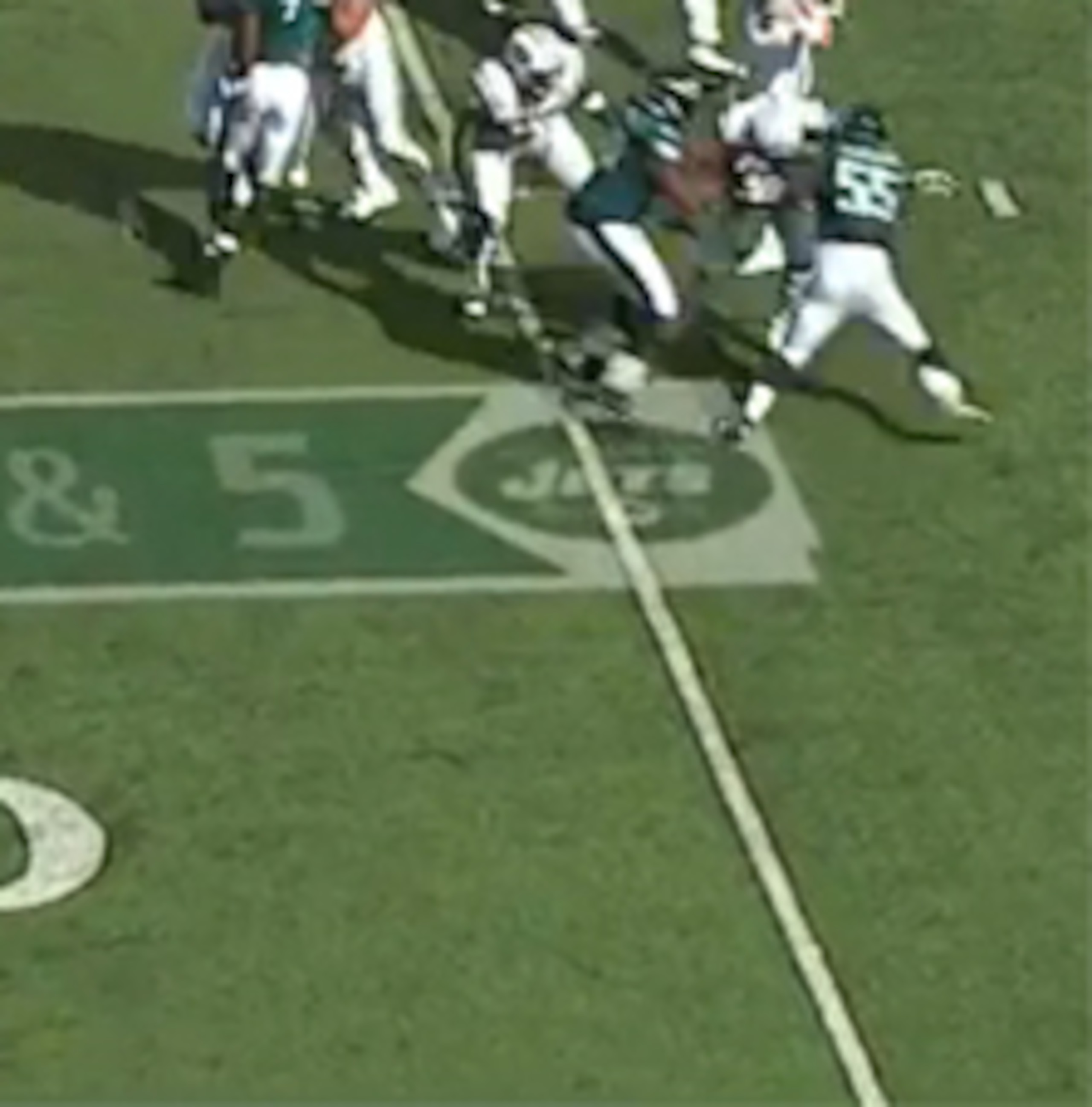
Rookie wide receiver Devin Smith has only played in three games this season. Smith is the best deep-threat receiver to come out of college in years. With Fitzpatrick, according to Pro Football Focus, he has just five receptions for 53 yards, with a long of 16, despite being targeted 14 times.
Fitzpatrick simply hasn't been able to find him. The receiver has great ball skills and is very fast, but Fitzpatrick can't get the ball out ahead of him. That is what happened on this play.

The quarterback threw the ball from a clean pocket, and Smith had got ahead of fellow rookie Eric Rowe on the outside. Fitzpatrick needed to lead him downfield, into the end zone, so he could have an opportunity to accelerate onto the ball.
Instead, Fitzpatrick's pass died on its way. His pass not only wasn't far enough downfield, but it also couldn't reach the sideline. This means Smith had no chance of stopping Rowe from making the interception.
One of the quarterback's other interceptable passes came just before this play, on an identical throw to Smith down the left sideline. The defensive back couldn't pull the ball in on that occasion, but Fitzpatrick made the same poor throw.
When Fitzpatrick's mistakes have come this year, they have come in bunches. Against the Miami Dolphins, he had five interceptable passes, and against the Indianapolis Colts, he had four. Three of those four interceptable passes came in the second quarter, with two coming on the same drive.
Two of those three were also bad deep throws.

On this play, pre-snap recognition was huge for Fitzpatrick. Mike Adams is one of, if not, the NFL's slowest safety. Before the ball is snapped, Adams rotates into a single-high position over the middle of the field.
This puts the Colts in a Cover 3/Cover 1 look with Vontae Davis covering Brandon Marshall on the near side of the field. Adams rotated from that side of the field, so he has less space to cover if he wants to follow Fitzpatrick's eyes to the receiver.

Fitzpatrick initially looks at Adams, but only for a moment. He doesn't attempt to move the safety or prevent him from following his eyes. As soon as he gets to the top of his drop, he turns and heaves the ball toward Marshall down the left sideline.
Marshall wasn't open. He needed a back-shoulder throw to have a chance at playing the ball in the air. Davis should intercept the ball himself as Fitzpatrick leads his receiver too far downfield.
Poor accuracy doesn't lead to an interception because Marshall is able to tip the ball away from Davis with his length. However, Fitzpatrick's inability to prevent Adams from reading his eyes means he is in position to catch the tipped pass.
On one play, Fitzpatrick showed off a lack of intelligence and poor accuracy. This was the rarer occasion when his errors were punished.
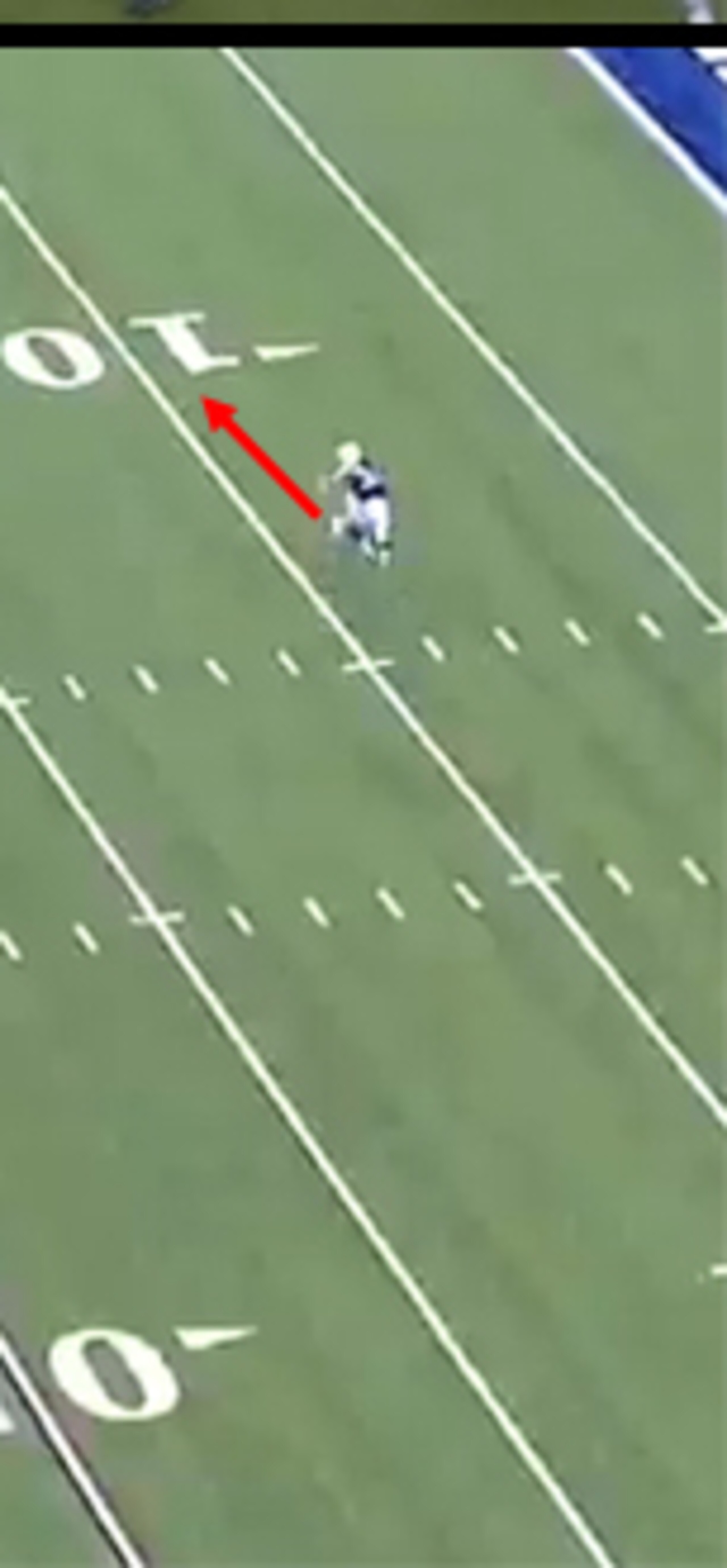
Fitzpatrick has a tendency to rush through his progression and throw the ball blind to the backside of the play. That is what he did on this play when he began reading the right side of the field before coming back to Marshall deep on the left side.
He never looked to see that Marshall was being double-covered by a cornerback and safety over the top.
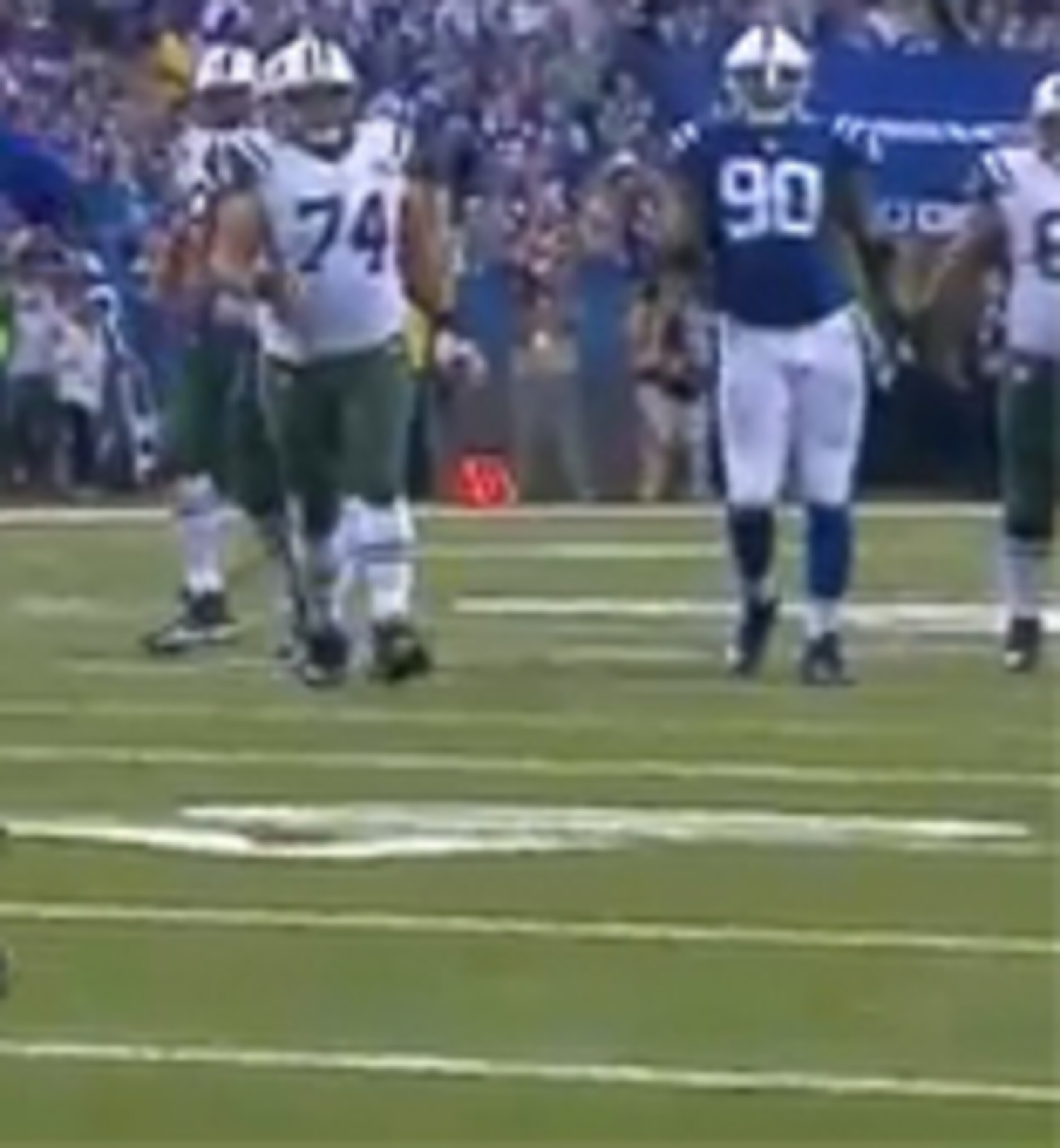
Marshall had no space to adjust to Fitzpatrick's pass that floats over his head. His length is again invaluable in preventing the first defender from catching the ball. The deep safety had come over the top of him and attempted to pull the ball down into his chest.
As the safety landed on the ground, the ball came down over his chest. He snatched at the ball, and it bounced out of bounds.
The Jets have enjoyed a great start to the season. Their defense should continue to be one of the best in the league, while Ivory will allow the running game to be consistent so long as he stays healthy. Eric Decker, Devin Smith and Brandon Marshall are as good a wide receiver group as any other.
Fitzpatrick success should/will prove to be unsustainable, though. The Jets are already asking him to throw the ball as little as possible. He is averaging 34.2 attempts per game, but that number is skewed by a 58-attempt game against the Eagles.
In three of the other four outings, he threw the ball fewer than 30 times.
Whether Geno Smith can make the offense better or not is unclear. However, considering his skill set, the talent available to the Jets and the team's new offensive coordinator's intelligence, he would at least be in position to succeed if given the opportunity.
That isn't something that could have been said at any other time in his career.
Beating the New England Patriots this weekend will likely lock Fitzpatrick into the starting role for the remainder of the season. That may prove to be a problem over the long term, even if the short-term outlook is better because of the result.
.jpg?w=2560 "Vikings Buccaneers Football")