

Do NBA Teams Pay More for Offense or Defense?
There are many ways to get paid in the NBA. However, not all of them are created equally, and the discrepancy often boils down to strange valuations of contributions on each side of the floor.
Even though scoring is usually the first stat cited in many conversations and highlights almost exclusively show replays of thunderous dunks, flashy feeds and deep triples, basketball is, after all, a sport where teams can win through many unique methods of roster creation. But no matter how different some styles might be, all must involve defense to some extent.
Offense matters, sure. But without defense, the good teams have trouble becoming great. Similarly, the league's elite talents experience difficulty when attempting to transition into the realm of historical excellence. Though this is but one of many examples, you need look no further than the reigning MVP for proof.
TOP NEWS

J-Dub Suffers Gruesome Leg Injury
.jpg?w=2560)
Terrible Contracts NBA Teams Wish Would Disappear 🫣

Embiid Out vs. Pistons
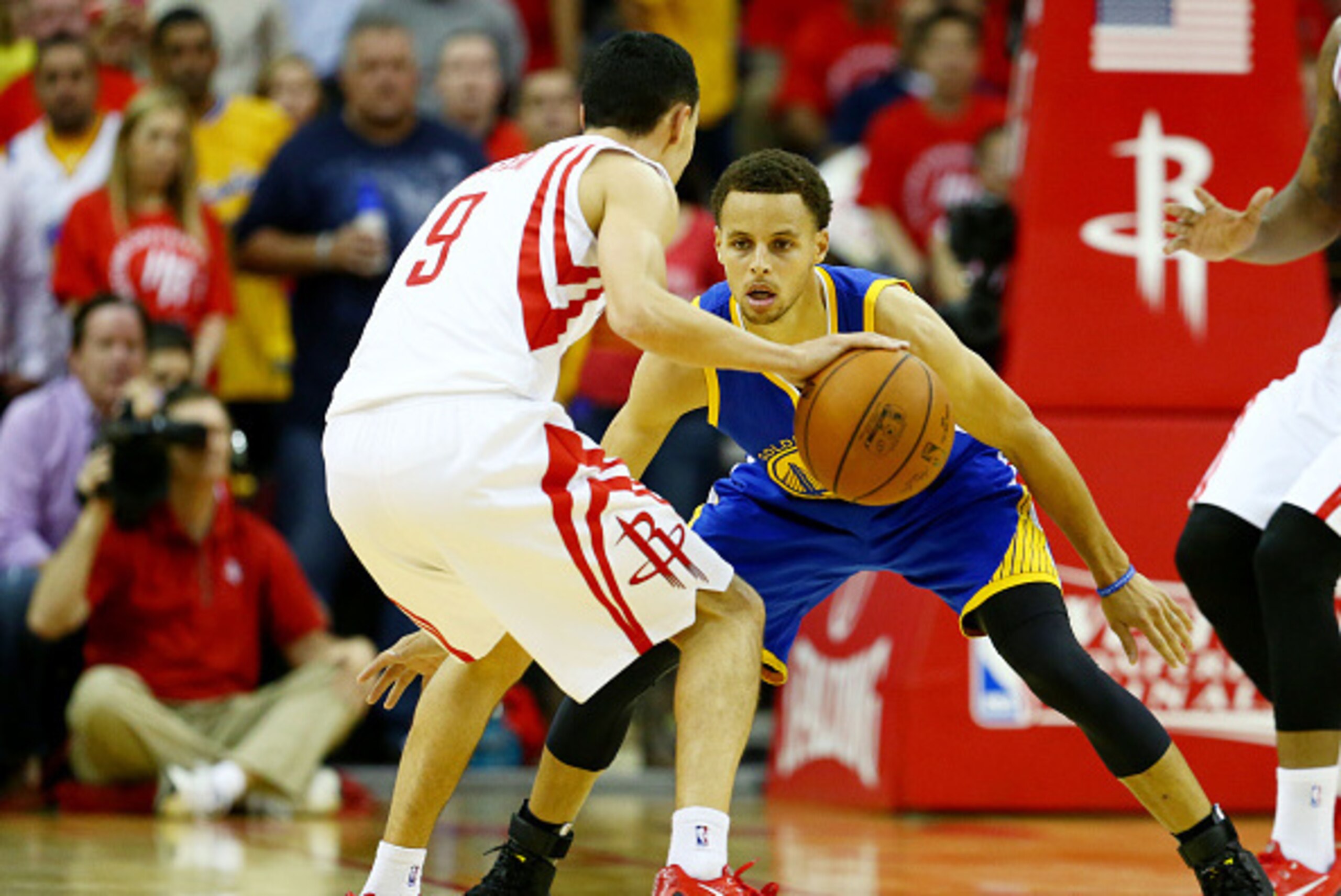
Stephen Curry has been a stellar offensive player for years, but it wasn't until he figured things out on the defensive end that he made the leap into the top individual echelon and got his hands on the coveted Maurice Podoloff Trophy. Though casual fans might overlook his contributions on the less glamorous side, his ability to shepherd players into certain spots, wreak havoc in passing lanes and do more than just hold his own paid huge dividends for the Golden State Warriors in their run to 67 wins and the end of a 40-year title drought.
There's no doubt defense helps win games on the court. But does it get players paid when they're hitting the free-agency pool or eligible for a contract extension?
It turns out not all facets of the game are created equally.
In order to look at this objectively, we used a set of metrics called offensive box plus-minus (OBPM) and defensive box plus-minus (DBPM). Each estimates how many points per 100 possessions better an average team would be with the player in question on the floor rather than an average player, limiting the impact to one side of the floor. Though they're by no means perfect measures, they're solid indicators of level of play and have the added benefit of operating on the same scale.
That's important because we're not concerned with the raw OBPM and DBPM numbers quite yet. Instead, we want to look at what I'm calling "offensive tilt," as determined by subtracting the latter from the former. A negative difference indicates that the player is more defensively oriented, while a positive one shows offensive superiority. A score of exactly zero indicates complete neutrality.
Here's an example, using Russell Westbrook's numbers from the 2014-15 campaign:
| 8.8 | 2.2 | 6.6 |
Even though the dynamic Oklahoma City Thunder point guard was quite good on defense throughout the healthy portion of his season, he was just that much better on offense. And as a result, he was still one of the more offensively tilted players in the Association.
On the flip side of the floor-general spectrum, we have Michael Carter-Williams. Between his work for the Philadelphia 76ers and Milwaukee Bucks, he compiled a minus-1.6 OBPM and a 0.9 DBPM, which gives him an offensive tilt of minus-2.5.

He falls very much on the defensive side of the equation, and that's what you might have expected from the lanky 1-guard with a broken jumper and turnover issues. Because of that, he'd probably have a bit more trouble getting paid if he were a member of the free-agency class or eligible for an extension.
After all, that's what happened to this year's crop:
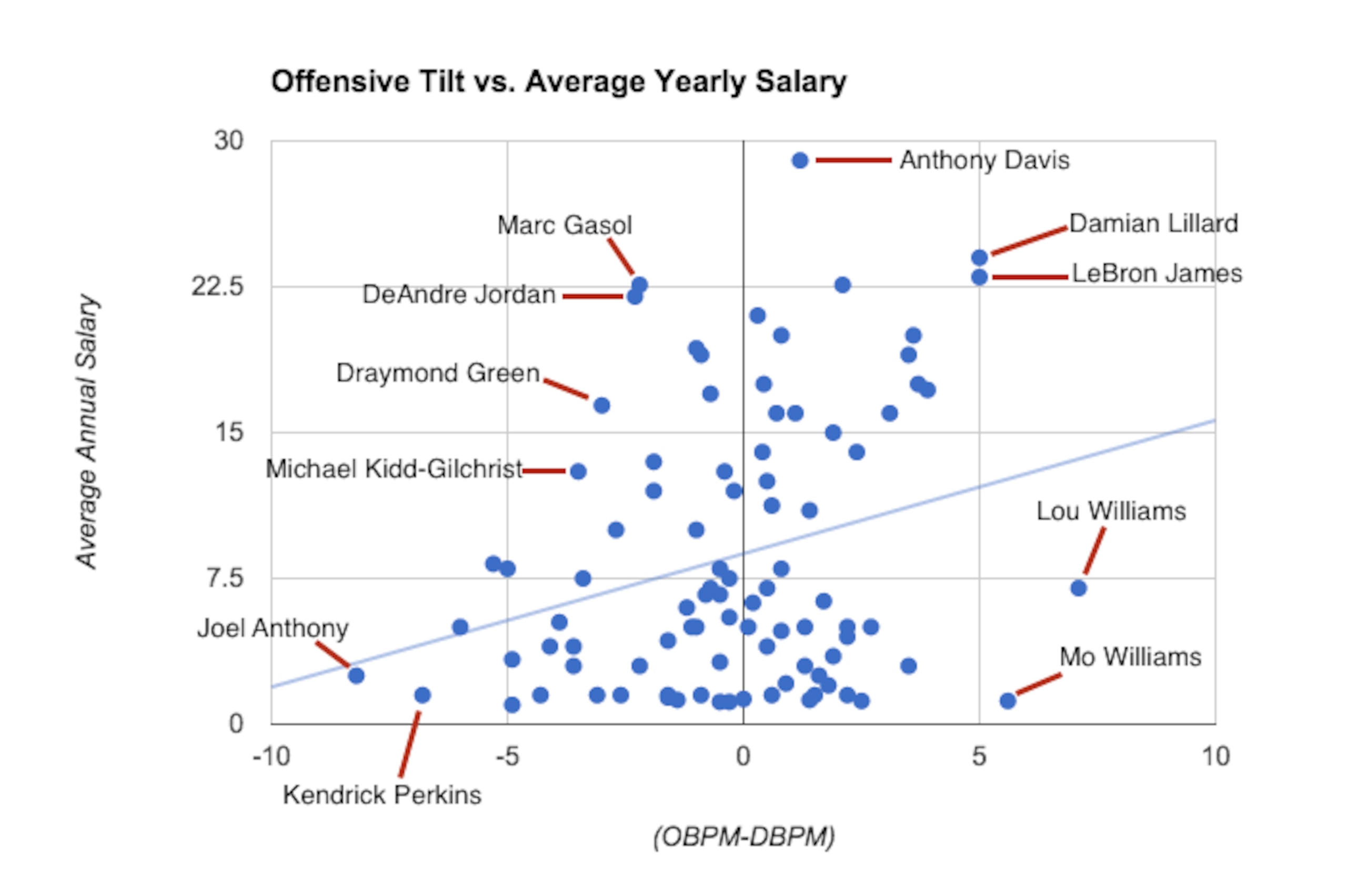
Though veteran offensive specialists such as Lou Williams and Mo Williams are the exceptions, players who are better at offense typically got paid more this summer. It's exceedingly rare to find a one-way defensive stud making bank, especially because DeAndre Jordan and Marc Gasol don't qualify as such. Both big men actually had positive OBPMs in 2014-15, even if they're slanted heavily toward the point-preventing side.
The players with a neutral focus are all over the map, which makes sense because those players could be terrible on both ends, average on both or dominant in all facets of the game. However, there certainly seems to be a positive correlation here.
Just look at the average annual salary of the players in each grouping:
| -10 to -8 | 1 | $2,500,000 |
| -7.9 to -6 | 2 | $3,250,000 |
| -5.9 to -4 | 6 | $4,347,222 |
| -3.9 to -2 | 12 | $9,145,833 |
| -1.9 to 0 | 26 | $7,303,526 |
| 0 to 1.9 | 28 | $8,868,155 |
| 2 to 3.9 | 13 | $11,269,231 |
| 4 to 5.9 | 3 | $16,066,667 |
| 6 to 7.9 | 1 | $7,000,000 |
It should be telling enough that there's a nearly untempered rise as we move closer to the offensive specialists, though Lou Williams does throw a minor curveball at the very end by virtue of being the only player in his category.
But before we look at offensive and defensive contributions separately for each player, there's one way to make this even more definitive.
By analyzing those who were a certain difference away from perfect neutrality, we can see that those who skew toward the scoring end are always going to make more money:
| 0 to 1.9 | $7,303,526 | $8,868,155 |
| 2 to 3.9 | $9,145,833 | $11,269,231 |
| 4 to 5.9 | $4,347,222 | $16,066,067 |
| 6 to 7.9 | $3,250,000 | $7,000,000 |
| 8 to 10 | $2,500,00 | N/A |
But why?
There are a couple of reasonable explanations here.
First, it's important to note that the NBA is still in the business of entertaining fans. As important as it is to win basketball games and compete for championships, most organizations have to put forth a team that's both competitive and fun to watch on the court. While defense is quite important to the former, it's pretty telling that offensive highlights are the ones that typically take up airtime after the final buzzer.
Second, defense is just harder to quantify.
Though modern-day analytics—especially those that stem from player-movement cameras—are becoming increasingly adept at representing a player's point-preventing value, it's tougher to be certain that the numbers are correct. Scoring figures, true shooting percentage, assist percentage and other offensive metrics are far more established and less reliant on context.
This February, Grantland's Kirk Goldsberry wrote about a new defensive metric presented at the MIT Sloan Sports Analytics Conference in Boston, hailing it as a breakthrough in our ability to measure a player's impact. His conclusion is quite telling as to how far defense still lags behind offense, though:
"This research may not change basketball forever, but it represents an important publicly readable step in the evaluation of defensive play in the NBA. There are still many challenges in understanding defensive performance; with no prior knowledge about a team’s principles and rotations, it’s very difficult to know what a defender is supposed to do. But until Gregg Popovich and Tom Thibodeau start publishing their defensive playbooks, we’re just going to have to make educated guesses. Regardless, while there will probably always be an analytical bias that leans toward offense, this work is evidence that the integration of statistical modeling, computation, and player tracking offers an unprecedented opportunity to improve our understanding of defensive play.
"
It's not just the analytical bias that skews more toward offense. The income gap does as well.
Below you can see how the average annual salary of players who signed new contracts this summer trended up as offensive performance—measured by looking at the percentile of players' OBPMs among fellow free agents and extension candidates—did the same:

That's a fairly definitive trend, even if there are always going to be some notable exceptions. As players get better on offense, they tend to fill their coffers closer to the brim, especially if they're also able to make notable contributions in other areas as well.
Unfortunately, the same isn't true of defense:
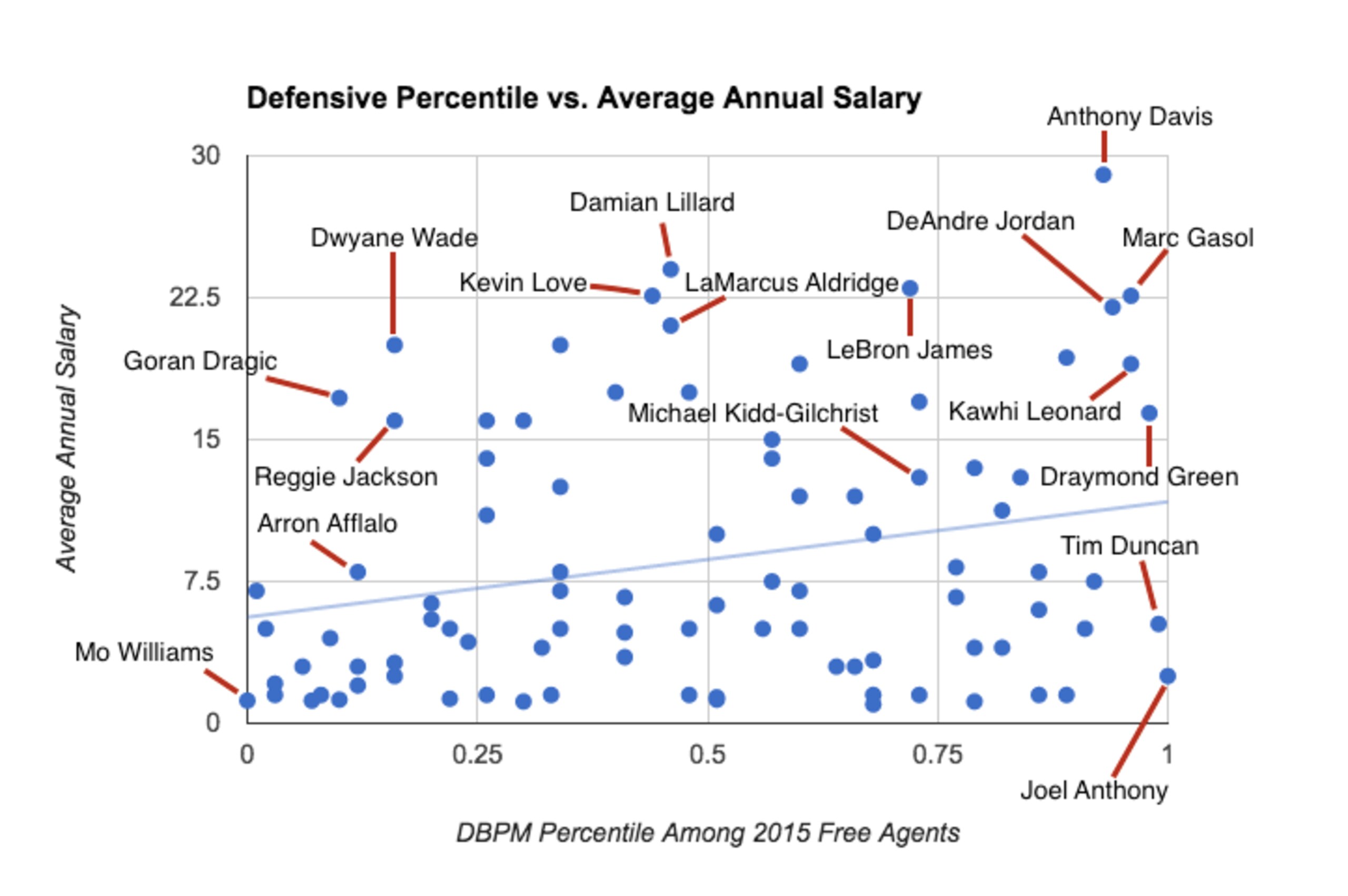
Michael Kidd-Gilchrist wasn't a free agent this summer, but he did sign a big extension with the Charlotte Hornets, one that will pay him $52 million over the course of four seasons. He's the closest thing we have to a true defensive specialist above the trendline you can see in the previous chart.
"When he's on the floor, we play well; when he's not on the floor, we don't. ... As much as anybody that we have had in the two years I've been here, he's been the guy that we can't play well without for any long period of time," Charlotte head coach Steve Clifford told reporters about the lockdown wing defender.
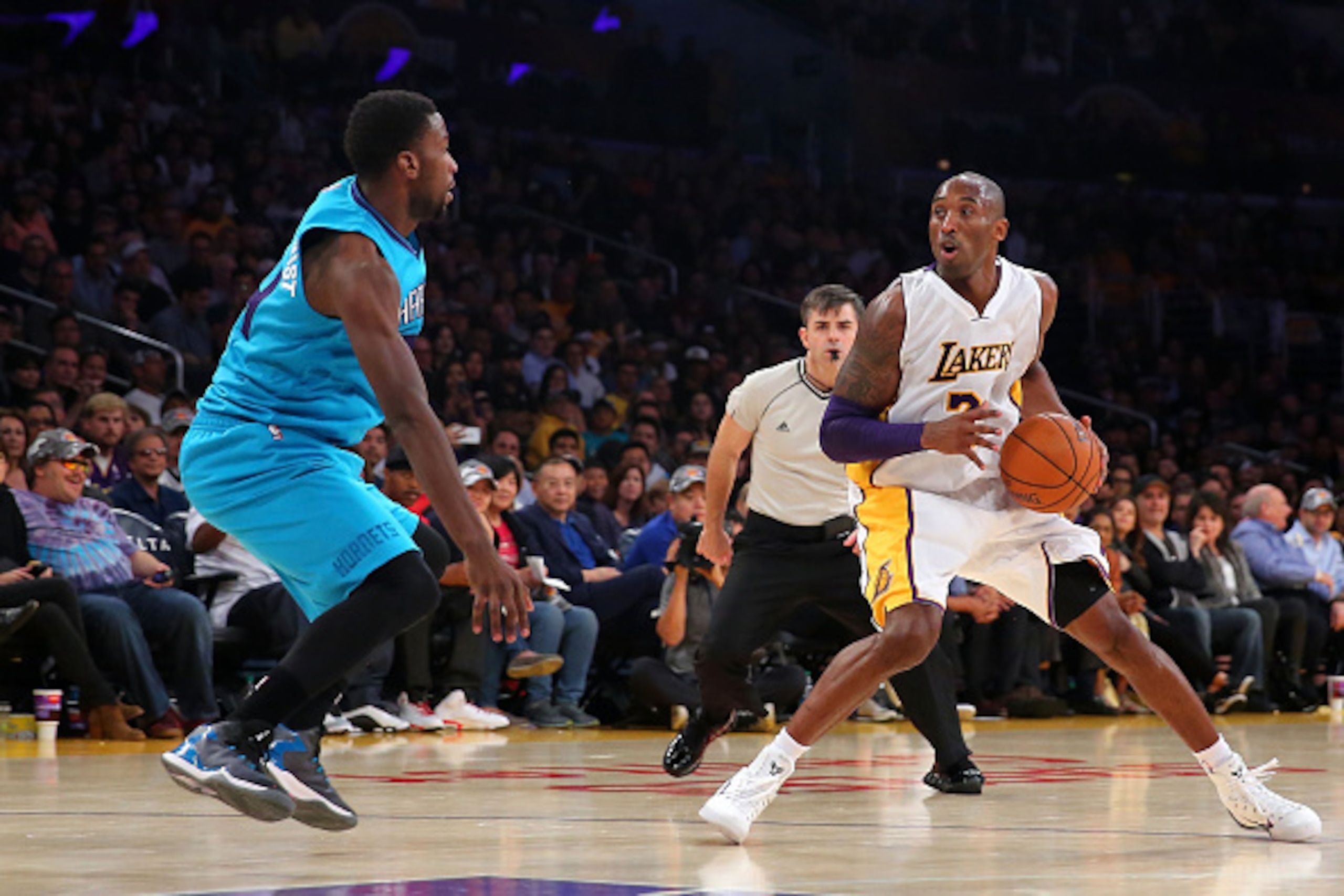
But that mentality doesn't always translate into dollars for the players who prove themselves invaluable on the defensive end. Not every coach has a huge impact in the realm of front-office decisions, and many men who pace the sidelines are far less defensively inclined than Clifford.
Despite all this, there's still a positive correlation in the above chart. As those eligible for new deals get better at shutting down the opposition, they get paid more.
The relationship just isn't nearly as strong as the one that exists on the more glamorous end. A defensive specialist with an equivalent impact to the one produced by an offense-only player will almost always make less money.
NBA teams spend offseasons trying to scour the market for inefficiencies. Finding them allows for better team-building strategies that come with a lesser financial burden.
Right now, defense just doesn't get paid what it's worth, and savvy franchises are going to snatch up those types of players, leaving themselves with plenty of leftover cash to get the oft-overvalued scorers onto their rosters all the same.
Until ace defenders are paid what they deserve, those who thrive on that end of the floor will turn into something that many of them already create: steals.
All stats, unless otherwise indicated, come from Basketball-Reference.com.
Adam Fromal covers the NBA for Bleacher Report. Follow him on Twitter: @fromal09.
.jpg?w=2560)


.jpg?w=2560 "Raiders Could Start Mendoza")
.jpg?w=2560 "Rodgers Iced Out on Plane 💎")
.jpg?w=2560 "🚨 Week 8 AP Top 25 Poll")