
What to Expect from Miami Dolphins Offense in Year 2 Under Bill Lazor
Between four years with the Texas A&M Aggies and two years with the Miami Dolphins, Mike Sherman was the only offensive coach whom quarterback Ryan Tannehill knew from 2008 to 2013.
Now, entering the Dolphins' second year under offensive coordinator Bill Lazor, the expectation is that the offense will begin to make strides and build off what it accomplished last year.
Another year means the players will have a deeper knowledge of the offense. It means the coaches will have a better understanding of what worked and what didn't work, and they can adjust accordingly. It means the entire unit should be taking steps forward—not just its quarterback.
.jpg?w=2560 "Commanders Eagles Football")


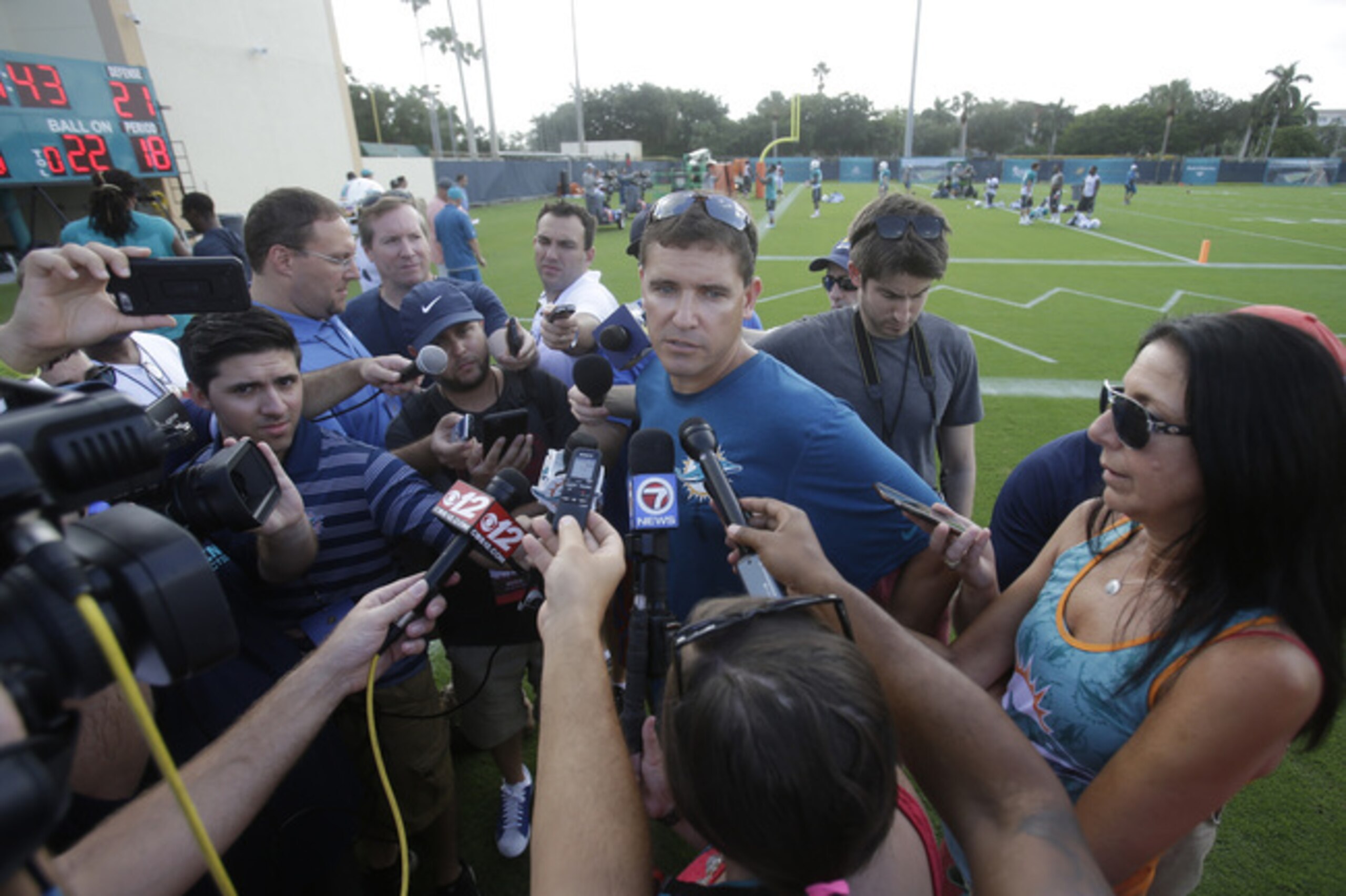
Head coach Joe Philbin had this to say about Lazor's offense:
"Last year was algebra I and II, and we're into trigonometry now. Bill can sit in a meeting now and he installs the plays and he can ask more questions. He's getting more feedback from the players and they know the adjustments. ... Instead of him having to explain everything, I think we're getting quicker meetings, better meetings, and the players are more engaged because we have a lot of carry-over.
"
The system is much the same, but make no mistake: Not every player is building off the familiarity he built with the offense last year.
Of course, as with most things relating to the Dolphins, it all starts with the offensive line. Get Tannehill some better protection, and he should be more successful than he's been—which is saying a lot, given the fact that he has improved his stats every year despite mounting pressure in his face.
The Dolphins appear to be on their way to solidifying a starting offensive line, but that's not the only thing the coaches have to be thinking about.
One more pressing question faces the Dolphins offense this season: How quickly can Tannehill's new weapons get on the same page with their triggerman?
| Mike Wallace | 67 | DeVante Parker | 0 |
| Charles Clay | 58 | Jordan Cameron | 24 |
| Brian Hartline | 39 | Greg Jennings | 59 |
| Brandon Gibson | 29 | Kenny Stills | 63 |
The Dolphins purged a good deal of their skill-position group in the offseason, parting with wide receivers Mike Wallace, Brian Hartline and Brandon Gibson and tight end Charles Clay—four pass-catchers whose experience in the offense (albeit only one year's worth) will be lost and whose production the team will need to replace.
They were four of the Dolphins' six leading receivers, with a combined 193 of the team's 394 total catches in 2014 (48.98 percent).
The new group has a lot of catching up to do.
Lazor had this to say about the new group:
"We got an awful lot of skill players that weren't here last year — Greg Jennings, Jordan Cameron, Kenny Stills. We got a lot of players — DeVante Parker, when he's back out there. So for them it's still year one. But we're gonna go as fast, really as Ryan Tannehill and Mike Pouncey can go. The other guys gotta keep up.
"
The Dolphins offense ran a play every 26.95 seconds, which was the 11th-fastest time in the NFL, according to Football Outsiders. That's not dramatically different from their 2013 play-per-second rate of 26.66 seconds, which was the 10th-fastest that year.
But as Lazor has explained in the past, pace and tempo are not necessarily about running as many plays in as short a time frame as possible. That's how his mentor, Philadelphia Eagles head coach Chip Kelly, approaches tempo, but that's not how Lazor sees it:
"There are a lot of different definitions of that, and I think you have a chance to see enough of it on the practice field. At the snap of the ball, we want to be fast. That's including our offensive linemen coming off the ball in the run game. And part of it is knowing what to do and be decisive. In this league, you've got to play fast, you've got to be physical.
"
Tempo is also about coming out of the huddle, getting the protections and the checks called quickly and snapping the ball shortly thereafter. Those are things that Pouncey and Tannehill will already be familiar with, which is why the rest of the offense must keep up.
But tempo can be vague and may only be measured by the quality of execution—after all, it's hard to run a lot of plays if your plays aren't successful. So what is a true measure of success for the Dolphins offense in 2015?
"[If you score] 400 points, it's a decent year at the office, I guess, if you're an offensive coach," Philbin said. "Now, I would love to score 500 points."
In order to make the playoffs, the Dolphins may need at least 400 points from their offense. Last year, the Dolphins scored 24.3 points per game.
That goal seems attainable.
Five hundred points, though? That would be an average of 31.25 points per game, nearly eight more points per game than the Dolphins averaged last year. At least they're keeping their goals somewhat realistic.
Unless otherwise noted, all quotes obtained via team news release.
.jpg?w=2560 "Chiefs Dolphins Football")
.jpg?w=2560 "Texans-Mixon Released Football")


.jpg?w=2560 "Love's Body Already 'Tired'")