Brandon Sutter Trade Looks Even Worse for Canucks After Terrible Contract
From a certain point of view, the acquisition and subsequent re-signing of Brandon Sutter check off a lot of boxes for the Vancouver Canucks. Sutter is a big, young centre with a reputation for solid defensive play. His last name alone virtually guarantees that he’s chock-full of intangibles.
Perhaps that’s why Canucks general manager Jim Benning made his team worse by overpaying in trade and then doubled down on his error by signing Sutter to a ludicrous five-year extension:
TOP NEWS

Bear Kills NHL Player's Dad

NHL Reveals Team Playable Hockey Bucket
1 Player on Every Team to Get Excited About 🤩
As with Dave Bolland and David Clarkson and countless others before them, Vancouver’s management seems to be betting that a host of qualities not easily quantifiable—character, grit, defensive play and the like—will make up for Sutter’s anemic offensive production. As Sportsnet noted immediately following the deal, it’s a unique bet on the Canucks’ part:
Things look even worse once we drill down to even-strength scoring, because Sutter’s been posting those unimpressive totals while playing regular time on the man advantage.
Over the last three seasons, 375 different forwards have played at least 1,000 total even-strength minutes in the NHL. That averages out to 12.5 per team and makes that number a pretty acceptable threshold for “regular NHL forward.” Sutter is tied for 312th on that list in even-strength points-per-hour. In terms of scoring, that makes him a run-of-the-mill No. 11 forward.

That simply isn’t good enough for a scoring line. Over the last three years, Nick Bonino alone (one of the players dealt for Sutter) has scored at better than 170 percent Sutter’s rate at evens. Even departed Brad Richardson, who scores at a typical third-line rate, averaged nearly 130 percent of Sutter’s per-hour point production.
In comments to the Vancouver Sun’s Brad Ziemer, both Benning and Sutter tossed around the notion that Vancouver’s newest centre might take on second-line duties next season. Benning called Sutter a “foundation piece” though he deferred to his head coach on usage, while Sutter talked about there being an opportunity to take on a second-line role. Both seem oblivious to the fact that Sutter doesn’t score nearly enough to be an asset to a scoring line.
This dearth of even-strength scoring means that Sutter needs to contribute in other ways to compensate.
If we’re looking to intangibles to make up the gap, we run into some problems.
Sutter plays a chippy game, but he’s hardly a crash-and-bang forward; he ranked 10th among Penguins forwards in hits last season so those hoping for a physically dominant forward are likely out of luck. He’s not massive, either; he stands 6’3”, but at 190 pounds, he is basically on par with the Sedin twins.
Nor is Sutter a virtuoso in the faceoff circle. In three years with the Penguins he won 1,250 even-strength faceoffs and lost 1,235. That puts him just barely above average, which certainly makes him useful but hardly pinpoints him as the guy any NHL team wants taking every critical draw.

Sutter’s vaunted defensive game also looks considerably less bullet-proof upon further inspection, though that was one of the primary points which Benning highlighted in his comments to Ziemer:
"Brandon is a proven NHL player, a match-up player. He is playing against other team’s top players and shuts them down. And he can still bring offence to our team.
"
Benning’s claims about Sutter’s offensive game are contradicted by the player’s actual performance in Pittsburgh, and the same is true about him playing against the other team’s best players.
Sutter ranks seventh in quality of competition among Pittsburgh’s most-used forwards over the last three seasons; shockingly, the Pens’ coaches over this span have played Sidney Crosby and Evgeni Malkin more frequently against top opponents. Calling Sutter a matchup player is a little like calling Nick Spaling a matchup player.
Actually, that isn’t fair. With Spaling on the ice last year, the Penguins out-shot and out-chanced their opponents. With Sutter on the ice, nearly 55 percent of all even-strength scoring chances were in favour of the opposition. Goals tell much the same story, as the Penguins were outscored 77-69 with Sutter on the ice over his three years with the team.
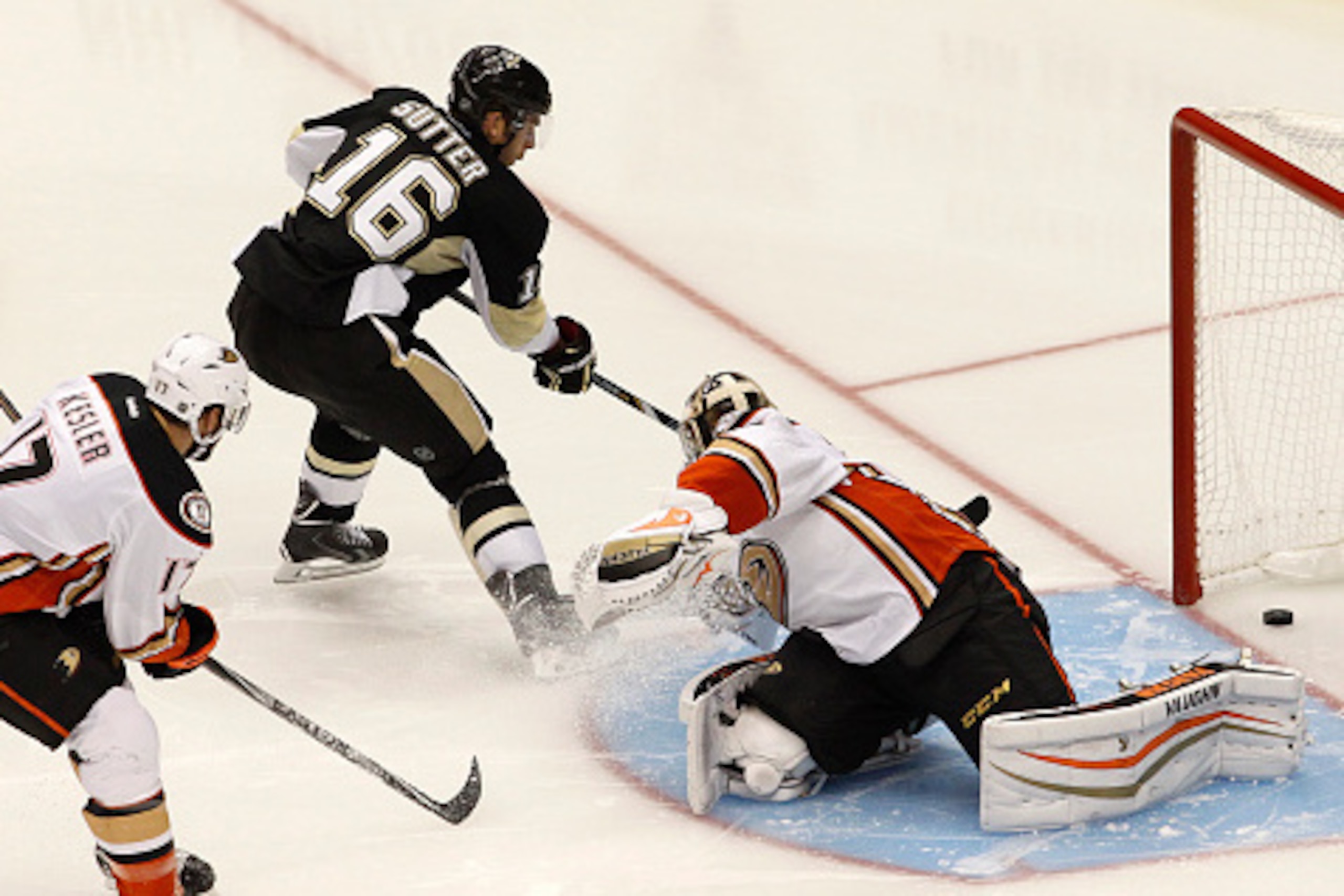
The news isn’t all bad, of course. Sutter is an accomplished penalty-killer, a mainstay on what was the NHL’s third-best team while shorthanded last season. He’s also an above-average second power-play unit option, and it’s possible that if given more opportunity there, he’ll blossom offensively. It’s also worth noting that he was trusted with defensive zone work by his coaches in Pittsburgh at even-strength.
Still, it’s hard to get from that to the exorbitant price Vancouver paid first to acquire and then to sign Sutter. For all his special teams acumen, most of the game is played at even-strength, and even calling Sutter a proven third-line centre is pushing it given how little he scores and how poorly his team does when he’s on the ice.
To acquire Sutter, the Canucks gave up Bonino, prospect defenceman Adam Clendening and swapped a second-round selection for a conditional third-round pick. That’s a lot of sweetener given that Bonino is the superior even-strength player.
Now Vancouver is also paying him like a top-flight second-line player. As a quick glance at cap site General Fanager shows, if Sutter’s new deal kicked in today the Canucks’ centre would rank 97th among NHL forwards by cap hit; by definition, there are 90 first-line players in the game, so that’s obviously second-line centre money.
The Canucks traded too much to acquire Sutter and now have spent too much to sign him. Now the question is whether head coach Willie Desjardins will play him too much as well.
Statistics courtesy of NHL.com and war-on-ice.com.
Jonathan Willis covers the NHL for Bleacher Report. Follow him on Twitter for more of his work.





.jpg?w=2560 "49ers FB Fined for Beer Celly")