Bradley Beal's Extension Should Be Priority No. 1 for Washington Wizards
The Washington Wizards need to gamble on Bradley Beal before the 22-year-old beats them to the punch.
Patience is rarely a virtue for NBA teams with rookie-contract extension candidates, and the Big Panda's price tag seems primed to rise if he opens next season without a new deal.
Granted, it's not particularly cheap at the moment. While he's encountered issues with injuries, inconsistencies and some frustratingly low efficiency marks over his first three campaigns, he's also flashed All-Star potential.
TOP NEWS
KAT's Contract News Quote 😬

1 Player Every Team Should Trade 🔀
Most Fascinating Players This Season 😲
He has a knack for elevating his play when the stakes are at their highest. His resume pegs him as a good regular-season player, but he's been a borderline great one once the playoff party opens.
| Regular Season | 15.6 | 3.0 | 3.8 | 51.3 | 14.0 | 102 | 106 |
| Playoffs | 21.2 | 4.6 | 5.2 | 52.4 | 17.5 | 108 | 102 |
He's an elite shooter from distance—one of only 10 players with at least 300 triples and a 40-plus three-point percentage over the past three seasons combined—but his other categories haven't reached such a lofty level.
Yet.
Taking both his age and ability into account, it isn't hard to imagine him ascending to that exclusive company sooner rather than later. That's why the Wizards must do everything in their power to lock in his next pay rate now before his value sees a potentially astronomical spike.
They're reportedly trying to do precisely that. As sources told CSN Washington's J. Michael, the Wizards are discussing an extension with Beal's representatives, but the two sides are "not close to reaching terms just yet."
That could be a good thing. One would assume the Wizards are searching for savings here. Had they put a max-level offer in front of him—which would include a starting salary of about $21 million—Beal may have already put pen to paper.
But Washington has seemingly stopped short of that line, as it should. That's a ton of green to give someone who has yet to post even an average player efficiency rating of 15.0 (Beal's single-season best is 14.3), let alone a guy who has lost 54 games due to injury already, including a fractured wrist and three stress-related ailments in his right fibula.
"There is very little in his dossier to suggest a star worthy of a max salary," Grantland's Zach Lowe wrote.

But the Wizards should also know how quickly that can change.
The 2015 free-agent frenzy was littered with players who boosted their value after declining to sign (or failing to work out) early extensions. Jimmy Butler parlayed his All-Star breakout into a five-year, $90 million deal with the Chicago Bulls, more than doubling the four-year, $44 million offer he declined in October.
Reggie Jackson secured a five-year, $80 million pact from the Detroit Pistons, after turning down a four-year, $48 million offer from the Oklahoma City Thunder. Enes Kanter landed a four-year, $70 million contract in OKC. Brandon Knight earned a five-year, $70 million commitment from the Phoenix Suns.
The Wizards need to know those figures, but they aren't the ones the team should be focusing on. Rather, they should look at the arrangements made last fall to guys who never hit the open market: four years, $48 million for Kemba Walker; four years, $50 million for Kenneth Faried; four years, $53 million for Nikola Vucevic; four years, $55 million for Ricky Rubio.
All of those players carried question marks to the negotiating table, and their prices reflected that uncertainty. Beal won't sign anything that low—"I'm not going to sell myself short," he said, via Jorge Castillo of the Washington Post—but the Wizards must be wary of breaking the bank for a three-year veteran whose intrigue is still tied more to potential than actual production.
"Beal has encountered a moment in his career when his potential remains near infinite but where his continued ascent no longer seems so perfectly inevitable," wrote ESPN.com's Israel Gutierrez. "For one of the tidiest players in the NBA, the trajectory of things is starting to get a little messy."

While the Wizards are investing in Beal's future, their contract offer can't ignore his past.
His injury history must be factored in, whether through a lower annual salary or an early-escape clause like team options tacked on at the end. His stat lines also open themselves to scrutiny.
Among the 64 players to average 15-plus points last season, Beal ranked 63rd in PER and tied for 51st in field-goal percentage (42.7). He has taken more long twos than he should—though, to be fair, that's partially a reflection of Wizards coach Randy Wittman's offense—and Beal was a bottom-third finisher as a pick-and-roll ball-handler (0.65 points per possession, 25th percentile).
Those problems all seem correctable, and the Wizards have plenty of reasons to stake a small fortune on his development.
His perimeter stroke fits perfectly alongside John Wall, Washington's All-Star point guard who has four years and more than $70 million left on his contract. Beal's growing comfort with the basketball could make a lethal secondary playmaker. And he's already an effective defender, having held opponents 2.7 percentage points below their field-goal average on shots outside of 15 feet last season.
He's a valuable player now, and his ceiling still sits as tall as a skyscraper. The Wizards would be wise to lock him down before he irons out his remaining kinks, but they'll need to extend an offer he deems reasonable.
After watching multiple players get rewarded for their patience and knowing the salary cap is set to burst with the new TV money next summer, Beal sounds ready to bet on himself if he needs to.
"My goal this offseason is staying healthy," Beal said, via Castillo. "That's always what's set me back each year I've been here. ... I think if I can put together a full season, I can be one of the elite players in this league."
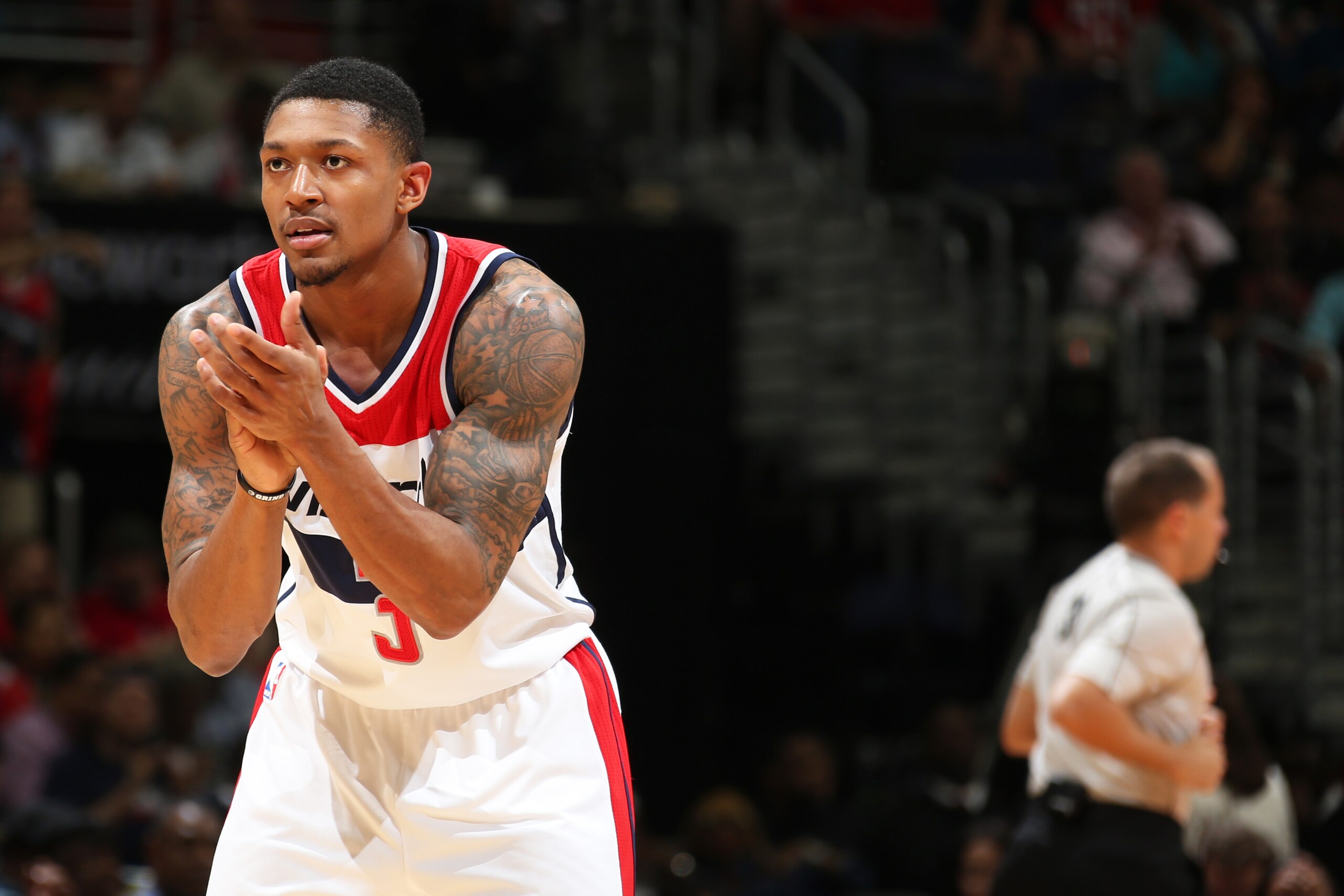
If that happens, Beal is definitely getting a max deal.
But if the Wizards act now with an offer slightly below it, perhaps the security of an eight-figure contract is too tempting to pass up for a player who has yet to have an injury-free season. Instead of $90 million over four years, maybe Washington could work out something in the range of Klay Thompson's four-year, $70 million contract.
That would net the Wizards an annual savings of $5 million over the life of the deal, while putting Beal in the same pay grade of a more accomplished player at his position.
If the Wizards wait to re-sign him next summer, they would have some added spending power. Only his $14.2 million cap hold would be on the books, so Washington could use that extra money to chase a premier player (like District native Kevin Durant) and add some talent around him.
Still, the team's cap situation already allows for ample wiggle room. The Wizards have six players entering the final year of their contracts and more than $26 million slated to come off of the books next summer. Outside of big-money deals to Wall and Marcin Gortat, there isn't much left on the payroll beyond the 2015-16 campaign.
| John Wall | $16,957,900 | $18,063,850 | $19,169,800 |
| Marcin Gortat | $12,000,000 | $12,782,609 | $13,565,218 |
| Bradley Beal | $7,471,412 | N/A | N/A |
| Martell Webster | $5,845,250 | N/A | N/A |
| Otto Porter | $5,893,981 | $7,732,904 | N/A |
| Kris Humphries | $4,630,000 | N/A | N/A |
| Drew Gooden | $3,547,000 | N/A | N/A |
| DeJuan Blair | $2,000,000 | N/A | N/A |
| Kelly Oubre | $2,006,640 | $2,093,040 | $3,208,630 |
| Guaranteed Total | $30,964,540 | $30,846,459 | $32,735,018 |
The second-to-last line of the table above is the important one: guaranteed money.
Only three of those players have fully guaranteed contracts for 2016-17: Wall, Gortat and rookie Kelly Oubre. Beal would only have his qualifying offer left if he hasn't signed anything by that point. Otto Porter has a team option, Martell Webster has a partial guarantee and the salaries of Kris Humphries, Drew Gooden and DeJuan Blair are nonguaranteed.
In other words, the Wizards can pay Beal now and have money for more talent later.
The difference in his cap hold amount is only significant if they give him the max. If they can sign him in that $17 million-per-year range, then you're only looking at $3 million in added flexibility—plus the very real possibility of Beal's total contract ballooning by $20 million if he earns max money next season.
The Wizards are better off placing a swift, smart bet on Beal this summer. If he's allowed to gamble on his future, Washington could be left footing an enormous bill.
Unless otherwise noted, statistics used courtesy of Basketball-Reference.com and NBA.com. Salary information obtained via Basketball Insiders.

.jpg?w=2560 "Cam Ward Says He's Not A Loser")
.jpg?w=2560 "🚨 Texans Trade for MHJ")
.jpg?w=2560 "Grading MHJ Trade 📝")
.jpg?w=2560 "Chargers Fall to 0-5 🤢")
.jpg?w=2560 "MHJ Bought Own Jugs Machine")