What Do LA Clippers Need from Josh Smith's Arrival?
The Los Angeles Clippers got a little deeper when they signed Josh Smith, as the team announced Thursday afternoon.
Smith, who split last year between the Detroit Pistons and Houston Rockets, joins a once-depleted Clippers team that has added depth to a talented roster this summer. The man who acts as NBA fans' resident punching bag is just another piece to lengthen what's already a solid bench.
Smith is obviously a flawed player, but the emphasis on his faults is a bit exaggerated.
TOP NEWS
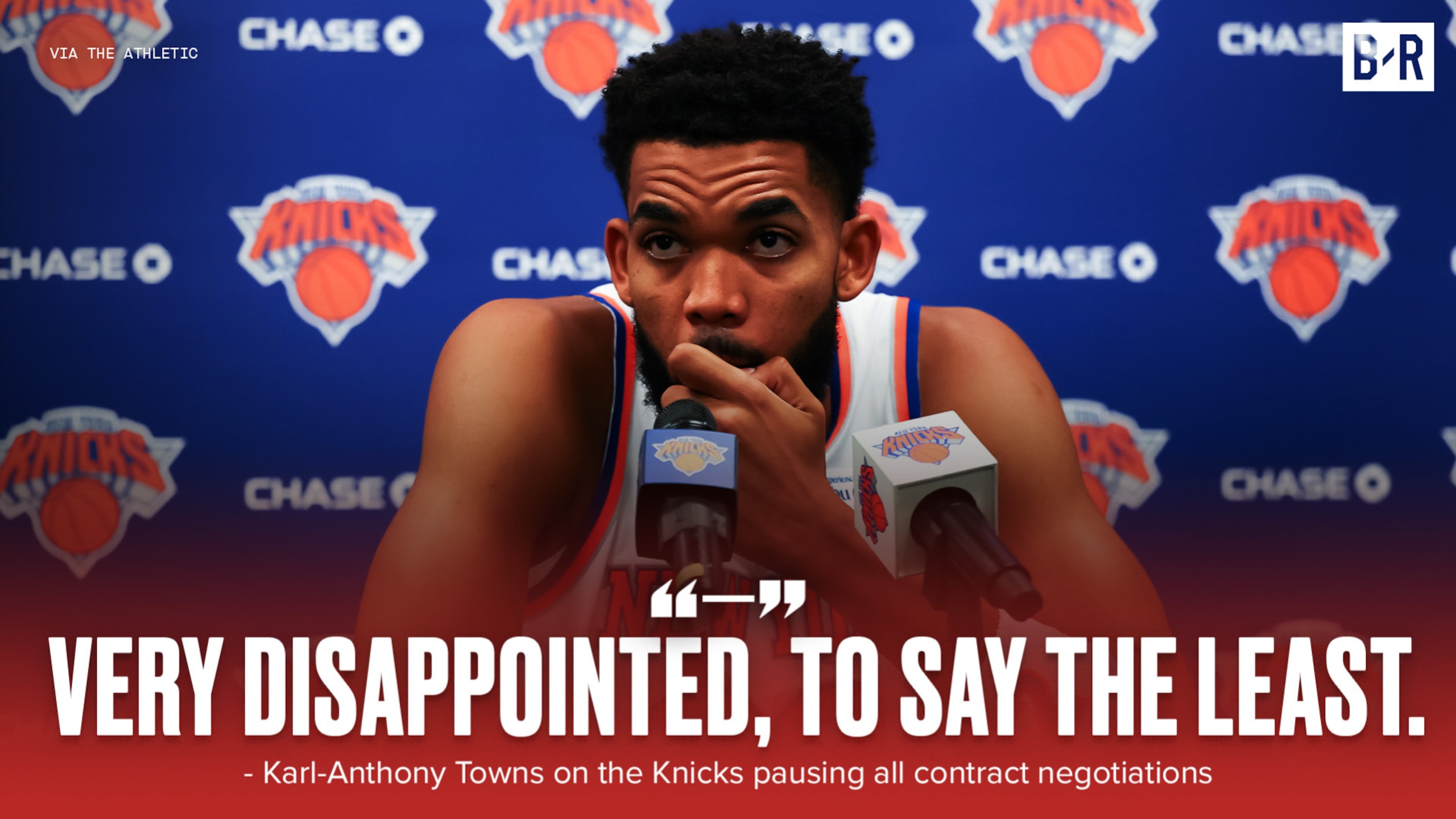
KAT's Contract News Quote 😬

1 Player Every Team Should Trade 🔀
Most Fascinating Players This Season 😲
He's able to create for others and is one of the league's best-passing power forwards—and he joins Blake Griffin, who is probably atop the NBA in that category. He may not be the athlete he once was, but he still makes a difference on defense and can get up to block shots. He lends some positional versatility, too. The Clips could even play him at the 5 in sparse small-ball moments throughout the season.
But because all of his problems are so obvious, it's easier to put them under a magnifying glass.
Any fans, even the most casual ones, can watch him and realize his three-pointers are suboptimal shots. Or that some of his decisions on the floor are the wrong ones. They're so in-your-face that they're hard to ignore.

It's the Russell Westbrook Phenomenon, even if Smith's game is obviously levels below that of the Oklahoma City Thunder point guard.
The reality, though, is there are plenty of other players out there with more subtle flaws, but ones that are far more damaging. Guys who constantly get turned around on defense or get blown by all the time or die on screens or willfully chase offensive boards they have no shot at—they don't get knocked nearly as much. But their blunders can cost teams possessions just as much as, (and sometimes more than), an ill-advised open three or silly mid-range jumper.
Speaking of which, aren't we a tad hypocritical about Smith, who is a 29 percent career three-point shooter, though he did knock in 33 percent of his long balls after heading to the Rockets for 55 games last season?
Look, no one is arguing he needs to take more threes, or even that he should be taking as many as he does, but we do live in a world in which the same people who are lambasting Smoove for chucking what are often open 24-footers are the same ones who are claiming that an unguarded three-point shot with your feet set is usually a good one, even if you're not the most accurate shooter.
Smith shouldn't be taking all those attempts, but they're not the worst shots in the game. If he hits just 30 percent of his threes, he's still turning in a better point-per-shot ratio than the loads of inefficient but understated mid-range-heavy gunners who shoot in the high 30s on their long twos.
There's an argument to be made in the middle ground.

Of course, Smith takes those twos, too, though he did almost completely eliminate them from his game with Houston. Under 7 percent of his field-goal attempts came from 16 feet out to the three-point line, helping him reach by far the lowest number of his career in that category.
Even if that is an integral part of the Rockets' offense, which prioritizes three-pointers and shots at the rim in a more extravagant fashion than any other attack in the league, it does show something important: Smith can be coached.
If he went to Houston and continued playing the same way he had in Detroit, that'd be a different story. But Smith actually did a decent job playing within the flow of the offense once leaving what was one of the worst situations in the league at the time of his departure. Maybe he learned something while he was playing for the NBA's analytics poster boys. Maybe he discovered something new as he developed beautiful big-to-big chemistry with Dwight Howard, something that could translate seamlessly into the Clippers' attack with DeAndre Jordan.
Or maybe he didn't. Maybe I'm reaching. But even if I am, we're not talking about a big financial commitment.
This is a minimum deal. There's no risk there.
That's the thing about basketball fans: We talk about how we like Player X and dislike Player Y, but in reality, we have to add context.
No general manager purely likes Player X or Y. He likes them for a price.
For a price.
That's a phrase we rarely add onto the end of such sentences, but one that is almost always necessary. And the public tends to form these opinions of players on big-money deals, which then stick with guys after the contracts are no longer around*.
*Smith's is kind of still present in Detroit with the Pistons owing him $5.4 million a year until 2020. They used the "stretch provision" to waive him and pay out the final dollars on his deal—he was owed $27 million over two years—over the course of five seasons.
Do you want Smith for $13.5 million a year? Heck no. But for the minimum? Yes, please.

As long as you're not bringing in a guy who is going to tear up your locker room, a minimum deal isn't going to be a bad one. Where's the financial risk? And if you're getting someone who can actually contribute in a legitimate fashion—like Smith with his passing, athleticism, defense and versatility—you have yourself a steal.
Rivers' team already has a locker room which could potentially be fragile, especially after trading for Lance Stephenson, but we've never heard anything to indicate that Smith's off-court demeanor would be a problem. It's his on-court knuckleheadery that elicits the issues.
The Clippers were one of the shallowest teams in the league last year. You could argue that Wesley Johnson, had he been on the squad, would've been their sixth- or seventh-best player during the 2015 postseason. Now, after signing with the Clips this summer, he will go into October as someone who may struggle even to get on the floor.
This has transformed into a deep team, and Doc Rivers, who has taken deserved criticism over the past couple of years because of his front-office decisions, deserves some dap for that, bringing in Stephenson, Paul Pierce, Cole Aldrich, Johnson and now Smith. Who would've thought, back when DeAndre Jordan was a Dallas Maverick for five days, that this could happen?
And because of that depth, L.A. can afford to put up with the occasional shoddy night from Smith, who doesn't have to perform at a high level for 28-plus minutes every evening.
He's not a gamble. He's also not a certainty. But there's a pretty decent chance the Clippers will be satisfied with the contract come the end of the season.
Follow Fred Katz on Twitter at @FredKatz.
All statistics courtesy of Basketball-Reference.com and NBA.com unless noted otherwise.

.jpg?w=2560 "Cam Ward Says He's Not A Loser")
.jpg?w=2560 "🚨 Texans Trade for MHJ")
.jpg?w=2560 "Grading MHJ Trade 📝")
.jpg?w=2560 "Chargers Fall to 0-5 🤢")

.jpg?w=2560 "MHJ Bought Own Jugs Machine")