How Greg Monroe Can Thrive at Center of Milwaukee Bucks' Attack
No one expected Greg Monroe to sign with the Milwaukee Bucks. With the Los Angeles Lakers and New York Knicks in the chase for his services, the former Detroit Pistons power forward had piles of money from two of the biggest markets in the country staring him in the face.
Yet Monroe's choice, although surprising, makes perfect sense upon further analysis.
TOP NEWS
KAT's Contract News Quote 😬

1 Player Every Team Should Trade 🔀
Most Fascinating Players This Season 😲
The Bucks' emerging status as a playoff contender in the Eastern Conference makes them an intriguing team moving forward. The young core of Giannis Antetokounmpo, Khris Middleton, Michael Carter-Williams and Jabari Parker has boatloads of potential—particularly as a long, athletic and switch-heavy unit that head coach Jason Kidd guided to the second-best defensive rating in the league last season, per NBA.com.
What their core lacks is an offensive centerpiece and more specifically a big man with competent scoring skills from the free-throw line and inside of it. Although Parker projects as a ball-dominant, small-ball point-forward capable of leading an offense, it's neither fair nor reasonable to dump the majority of the offensive load on his shoulders in only his second (and potentially first full) season in the NBA, especially as he's coming off a torn ACL.
That's where Monroe enters the picture. He'll immediately boost the league's sixth-worst offense with his versatile inside game. He can face up against slower bigs or back down stretch 4s with his bruising post work. In Milwaukee's guard-heavy attack, he can competently handle the ball in dribble handoffs to keep the action pinging from side to side.
There are legitimate questions, however, as to whether Monroe can ever be the focal point of a truly efficient offense. When push comes to shove, he's a one-on-one power forward without the range to spread the floor. He can't play the 5 because he's neither big nor athletic enough to protect the rim, although Kidd might experiment with such lineups because of his preference for long-armed small ball.
Zach Lowe speculated as such over at Grantland:
"And that’s the best part here: imagining how Monroe might work as a hub on offense in hybrid lineups, with Middleton and Antetokounmpo on the wing, and Parker at power forward. Those feel like younger, springier versions of the “long-ball” lineups Kidd used in Brooklyn, with Paul Pierce as a stretch power forward.
"
Monroe won't see the majority of his minutes at the 5, but it's possible we could see it in spurts. Stan Van Gundy tried it throughout his first year in Detroit and backed his star publicly to Vincent Goodwill of the Detroit News.
"I think Greg's actually pretty good defensively," Van Gundy said. "I've thought that all year. He's a very good low post defender, in my opinion. And he's a smart defender. He doesn't make a lot of mistakes."

Still, Zaza Pachulia, John Henson or Miles Plumlee will see minutes alongside Monroe, none of whom provides much in terms of offense. Especially with Carter-Williams at point guard, that leaves Milwaukee with three players who cramp spacing while sharing the floor.
When Reggie Jackson, Monroe and Andre Drummond played together last year in Detroit, the Pistons sputtered to a minus-12.3 net rating, including an abysmal 99.6 offensive rating, per NBA.com. That doesn't bode well for the Bucks, whose Carter-Williams-Monroe-Pachulia combo brings similar, if not worse, attributes.
But that doesn't tell the whole story. Jackson was the focal point of the offense in Detroit via his pick-and-roll play with Drummond dominating the action. Van Gundy sprinkled in Monroe isolation sets here and there, but he's ultimately a four-around-one coach.
He prefers the pick-and-roll surrounded by shooters—the formula he used in Orlando with Dwight Howard. Spread the floor, set a high ball screen and force the defense to decide between guarding the paint or the three-point line.
Milwaukee presumably brought Monroe in to serve as its centerpiece. His greatest strength isn't the pick-and-roll; it's operating from the elbows/15-foot baseline area, where Kidd likes to initiate his offense. In this role, Monroe can use his superb one-on-one skills to draw help and find guards on the perimeter.
That was Milwaukee's biggest problem last season: It had no one who could truly break down a defense with any type of consistency. Monroe brings that skill and then some, albeit from a different point of attack than is typical in today's NBA.
Too many possessions for Milwaukee ended like this one with lots of half-attacks and stymied drives. Fruitless kick-outs and tough shots at the end of the shot clock became the norm:
The Bucks make four attempts to beat defenders off the dribble, and none are successful. Middleton, who has emerged as a strong "three-and-D" player in the league, cannot use the advantage of a close-out to blow by his defender. Without players who can capitalize on these tiny slivers in the defense, offense is difficult.
Monroe solves this problem as Milwaukee's focal point. The team will likely need another major offensive weapon to make serious noise in the East, but at the very least he serves as a nice stopgap between now and the hopeful development of Parker into that kind of player.
In straight pick-and-roll in which Monroe is not directly involved, he becomes problematic as a non-stretch 4. Check out the spacing on this Jackson-Drummond pick-and-roll: Monroe is standing at the top of the key as the action unfolds on the right side.
As soon as Drummond rolls to the rim, two Cleveland Cavaliers defenders stick with the ball. Kevin Love, who's guarding Monroe, completely sinks in and "tags" Drummond—a defensive technique in which a help defender quickly bumps a roller to give his original defender time to recover.
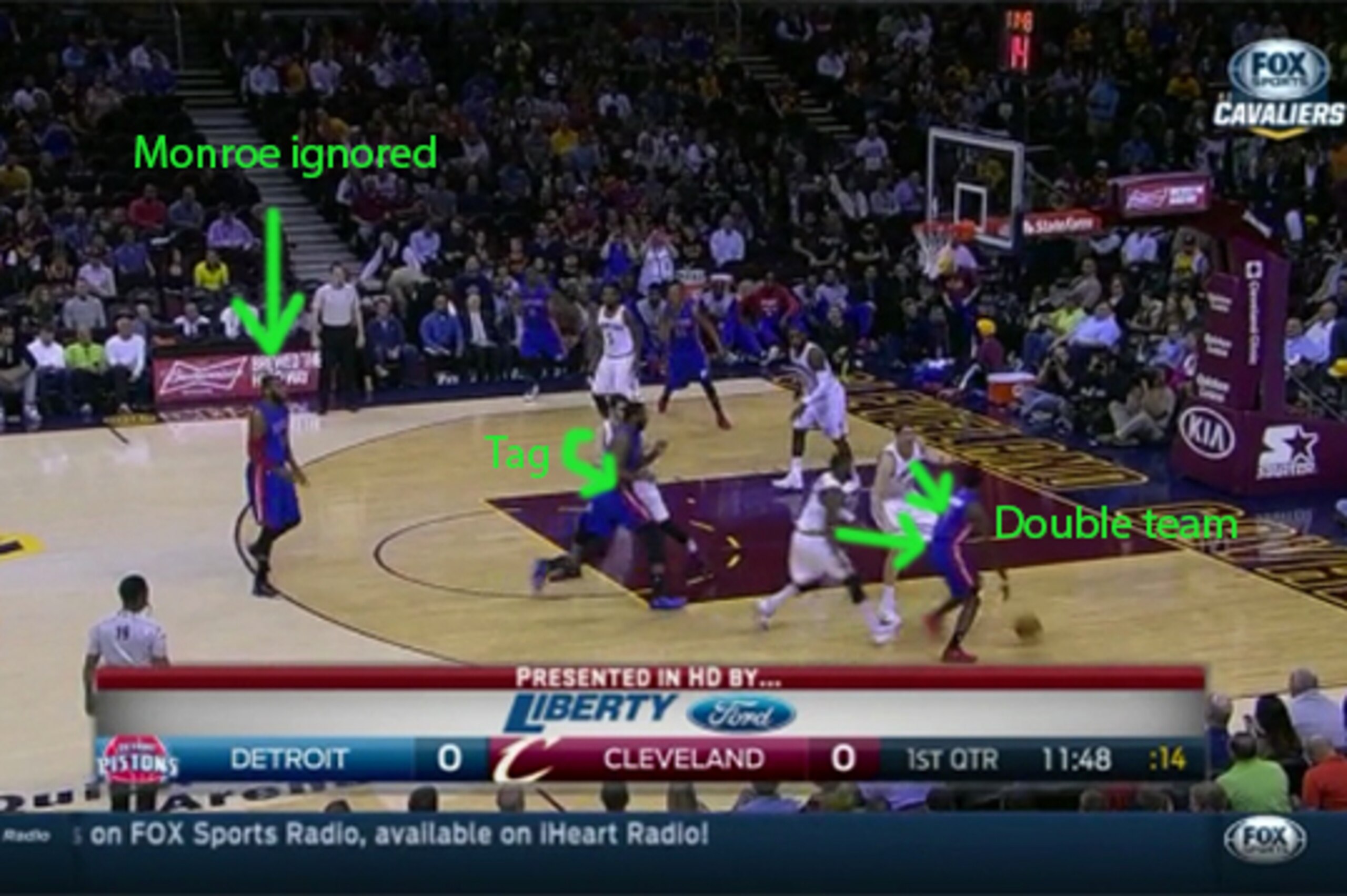
Except in this instance, Love pays no attention to Monroe and does not recover to him. Timofey Mozgov, who is initially guarding Drummond, sticks with the ball in what effectively turns into a double-team. He knows that Love can sink in to help him.
With nowhere to go, Jackson throws up an ill-advised lob to Drummond, which is intercepted in traffic.
This is the reverberating effect of having Monroe on the perimeter in any pick-and-roll situation. He is no threat to roam the three-point line and punish sagging defenders. The obvious option on the play above was for Monroe to follow in behind, giving Jackson an outlet pass and making Love pay for ignoring him.
But Monroe isn't a shooter and doesn't think like a perimeter player. He's not stalking the three-point line for an opportunity.
Now flip the script and put Monroe in the ball screen. His skills allow him to make secondary moves when he receives pocket passes, as we can see here when he hooks up with Tayshaun Prince.
This free-throw-line area is where Monroe makes his money. Parker-Monroe pick-and-rolls could be dangerous option because there's no good way to defend them. Switch, and both Parker and Monroe have mismatches. Pressure Parker, and he's a capable enough passer to find Monroe, who can then make plays from the elbows.
And then there's the matter of Monroe operating with the ball in his hands from the jump. Here the Pistons run an action to dump it into him in the post, but Draymond Green of the Golden State Warriors immediately doubles him.
We can see Monroe's patience on this play because he does not immediately dribble the basketball. Instead, he pops his head up, surveys the floor, throws in a pump fake and fires a dart across the court for an open three-pointer.
Golden State wasn't the first team to bring extra help to any Monroe isolations. He averaged 16 points in only 31 minutes per game for a reason. According to Synergy Sports, he created .909 points per possession out of the post (on both his own shots and field goals he set up for teammates), a number higher than two-thirds of the half-court offenses in the league.
Still, Monroe probably isn't the answer for a championship. He needs the ball in his hands to be most efficient and struggles playing away from the ball. Featuring him will alleviate some of Milwaukee's problems, but he's not good enough to carry the load for a real contender.
But that doesn't mean this signing by the Bucks doesn't fit their needs at this moment. His deal is for only three seasons at most (he has a player option after the third year), which gives the Bucks time to develop and cut him loose when other pieces, namely Parker, step up to the plate.
Unless some of the younger players take major steps forward, it's hard to see Milwaukee finishing much higher than it did last year in the Eastern Conference.
But in terms of the team's forward-thinking approach, Monroe is the right fit at present.

.jpg?w=2560 "Cam Ward Says He's Not A Loser")
.jpg?w=2560 "🚨 Texans Trade for MHJ")
.jpg?w=2560 "Grading MHJ Trade 📝")
.jpg?w=2560 "Chargers Fall to 0-5 🤢")
.jpg?w=2560 "MHJ Bought Own Jugs Machine")