

Realistic Expectations for Sam Dekker's Rookie Season with the Houston Rockets
The Houston Rockets drafted Sam Dekker with their first-round pick in a somewhat—but not entirely—surprising selection. The Wisconsin small forward fell in the draft, and the Rockets were happy to sweep him up. What can Rockets fans expect from their newest rookie?
Houston was expected to take a point guard, and Jerian Grant out of Notre Dame (who was the next pick taken) would have been a nice fit alongside James Harden. But the Rockets went with the “best player available” philosophy, and Dekker was arguably that.
Who Is Sam Dekker?

Dekker measured 6’7 ¾” at the combine without shoes and 6’9” with them. He’s a sturdy 219 pounds with 7.5 percent body fat, per NBA.com. He has a vertical of 34 ½ inches and ran the agility test in 10.64 seconds. The only drafted player who beat Dekker in both categories was Devin Booker.
And while it’s easy to make casual comparisons to other white small forwards, ranging from Wally Szczerbiak to Chandler Parsons, Jonathan Wasserman suggested Jeff Green is the most appropriate:
And Layne Vashro has a handy-dandy tool at Nylon Calculus that uses both combine measurements and college stats to generate a similarity score to other NBA players. According to that, the best comparison for Dekker is a young Tayshaun Prince.
Dekker’s scouting report from Jonathan Givony at DraftExpress.com is pretty effusive of both his offense...
"One of the most versatile and efficient offensive players in the college game, Dekker does a little bit of everything, even if he doesn't truly excel in any one area. He is good in transition, can attack his man off the dribble, moves off the ball intelligently, crashes the offensive glass, and can make an open jumper, giving him many different ways he can contribute to a NBA team early on in his career.
Dekker's size, athleticism and versatility shines through most vividly in the open floor, where he is very effective grabbing a rebound and going coast to coast as the ball-handler. He didn't get as much of a chance to show this part of his game at Wisconsin (one of the slowest paced teams in the NCAA) as he will in the more up-tempo settings of the NBA, but he clearly can.
"
... And of his defense:
"Defensively, Dekker is similarly versatile, being capable of guarding bigger players with his size, strength and toughness, and smaller players thanks to his solid lateral quickness and strong effort level. He should be able to switch seamlessly between shooting guards, small forwards and power forwards in pick and roll situations, which is attractive in today's NBA. He's the type of player who doesn't back down on this end of the floor, as you'll regularly see him taking charges and throwing his body around, showing a nice competitive streak.
"
In many ways, he fits in nicely with the Rockets, who like to push the ball in transition on offense and switch more than most teams on defense. Based on his style of play, skill set and size, he’s very much the type of player the Rockets like to add.
But Why a Small Forward?

The more intriguing question than “Why Sam Dekker?” is “Why did the Rockets draft a small forward at all?” The Rockets have a much greater need at point guard. They have just one on the roster who is under contract, and that’s the 37-year-old Pablo Prigioni.
Last year’s starter, Patrick Beverley, is a restricted free agent. And combo guard Jason Terry has expressed that he would like to return, per the Houston Chronicle's Jenny Dial Creech. Retaining the status quo, though, isn’t a great game plan for the Rockets, since that was their biggest weakness last season.
Meanwhile, they sport a glut of forwards. They have Trevor Ariza as the starting 3. Terrence Jones and Donatas Motiejunas are expected to compete for the starting 4.
Corey Brewer was the backup small forward last year. He and power forward Josh Smith are free agents, but like Terry, they would like to return, per Dial Creech.
In addition, the Rockets have restricted free agent K.J. McDaniels, who plays both wing spots, and combo forward Kostas Papanikolaou has a team option on his contract. And the Rockets’ second-round pick, Montrezl Harrell, is another forward.
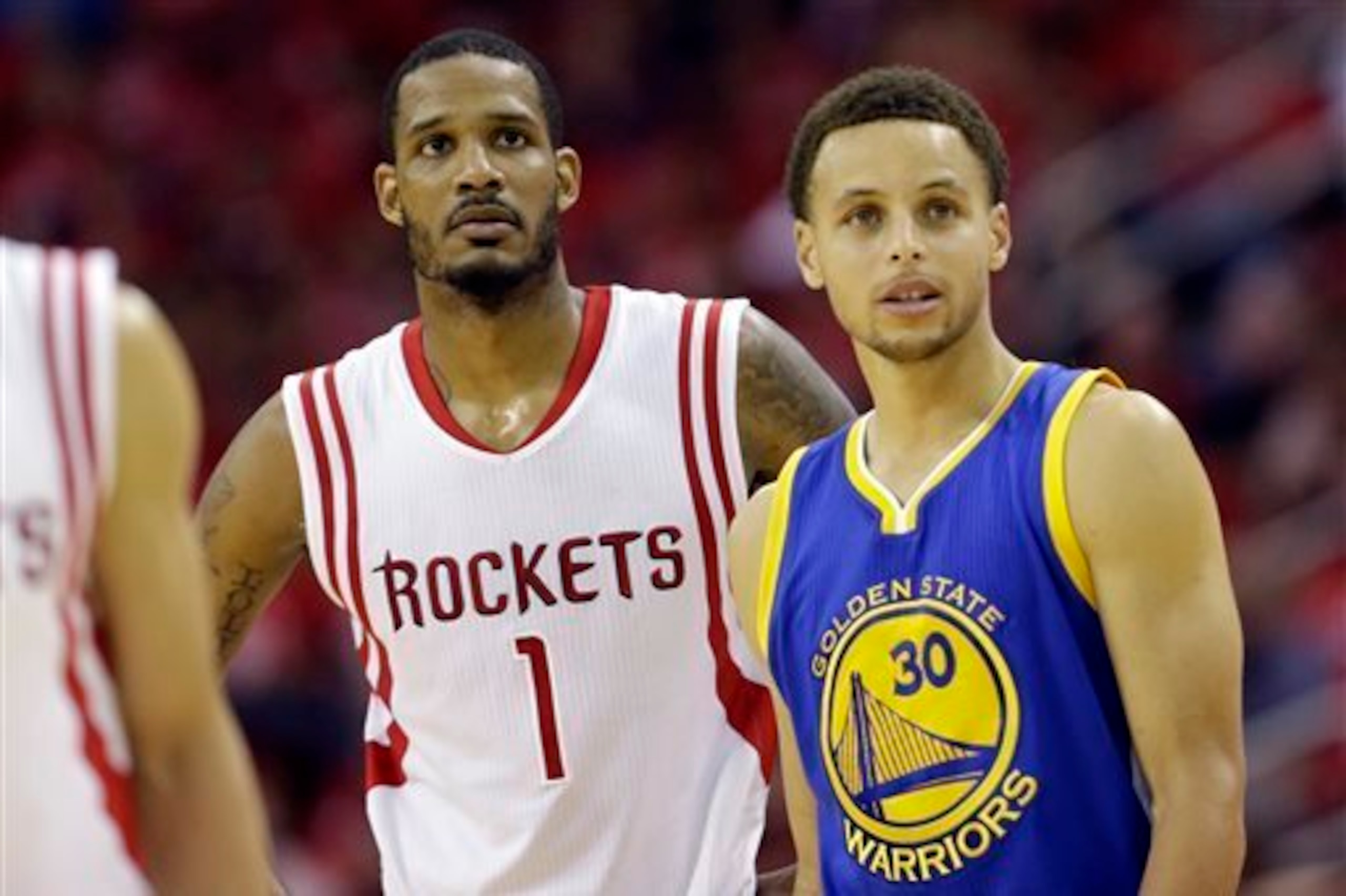
Per Jonathan Feigen of the Houston Chronicle, general manager Daryl Morey still intends to bring back all his forwards, saying that the team’s free-agency plans are “most likely unchanged.”
Morey explained the reasoning for the selections: “We always go with who we think is the best player. We took who we think is the best player at each (draft) spot. If Sam Dekker was gone, I think guard (sic) was the next guy on the board.
And this should not come as a shock. Morey has traditionally drafted the best player available, then used free agency and trades to fill holes in the roster. He’s always been a forward-thinker, but this year that’s taken on a different meaning.
The bottom line is that Dekker doesn’t appear to be a piece to win now. Morey explained:
"We have a very hard roster to get minutes on with the Rockets. I think our normal developmental program last year had (Clint) Capela helping us with minutes at the end of the year. I think if we got Sam or Montrezl (Harrell) helping us at the end of the year, that will be fantastic.
"
Capela and Nick Johnson both spent a large portion of last season in the D-League with the Rockets affiliate Rio Grande Valley Vipers. They use the development opportunity more than most teams, and to their credit, it seemed to work well. Capela was impressive in the postseason, recording a 21.8 player efficiency rating, per Basketball-Reference.com.
Feigen questioned Morey about the Rockets’ other plans this offseason:
"Before then, the Rockets will move to free agency. Morey described the plan to sign his own free agents – Pat Beverley, Josh Smith, KJ McDaniels, Jason Terry and Corey Brewer – as “most likely” unchanged, though he could kick the tires on much larger, roster-changing moves.
“I think there’s possible opportunities we have to explore that are bigger, but I think they’re unlikely,” Morey said. “It’s probably likely we’ll stay over the cap and use our mid-level.”
"
It would appear, then, that the Rockets will meet the point guard need through the mid-level exception, and increasingly it appears they will spend it on Sergio Llull, according to Nikos Varlas of Eurohoops. And that would further explain why the Rockets didn’t address the need through the draft.
Realistically, Rockets fans should not be putting too much hope in Dekker being the player who is going to put them over the top this year. Houston didn't choose him with that in mind. It will develop him, as it has its other youngsters.
Best-case scenario, Dekker impresses with the Vipers, and that lands him more minutes with the mothership later in the season. But, even if that doesn’t happen, Rockets fans need to remember that it’s not an assessment of his value. This is just the way Houston develops players.


.jpg?w=2560 "Chiefs, Steelers Eye WR Trades")





