San Francisco 49ers: What Can We Learn from Geep Chryst's History?
New San Francisco 49ers offensive coordinator Geep Chryst has plenty of football experience. He’s been a coach in college, the NFL and the WLAF since 1987, working as a position coach for quarterbacks, running backs, wide receivers and tight ends—everything but the offensive line. There’s no doubting he has a long and varied history, picking up bits and pieces from wherever he’s been to become a better coach.
He’s even been an offensive coordinator once before. The San Diego Chargers used Chryst as their offensive coordinator from 1999 through 2000, having him coach quarterbacks at the same time. Head coach Mike Riley was also an offensive-minded coach, but Chryst was brought in to work with young quarterbacks specifically in addition to calling the offense.
After all, he had had success working with Jake Plummer in Arizona, so surely he could help develop young quarterbacks in San Diego, right?
Well, not so much. The Chargers finished 28th and 26th in total offense in Chryst’s two years as head coach. They were slightly better in the air, finishing 18th in passing in each of those two seasons, but that’s more of an indication that the team was trailing a lot and had to throw to try to stay in the game, rather than an indication of a lethal passing offense.
In short, the Chargers offense was fairly terrible during Chryst’s tenure, and the team’s 9-23 record can be easily blamed on the offense. After all, this was a defense that had players like Junior Seau, Jamal Williams and Rodney Harrison on it—the defense isn’t what crumbled in San Diego.
So, if the offense was at fault, how much of it is Chryst’s fault? While no team was rushing to give Chryst another offensive coordinator job after his tenure in San Diego, a coach can only work with what he has.
To answer that question, we need to look at the caliber of players Chryst had in San Diego. By comparing the talent that roster had to the talent the current 49ers have, we can see if there’s any reason to believe Chryst will have more success in his second attempt at being an offensive coordinator.
Quarterbacks
1 of 5
Chryst was brought into to be a quarterback whisperer, as it were. From 1996 to 1998, he served as quarterbacks coach for the Arizona Cardinals, working first with end-of-career Boomer Esiason and career journeyman Kent Graham before getting the opportunity to work with second-round pick Jake Plummer in 1997.
Esiason, even in his second-to-last season, still had the tools to be a great quarterback, and his one year under Chryst was a significant step up from his last two seasons with the New York Jets.
Graham’s 1996 season with Chryst was arguably the best in his career, as he completed 146 passes for 1,624 yards and 12 touchdowns to just seven interceptions. You can make an argument it’s that season that kept getting him chances to step in after injuries occurred later in his career.
Plummer, on the other hand, had rookie struggles and didn’t exactly become a top quarterback in Chryst’s first two seasons working with him. There was, however, notable improvement from 1997 to 1998.
Plummer’s completion percentage rose while his interception percentage dropped, and he led the franchise to its first postseason win since 1947. There was clearly enough there for the Chargers to be intrigued at the possibility of having Chryst work with their struggling rookie quarterback, Ryan Leaf.
Insert dramatic sting here.
To be fair, Chryst didn’t have to work with Leaf in his first year in San Diego. Leaf hurt his shoulder in training camp and missed the entire 1999 season. Instead, Chryst worked with two quarterbacks approaching the ends of their careers: Jim Harbaugh and Erik Kramer.
Neither had seasons to write home about, though Harbaugh had some success coming off the bench in 2000. Kramer, on the other hand, looked awful after a couple of solid seasons in Chicago leading up to his San Diego stint.
Harbaugh finished his tenure under Chryst with 372 completions for 4,177 yards, 18 touchdowns and 24 interceptions, arguably the worst numbers of any of his NFL stops. Considering these were the last two years of his career, that might explain his struggles.
Kramer’s one season under Chryst saw him complete 78 passes for 788 yards and two touchdowns, along with 10 interceptions, which is easily the worst stretch of his NFL career. It’s fair to say Chryst didn’t coach up either player significantly, but he rode them to an 8-8 season.
Then, in 2000, Leaf came back, and that’s when the bottom fell out.
Leaf was the primary starter in 2000, with Harbaugh coming in and out of the lineup as Leaf got hurt and healthy and hurt again. Harbaugh played decently in his stretches in the lineup; Leaf did not.
I suppose it’s worth noting that Leaf played better in 2000 than he did in his rookie year of 1998. He completed a full 50 percent of his passes and increased from two touchdown passes to 11 on less than 80 additional pass attempts. His interception rate dropped, and his quarterback rating jumped from 39.0 to 56.2. Two years working with Chryst made Leaf just a really bad quarterback, rather than an utter disaster.
That 2000 season is why Chryst’s overall record looks so bad, because they stumbled to a 1-15 record. I don’t think you can blame Chryst for not being able to win with Leaf; he didn’t draft him, and it quickly became clear that no one in the NFL could win with Leaf. When he was stuck with aging quarterbacks like Harbaugh, he did better.
And then, he went back to Arizona and revitalized Plummer’s career again. Plummer really struggled in the two years Chryst was gone, throwing 45 interceptions and just 22 touchdowns and watching his yards per attempt plummet from the upper six-yard mark down to just 5.9.
Chryst’s return, however, shot Plummer back up to his heights, returning him to the completion percentage and yard totals of Chryst’s earlier run while cutting his interception rate down to career lows.
If that’s where the story ended, we’d have a clear pattern of Chryst boosting players to their maximum potential, even if that potential is as low as Leaf’s. Plummer’s 2002 season, however, saw him right back in the dumps, and neither Jeff Blake nor Josh McCown had good seasons for Chryst in 2003, and he left as part of the house cleaning Arizona did after that season.
We’ve seen the success Chryst has had with Alex Smith and Colin Kaepernick in San Francisco, so I’m willing to give him the benefit of the doubt that his San Diego situation was that bad, working with historic draft busts and aging veterans. He should have more success with Kaepernick in San Francisco.
At the same time, I wouldn’t call him a quarterback whisperer. He’s had good seasons with Plummer and Kaepernick, and he’s had bad seasons with them. If you want to overstretch to fit the narrative, the evidence points to Chryst being able to develop quarterbacks to a point, but only so far—he’s great to work with rookies, but he can’t get them over the hump to the next level.
It took Mike Shanahan, for example, for Plummer to become a Pro Bowl quarterback. There’s only two data points there, so it’s not the most solid description in the world, but there’s not enough in Chryst’s history for me to say that he will be good at continuing to guide Kaepernick’s development
He should at least get everything he can out of Kaepernick’s current level, though, which should be a major boost over his San Diego days.
Running Backs
2 of 5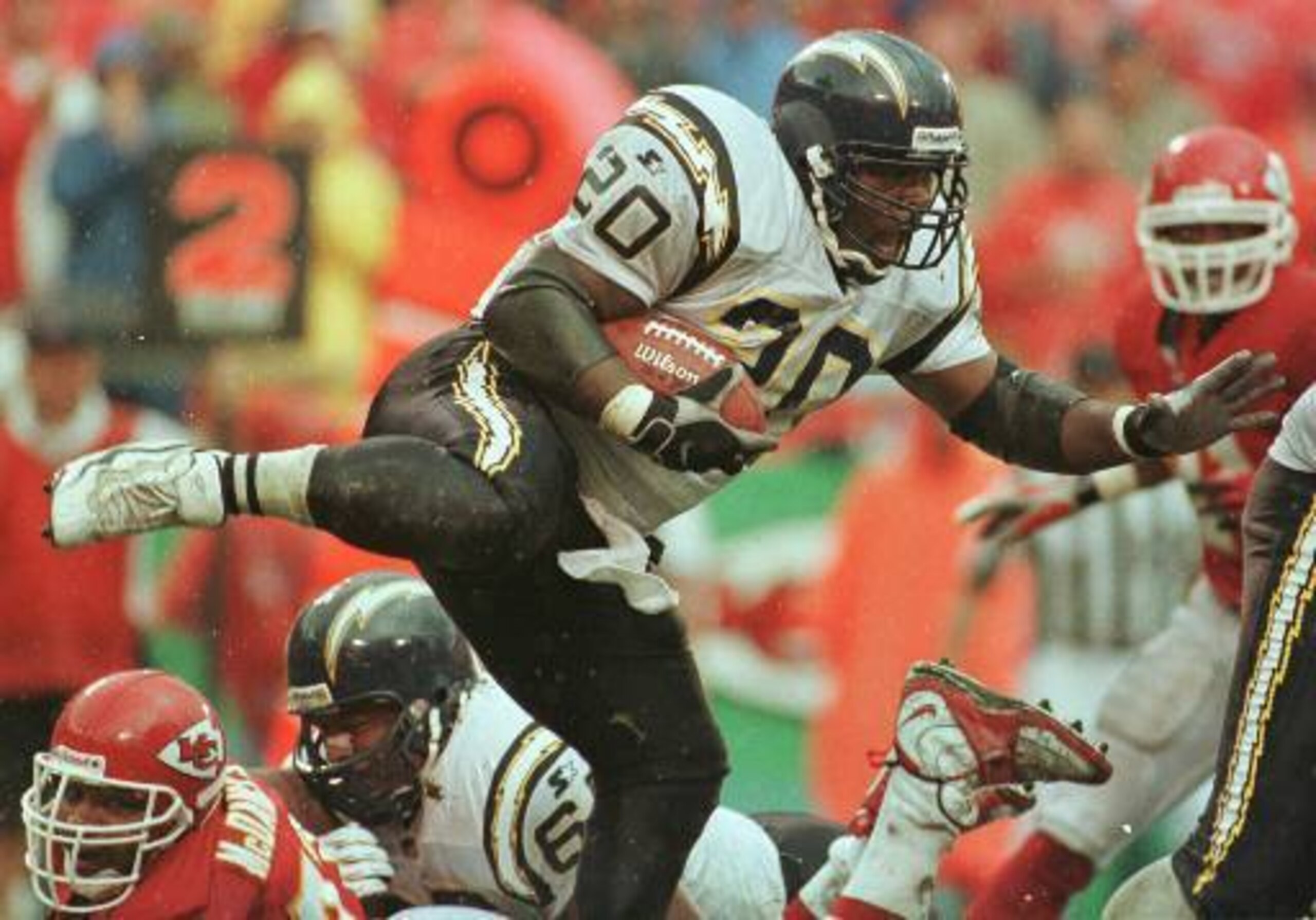
Chryst has never served as a running backs coach in the NFL, so we can just focus on his two seasons in San Diego.
There’s nothing overly good here. In 1999, the primary back was Natrone Means. San Francisco fans will remember Means as the Chargers’ Pro Bowl running back the year they lost Super Bowl XXIX to the 49ers, but that year was clearly a career outlier.
Means had left and come back by 1999, and he managed 112 carries for 277 yards and four touchdowns. He didn’t get a carry for Carolina the next season and was out of the league.
The Chargers’ leading rusher that season was actually Jermaine Fazande, who had 91 carries for 365 yards and two touchdowns. That performance was enough to have him split the lead back duties with Terrell Fletcher the next season.
Neither topped 400 yards, and the team as a whole managed just 3.0 yards per carry. Fazande never played in the NFL again, and Fletcher received only 55 more carries in his career.
This is a dismal set of running backs. While there’s no guarantee that Carlos Hyde will continue to develop or that Kendall Hunter will bounce back from his knee injury, Reggie Bush instantly becomes the most talented back Chryst has ever had to work with.
I don’t think there’s any argument that the 49ers’ 2015 corps should be much more successful than anything Chryst had to work with in San Diego. It would be stunning to see Chryst’s running game be as inefficient as it was with the Chargers. You can’t run the ball without a solid running back.
Wide Receivers
3 of 5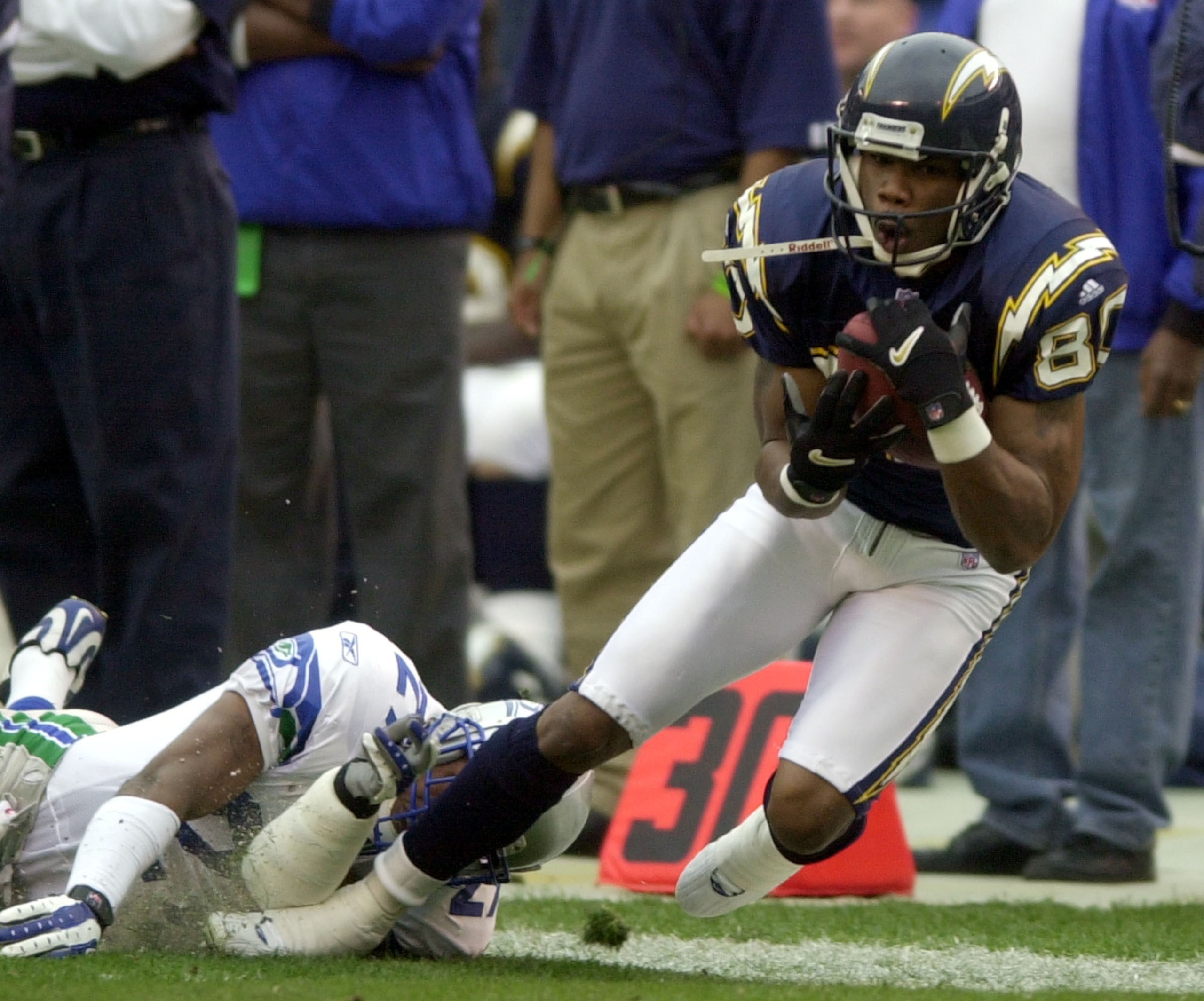
So, if Chryst’s quarterbacks were bad, and his running backs were bad, he must have had some receivers to work with in San Diego, right? They couldn’t whiff on all the skill positions, surely.
And indeed, they didn’t. Chryst’s San Diego Chargers boasted the services of Jeff Graham, who bounced around from team to team in his NFL career and yet still was productive everywhere he went. In fact, Graham is one of only two players who has more than 1,000 career receiving yards with four different teams.
The ex-second-round pick had an 11-year career, and while San Diego was his last stop, he was still effective. In Chryst’s two seasons, Graham caught 112 passes for 1,875 yards and six touchdowns. That’s not going to send anyone to the Hall of Fame or anything, but those are very solid numbers for a productive veteran, especially considering the quality of quarterback he had to deal with.
Graham may have been the only player who was good for both of Chryst’s two seasons as the offensive coordinator, but he wasn’t the only solid receiver in the corps. The 2000 Chargers also had a good season from Curtis Conway, who had just arrived as a free agent after a successful stretch in Chicago.
The former seventh overall pick had 53 receptions for 712 yards that season, again catching passes from Ryan Leaf and a falling-apart Jim Harbaugh. A Graham-Conway combination was a solid one, and when passes were rarely thrown in catchable locations, they made the most of it.
Conway was an improvement over 1999’s secondary receiver and second-round pick Mikhael Ricks. While not nearly as big of a bust as Leaf was, Ricks never had more than 500 yards in a season. The 1998 Chargers draft was horrible.
Still, despite this being the best area of Chryst’s time in San Diego, the 49ers squad does look better. Anquan Boldin maps on as a much better Jeff Graham—the traveling veteran who catches everything.
It’s perhaps too soon to call Torrey Smith better than Curtis Conway, but he fits as a big free-agent acquisition to add another element to the offense. Add in the potential of the platoon of young players the 49ers have, and I think the edge again goes to San Francisco, albeit not as strongly as it did at quarterback or running back.
.jpg?w=2560 "Seahawks Chiefs Football")


Tight End
4 of 5
Other than quarterback, tight end is where Chryst made his name in the NFL. He was a tight end position coach for eight seasons—three in Arizona and five in Carolina—before coming to the 49ers.
In Arizona, Chryst worked with Pat Carter and got the best season of his career out of him. His 26 receptions for 329 yards in 1996 were the most in his NFL career. 1997 and 1998 saw Chryst use Chris Gedney, getting his top two receiving seasons out of him, as well.
The 1998 season also featured Johnny McWilliams at tight end, and he also set his career high for receiving yards under Chryst. So far, so good.
In San Diego, Chryst continued his pattern of using tight ends a lot. In 1999, the team’s second-leading receiver was tight end Freddie Jones, who set what was then a career high in receiving yards with 670. He broke that mark the next season with 766, though he was much less efficient in 2000 than he was the year before, which can again be attributed to poor quarterback play. Still, that’s five seasons and five receiving records for Chryst’s tight ends up to this point.
Chryst next coached tight ends starting in 2006 in Carolina, to much less success. Neither Kris Mangum nor Michael Gaines lit up the field in 2006, and neither was with the team the next season.
The Panthers used a fifth-round pick on Jeff King that season, and he was thrust into the starting lineup in 2007, where, after some growing pains, he became decent enough, splitting snaps with Dante Rosario. Both of them hit career highs under Chryst, and both developed into solid players—at least for a time.
That’s eight tight ends, with six of them putting up career highs in receptions and yards under Chryst. Not one of them was mega-talented as a receiver, either, with only Jones having what I would call a notable career as a pass-catching tight end.
The 49ers are loaded with tight ends, and Chryst likes using them. If Vernon Davis can recover from a horrible 2014 season, he’ll be the most talented tight end Chryst has ever had the opportunity to use, though hoping that Davis will top his career high of 965 yards seems overly optimistic.
If Davis doesn’t bounce back, I’d give the edge in talent to Chryst’s San Diego teams, as Jones was an excellent tight end for many years. Still, considering the success Chryst has had developing tight ends, his promotion to offensive coordinator bodes well for Vance McDonald, Blake Bell, Garrett Celek and Derek Carrier. You can expect the tight ends to play a larger role in 2015.
Offensive Line
5 of 5
Here were Chryst’s primary offensive linemen in San Diego:
- Left tackles John Jackson and Ben Coleman
- Left guards Aaron Taylor and Raleigh Roundtree
- Center Roman Fortin
- Right guards DeMingo Graham and Kevin Gogan
- Right tackle Vaughn Parker
The dramatic shift in three starting offensive linemen from 1999 to 2000 already tells us something about the quality of the line, but it’s not as bad as it first seems.
Kevin Gogan’s the name that should jump out to 49ers fans; he made the Pro Bowl twice with the team in 1997 and 1998. By his stint in San Diego, Gogan was 36 years old and a shadow of the player he used to be. He was cut after the season and never played again.
John Jackson played 14 years in the NFL and started 166 games, mostly with the Pittsburgh Steelers. While he wasn’t the same player in San Diego, as he approached the end of his career, he was decently solid. I’d call him a useful piece to have.
Aaron Taylor was plagued by injuries, causing him to retire after the 1999 season after coming over on a large contract from Green Bay. He would have been useful had he ever stayed healthy, but a banged-up Taylor was nothing to write home about.
Vaughn Parker and Roman Fortin each had long NFL careers as decent, if second-rung, offensive linemen. They weren’t as talented as Jackson or Taylor, but they were solid enough.
Neither DeMingo Graham nor Raleigh Roundtree had a particularly notable NFL career.
So, that’s two excellent players at the end of their careers, one promising player who was cut down by injuries, two solid veterans still playing at decent levels, and two blanks. That’s not the worst line combination I’ve ever heard of, though it’s nothing spectacular.
Is it better than what the 49ers have? Well, Joe Staley is better than anything the Chargers had at left tackle, and Alex Boone’s probably better than whichever guard position he’ll end up at, but it’s murky after that.
Daniel Kilgore has had one good half-season as a starter, but we don’t know how he’ll continue to play. Erik Pears is coming off of some awful seasons in Buffalo, though he was playing out of position. Brandon Thomas and Marcus Martin have potential, but they’re second-year players without significant experience at this point.
Just because of all the uncertainty, I have to give the edge to Chryst’s teams in San Diego at this point, though the 49ers have the bigger upside.
So, the 49ers are better at quarterback, running back, wide receiver and possibly tight end than Chryst’s San Diego teams, while the offensive line is a downgrade.
Somehow, upgrading from Ryan Leaf and whichever running backs were walking by the practice facility that day should mean Chryst’s second stint at offensive coordinator goes significantly better than his first one.
Bryan Knowles is a Featured Columnist for Bleacher Report, covering the San Francisco 49ers. Follow him @BryKno on Twitter.
.jpg?w=2560 "Raiders Saints Football")