

How to Restructure the NY Giants Offensive Line After the Will Beatty Injury
Injuries.
Is there a dirtier word that can be said to New York Giants fans?
Not even the mention of heated NFC East division rivals seems to make Big Blue cringe more than the word “injury” and with good reason.
.jpg?w=2560 "Rams Raiders Football")

.jpg?w=2560 "Steelers Saints Football")
The Giants have led the NFL in injuries for two straight seasons, thanks in part to the injury bug beginning its feast on key players as early as the spring.
Over the last four years, the Giants have seen at least one key player get hurt during the non-contact offseason period: receiver Hakeem Nicks (foot, 2012), fullback Henry Hynoski (knee, 2013), linebacker Jon Beason (toe, 2014) and left tackle Will Beatty (pectoral, 2015).
We can debate the reasons why this team has been so unfortunate another time, but for right now, the newly renovated offensive line has suffered a significant setback that warrants immediate action.
Before going into the potential solutions for this unit, one important factor needs to be kept in mind.
Because of the non-contact nature of the OTAs and the full-team minicamp, it's going to be hard to fully ascertain the progress of the pit players (offensive line and defensive line).
What can be gauged is technique and whether that improves, something that should start to present itself during the OTAs scheduled to start next week.
In the meantime, what might the Giants do on the offensive line to compensate for the loss of Beatty, regarded by Pro Football Focus as the highest-graded starting Giants offensive lineman (13.0) in 2014?
There are numerous combinations the Giants are sure to try. Barring any more injuries to the unit, (knock on wood), here is the one that is intriguing:
| Ereck Flowers | Justin Pugh | Weston Richburg | John Jerry | Geoff Schwartz |
Let's break it down, position by position.
Left Guard
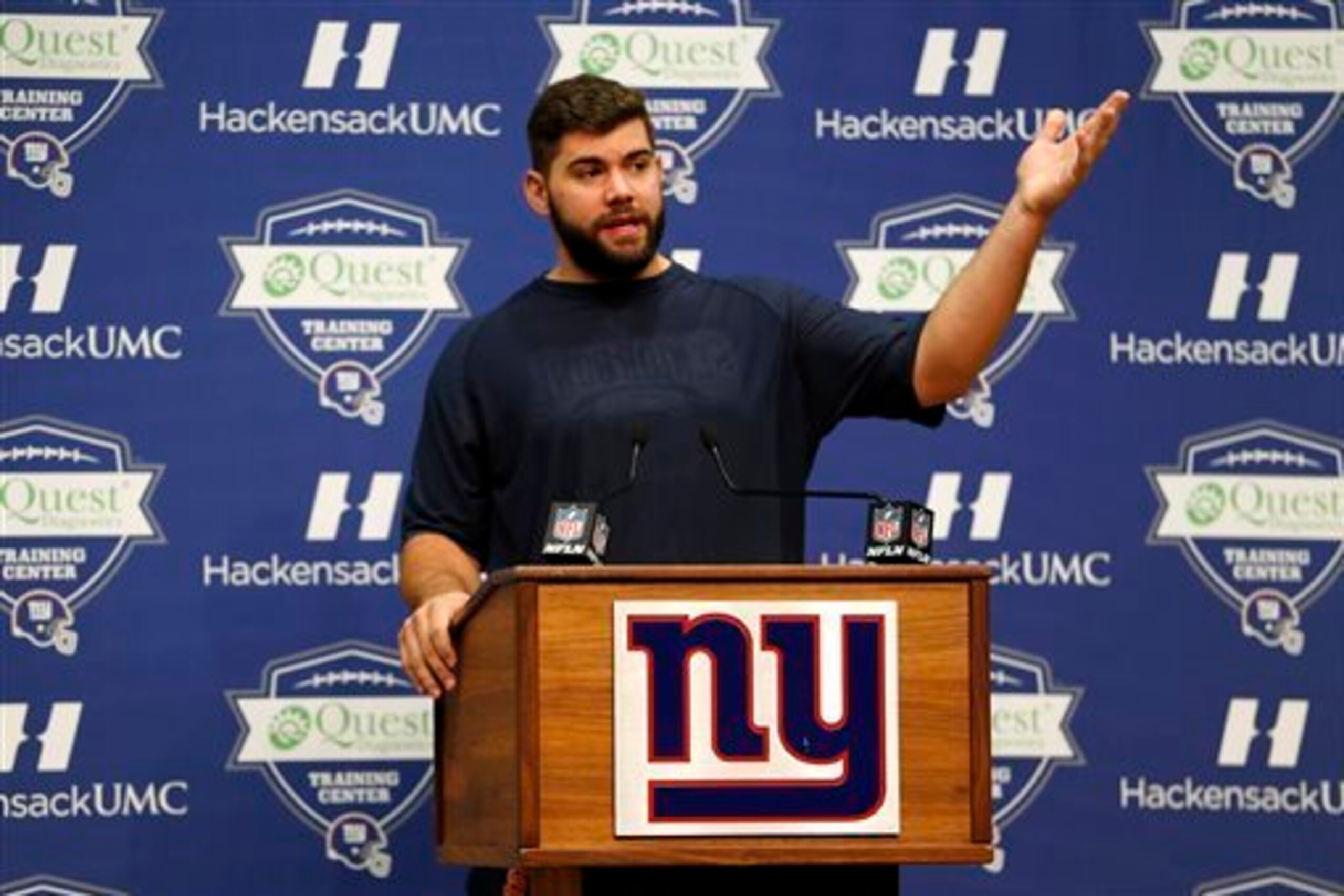
Let's start with the left guard position because there's a point that's made here that will be relevant to the left tackle position.
Before the injury to Beatty, it was widely speculated Justin Pugh, the right tackle for the last two seasons, was ultimately headed inside to left guard, the position that opened when center J.D. Walton was released to make way for Weston Richburg, the previous left guard. (Got all that?)
When Pugh, a college left tackle, made the switch to right tackle in 2013, he had some hiccups for the first half of his rookie season before finally settling down.
During those first eight games, he finished with negative grades in six of the eight—Pugh's transformation was equivalent to writing all of his life with one hand and then suddenly having to switch to the opposite hand.
At the end of his rookie season, Pugh spoke about the challenge that came with the transition with Michael Eisen of the team's website:
"Everything is just opposite. I'm not used to double team blocks with your left foot. I guess people wouldn't see it if they've never played the position before but to switch everything - you have to protect your inside, because it's the quickest way to the quarterback.
So when you're switching from that left side to the right side, now all of a sudden everything is opposite, so your left hand, which used to be the outside punch, now becomes the most important part of your technique. Just pushing your weight off a different foot, it's very different.
"
Switching Pugh back to the left side and at guard shouldn't create too much of a hiccup in his performance, assuming his muscle memory kicks in, which it should.
Left Tackle
Speaking of muscle memory, let's discuss the left tackle spot and why Ereck Flowers, despite being a 21-year-old rookie with some technique flaws, is the best choice for the position.
Widely regarded as the most critical position on the offensive line, it might make some people squeamish to start the young Flowers at that critical spot.
The good news is Flowers' technique issues are coachable, and the Giants have more than three months to work on ironing out those issues before opening day.
Regardless of public opinion, the Giants thought enough of Flowers to make him a top-10 draft pick because they saw a young man who played left tackle in college and who they thought could play that position at some point in the pros.
To be successful at left tackle, a player needs to be able to match the quickness of the man across from him (usually the defense's fastest pass-rusher).
This could be an area of concern with Flowers, according to Dane Brugler of NFLDraftScout.com, who wrote, “Lumbering lateral moves with choppy footwork and frame tightness, especially when redirecting his momentum—allows quick-footed rushers to cross his face.”
So what does Flowers need to address to minimize this issue? He can start with his footwork, which Lance Zierlein of NFL.com characterized as “sloppy and undisciplined,” which leads to a narrowed base and balance issues that allow a speed rusher to penetrate.
That can be corrected with reps, as is Flowers' tendency to sometimes lean forward or lunge during pass protection.
The good news is Flowers has many of the physical attributes teams desire in a left tackle, such as a wide wingspan (34.5-inch arms), good power and the quick feet to set up for the pass block.
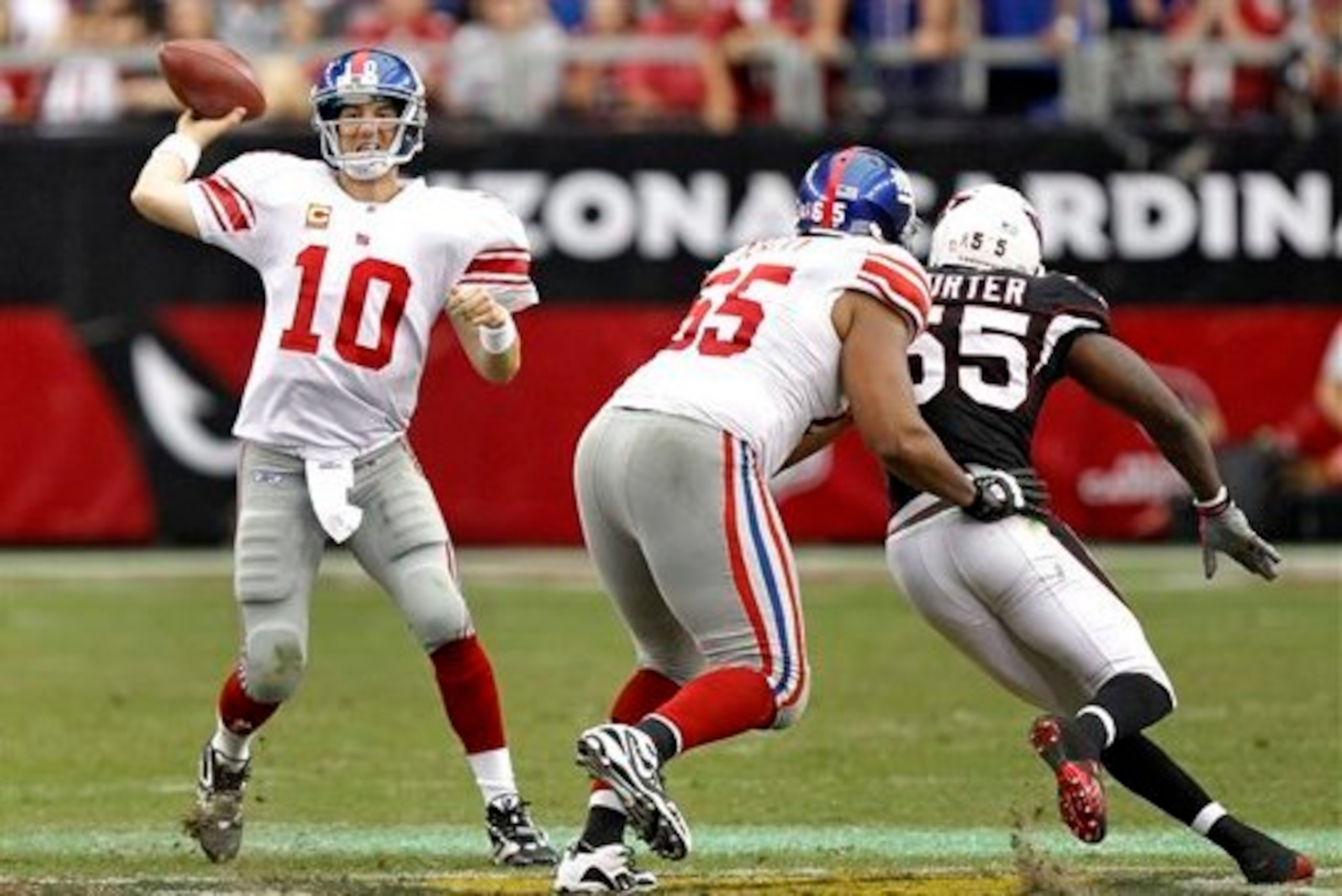
If he can get his hands into the defender and give him a little push, which delays the charge, that could make a difference for quarterback Eli Manning, who in 2014 averaged 2.49 seconds in the pocket versus the 2.73 average seconds in 2013.
So yes, Flowers is young, and yes, he has some rough edges that need to be smoothed out. If he stays healthy and works at cleaning up these issues, there's no reason to think he won't flourish at left tackle in this level, even if he's forced to play there a little sooner than anyone planned.
Center
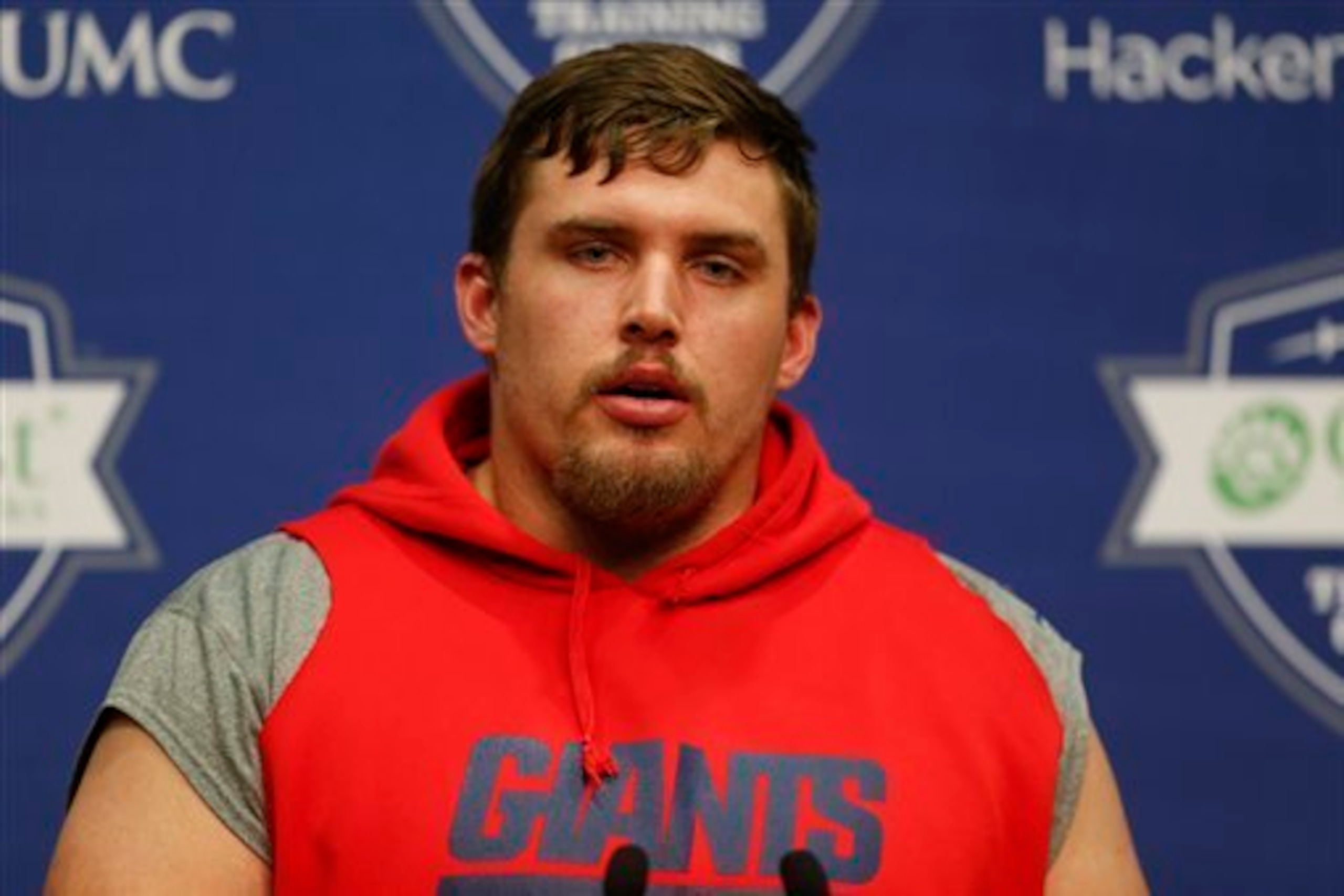
Last year, the Giants drafted Richburg in the second round to be their starting center of the future. However, due to injuries, Richburg was forced to step in at guard, a position he didn't really have much experience playing while in college.
The good news is the experience helped Richburg, who told reporters in April there “may be some comfort level” in playing center.
“Sometimes, it wasn't pretty; I'll admit it, but [playing guard] gave me tons of experience at a different spot,” he said of his rookie-year stint at guard.
“I feel like I'm more comfortable at center, so going to a place where I'm a little more uncomfortable kind of help me see it from a different angle, a different point of view. If I'm able to move in, it will help me understand what my guards are thinking and how I can help them with how I play.”
What about former CFL offensive lineman Brett Jones, who was a standout at center for the Calgary Stampeders?
Read on.
Right Guard
One thing to remember about the Giants is they like for all of their offensive linemen to be able to play multiple positions.
That includes Jones, the 23-year-old star offensive lineman from the CFL who signed with the Giants in February.
Jones, who primarily played center in the CFL, told me he anticipates he will get some snaps at guard in order to increase his value to the team.
He also said he understands his conversion from the CFL to the NFL, as well as really learning the intricacies of a new position, will take time.
“I just want to make sure that I'm doing exactly what I'm supposed to be doing on every single play and that I'm not making those mental errors that are inexcusable,” he said.
“I want to make sure that each day I'm able to work on something new because I've already developed muscle memory with what I previously worked on and keep getting better.”
The good news is Jones is a very intelligent young man who seems to be a fast learner.
Until he masters the role, it makes sense for the Giants to turn to John Jerry for the role. Jerry, of course, played right guard for the Giants last year, so there would be zero learning curve necessary for him as far as learning a new offense.
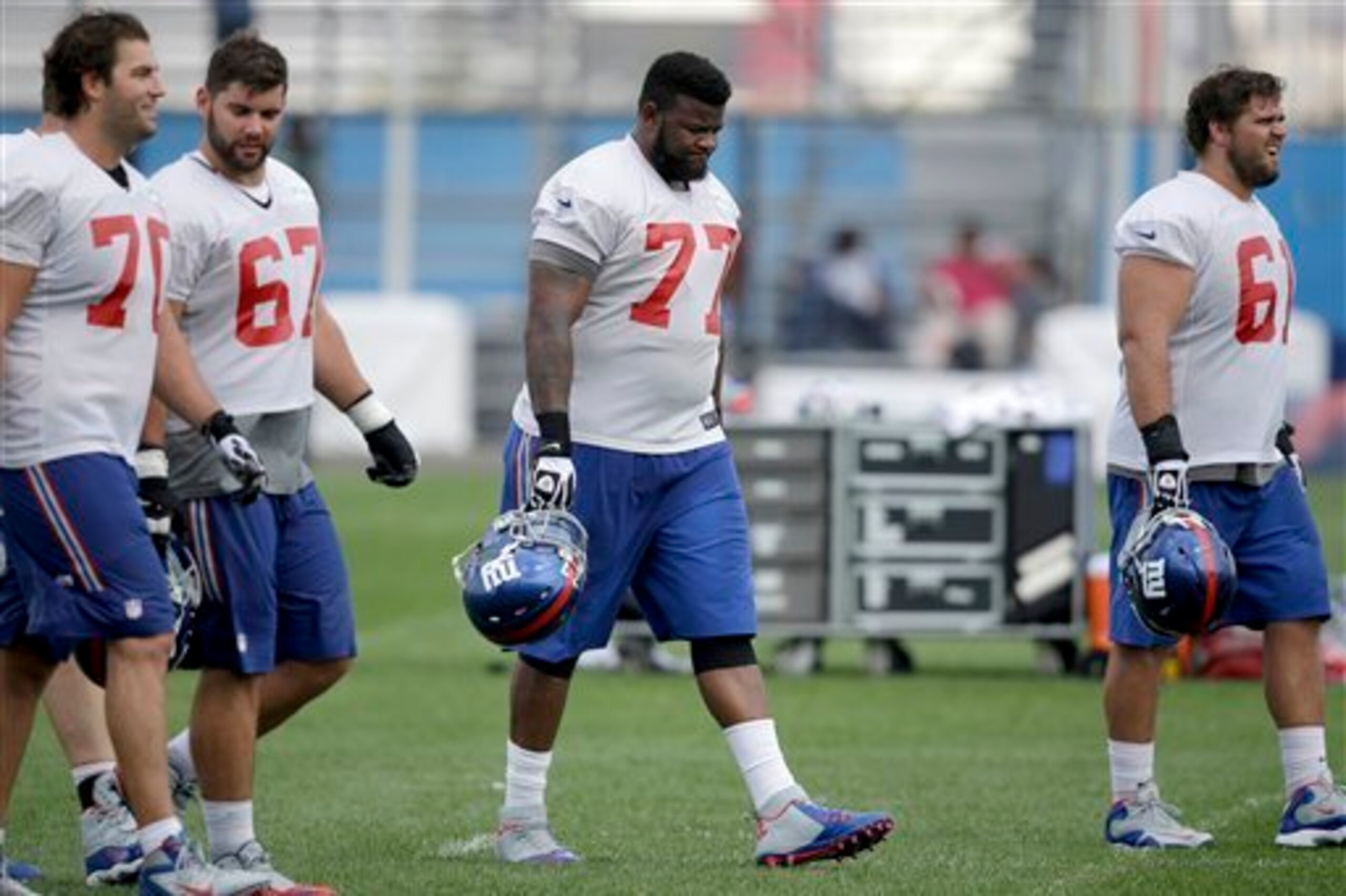
The drawback with Jerry, however, is he's not exactly coming off one of his better years.
Last year, he was graded by PFF as the Giants' worst run-blocker, earning a minus-16.4 mark.
He was better, but not great, as a pass-blocker, finishing with a minus-1.1 mark, a grade that probably factored in his struggles against twists that some defenses ran against the Giants to create confusion.
If Jones is able to develop quickly to where he gains the coaches' trust, it would not be surprising to see him inserted into the lineup later in the season.
While it would be unusual for the Giants to start two rookie offensive linemen, the good news is Jones and Flowers would each have veterans surrounding them, which might make the situation more bearable if it comes down to that.
Right Tackle
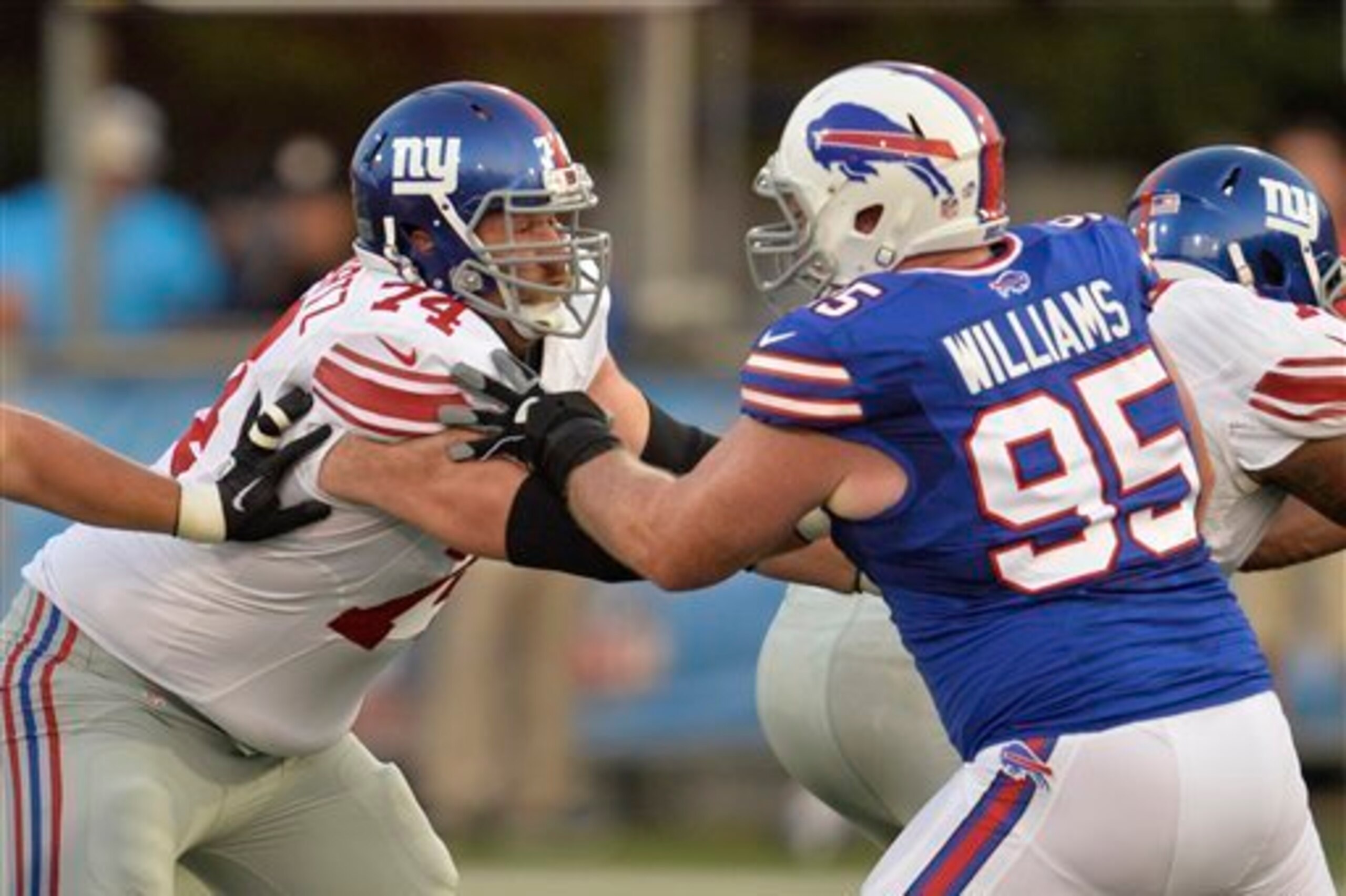
Last but not least is the right tackle spot, where Geoff Schwartz, originally signed last offseason to play left guard, might make the best option.
Why? Per data collected from PFF, he's played 11 games at that position, starting eight games total. (Six with the Carolina Panthers in 2009 and 2010 and two with the Giants in 2014.)
In those games—more than 400 snaps combined—PFF credited Schwartz with a combined five sacks and 13 combined quarterback hurries/hits.
In the two games he started at right tackle last year for New York, Schwartz turned in a strong performance as a run-blocker, earning a 4.0 grade before a season-ending ankle injury ruined his return from an earlier toe problem.
Postscript: What to Do With Will Beatty?
The Giants, in their announcement of Beatty's injury and subsequent surgery, listed the veteran offensive tackle's recovery timetable as being five to six months.
If all goes according to schedule, Beatty would then presumably be recovered no later than mid-November.
What's not clear is whether that quoted recovery period also includes the time necessary for Beatty to get back into football shape.
As he recovers, he probably won't be cleared to lift weights for a while, so he'll more than likely have to work on rebuilding his strength.
In the meantime, he's probably going to be placed on the PUP list.
When final roster cuts are announced, Beatty will probably then be moved to the inactive PUP list, where he won't count against the 53-man roster.
Will he be back on the field for the Giants in 2015? That appears to be the plan, though if the offensive line is playing well, it would be hard to justify making a change—though Beatty could always be the extra offensive lineman the Giants use in their jumbo package.
Down the road, if the new offensive line configuration—whatever it might be—plays well without Beatty, the Giants will have a decision to make next offseason.
| 2016 | $4.175 million | $6.675 million |
| 2017 | $6.825 million | $6.825 million |
Beatty's contract ends after the 2017 season, when he will be 32 years old. He's scheduled to count for $9.175 million in 2016, a hefty figure for the team to carry if they find Flowers is ready to assume the role full time.
If that does happen, and Flowers handles the position, the Giants will almost certainly try to do something to lower Beatty's number.
If he refuses, the most likely scenario is the Giants will designate him as a post-June 1 cap transaction, which would result in a $6.675 million cap savings and only $2.5 million of his remaining prorated bonus being charged to the team's 2017 salary cap.
Unless otherwise sourced, advanced statistics via Pro Football Focus and salary cap and contract information is via Over the Cap.
Patricia Traina covers the Giants for Inside Football, the Journal Inquirer and Sports Xchange. All quotes and other information were obtained firsthand, unless otherwise sourced.
.jpg?w=2560 "Cowboys Packers Football")



.jpg?w=2560 "🚨 Week 8 AP Top 25 Poll")
