
Who Will Win Washington Redskins' Outside Linebacker Battle?
Replacing Brian Orakpo is no easy task for the Washington Redskins despite how his play deteriorated in 2014. Months after signing a franchise tag, Orakpo appeared in just seven games and logged only half a sack.
But when yet another injury predictably got the better of Orakpo and ended his season, Washington's D' struggled putting the heat on quarterbacks. In fact, the unit finished with a mere 36 takedowns, 13.5 of which came from Orakpo's fellow outside linebacker, Ryan Kerrigan, who carried the pass-rush burden in the Pro Bowler's absence.
Creating more pressure and more splash plays, in this case sacks and forced fumbles, has to be a priority for new coordinator Joe Barry. A change in the techniques up front, moving from two-gap to principles to single-gap attacking, will help, along with a bevy of new D-linemen added during free agency.
.jpg?w=2560 "Rams Raiders Football")

.jpg?w=2560 "Steelers Saints Football")
But the real key will be identifying the right replacement for Orakpo. In this case, the right replacement means a rush linebacker who can apply consistent pressure off the corner and be stout setting the edge against the run. For the purposes of this article, let's consider the ability to competently handle coverage responsibilities in space as gravy.
Barry has up to three candidates to choose from, including undrafted Jackson Jeffcoat. But it's a pair of second-round picks who really stand out.
Last year, Bruce Allen used the top pick of his lone draft as general manager to take Stanford rush end Trent Murphy. It wasn't a bad move considering he had led collegiate football in sacks during his final season with the Cardinal.
But Murphy struggled to make an impact as a rookie pro. He finished his debut year in the NFL with just 2.5 sacks.
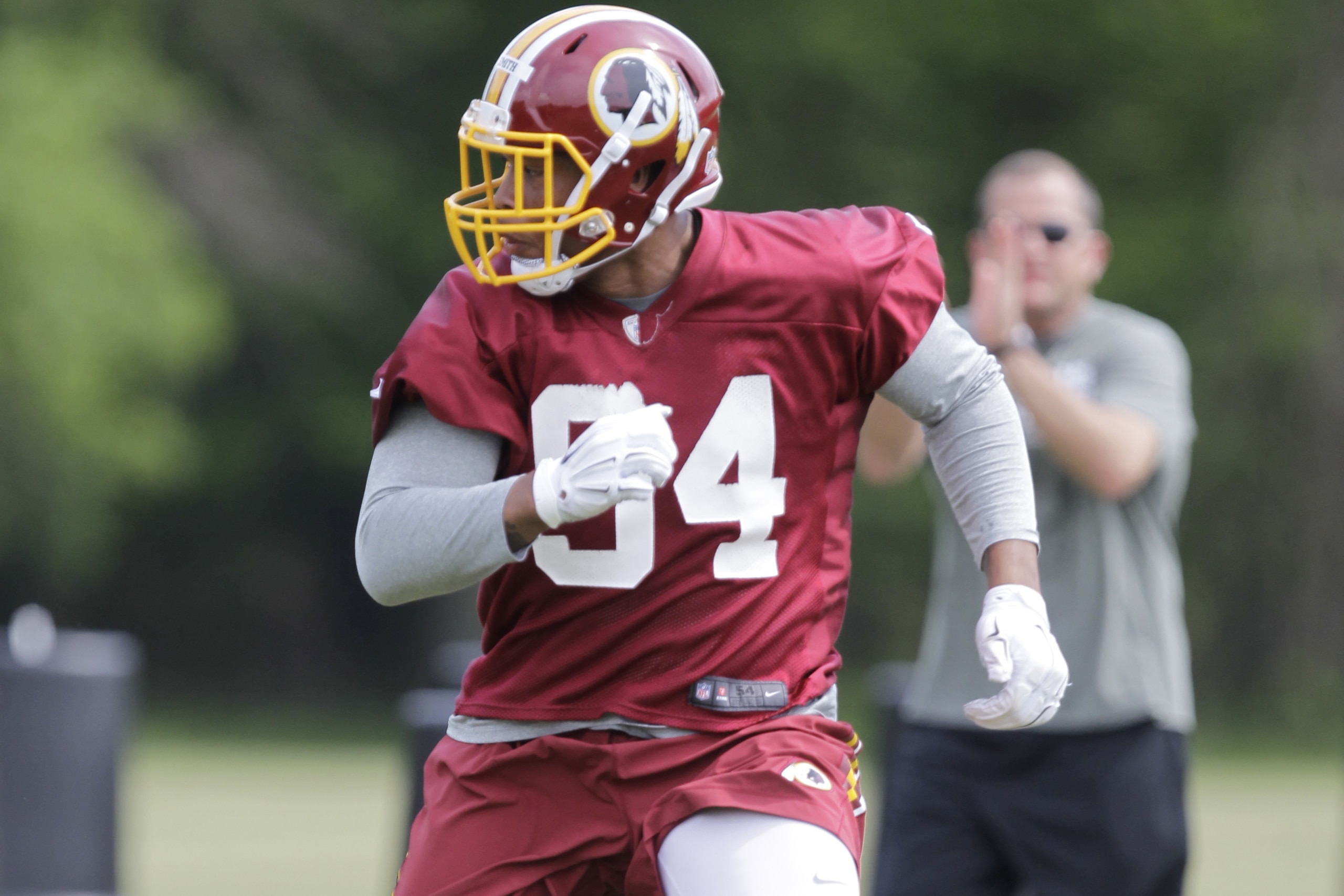
That middling production likely influenced new GM Scot McCloughan's decision to take ex-Mississippi State defensive end Preston Smith off the board in the second round of the 2015 NFL draft.
Smith generated buzz by logging an impressive nine sacks in the always tough SEC last season, per CFBStats.com. But questions abound about where he'll fit best at the pro level.
B/R analyst Michael Felder is adamant Smith shouldn't even feature in any conversation about playing outside linebacker. Instead, he believes the former Bulldogs stalwart is a natural fit as a 5-technique defensive end:
For a contrasting view, B/R's Chris Simms compares Smith to former New England Patriots edge-defender Willie McGinest. Simms sees no problem with Smith succeeding Orakpo, based on his ability to consistently win one-on-one matchups with strength and length:
The latter quality Simms emphasized represents possibly Smith's best chance to win a starting job in his first year. Length, specifically arm length, is a vital requirement for a premier outside pass-rusher in the NFL.
Long arms enable edge players to lock up and push off massive offensive tackles. They can keep a blocker on the back foot, while a pass-rusher sets up his next move.
That Smith possesses this crucial quality is immediately obvious, according to Mike Jones of The Washington Post:
"The first thing that jumps out about Smith is his length. The guys who did the measurements at the combine might need to re-check their records, because his arms look way longer than 34 inches. His hands almost hang down to his knees. Smith said his length usually is a great asset. It allows him to hold blockers at bay as he pursues running backs or quarterbacks.
"
Smith has the traits of a classic edge-rusher. But he's also a very thickly built, rather stiff-moving 6'5", 271-pounder.
Those dimensions and the limited range are likely why Felder insists that holding the point of attack, rather than leading the charge to break it down, is where Smith's future really lies.
Yet those concerns are also applicable to Simms' comparison with McGinest. The fourth overall pick of the 1994 NFL draft, McGinest was never a standout speed-rusher, despite 86 career sacks.
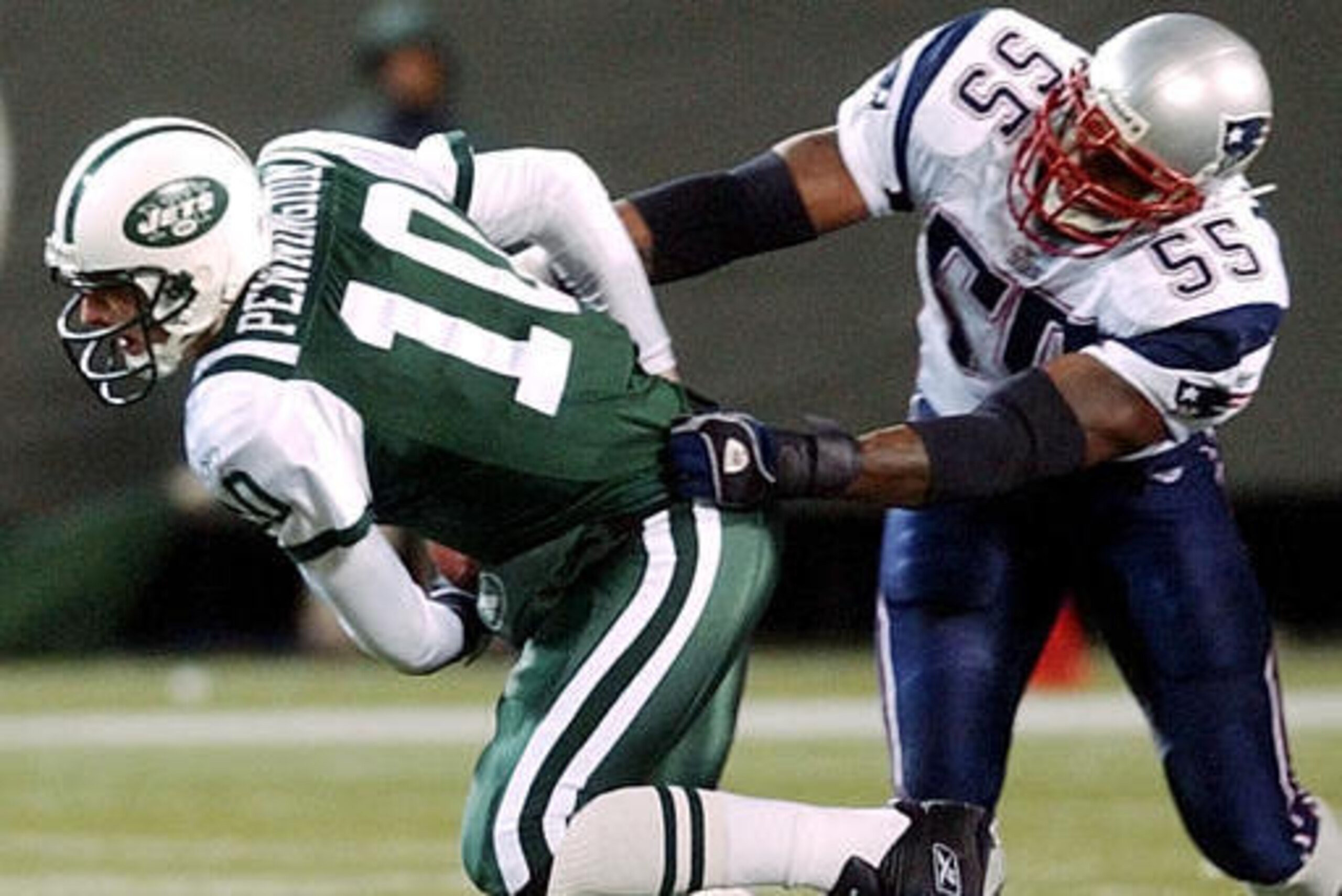
Instead, what made the 6'5, 270-pound front-seven chameleon so valuable was his versatility. McGinest had the power to set the edge against the run. He could also play with his hand down or rush from a standing position on either side of the formation.
He lent tremendous flexibility to every defensive coordinator he worked with. McGinest was the classic "Elephant" at the edge of a defense who could make a front show various guises to an offense pre-snap.
Depending on how he lined up, the Pats were either a 3-4, 4-3, or even a 5-2 team. Barry will need the same organized chaos along his front in Washington.
Smith can provide it, with the only question being exactly when and how often he sees the field.
If he wants to be a regular on base downs, Smith must show a talent for standing up to the run. He occasionally struggled in this vital area during the Redskins' rookie minicamp, per ESPN's John Keim: "Once or twice Smith didn’t set the edge as strong as you would like; got a little too bent on one occasion and lost his power."
Smith had better make quick progress in the running game, because setting the edge is one thing Murphy does really well. Take a look at this example from Week 9's narrow loss to the Minnesota Vikings, Murphy's best game of 2014, for proof.
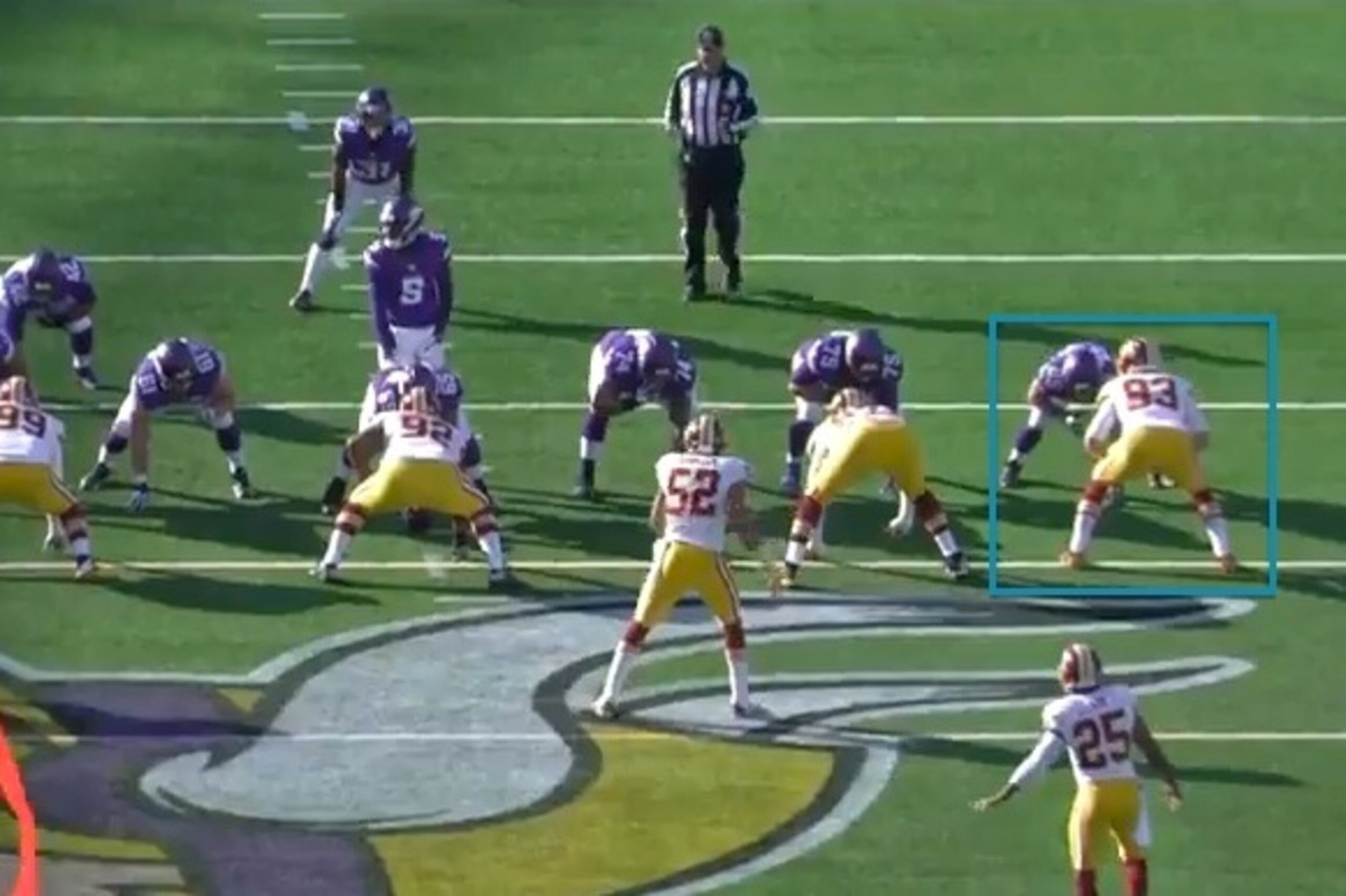
Murphy began the play aligned over 250-pound tight end Rhett Ellison:
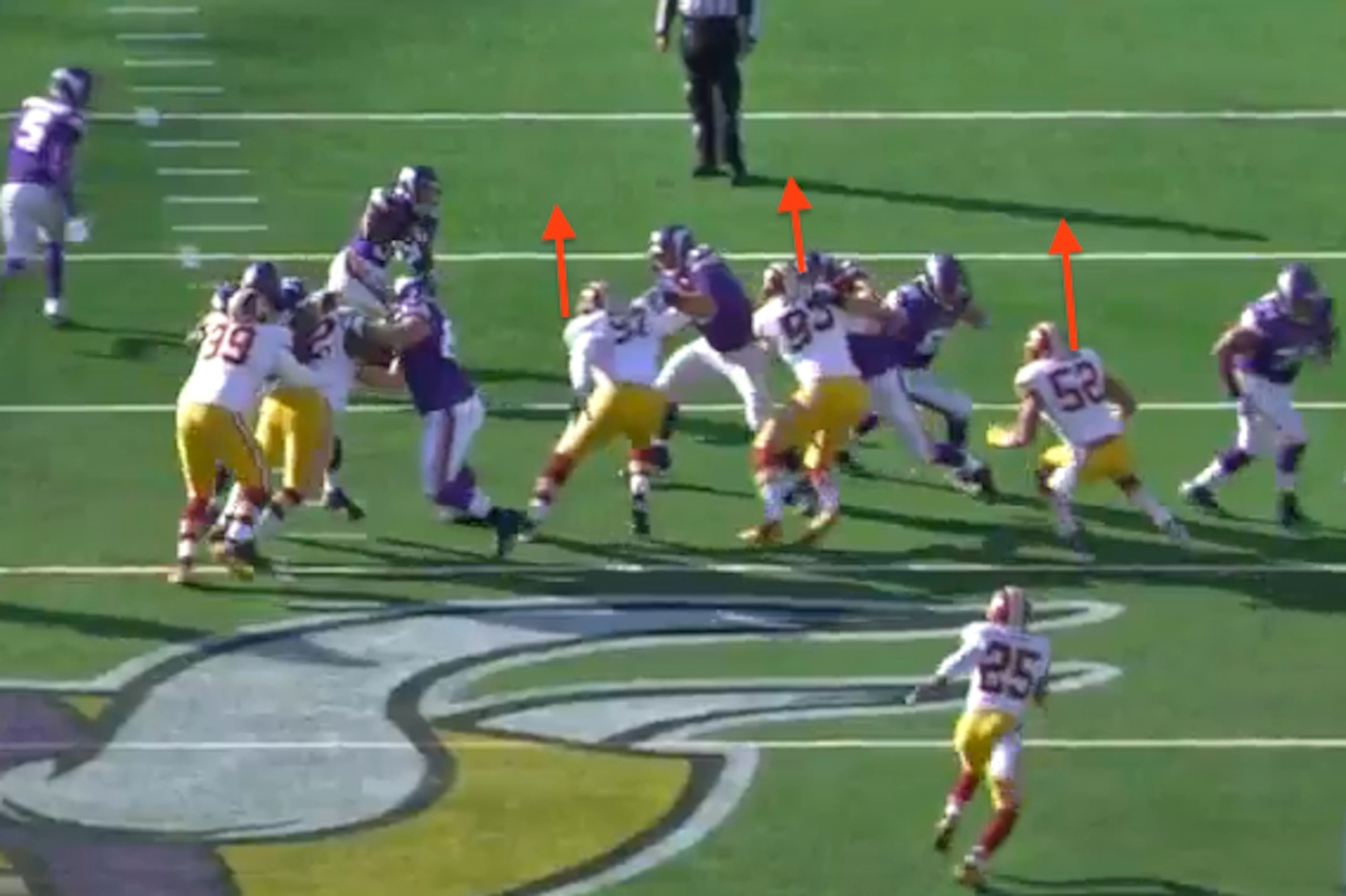
Murphy quickly clamped onto Ellison and rocked the tight end back on his heels. More importantly, he got across Ellison's inside shoulder, closing off the interior rushing lane:

This is a vital part of good run defense. Murphy led a push inside designed to force running back Jerick McKinnon to the edge.
His ability to hold up Ellison and prevent him from moving to the second level left a pursuit player such as inside linebacker Keenan Robinson free to track the run. This is a core part of any 3-4 scheme:
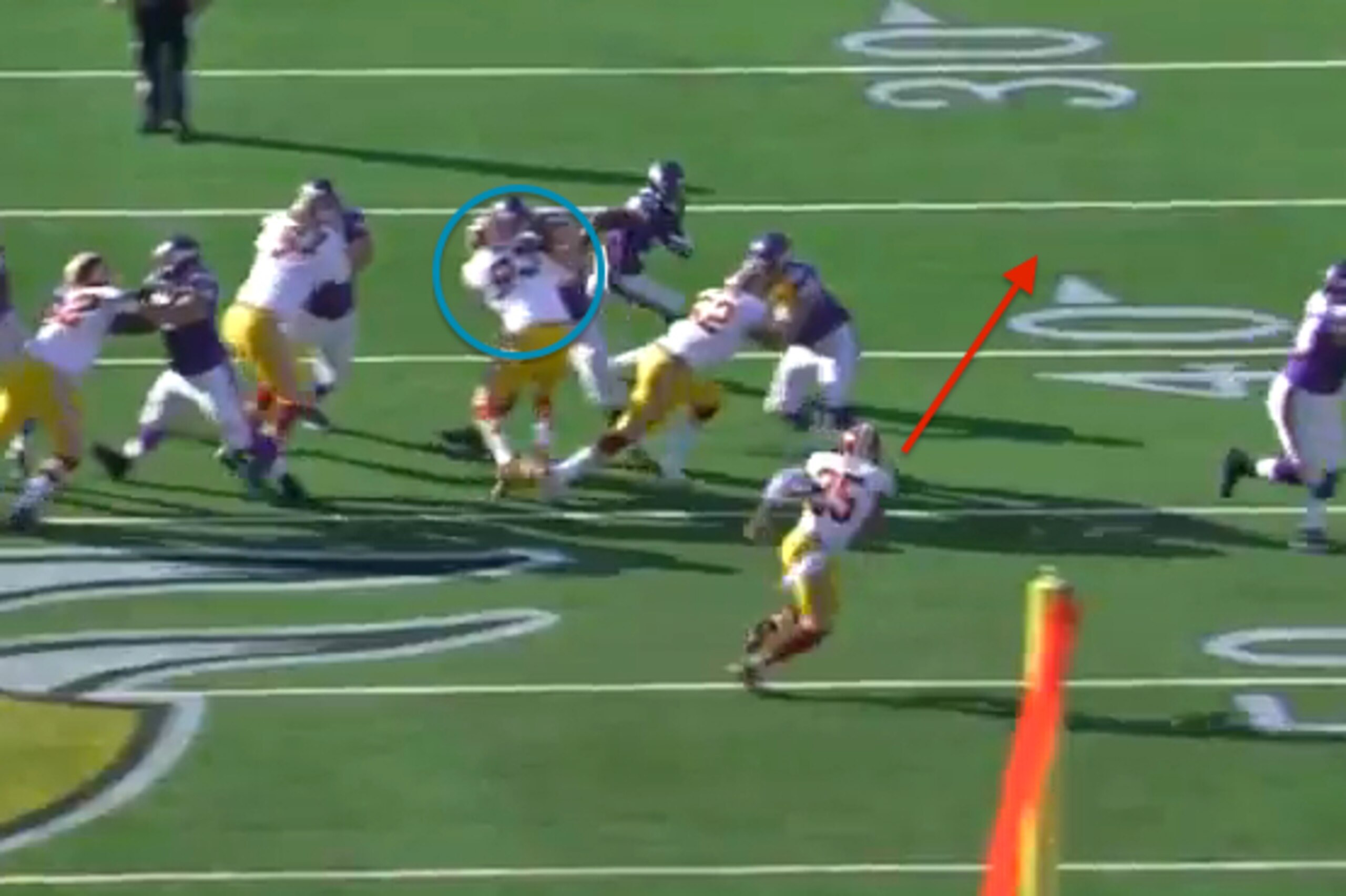
With every hole covered up, McKinnon had to press his run laterally toward the sideline. No back likes to move sideways.
Because of the way front-line players like Murphy held up their blockers, the Redskins were able to swarm to the ball. They had free runners, in this case free safety Ryan Clark, who eventually dropped McKinnon for a minimal gain:
Murphy is determined to build on his core playing strength. He's revealed efforts to bulk up this offseason, during an interview with Redskins Nation host Larry Michael, per the team's official site.
Those efforts could make Murphy an even tougher anchor against the run. But while that's always useful, extra pounds could limit Murphy's flexibility as an edge-rusher. He was fairly limited in this area as a rookie.
Two plays from the Vikings game revealed the good, the bad and the ugly of Murphy as a pass-rusher. The first came on a 2nd-and-8 in the opening quarter, a play Murphy began matched up over left tackle Matt Kalil:
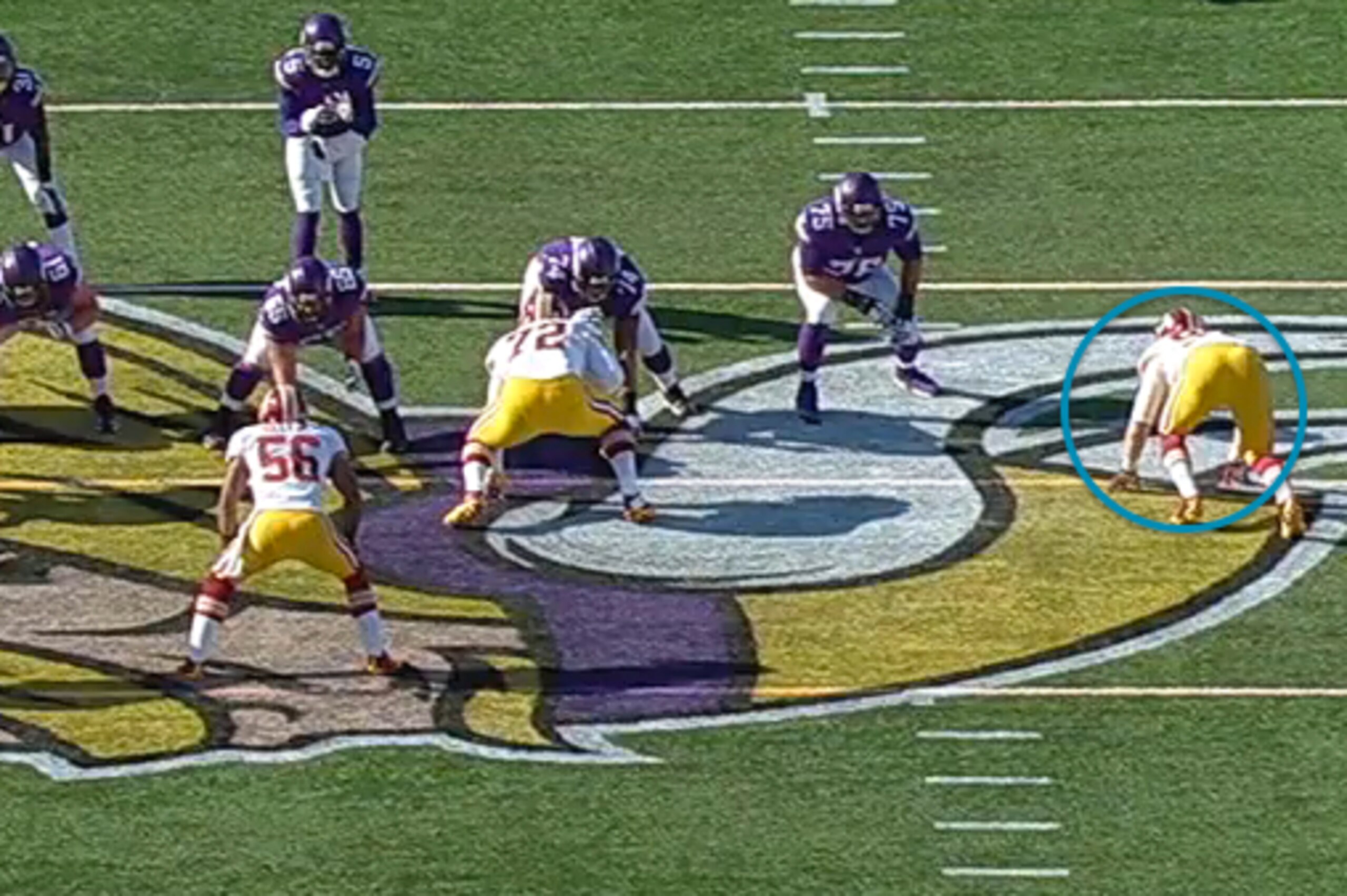
Murphy adopted a four-point stance, something that's become en vogue for edge-rushers seeking the advantage of a quicker takeoff. On this occasion, the stance allowed Murphy to set Kalil up for a devastating inside move.
The deception began with Murphy pressing his rush hard over Kalil's outside shoulder. The strong move toward the edge forced Kalil to lean that way as he planted his back foot on the outside:

With Kalil off balance and having lost leverage, Murphy slid across his face to the inside lane:
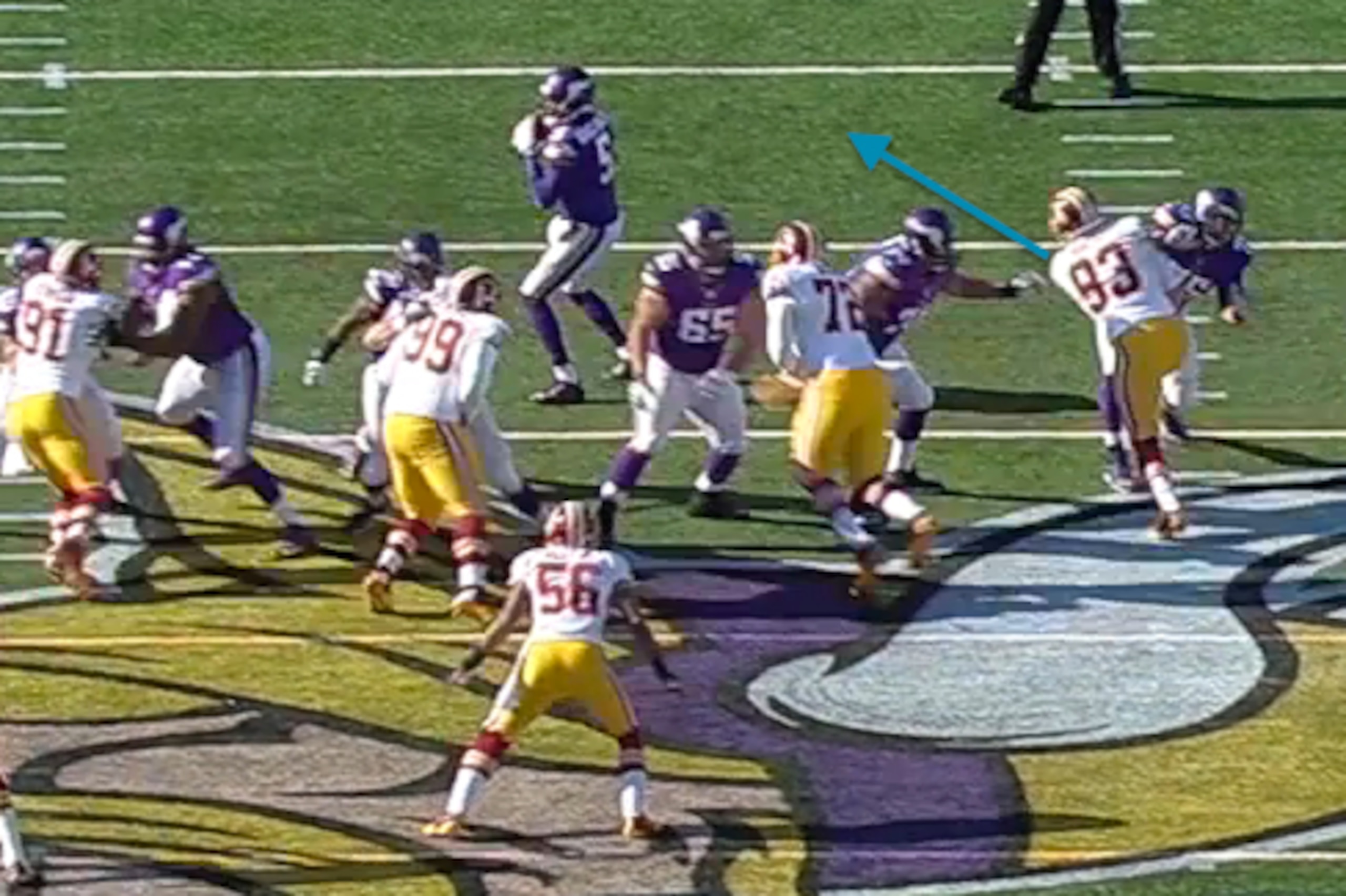
Once he'd shrugged Kalil aside, Murphy showcased his power and fluidity by bulldozing his way through the left guard, before dipping under the block to close on quarterback Teddy Bridgewater. The result was a sack for an eight-yard loss:
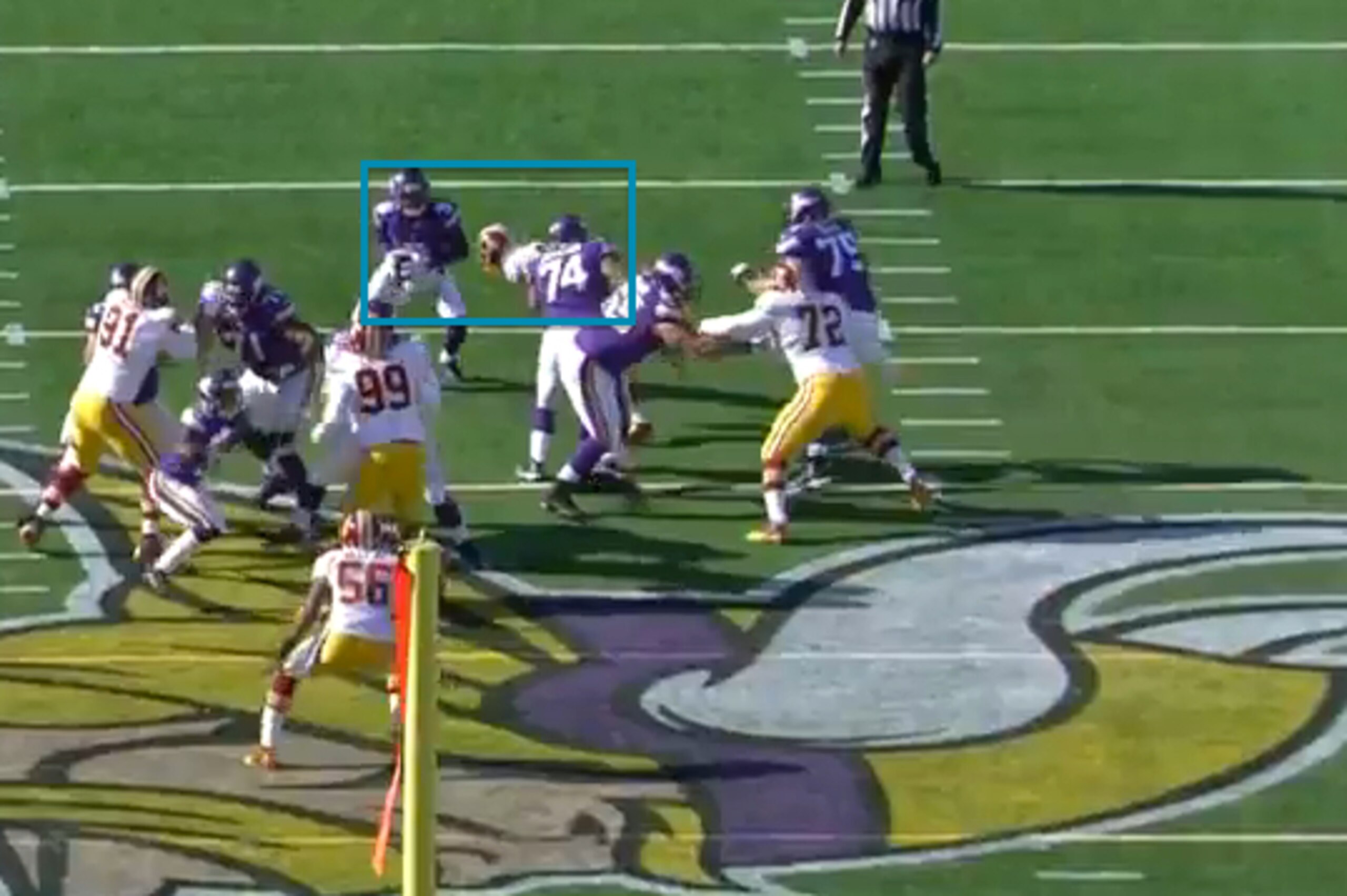
Murphy displayed excellent playing strength and useful agility executing this smart double move. But while he can win on the inside, Murphy isn't as effective on the outside.
Later in the game, he again found himself lined up over Kalil. This time Murphy would rush the outside from a two-point stance:
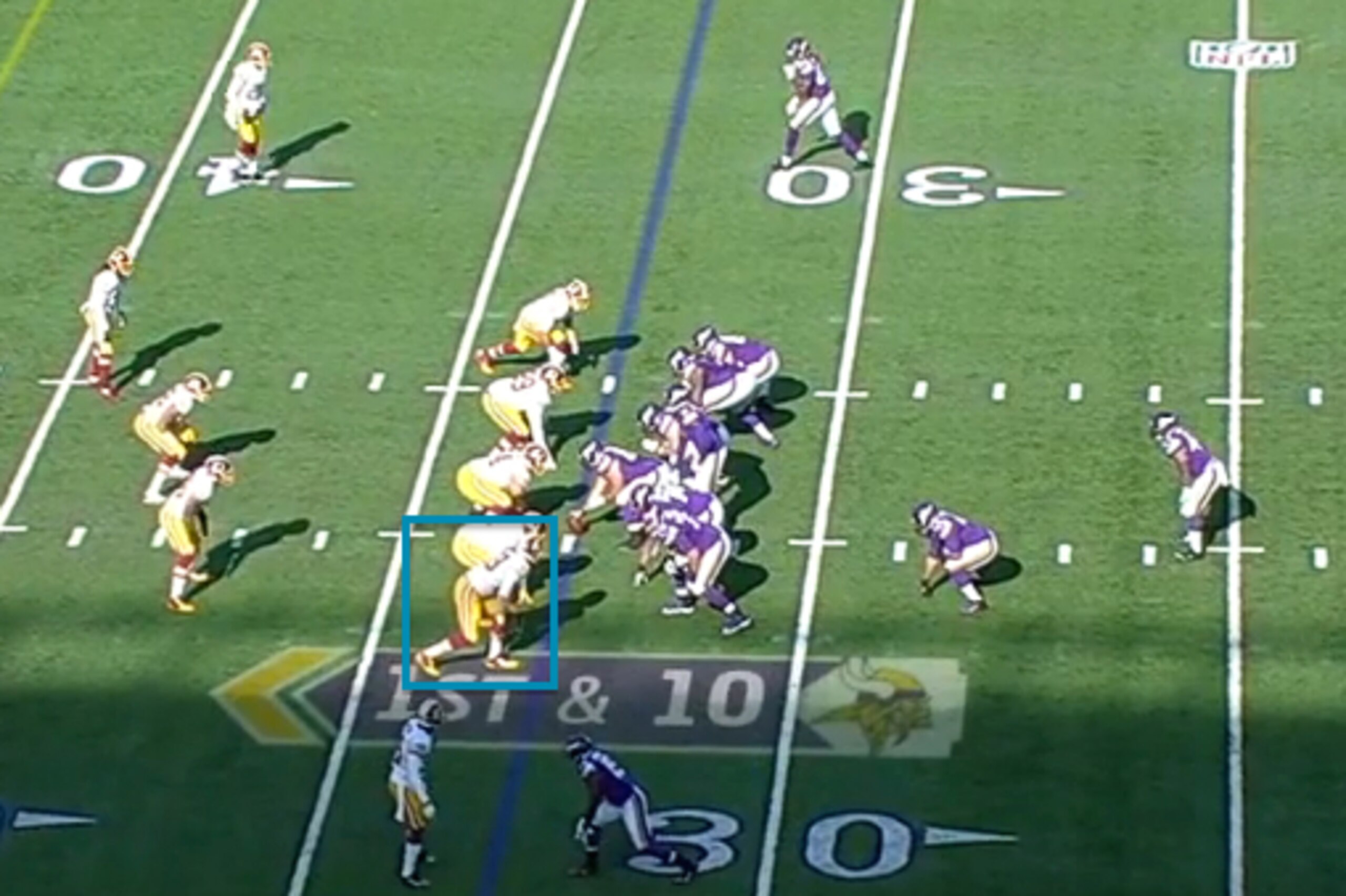
Murphy didn't take a wide enough angle off the snap. Instead, he got too far to the inside, but not far enough into Kalil's chest. So the left tackle was able to clamp onto Murphy and prevent a push-off with the arms:
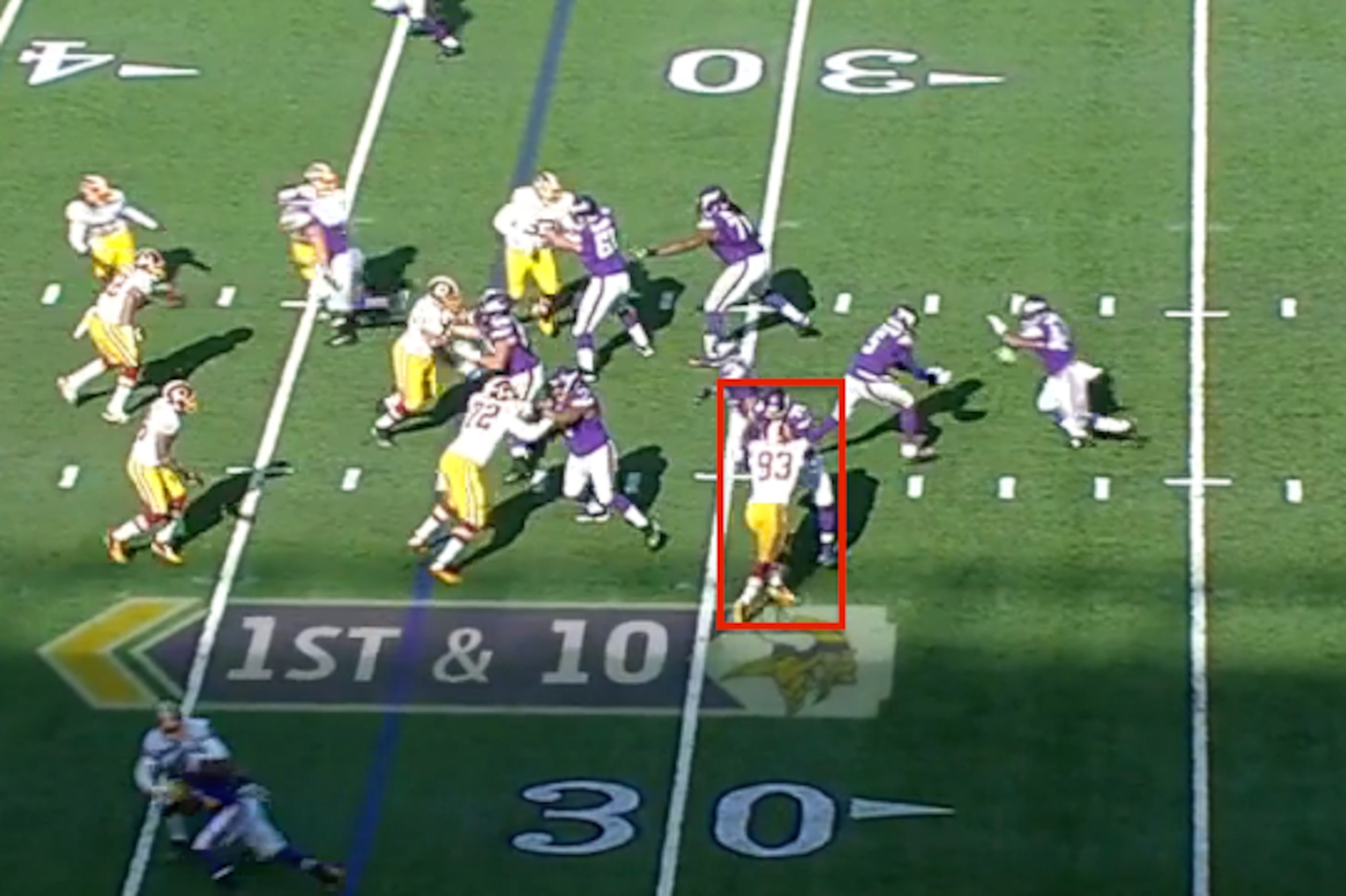
Kalil was able to turn Murphy easily and push him out of the rush lane:
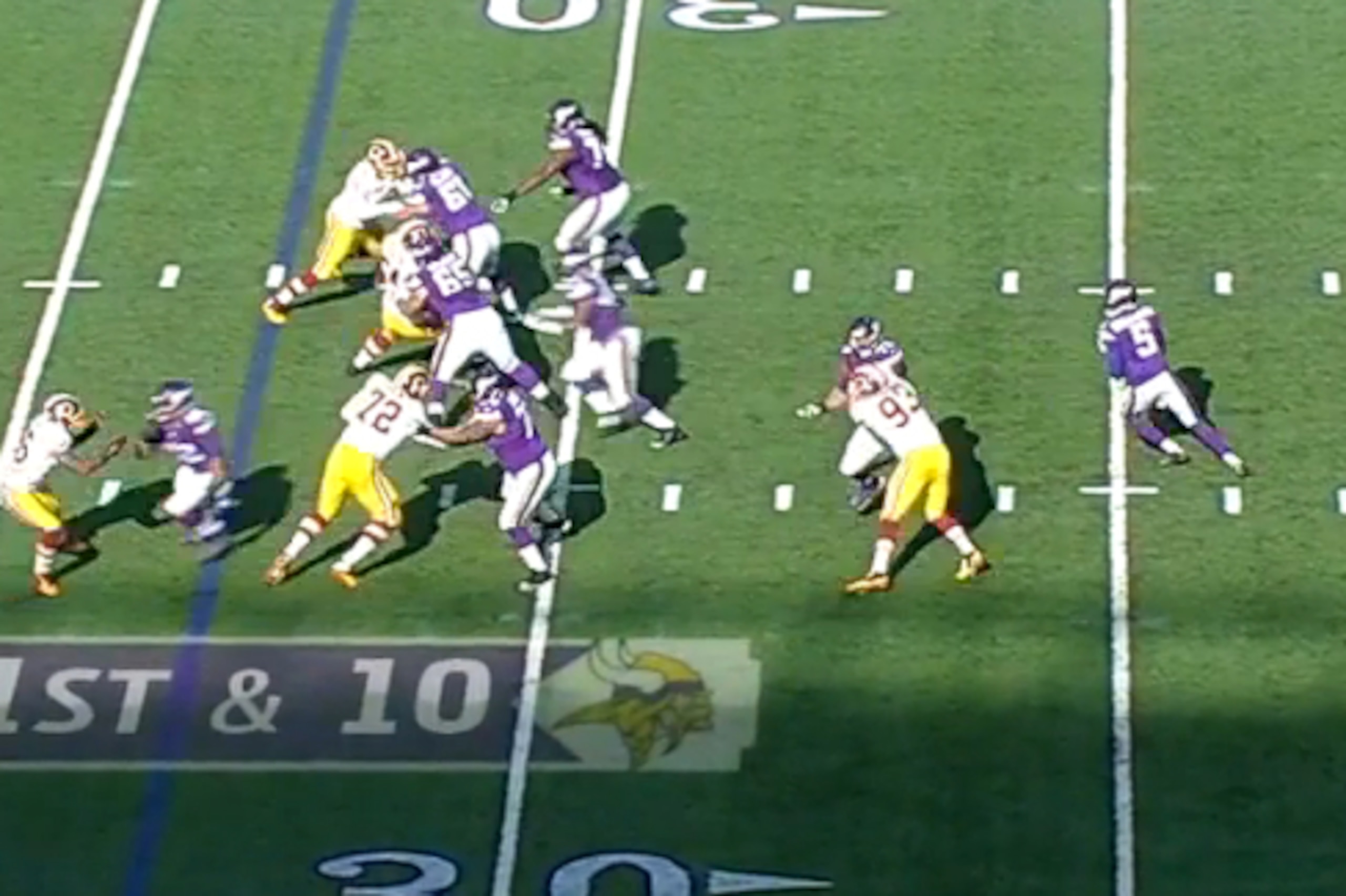
With Murphy turned, Kalil was easily able to carry him past the quarterback and out of the play. Bridgewater was then able to climb the pocket and step up into an obvious throwing lane:

Murphy didn't move fluidly enough to get to the edge. His sluggish speed allowed Kalil to set his feet and dictate where the pass-rusher went.
Murphy's strength against the run but limitations rushing off the corner create an intriguing dilemma for Barry and the Redskins. His talent for setting the edge could make him the obvious starter in an NFC East loaded with talented running backs such as DeMarco Murray and Ryan Mathews, as well as powerful offensive lines.
But in the pass-first modern era, most defenses place a greater premium on a flair for getting to quarterbacks. That could give Smith the advantage thanks to his ability to attack from multiple spots, along with the physical assets to win on the edge.
Identifying a clear starter at this stage is certainly a tough call. What may make most sense is reaching a happy compromise. ESPN 980's Kevin Sheehan told B/R's Stephen Nelson that Washington may want to use Smith as a third-down, situational pressure specialist as a rookie, leaving the dirty work of base defense to Murphy:
Sheehan's idea seems like the safest bet. Ultimately though, the winner will be decided by who makes the most explosive plays.
Given the many ways Smith could be used, he's the more likely eventual winner in a league that values pass-rushers above all else defensively.
All statistics and player information via NFL.com.
All screen shots courtesy of Fox Sports and NFL.com Game Pass.
.jpg?w=2560 "Cowboys Packers Football")




.jpg?w=2560 "🚨 Week 8 AP Top 25 Poll")