NBA stocks are extraordinarily volatile at this time of year.
For those who shine under the brightest postseason lights, their profiles can reach near-mythical proportions. But the players who stumble on this stage become involuntary stars of their own disaster movies.
With one round-plus already in the books, this playoff field has overflowed with disappointments. Ghastly shooting percentages, nonexistent defensive efforts and disappearing acts are just some of the things responsible for putting players on this list.
Some of their teams have already bowed out of this race. Others are still fighting in spite of these discouraging displays.
These are the stocks that have suffered most during the second season.
Ryan Anderson, PF, New Orleans Pelicans
1 of 7
The New Orleans Pelicans were barely around long enough for Ryan Anderson to really disappoint. But the typically sweet-shooting forward's offensive struggles contributed, at least in part, to the Pellies' swift departure.
His body of work looks deceptively decent: 10.8 points in 23.8 minutes per game and 41.7 percent shooting from three-point land. But those numbers were almost entirely the result of the one strong game he sandwiched between three abysmal outings.
The 27-year-old has to consistently hit shots to maintain any effectiveness. He doesn't help enough in other areas to withstand a night of misfiring, and he even hurts this team in certain aspects. To wit, New Orleans allowed 6.3 points per 100 possessions less when he wasn't on the floor during their opening-round series loss to the Golden State Warriors.
And more often than not, he wasn't countering that production at the opposite end. Take away his 26-point eruption in Game 3, and he managed just 5.7 points on 27.3 percent shooting for the series. That's not nearly enough to compensate for his defensive deficiencies.
Between Anderson's three forgettable efforts and Omer Asik's no-show (eight points, zero blocks in the entire series), the Pelicans never had a chance to shock the top-seeded Dubs.
Jeff Green, SF, Memphis Grizzlies
2 of 7
On paper, the idea of Jeff Green still fits the Memphis Grizzlies like a glove.
He's a scoring threat unlike any they have on the perimeter. He can space the floor, carry the offense for stretches and spark a transition game that keeps the Grizzlies from getting bogged down in their own mud.
But Memphis still hasn't seen that Jeff Green since landing him in a mid-January three-team trade. The Grizzlies were 9.8 points per 100 possessions better without him during the regular season, and that gap has only slightly dipped in the playoffs (8.1 points).
Aggressiveness has always been an issue for him, and frankly, the Grizzlies might not even want him to dial it up at this point. Their occasional scoring struggles could be made significantly worse with more of this Jeff Green. He's averaging more shots (10.1) than points (9.0) in the postseason while shooting a woeful 31 percent from the field and 20 percent from three.
He has the physical tools to help out in more ways than scoring, but the other categories on his stat sheet have almost always underwhelmed. With Tony Allen defending at an All-Defensive-first-team level (and letting everyone know about it) and Courtney Lee rediscovering his shooting stroke, Memphis might be done hoping the reality of Green comes close to matching what he was supposed to be for this team.
Damian Lillard, PG, Portland Trail Blazers
3 of 7
The Portland Trail Blazers' chances of navigating a lengthy playoff run didn't look good. Not after losing Wesley Matthews and his invaluable combination of floor spacing, defense and emotional leadership to a torn Achilles tendon in early March.
The Blazers literally limped into the postseason, but so did their first-round opponent. Memphis was in slightly better shape, but Portland carried the two biggest scoring threats into the series: Damian Lillard and LaMarcus Aldridge.
Neither of the Blazers' two All-Stars performed as such. Both had major issues at the offensive end—Aldridge shot just 33 percent from the field, and Lillard misfired on 26 of his 31 three-point attempts. But Aldridge found other ways to make an impact, tallying 11.2 rebounds and 2.4 blocks per game. Lillard disappeared in some areas (4.6 assists in 40.2 minutes) and stood out for the wrong reasons in others.
"Lillard isn't just a weak point in Portland's defense, he's THE weak point among the starters," wrote Blazers Edge's Dave Deckard. "Coach [Terry] Stotts has to watch which reserves he plays alongside Lillard as well, as any combination lacking an adequate defender at shooting guard makes the backcourt turn toxic."
Grizzlies point guards feasted on Lillard's defense. Mike Conley averaged 16 points on 50 percent shooting before missing the final two games with facial fractures. Beno Udrih put up 11.8 points in 20.5 minutes while converting 48.7 percent of his field goals.
Lillard's defensive problems are easier to overlook when he's posting quantity-plus-quality stats on the other end. But when his one-way production isn't coming, he doesn't have a lot to offer.


Kyle Lowry, PG, Toronto Raptors
4 of 7
Kyle Lowry started in the All-Star Game this season. It's important to remember that while processing just how far the Toronto Raptors point guard plummeted during the playoffs.
Truth be told; his hot start may well have contributed to his frigid finish. He powered the Raptors through DeMar DeRozan's lengthy absence with a groin injury, and Lowry cruised into the All-Star break carrying per-game averages of 18.6 points and 7.2 assists.
Then, the 6'0" bulldog seemingly slammed into a wall. He managed only 15.1 points and 5.4 assists after the break, missing significant time due to back spasms. He looked even worse in the playoffs, posting just 12.3 points on 31.6 percent shooting and 4.8 assists while his fourth-seeded Raptors were swept by the fifth-seeded Washington Wizards.
"In the first two games, Lowry was undone by foul trouble," wrote Dave Feschuk of the Toronto Star. "In Game 3, save for some late fireworks that kept the Raptors within a possession in the dying moments, he was simply foul."
By the time Lowry recovered for 21 points and eight boards in the series finale, Toronto's fate had already been sealed. The same All-Star point guard who once lifted the Raptors up played an unsightly part in bringing them down.
Nene, PF, Washington Wizards
5 of 7
The Washington Wizards have found their formula for far more efficient offense and, as a result, more substantial team success.
And that formula does not include bruising big man Nene, who's gone from quiet to silent the deeper the Wizards have advanced.
Since double-dipping in Washington's playoff opener, both his scoring and rebounding have tailed off considerably. He's down to 4.8 points and 4.4 rebounds a night over his last five outings. He has almost as many turnovers (six) as boards (seven) in the Eastern Conference semifinals, and he's yet to make a field goal during the series.
"He's got to fight through it. He's got to play through it," Wizards coach Randy Wittman said, per CSN Washington's J. Michael. "Things in this world aren't perfect. When you struggle like that you got to play harder, be more concentrated."
Or, in Nene's case, be more marginalized.
The Wizards get much better spacing when they slot either Paul Pierce or Drew Gooden at the 4. And it's imperative to keep the paint unclogged so John Wall and Bradley Beal can attack off the bounce.
There's no reason to force Nene back into the equation. The Wizards have been 10.1 points per 100 possessions better without him. But he has to find a way to be more effective when he does see the floor.
Joakim Noah, C, Chicago Bulls
6 of 7
The Chicago Bulls have never looked to Joakim Noah for scoring.
Even when he's served as a substitute offensive catalyst on some of their undermanned teams in the past, he's made his biggest mark with his passing. And it's impossible to quantify the impact of his emotional leadership and defensive communication.
But his complete collapse on the offensive end is a major reason he's on this list. There's a big difference between serving as a complementary scorer and putting up just 5.4 points in 32.5 minutes per game. Especially when you're a center shooting only 43.8 percent from the field—and a career 71.6 percent free-throw shooter who's just 1-of-14 from the charity stripe.
Noah's problems go far beyond scoring. He hasn't looked healthy all season (he had knee surgery last summer), and he's been a couple of steps slow chasing Cleveland Cavaliers shooters off the perimeter and keeping their bigs off the glass. During Wednesday's 106-91 loss, he barely had more total rebounds (seven) than Tristan Thompson corralled at the offensive end alone (six).
Bulls coach Tom Thibodeau offered some simple advice to his struggling center after the game.
"Find another way to help," Thibodeau said, via CSN Chicago's Vincent Goodwill. "Don't allow the offense to impact your entire game."
Bulls fans might offer different advice to Thibs: Don't let a struggling Noah impact your playoff run. Chicago has other frontcourt options (Taj Gibson, Nikola Mirotic), and it might need to utilize them a lot more going forward.
Rajon Rondo, PG, Dallas Mavericks
7 of 7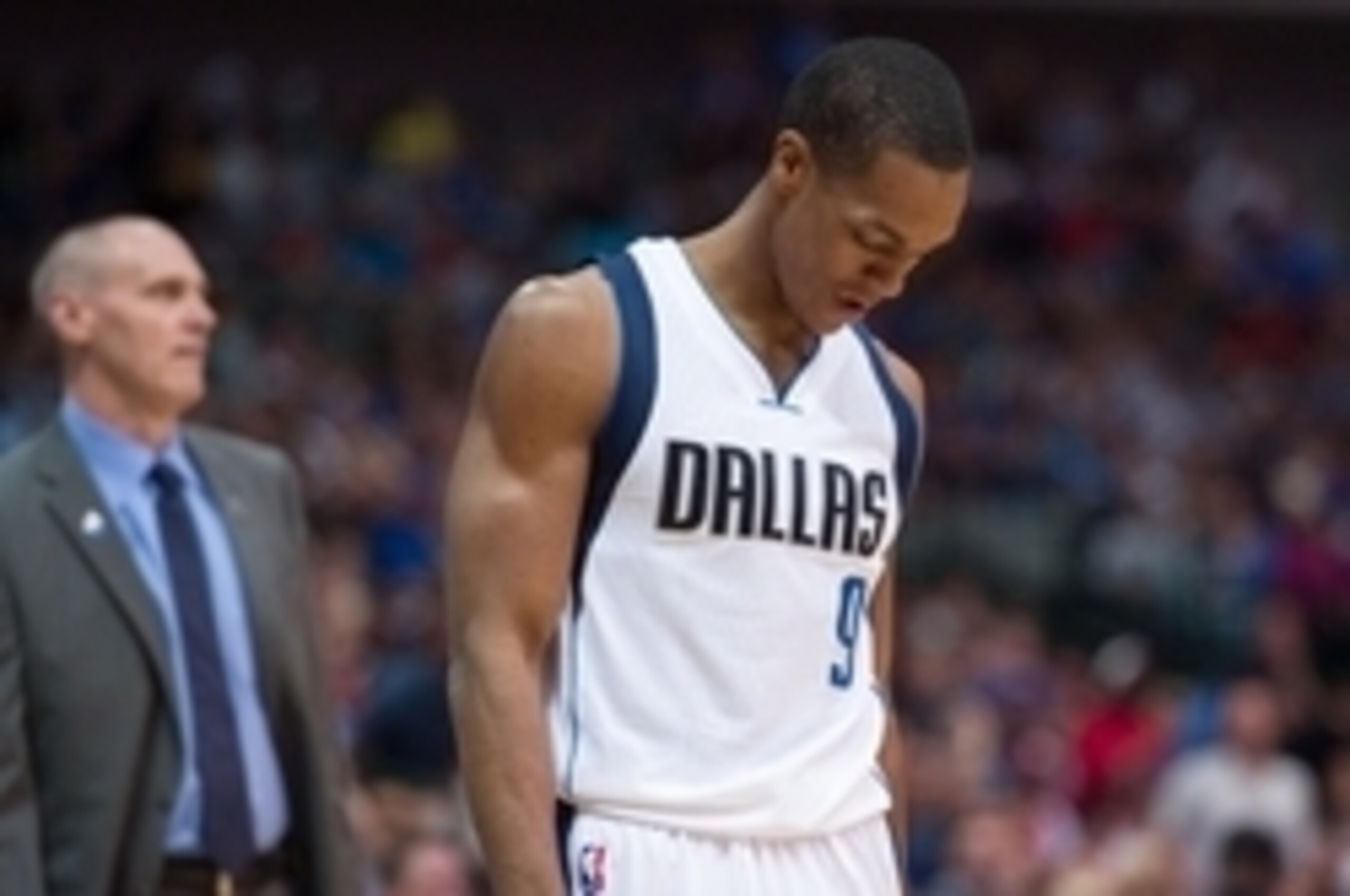
There are playoff disappointments, and then there's whatever happened to Rajon Rondo.
The mercurial, ball-dominant point guard was an awkward fit for the Dallas Mavericks the moment he arrived from the Boston Celtics in a mid-December swap. He sapped the offense's spacing with his inability to even threaten a defense away from the basket. His defense was never nearly as good as advertised. His relationship with coach Rick Carlisle was uncomfortably rocky.
But things went from bad to disastrously worse during Dallas' brief playoff appearance.
Rondo played 37 minutes in the Mavs' first two games with the Houston Rockets. Dallas was outscored by 35 points during that time. His first outing was rough: 15 points on 16 shots. His second was brutal: four fouls in 10 minutes, one technical foul and an egregious eight-second violation.
His third appearance never happened. The Mavs initially ruled him out indefinitely with a back injury, via ESPN.com's Marc Stein, but that reportedly wasn't the case for his absence. He and the team had "made a mutual decision to part ways," sources told ESPN Dallas' Tim MacMahon. The mysterious back ailment was only an attempt to help Rondo "save face."
It didn't work.
Rondo is now entering unrestricted free agency with his stock quite possibly at an all-time low. His game hasn't looked the same since the torn ACL he suffered in January 2013, and his reputation as a malcontent has only grown worse.
Others may have disappointed this postseason, but no one did more damage to himself and his team than Rondo.
Unless otherwise noted, statistics used courtesy of Basketball-Reference.com and NBA.com.


.jpg?w=2560 "Rodgers Iced Out on Plane 💎")
.jpg?w=2560 "Raiders Could Start Mendoza")
.jpg?w=2560 "🚨 Week 8 AP Top 25 Poll")
.jpg?w=2560 "Mahomes Told Teammate to Leave Meeting")
.jpg?w=2560 "Lamar Being Out Shocked Ravens")

.jpg?w=2560 "Packers Safety Slams Refs 🤬")