
San Francisco 49ers: Ranking the 10 Draft Picks in 2015
It’s fair to say that, at this point, the San Francisco 49ers’ 2015 draft class was not as well-received as the 2014 class. Whereas last year the 49ers were fairly universally considered to have put together the top class of the draft, the opinion of this year’s class is more muted. According to Football Outsiders, the 49ers received the second-lowest average grade among experts, only outranking the Buffalo Bills, who lacked a first-round pick.
The 49er’s draft was called filled with more “potential than polish," per the Sporting News' Vinnie Iyer, and the selections were questioned when compared to the talent the 49ers already had on the roster. It was, generally, considered to be a disaster of a draft.
That’s perhaps a wee bit harsh, but I generally agree that this year’s class is less immediately exciting than last year’s. When I looked at the 49ers’ 2014 class in the immediate aftermath, I was happy with 10 of the 12 picks. This year, it’s only four of 10.
It’s silly to grade a class before the players even show up for their first minicamp, but it just feels like the 49ers reached more and received less than they have in recent years. If there’s a bright side, and there is, it’s that the team made 10 selections—the odds are strong that a couple of them will vastly outperform their draft position simply based on the law of averages.
It feels like the 49ers took their draft capital and bought a bunch of lottery tickets. No one is guaranteed to be successful, but the sheer number of selections probably means that two or three of these players will be useful contributors for years to come.
This slideshow is going to rank San Francisco’s 10 draft picks from best to worst before they ever take a snap. We’re looking at three major criteria here:
- The talent level of the players. The better they are projected to be in the NFL, the better the selection.
- The need for San Francisco. Adding a wide receiver, even at a bit of a reach, is a positive for the 49ers. Adding a running back, even at a bit of a value, is less so. That’s not to say a running back couldn’t be the best pick—simply that all things being equal, it’s better to get players at positions you don’t have talent.
- The value of the selection. Did the 49ers reach for a player two rounds early, or did they find a falling gem?
These are all subjective rankings at this point. Perhaps my 10-rated player will end up being the gem of the class, and we’ll laugh at my poor opinions in five years’ time. Until the rookies take the field, though, these are my rough initial opinions, starting with, in my opinion, the steal of the draft.
1. Eli Harold, OLB, Virginia (No. 79)
1 of 10For the second straight year, the 49ers did the best in the third round. Before the draft, there was an outside chance Harold could have gone in the first round. Getting a talent like him in the middle of the third round is a boon.
Harold has the skills needed to develop into a formidable edge-rusher. He’s quick, having put up a 4.6-second 40-yard dash at the combine, and his 123-inch broad jump and 4.16-second 20-yard shuttle are impressive for a 247-pound guy. He explodes out of his stance and can blast around the corner, changing directions on a dime to chase down the ball-carrier.
Does he need to develop more strength? Yes. But he’s going to be a perfect fit in the 49ers’ pass rush. The fact that seven outside linebackers went ahead of him is almost hard to fathom.
Outside linebacker may not have been the team’s biggest need, but you can definitely see why the 49ers stocked up there. Ahmad Brooks is getting old, argued with management last season and has a large contract figure. Aldon Smith also has a large contract figure and is one off-field incident away from a yearlong suspension. Aaron Lynch was good last year, but only has one season of experience.
Harold might not get into the starting lineup right away, but the 49ers definitely needed a little more depth at linebacker, so the selection makes sense.
It comes down to this—Harold was the best player left on the board not named La'el Collins and plays a position of moderate need. The 49ers were fortunate to grab him when they did. He’s the one pick they made in this year’s draft that I really love.
2. Trenton Brown, OG, Florida (No. 244)
2 of 10Picks in the seventh round are supposed to be fliers—they’re certainly not guaranteed to make the team, so it’s not a huge deal if they don’t work out. What you’re looking for is a player with great untapped potential who might develop into something useful with a little work.
The 49ers found such a player in Brown.
He is, for lack of a better term, a mountain. He’s 6’8” and 355 pounds, with 36-inch arms and massive hands. You can’t teach size. He’s not just a blob, either—he knows how to use his length and power to his advantage, driving smaller defensive linemen out of the play. Obviously, his size dwarfs everything else, but considering his bulk, he’s decently mobile as well.
He’s raw, having only started playing football as a junior in high school, but this is a franchise that is taking rugby players and discus throwers and trying to convert them into NFL players. Brown is a much more likely project to work out than someone trying to change sports. The fact that he was selected with an extra pick the 49ers got by trading back in the fifth round is icing on the cake.
Was he the best guard available? That’s debatable, but he certainly has a high ceiling for a seventh-rounder. You don’t see players with Brown’s raw size walk through the door every day. He’ll likely end up on the practice squad as the 49ers develop his game. That’s pretty much my ideal seventh-round selection, all things considered.
3. Mike Davis, RB, South Carolina (No. 126)
3 of 10If the 49ers hadn’t selected Carlos Hyde in the second round last season, I would have liked the Davis selection better. As it is, it's good value for a player without a well-defined role on the 2015 squad.
Davis is a compact and powerful runner, though he’s a bit short at 5’9”. He’s not going to run around guys, with Pro Football Focus giving him a terrible elusive rating of just 34.9, but that’s not his style. He’s a downfield, north/south runner with enough burst and agility to hit a hole quickly once it opens up.
He produced like gangbusters at South Carolina. Despite a few nagging injuries, he nearly had back-to-back 1,000-yard seasons, averaging 5.4 yards per carry over the course of his career. He’s also sure-handed out of the backfield, with 70 receptions over his three years as a Gamecock.
I worry that his stock is headed downward, as the 2013 Davis looked like a much more explosive and exciting player than the 2014 edition. He did have those nagging rib injuries last year, which makes me worry about his health moving forward. Scouts have also raised questions about his conditioning and love for the nightlife, according to ESPN.
My biggest question, though, would be where he fits on the depth chart right now. Hyde obviously isn’t going anywhere, and the 49ers just brought in Reggie Bush in free agency. They may have been better off taking someone like Florida State receiver Rashad Greene instead.
All things considered, though, I like the Davis pick. His running style fits what the 49ers like to do, and he has the chance to be a long-term backup for Hyde. He probably never becomes a starter, but the 49ers don't need a starter. It will be interesting to see how many carries he picks up in his rookie season.
.jpg?w=2560 "Rams Raiders Football")

.jpg?w=2560 "Steelers Saints Football")
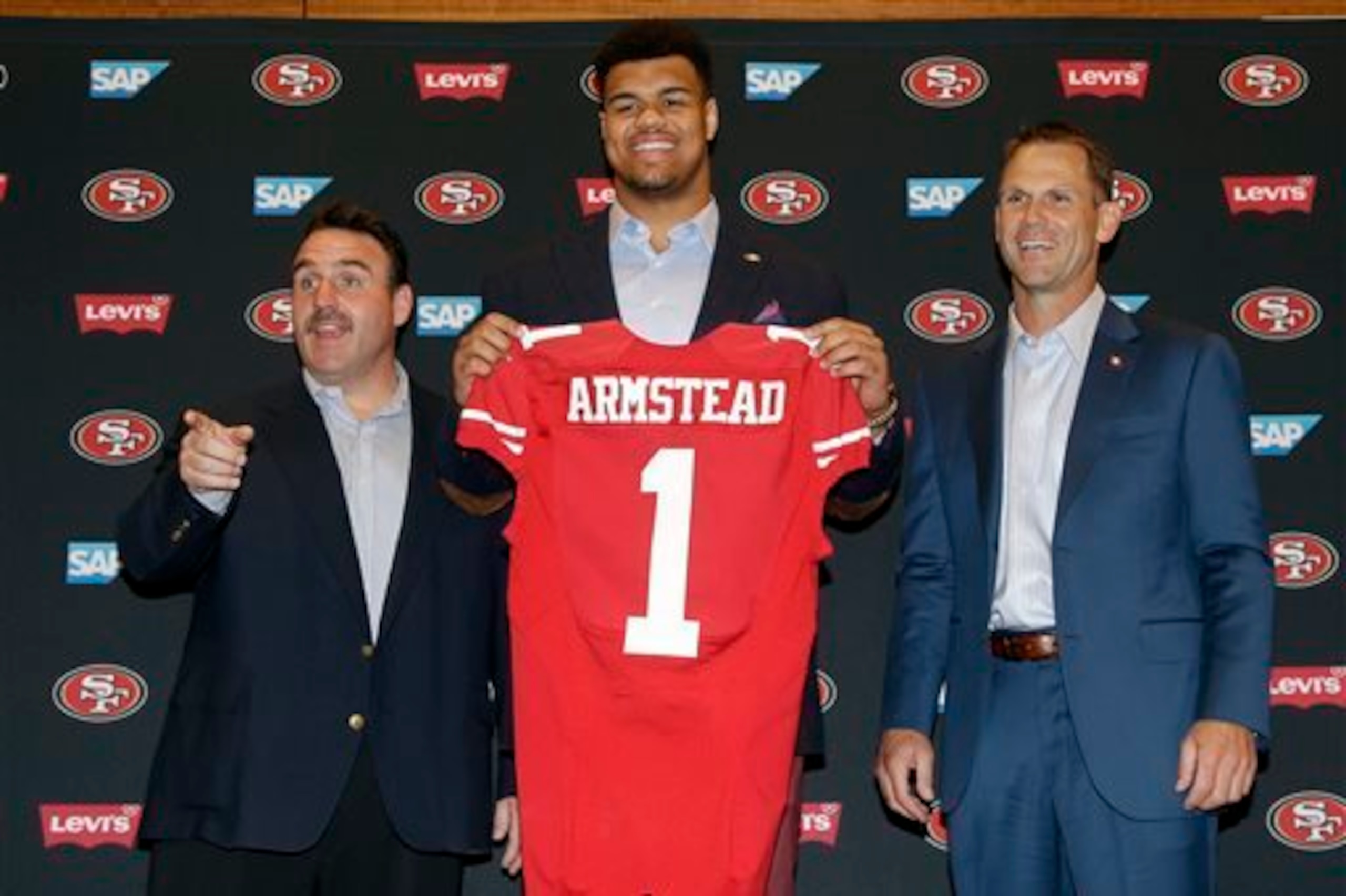
4. Arik Armstead, DE, Oregon (No. 17)
4 of 10Arik Armstead is a bit like sushi at this point. He’s raw and not to everyone’s taste. There was hope that the 49ers would have used their first pick on a wide receiver, ideally with a trade down. There was hope that DeVante Parker would fall just one more slot, but he was taken by the Miami Dolphins at No. 14.
Armstead was not the exciting pick.
He was, however, the best player on the board when the 49ers were on the clock at No. 15. They traded back and added an extra fourth-round pick and a fifth-round pick next year and still got their guy. That plays into things as well.
Like Trent Brown, Armstead is a massive human being. At 6’7” and 292 pounds, he towers over most defensive linemen in the NFL and has the frame to add more functional weight. Despite his size, he’s a top-level athlete who is light on his feet for someone of his size. He has powerful, violent hands, which he uses to give himself almost instant leverage. He shoves opposing linemen straight back into the backfield. He projects to be a great 5-technique, and with Ray McDonald out of town and Justin Smith possibly retiring, that was definitely a need.
The problem is, of course, that he projects to be good rather than actually being good so far. Armstead wasn’t invisible in college, but his pass-rush production left something to be desired. While he racked up 46 tackles in 2014, he only had 2.5 sacks. You’d expect someone with his power and size to destroy inferior college talent, but that never really happened.
Armstead, basically, isn’t the sum of his parts quite yet.
Nevertheless, he is the best player the 49ers drafted—which you’d hope would be the case since he was the first-round selection. I do worry that he’s not going to produce much in Year 1; a receiver like Breshad Perriman or Nelson Agholor might have produced more immediate tangible results.
If the 49ers were going to go with any non-receiver, however, Armstead was the right pick. Jim Tomsula has done a great job of coaching up defensive linemen, and he can turn Armstead into an NFL force. The fact that he improved from 2012 to 2013 and again from 2013 to 2014 bodes well.
I would have preferred another trade back and a late-first-round receiver, but I can get on board with the Armstead selection. He has the potential and frame to be a Pro Bowl-caliber player. He is the last of the four picks I graded positively.
5. Rory “Busta” Anderson, TE, South Carolina (No. 254)
5 of 10While in the end, I’m leaning slightly negative toward the Anderson selection, it’s close. There’s a significant gap between the top five and bottom five picks, in my opinion, and Anderson would have been a perfectly solid pick had the 49ers not used a fourth-round pick on a tight end as well.
Heck, I even had the 49ers taking Anderson in a pre-free agency mock draft in this very slot. He’s an athletic son of a gun; he didn’t get to show any of it in the predraft lead-up thanks to a series of triceps tears, but he has outstanding speed on tape. He’s going to burn unathletic linebackers if matched up in man coverage and can find holes in the zone, as well. Just in terms of his ability to separate and get open, he’s above the class of most seventh-round selections.
Durability is a major concern. He managed to tear triceps in both arms at different points in 2014 and has a history of hamstring injuries as well, missing time in 2013 and being unable to work out at his pro day. It makes me wonder if the 49ers are planning on placing him on the non-football injury (NFI) list to let him heal and learn some; while he’d likely be fit for opening day, the 49ers do play fast and loose with the injury rules and like stashing rookies for a season or two.
I also worry about Anderson’s blocking; he’s too small to be an effective blocker but not quite fast enough or with good enough hands to make his living as a pass-catching-only tight end. That’s not necessarily a huge issue with the 254th pick in the draft, but he doesn’t thrill me.
If he is going on NFI, then I like the pick more. If not, I don’t see how he makes the roster. The 49ers drafted Blake Bell in the fourth round, are keeping Vernon Davis and still have Vance McDonald, Derek Carrier and Garrett Celek on the roster. It seems to me that if you’re grabbing a developmental player this late in the draft, it would have been better to do it at a position of weakness. Anderson is a solid player for this selection, but you have to wonder about the fit.
6. DeAndre Smelter, WR, Georgia Tech (No. 132)
6 of 10Now we’re getting into the picks I have issues with.
Smelter will almost certainly spend the year on an injured list. He tore his ACL in December and likely won’t be healthy enough to participate much in training camp or in the early part of the season. You can go ahead and write 2015 off for him now.
That makes some sense when you’re drafting a player at a position you’re glutted at. When the 49ers took Brandon Thomas in the third round last year, they knew they wouldn’t need his services in 2014 thanks to the presence of Mike Iupati and Alex Boone. They also knew that Iupati could easily be leaving after the season and Thomas could be penciled in then.
Receiver, on the other hand, was the 49ers’ position of most pressing need. They do not have a No. 1 receiver at the moment—they have a great aging possession receiver in Anquan Boldin and a good deep threat in Torrey Smith but no true game-changing player. They really needed a receiver in the first couple of rounds of one of these past two deep receiver drafts. Instead, they got no help for 2015.
Then, they took a receiver from Georgia Tech. There’s nothing wrong with receivers from Georgia Tech per se—Demaryius Thomas is a receiver from Georgia Tech, after all. But Georgia Tech uses a triple-option flexbone scheme that is as far from an NFL offense as you can get and still be playing football. Receivers in their scheme are asked to block and run a limited route tree, and almost nothing else.
Smelter is really, really good at blocking, so that’s a plus. He also led the draft class with 4.36 yards per route run, according to Pro Football Focus, which is partly a product of Georgia Tech’s offense but still impressive. He’s just a sizable project when it comes to developing the full set of skills a receiver needs in the NFL.
I’m not even convinced he was the best project receiver from Georgia Tech in this year’s class. Darren Waller is bigger, faster and more durable and has better ball skills at the moment. He was also taken in the sixth round as opposed to the fourth, where works in progress are more palatable.
If the 49ers wanted to wait until Round 4 to take a receiver, why not take Florida State’s Rashad Greene, who went seven spots later to Jacksonville? Greene is probably a slot receiver only, but he was crazy productive in college. He’s smooth and crisp with excellent route-running skills and will actually help a team this season.
I said when Smelter was drafted that there were 10 receivers on the board I’d rather have than him. In retrospect, that’s a bit harsh, but players like Greene, Stefon Diggs, Kenny Bell and Tre McBride will have better NFL careers than Smelter will.
7. Blake Bell, TE, Oklahoma (No. 117)
7 of 10Tight end was a moderate need for the 49ers entering the draft. Vernon Davis had an awful year in 2014 and won’t be around for much longer anyway. Vance McDonald and the rest of the backups have shown sparks but nothing too thrilling yet. So, using a fourth-round pick on a tight end makes a lot of sense in a vacuum.
I’m just not sure Bell is the right pick. He is a converted quarterback and is raw at this point. He doesn’t have much of a route tree yet, isn’t anything to speak of as a blocker and doesn’t have natural separation ability. He’s athletic as heck and looks the part of a tight end, and he has a natural feel for the passing game. His hands are solid, and he’s eager to contribute, but he’s just way behind the curve for where an NFL tight end needs to be at this point.
In short, he’s another project, just like Armstead, Smelter and Brown are projects. It’s OK to have a couple of players you’re trying to grow and develop, but at a certain point, you need players who can actually contribute as rookies.
I’m not even fully convinced that Bell would beat out a healthy Busta Anderson for a spot on the depth chart, and the 49ers got Anderson in the seventh round. Bell’s 16 career catches don’t precisely inspire confidence in his ability to complete his position change.
The 49ers took Bell as the fifth tight end in the draft. Once again, we’re talking about the expectations and value given at a pick. As a sixth-round selection, Bell’s upside and potential are enough to inspire a team to draft him. Maybe he makes the team, or maybe he gets sent down to the practice squad for a year. It’s not a big loss if he doesn’t contribute right away.
Fourth-round picks, even if the 49ers had three this year, are expected to do more than make the practice squad. Bell is not NFL-ready, but he was drafted like an NFL-ready prospect.
The 49ers would have been better off taking MyCole Pruitt of Southern Illinois or Nick O’Leary of Florida State instead. Both could contribute as a tight end in 2015, while Bell isn’t going to show anything at all until 2016 at the earliest.
8. Jaquiski Tartt, S, Samford (No. 46 Overall)
8 of 10I’m somewhat of an outlier when it comes to Tartt. CBS Sports gave him a grade equivalent to being picked in the second or third round, and NFL.com thought a third-round pick wouldn’t be too much for him. Tartt was surprised to be a second-round pick, according to CSN Bay Area's Matt Maiocco, but most people think he’s a minor reach, as opposed to a major one.
I also admit that my safety rankings were apparently far off from those of the NFL at large. I thought Anthony Harris from Virginia was a Day 2 pick, for example, and instead, the Vikings grabbed him as an undrafted free agent. Feel free, then, to assume that my opinion of Tartt might be similarly off-base.
That being said, I was stunned when Tartt came off the board at No. 46 overall. I thought that surely the 49ers had made a trade and someone else had come up to grab Tartt. The pick simply didn't make much sense to me.
First of all, he is not really a complete safety in my book—at least, not yet. He’s not going to excel in coverage and isn’t fast enough to get back in a play if he’s beaten. While he spent most of his career at Samford as a single-high cover safety, he’s just not athletic enough to do that at the NFL level, which means a position change is in order. He hits like a freight train, and there’s no denying it, but he’s a one-dimensional player.
Second, the 49ers don’t have an opening for him at safety at the moment. They spent their first-round pick two years ago on Eric Reid, and with the exception of some concussion issues, he’s been a solid player, making the Pro Bowl in his rookie season. The other safety, Antoine Bethea, might have been the best player on the 49ers last season.
They spent their first-round pick last year on Jimmie Ward, who played safety in college and is still a primary backup at the position even as he shifts to cornerback. Tartt is a step up from Craig Dahl, but that’s an awfully low priority to be addressing with the second pick in the draft.
Last year’s second pick, Carlos Hyde, also wasn’t a major need, but there are significant differences here. Everyone knew Frank Gore wasn’t going to be around for much longer, and there was no healthy heir apparent on the roster. The need wasn’t there for last season—or so we thought, before everyone got hurt or cut—but you could see it coming up on the horizon. Hyde was also generally considered one of the best players on the board when he was picked, whereas most people agree that Tartt was, at least, a bit of a reach.
Why not take a receiver? Jaelen Strong and Tyler Lockett were both still on the board at No. 46. Denzel Perryman was one of the top-rated inside linebackers, a position of massive need since Patrick Willis and Chris Borland both retired. Tight end Maxx Williams could have been the replacement for Vernon Davis next season, if he didn’t manage to win the job outright as a rookie. Ronald Darby and P.J. Williams were top cornerbacks and thus fill a bigger hole the 49ers actually have in the secondary.
The team could have even gambled on a troubled yet talented player like Randy Gregory. The Tartt pick just seems to be worse than a good double-digit number of options to me.
Don’t get me wrong: Tartt is still one of the three best players the 49ers drafted this year, behind Armstead and Harold. I’m not saying he’s a bad player, just that I don’t see him playing any sort of major role anytime soon. He’s the kind of player I’d take early on Day 3 and be raving about his upside, but I expect more from a second-round pick.
9. Ian Silberman, OT, Boston College (No. 190)
9 of 10Every year, NFL teams take players who went under the radar in the draft process and were roundly ignored by the media. These are players who didn’t get to go to the NFL combine and instead had to try to impress people at their pro day and with their game tape. These are the hidden gems that regional scouts try to dig up—trying to find the one player who has fallen through the cracks.
This is a long-winded way of saying I had no idea who Ian Silberman was when the 49ers drafted him.
That in and of itself doesn’t mean anything. It’s fair to assume that professional NFL scouts spend a little more time digging up hidden gems than a columnist on the Internet does.
So, who is Silberman? He’s a one-year starter for Boston College who probably needs to move inside at the NFL level. He has slow feet and struggles to get to the second level. He doesn’t have much experience in pass protection thanks to Boston College’s run-heavy offense. Pro Football Focus graded him as the 12th-worst tackle in the class, noting that he struggled in both run blocking and pass protection.
On the plus side, NFL.com says he plays stronger than his size would lead you to believe, which feels a bit like a backhanded compliment. He graduated from Florida and attended Boston College as a grad student, so you know he’s a quick study.
All in all, though, I like my sixth- and seventh-round picks to be astonishing in something and deficient somewhere else, rather than being mediocre everywhere. My philosophy is that you take a player for what he does well here and try to coach up his flaws to the point where they aren’t as noticeable.
That’s why I like the Trent Brown pick so much. His strength is enormous. That’s where you start when you’re developing him as a project.
I don’t see anything about Silberman that makes me go “that, there, is what we want to get out of him." From what little I’ve been able to watch, he seems like a generic bottom-of-the-roster training camp sort of player.
The 49ers' undrafted free agents this year are more what I’d want to have in picks like this—the SEC’s passing leader in Dylan Thompson, a productive but troubled safety in Jermaine Whitehead, the sure hands of DiAndre Campbell. You want something you can point to and go “yeah, this player probably won’t pan out, but look at what he can do!”
I don’t see that in Silberman, so he’s a wasted pick.
10. Bradley Pinion, P, Clemson (No. 165)
10 of 10
CBS Sports’ 11th-ranked punter, though it actually lists him as a running back on his player page.
Just…OK, a couple of things.
You don’t draft punters. Period. Under any circumstances. That’s a philosophical point of mine on the draft, and it’s hard for me to get away from that to begin with. Since 2011, and not including Pinion, five punters have been drafted—Brad Nortman, Bryan Anger, Sam Martin, Jeff Locke and Pat O’Donnell. Within 10 picks of each player, the following players were drafted:
- Audie Cole, the projected starting middle linebacker for the Minnesota Vikings before they drafted Eric Kendricks this year.
- Russell Wilson, the two-time Pro Bowl starting quarterback for the Seattle Seahawks
- Ricky Wagner, the Baltimore Ravens’ starting right tackle
- Jordan Mills, the Chicago Bears’ starting right tackle
- Zach Fulton, who started every game at guard for the Kansas City Chiefs last season
The point is that there are useful starters available when these punters are going off the board. Even if the punter turns out to be the next Ray Guy, that’s less valuable than an average starter at a position on offense or defense.
There is almost no correlation between punter draft position and NFL success. The top 10 punters in 2014, according to Pro Football Focus, included:
- Two fifth-round picks (Sam Martin and Thomas Morstead)
- Two sixth-round picks (Matt Bosher, Andy Lee)
- One seventh-round pick (Pat McAfee)
- Five undrafted free agents (Johnny Hekker, Jon Ryan, Tress Way, Brett Kern, Ryan Quigley)
No other position is going to have half of your top 10 be undrafted players. Add in other positively graded punters like Chris Jones, Marquette King and Drew Butler, and you can see that there is plenty of punting talent out there to get after the draft. Draft picks are valuable! Don’t waste them on specialists when you can find great ones a week later.
One of those top-10 punters? San Francisco's Andy Lee. There’s only one reason to move on from Andy Lee, and that’s his salary; cutting Lee after June 1 would save the 49ers just over $2 million against the salary cap, according to Over the Cap. That’s still not in the top 10 when it comes to punting salaries, though; Lee has the 11th-highest cap hit this season among punters. He was an All-Pro just two years ago and hasn’t seen much of a drop-off since; he’s still a value at his position.
The 49ers aren’t that desperate for cap room right now; unless they’re planning on cutting Lee immediately and hiring a free agent for camp, they’re well within acceptable tolerances for signing their draft class with some room to spare, with $6 million free.
That’s not the plan, however. Or, at least, Trent Baalke says that’s not the plan. He said in his press conference that Pinion would have to beat Lee out for the job in training camp. If that’s true, that’s worse! The 49ers aren’t going to keep two punters on the roster, and fifth-round picks make NFL rosters every year. So, either the 49ers cut Pinion, thereby wasting the fifth pick, or they cut Lee, one of the top punters in the NFL whose salary doesn’t get out of hand for another year or two.
Why not draft a punter—or, more to the point, pick one up in undrafted free agency—when Lee does decline, or when his deal shoots over $3 million per year starting in 2016? To draft a player essentially a year too early, Pinion must be special.
Only he’s not. Pinion’s raw numbers are somewhat impressive, averaging 42.6 yards per punt with a 4.1-second hang time, but he hasn’t shown any skill at directional punting yet, as he normally just booted the ball down the center of the field at Clemson. He’s good at not sending the ball flying into the end zone, and he has a big leg, but players like that are a dime a dozen.
He’s not someone like Austin Rehkow, PFF’s top-graded punter by a landslide, a guy who kicked a 67-yard field goal when he was still in high school, set the NCAA record in punting average as a freshman and looks two or three standard deviations above your average punter. Instead, Pinion is your standard above-average punting prospect, not three rounds better than players who went undrafted, like Kyle Loomis or Wil Baumann.
Even if Pinion becomes the greatest punter of all time, it’s still an iffy pick. Even if he holds down the position for the next 10 years—and, to be clear, he’s capable of doing that—it’s still not good value. Don’t draft punters...ever.
Bryan Knowles is a Featured Columnist for Bleacher Report, covering the San Francisco 49ers. Follow him @BryKno on Twitter.
.jpg?w=2560 "Cowboys Packers Football")




.jpg?w=2560 "🚨 Week 8 AP Top 25 Poll")