

Will Youth Movement in Oakland Pay Dividends for Struggling Raiders?
For the Oakland Raiders, the 2015 NFL draft was another opportunity to get younger after having the league’s oldest roster in 2014. General manager Reggie McKenzie started the youth movement in free agency when he didn’t sign a single player over the age of 28.
The shift should pay dividends in the win column for the struggling Raiders. Getting younger doesn’t guarantee success, but it makes it a lot easier in a league where athletic ability and healing time are important indicators of success.
Unfortunately, there are far too many factors to make definitive statements about how age affects a particular roster. For example, the younger players could be pedestrian athletes or have more concerning injury histories in comparison to the older players on a particular team.
.jpg?w=2560 "Rams Raiders Football")

.jpg?w=2560 "Steelers Saints Football")
Analyzing Roster Age Trends
After going over all three years of the data compiled by Jimmy Kempski of Philly.com, there was no clear correlation between team wins and roster age. It doesn’t mean age doesn’t matter, it only means that general managers have done a good job of keeping rosters in the competitive range of 24-27.
The evidence that exits suggests that shifts in roster age can make a difference. The overall trend between change in roster age and win change was weak, but it was in the right direction. It seems that bigger shifts matter more than slight age variations.
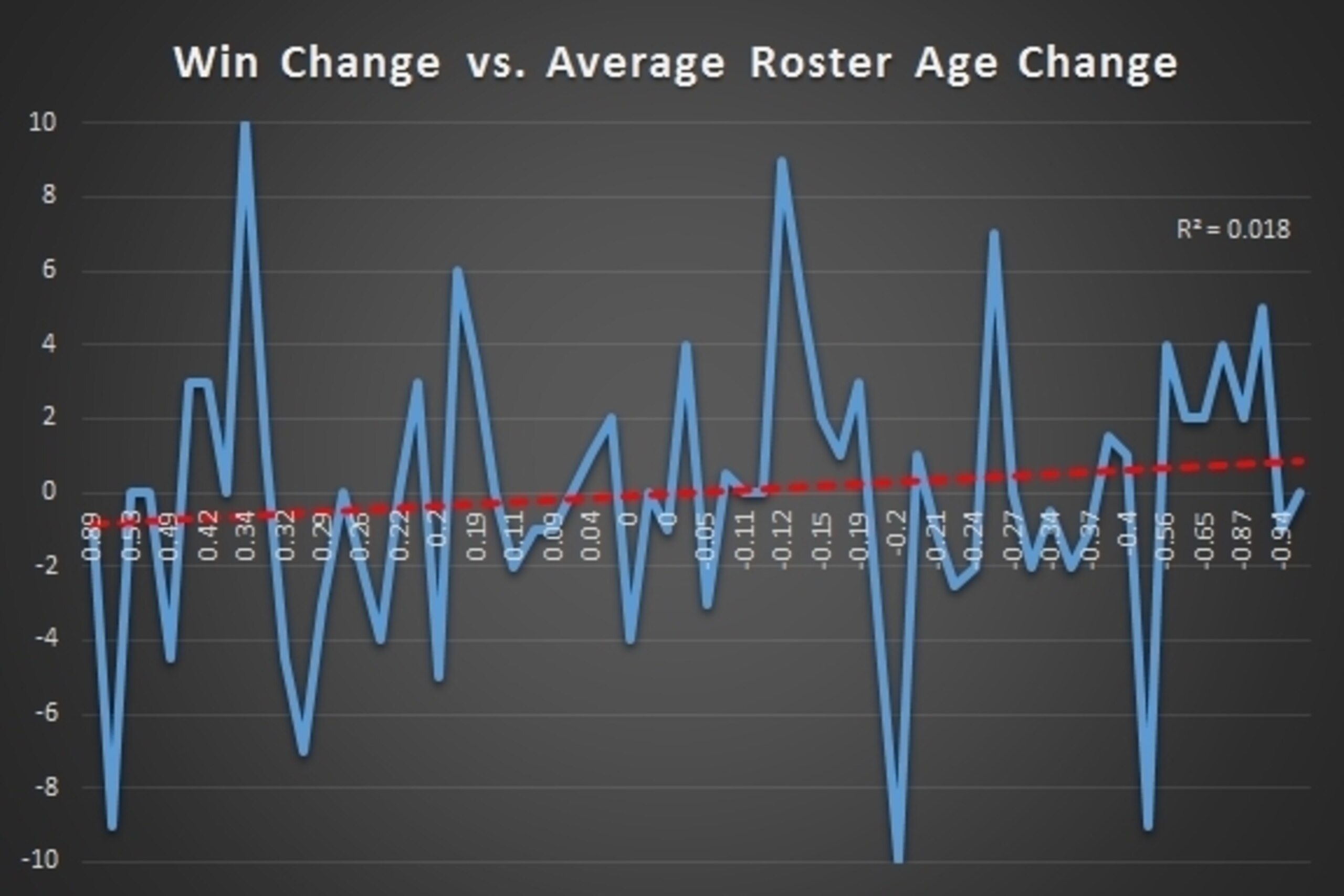
The eight teams that decreased their average roster age by 0.5 years or more averaged 2.25 more wins than the prior year. Only one team, the 2014 Denver Broncos got worse, going from 13 wins to 12 wins.
The four teams that increased their roster age by 0.5 years or more averaged 2.5 fewer wins than the prior year. None improved compared to the prior year.
The 2014 Raiders had the third-oldest roster out of 96 teams in the data set and the largest shift in age. In other words, no team got as old as fast as the Raiders did last year. It was an unnecessary overcorrection to 2013, when the Raiders got younger but were still above the league-average age.
A New Approach
McKenzie bet on experience, as few other general managers ever have, in 2014. The approach paid some dividends in terms of guiding younger players, but not in the win column.
Either McKenzie has used veterans as placeholders, he’s intent on not repeating his mistake from a year ago, or both. Bottom line, the Raiders are getting younger. Quarterback Matt Schaub, linebacker LaMarr Woodley and defensive lineman Antonio Smith were the first to go, but the Raiders are also releasing wide receiver James Jones and offensive guard Kevin Boothe.
Several other veteran players were not re-signed. The message is clear: If you are a player over 30, you are no longer safe in Oakland. Whereas Schaub, Woodley and Boothe weren’t productive, Jones led the team in receptions and touchdowns last season.
The Raiders also released linebacker Miles Burris, according to his Instagram. Burris, who will turn 27 in June, will likely be replaced by a linebacker several years his junior. Just about every roster move this season has resulted in the Raiders getting younger.
The only players over 30 remaining on the roster that aren’t primarily special teamers are safety Charles Woodson, left tackle Donald Penn, defensive end Justin Tuck and offensive lineman Khalif Barnes. The first three are likely in their final year, and Barnes is squarely on the roster bubble, but that’s not anything different for him.
| 2015 | 25.87 (Projected) | 14th in 2014 |
| 2014 | 27 | 32 |
| 2013 | 26.11 | 17 |
| 2012 | 26.38 | 19 |
With the mass exodus of older players, the Raiders’ average age will likely settle in under league average for the first time in the McKenzie era. That’s with Woodson (38), kicker Sebastian Janikowski (37) and long snapper Jon Condo (33) shifting the average 0.6 years.
It’s entirely possible the Raiders will end up having the biggest youth movement the league has seen in the last few years. They even have a chance to go from the oldest roster in the league to one of the five youngest in a single year.
All it would take is the team cutting Janikowski, who could be fighting for his job during training camp. Even if the Raiders reel in Seabass for another year, they are still going to end up with the second largest roster age shift over the last few years in all likelihood.
A cautionary tale is about the 2013 Buffalo Bills, who shifted their roster age by 1.27 years but didn’t win any more games. It’s one thing to have a young roster, but it’s another to have young talent.
The big shift in Oakland is possible because McKenzie expects his last two draft classes to contribute in a big way. Last year, the Raiders got more than 4,000 snaps from their rookies, and five are projected starters in 2015.
| Derek Carr | QB | 1017 |
| Gabe Jackson | LG | 836 |
| Khalil Mack | EDGE | 1034 |
| Justin Ellis | DT | 642 |
| TJ Carrie | CB | 568 |
| Keith McGill | CB | 147 |
| Shelby Harris | DE | 8 |
| Total | - | 4252 |
Quarterback Derek Carr and left guard Gabe Jackson will start on offense. Linebacker Khalil Mack, defensive tackle Justin Ellis and cornerback TJ Carrie will start on defense. All five are also 24 or younger.
Wide receiver Amari Cooper, the team’s first-round pick in 2015, is just 20. Defensive end Mario Edwards Jr., the team’s second-round pick, is just 21. Both will have important roles as rookies and shift the average roster age.
The important thing isn’t the age necessarily, but the production the Raiders can get out of younger players they can’t out of older players. Getting meaningful snaps from players who can barely legally drink is a big part of why the arrow is starting to point up in Oakland.
Every team is optimistic at this time of year due to the talent they just added in the draft, but no one knows how the picks will pan out before they play a single snap. The Raiders have reasons beyond just their 2015 draft picks to have hope.
.jpg?w=2560 "Cowboys Packers Football")



.jpg?w=2560 "🚨 Week 8 AP Top 25 Poll")
