San Francisco 49ers: Analysis and Grades for Last 5 Draft Classes
The 2015 NFL draft has just been concluded, and the San Francisco 49ers selected 10 players from the college ranks. These fresh new faces will compete for roster spots and playing time.
Time will most certainly tell whether 49ers general manager Trent Baalke did well in this draft. When analyzing any draft, it's important to not only focus on the player selected, but also roster needs at the time and those players who were passed up.
With the extremely high cost of acquiring top free agents, the draft is the best way to build a roster. The 49ers, under Baalke's leadership, have largely followed this plan, which has worked for them in the past.
The key to this approach, however, is that you must do well in the draft. Acquiring quality players who can develop into starters or at least major contributors is essential for a team's long-term success.
As we assess the 49ers draft classes over the past five years, the main focus is on how many players are either stars, on-track to be stars, solid contributors, bit players or non-factors.
We will grade each draft class as it looks today, with the full knowledge that things can quickly change as players develop or fall by the wayside. Under Baalke's direction, we have seen the full gamut from great to terrible.
2011
1 of 5
Of all of San Francisco's drafts over the past five seasons, the 2011 class is easily the best of the bunch.
In the first round, the 49ers selected Aldon Smith with the seventh overall pick. Although Smith has had some brushes with the law, his play on the field has been very good.
Smith broke into the league and dominated as a pass-rusher, becoming one of the most feared in the game, In his first two seasons, Smith collected 33.5 sacks and terrorized opposing offenses.
However, in 2013, Smith missed several games when he entered a rehab program for substance abuse. Still, he had 8.5 sacks in 11 games.
In 2014, Smith began the season on the sidelines, as he was suspended for eight games by the NFL. When he returned, he was not nearly as effective as in years past. Smith had only two sacks in the seven games he played.
The 49ers drafted Colin Kaepernick with their Round 2 selection. He is the unquestioned starting quarterback, and his success directly correlates with the 49ers' offensive productivity.
Kaepernick became a starter in 2012 when Alex Smith suffered a shoulder injury. He has kept the job and will enter the 2015 season as the 49ers starting quarterback. Still, he often struggled in 2014, and his woes crippled the 49ers offense. If the 49ers have any hope of winning in 2015, his play must improve.
Two-time MVP Kurt Warner worked with Kaepernick this offseason. The goal was to refine his throwing motion to improve his release and his accuracy. At the recently completed minicamp, Kaepernick showed off his new throwing motion. Cam Inman of the San Jose Mercury News reported on how Kaepernick looked and what his receivers thought of his improvement.
The 49ers also selected cornerback Chris Cuilliver in Round 3. Unfortunately, Culliver departed this winter, signing a free-agent contract with the Washington Redskins. Culliver was the 49ers' best corner in 2014 and will be missed.
Kendall Hunter was the 49ers' fourth-round selection. He has battled injuries throughout his career but when healthy has contributed as a situational, change-of-pace running back and on special teams.
The 49ers also got offensive lineman Daniel Kilgore and fullback Bruce Miller in the 2011 draft. Kilgore started at center in 2014 and was arguably the 49ers' best offensive lineman. A leg injury in the seventh game of the year ended his season.
Miller, a converted defensive end, has been the 49ers' starting fullback and should continue in that role.
This makes six players from the 2011 draft class who have played vital roles for the 49ers. Only four players, Ronald Johnson, Colin Jones, Mike Person and Curtis Holcomb who made little or no impact with the 49ers.
2011 Draft Grade: A
2012
2 of 5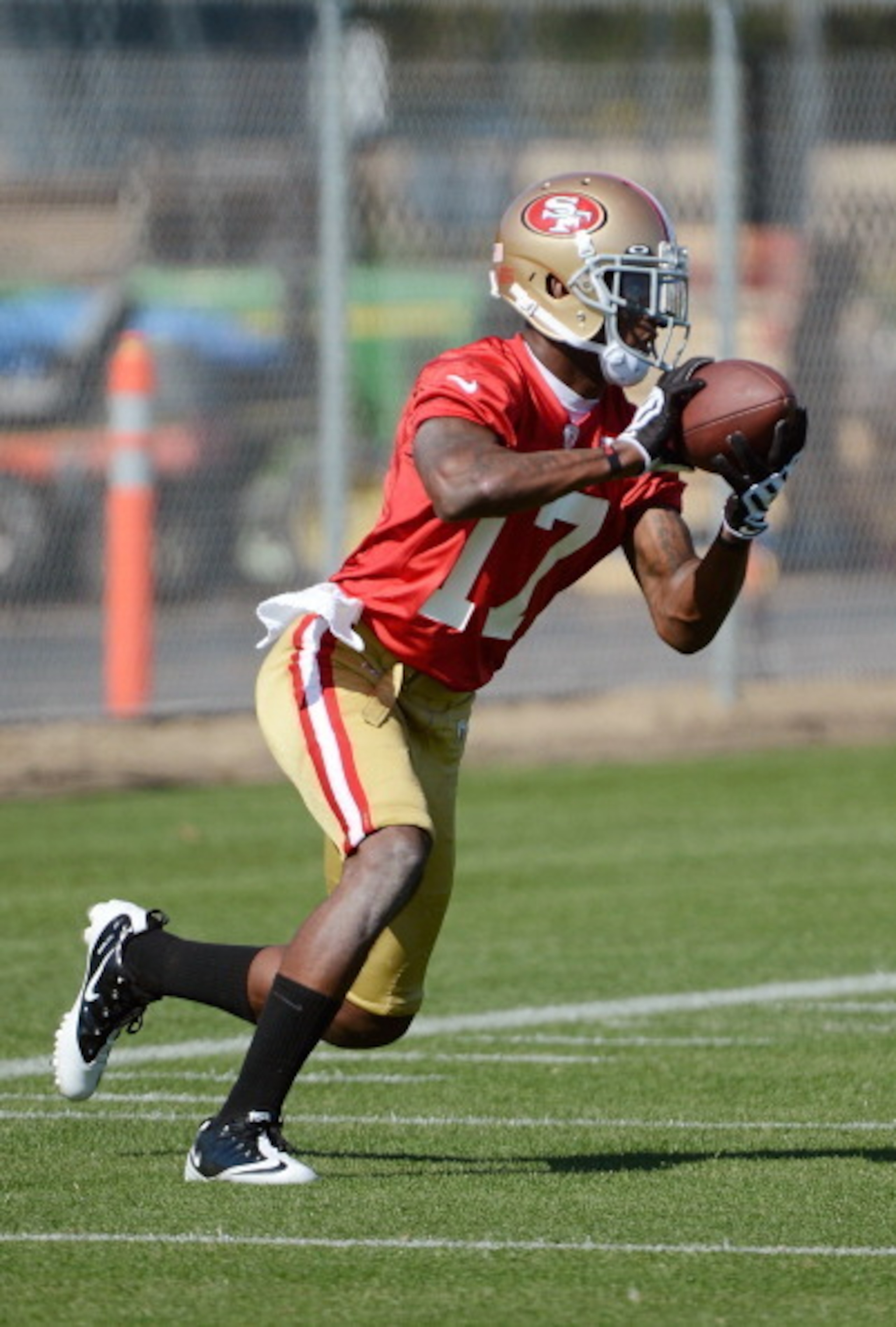
As good as Baalke's 2011 draft was, the 2012 draft was abysmal. This class is by far the worst in the five-year span from 2011-2015.
Baalke surprised most draft experts by making wide receiver A.J. Jenkins the 49ers' first-round pick. Jenkins was the 30th overall selection but should have gone much lower. He quickly showed that he was not ready for the NFL and only got into three games.
Jenkins did not catch a single pass in 2012 and was traded in the offseason to the Chiefs for another underachieving wide receiver, Jon Baldwin. Jenkins was one of the worst first-round draft picks in 49ers history.
LaMichael James was the 49ers' second-round pick, which was a bit curious because they already had Kendall Hunter, who has much the same skill set as James. Both are small, quick backs who can catch the ball out of the backfield.
James' best year was in 2012, when he carried the ball 27 times and rushed for 125 yards. He also played on special teams but did nothing to distinguish himself. According to Matt Barrows of The Sacramento Bee, James was unhappy in San Francisco due to his lack of playing time. He asked to be released, and the 49ers obliged.
After trading their third-round pick, Joe Looney, a guard, was the next selection. He was taken in the fourth round, 117th overall. Looney is the only player out of the entire 2012 draft who is still on the team. In three seasons with the 49ers, Looney has played in only 19 games, starting just four. He is a reserve guard who rarely plays and will likely have to show a lot of improvement to make the roster in 2015.
The rest of Baalke's selections also did not pan out: Darius Fleming, Trenton Robinson, Kevin Slowey and Cam Johnson are all not on the current roster.
The only player the 49ers have to show for 2012's entire seven-player haul is a backup offensive guard.
The blunders of 2012 are now haunting the 49ers. These should be the players who are now ready to step into major roles. Unfortunately, with only Looney remaining, that is not the case.
To call the 2012 draft a colossal bust is being way too kind.
2012 Draft Grade: F
2013
3 of 5
With 11 selections in the 2013 draft, Baalke had plenty of options. With the 49ers on the cusp of getting to the Super Bowl in 2012, this was an opportunity for Baalke to bundle multiple picks to get more impact-caliber players.
Unfortunately, it looks like the 49ers got just one star out of this entire draft. The Niners traded up to get safety Eric Reid. He was the 18th overall selection and made the Pro Bowl in his rookie season.
Reid has entrenched himself as the 49ers' starting free safety, starting 31 out of a possible 32 regular-season games (he missed one contest due to a concussion). Reid has seven interceptions over these past two seasons and, barring injury, should patrol the 49ers secondary for the next several years.
Outside of Reid, however, the star potential of the 2013 draft is very questionable. The 49ers had two picks in the second round, selecting defensive end Tank Carradine and tight end Vance McDonald.
Carradine was injured prior to the draft and did not play at all in 2013. In 2014, even with Ray McDonald missing games due to suspension and ultimately being cut, Carradine rarely played. He could not beat out the likes of Tony Jerod-Eddie, Quinton Dial or Demarcus Dobbs for playing time.
Carradine played in only nine games in 2014 and was credited with 16 tackles. He did have three sacks, however. With McDonald now gone and Justin Smith likely to retire, the 49ers need Carradine to step up and become a force on their defensive line.
If Carradine can emerge into a starting-caliber player, this draft grade will improve.
The other second-round selection, McDonald, has had problems with dropped passes and also staying healthy. In two seasons, McDonald has missed 13 of a possible 36 games. His productivity in the games he has played has been virtually nonexistent: McDonald has just 10 receptions for 149 yards.
As a second-rounder, this is a poor showing. Baalke may have tipped his hand about McDonald, as he selected two more tight ends in 2015.
The 49ers now have seven tight ends on the roster, with Vernon Davis, McDonald, Garrett Celek, Derek Carrier, Asante Cleveland, Blake Bell and Busta Anderson. In addition, long snapper Kyle Nelson can play tight end.
In the fourth round, Baalke also made two selections. He took wide receiver Quinton Patton, then running back Marcus Lattimore. Patton has shown some positive flashes but has yet to show any consistency and has battled injuries. In two seasons, Patton has played in only 10 games and has just six catches for 78 yards.
Patton has a golden opportunity in 2015, as he will be competing with Jerome Simpson and Bruce Ellington for the third wide receiver role. As with Carradine, if Patton can emerge and be a solid contributor, this draft grade will improve.
Baalke selected Lattimore with the knowledge that he had sustained a severe knee injury and would not be able to play in 2013. However, he could never make it back and gave up on his comeback attempt in 2014. This pick was a calculated gamble by Baalke, and he crapped out.
The 49ers' fifth-round pick, Quinton Dial, looks like he will be a rotational defensive lineman. He is serviceable, but not much more.
In the sixth round, the 49ers drafted linebacker Nick Moody. He has been an effective special teams player but has rarely played outside of that. Moody is still very raw and could develop into a decent defensive player; we just have not seen enough of him to know for sure.
The remaining three picks, B.J. Daniels, Carter Bykowski and Marcus Cooper, are no longer on the team.
Instead of bundling multiple picks to get more impact-caliber talent, Baalke opted to go for quantity and depth. With only one surefire starter out of this draft, the 49ers did not get as much as they should have.
2013 Draft Grade: C
.jpg?w=2560 "Rams Raiders Football")

.jpg?w=2560 "Steelers Saints Football")
2014
4 of 5
Baalke made two very questionable moves in the 2014 draft. In Round 1, he drafted Jimmie Ward, who had a broken foot and had surgery only two months before the draft.
In addition, Ward was going to have to learn a new position. Primarily a safety in college, the 49ers planned to move Ward to slot cornerback.
It is a big risk drafting a player in the first round who is coming off a broken foot and resultant surgery. It's an equally big risk to move a player to a new position, especially when they miss OTAs, minicamps and part of training camp.
Ward had some growing pains at his new position early on but was starting to play better when he suffered another broken foot, which put him out for the rest of the season.
The second mistake Baalke made was not selecting a top-quality receiver in the first three rounds of the draft. The 2014 draft had the best collection of wide receivers to ever come out of college in the same year. However, Baalke waited until the fourth round before he took Bruce Ellington with the 106th overall selection.
Ellington battled injuries and looked eerily similar to Kyle Williams. He will need to prove that he can stay on the field and make an impact on offense. Ellington caught only six passes last year. He also did an adequate but unspectacular job as a return man.
In Round 2, the 49ers surprised many by picking running back Carlos Hyde. He had some very good moments as Frank Gore's understudy but will now be the featured back in the 49ers offense.
In 2014, Hyde rushed for 333 yards and four touchdowns on 83 carries. He had a 4.0 yards-per-carry average. In contrast, Gore carried the ball 255 times, rushing for 1,106 yards and four touchdowns at an average of 4.3 yards per carry.
It remains to be seen if Hyde will have the durability of Gore. He has a very high, upright running style which exposes his legs to more hits. It will not be a surprise if Hyde is unable to play a full season, which is something we came to expect from Gore.
The 49ers had three selections in the third round. The first of these picks was offensive lineman Marcus Martin. He was forced into action when starting center Daniel Kilgore went down with an injury. Martin looks like he could develop into a solid player.
The second of the third-round selections was Chris Borland. He played very well and led the 49ers in tackles. However, Borland surprised everyone by retiring after only one season.
The last of the third-round picks was guard Brandon Thomas. He suffered an ACL injury in his final college season and sat out all of 2014. How Thomas and Martin develop will go a long way toward determining the overall grade of the 2014 draft class.
After, Ellington, the 49ers selected cornerback Dontae Johnson in the fourth round. He would not have played much save for injuries to Tramaine Brock, Jimmie Ward and Chris Cook. Johnson benefited from the playing time but is still learning. He will be fighting for a starting job in 2015.
Perhaps the best pick of this draft will turn out to be fifth-rounder Aaron Lynch. He showed a great deal of explosiveness as a pass-rusher and has the ability to wreak havoc on opposing offenses.
The 49ers also selected cornerbacks Keith Reaser in the fifth round and Kenneth Acker in the sixth round. Both sat out the 2015 season with injuries.
Defensive tackle Kaleb Ramsey and fullback Trey Millard also sat out the season with injuries.
Baalke has a penchant for drafting players who may be downgraded due to injuries. He is hoping that they will be bargains and reach their full potential prior to their injuries. The results of this strategy has been mediocre at best.
However, if Ward, Thomas, Reaser, Acker, Ramsey and Millard develop into solid contributors, Baalke's approach will have paid off.
It is still very early to provide a definitive grade for this draft, as things could definitely change based on the development of several players this year.
2014 Draft Grade: B
2015
5 of 5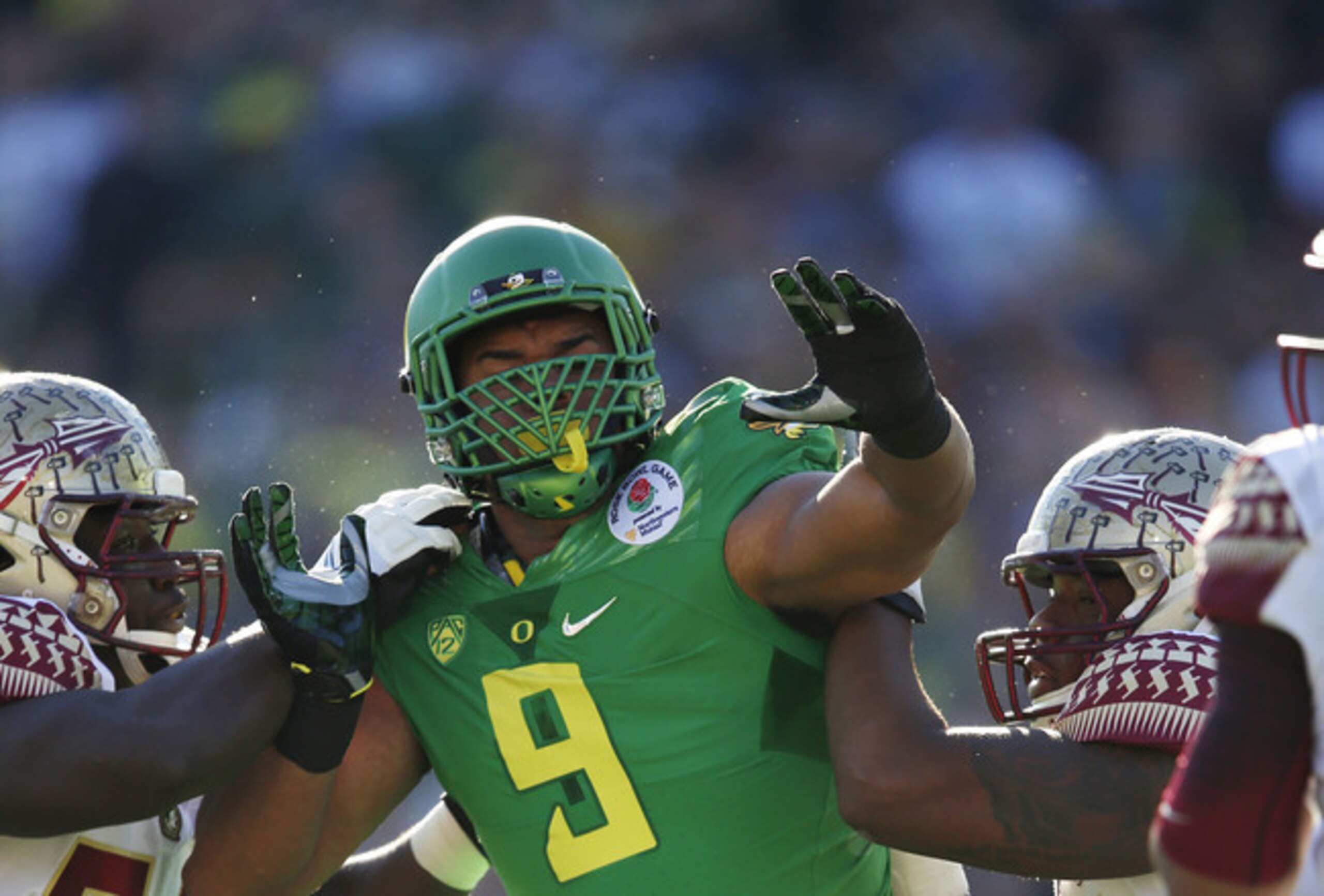
When you look at the 2015 draft, you must first assess what the needs of the team are and determine if Baalke filled those roster holes.
Going into the draft, the 49ers had key needs at ILB, CB, WR, D-Line and O-Line.
The 49ers selected Oregon defensive end Arik Armstead. He is an imposing athlete, standing 6'7"and weighing in at 292 pounds. The key will be whether Armstead can use his size and athleticism to develop into a force on the defensive line. If he can, Armstead can be a fixture on the 49ers defensive front for the next decade.
Armstead did not rack up the statistics over this past year. He had only two-and-a-half sacks on the year. He is a bit raw and will need to get stronger and improve his technique in order to be a star player.
Pete Prisco of CBS Sports had this to say about Armstead: "This kid has a ton of ability, but he didn't always play like it. Can he reach his potential on the next level? I think he can."
Armstead was a decent pick because of his upside. However, he won't likely contribute too much in 2015, as he will be learning and honing his techniques. He looks like a rotational lineman, at least for the upcoming season.
After Armstead, the 49ers draft became very peculiar.
In the second round, the 49ers selected safety Jaquiski Tartt, who played for Samford. Tartt could turn out to be an excellent player, but the 49ers did not address any of their key needs in Round 2. With Eric Reid, Antoine Bethea and Jimmie Ward all safeties, along with veteran Craig Dahl, the selection of Tartt was very questionable.
In the third round, Baalke selected outside linebacker Eli Harold. This pick is very interesting and could pave the way for the 49ers to release or trade Aldon Smith if he does not have a good season.
In addition to Smith, the 49ers also have Ahmad Brooks and Aaron Lynch as outside linebackers, so the selection of Harold was confusing.
The 49ers took two tight ends: Blake Bell in the fourth round and Busta Anderson in the seventh. Why Baalke went with two tight ends made no sense. The 49ers already have five other tight ends on the roster, including Vernon Davis and Vance McDonald.
In addition to Bell, the 49ers had two other fourth-round selections. They took running back Mike Davis and wide receiver DeAndre Smelter. Davis will provide depth in the running back corps, but Smelter tore an ACL in December and may miss the entire 2015 season.
In the fifth round, Baalke surprised everyone by taking a punter. The 49ers already have Andy Lee, one of the best punters in the game, so this pick made no sense.
The other two picks the 49ers made were offensive linemen. Ian Siilberman was selected in Round 6 and Trenton Brown in Round 7. The 49ers rounded out their draft by taking the aforementioned Anderson with their final pick, the 254th overall.
It is far too early to give this draft class a true grade, and things will change as we see whether any of these picks can develop into stars.
Nevertheless, it will be a surprise if any of these players make a major impact in 2015. This draft was filled with several players who have a big upside, but it did not fill many of the holes the 49ers had.
Three of the biggest needs the 49ers had going into this draft went largely unfilled. The 49ers did not make major improvements at inside linebacker, cornerback or wide receiver. Because of that, this draft class and Baalke's performance are downgraded.
2015 Draft Grade: D
Player stats courtesy of Pro-Football-Reference.com.
.jpg?w=2560 "Cowboys Packers Football")




.jpg?w=2560 "🚨 Week 8 AP Top 25 Poll")