

Cavs' Path to the Finals Minus Kevin Love Will Require Them to Do What Few Have
The news that Kevin Love will miss the rest of the playoffs, as part of a four-to-six month recovery following shoulder surgery, is extremely unwelcome for the Cleveland Cavaliers. It is not unprecedented. There have been plenty of playoff teams that have lost key players prior to, or over the course of, the postseason.
And there have even been a few, a very precious and persistent few, who have found ways to persevere. The Cavaliers, as they press on, can either take comfort in their existence, or draw concern from their scarcity.
The 1998-99 New York Knicks were one such squad. They had survived a turbulent lockout-shortened regular season, one in which their coach, Jeff Van Gundy, tried to incorporate Latrell Sprewell and Marcus Camby while compensating for the frequent absence of franchise cornerstone Patrick Ewing. They had upset the top-seeded Heat in the first round. They had swept the Atlanta Hawks, allowing just 76.5 points per game. They had stolen Game 1 in Indiana against the favored Pacers in the Eastern Conference Finals.
TOP NEWS
Buzz: Knicks' KAT Offer Revealed

Buzz: Bron Chopper Part of Deal 🚁

MJ Makes Record-Setting Donation 🙌
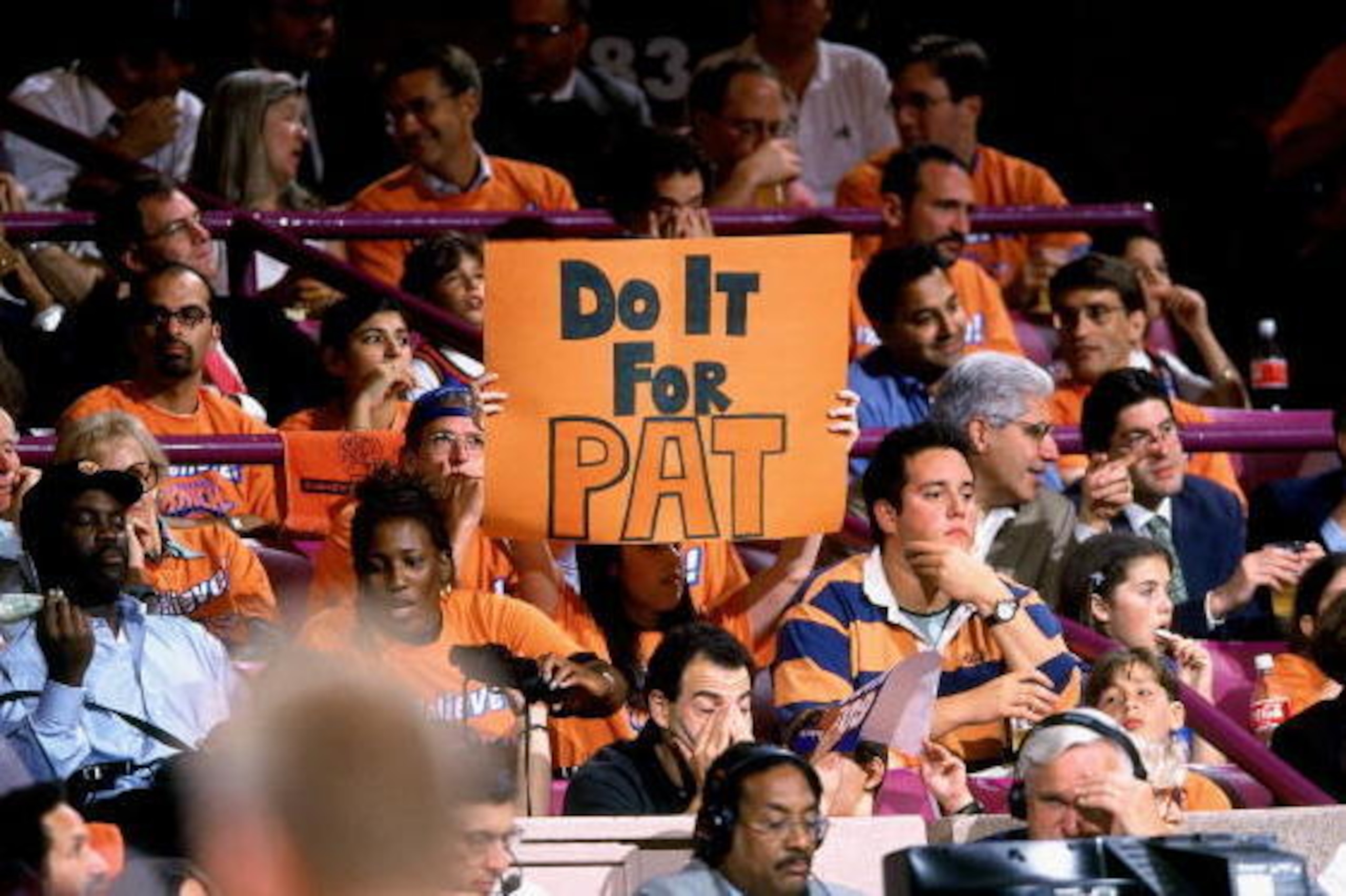
Then came Game 2 of that series against Indiana, when a gimpy Ewing missed a jumper at the buzzer. After that came the off-day examination, when he was declared out for the rest of the playoffs due to a partially torn Achilles' tendon.
Shock subsides over 16 years, so now Van Gundy can squint and see a sunny side. It's not that he looks back fondly at what befell Ewing at a critical stage of the center's career. "I felt incredibly badly for the best player in franchise history, three wins away from realizing getting back to the Finals for the first time since 1994," Van Gundy, now an ESPN/ABC analyst, recalled to Bleacher Report.
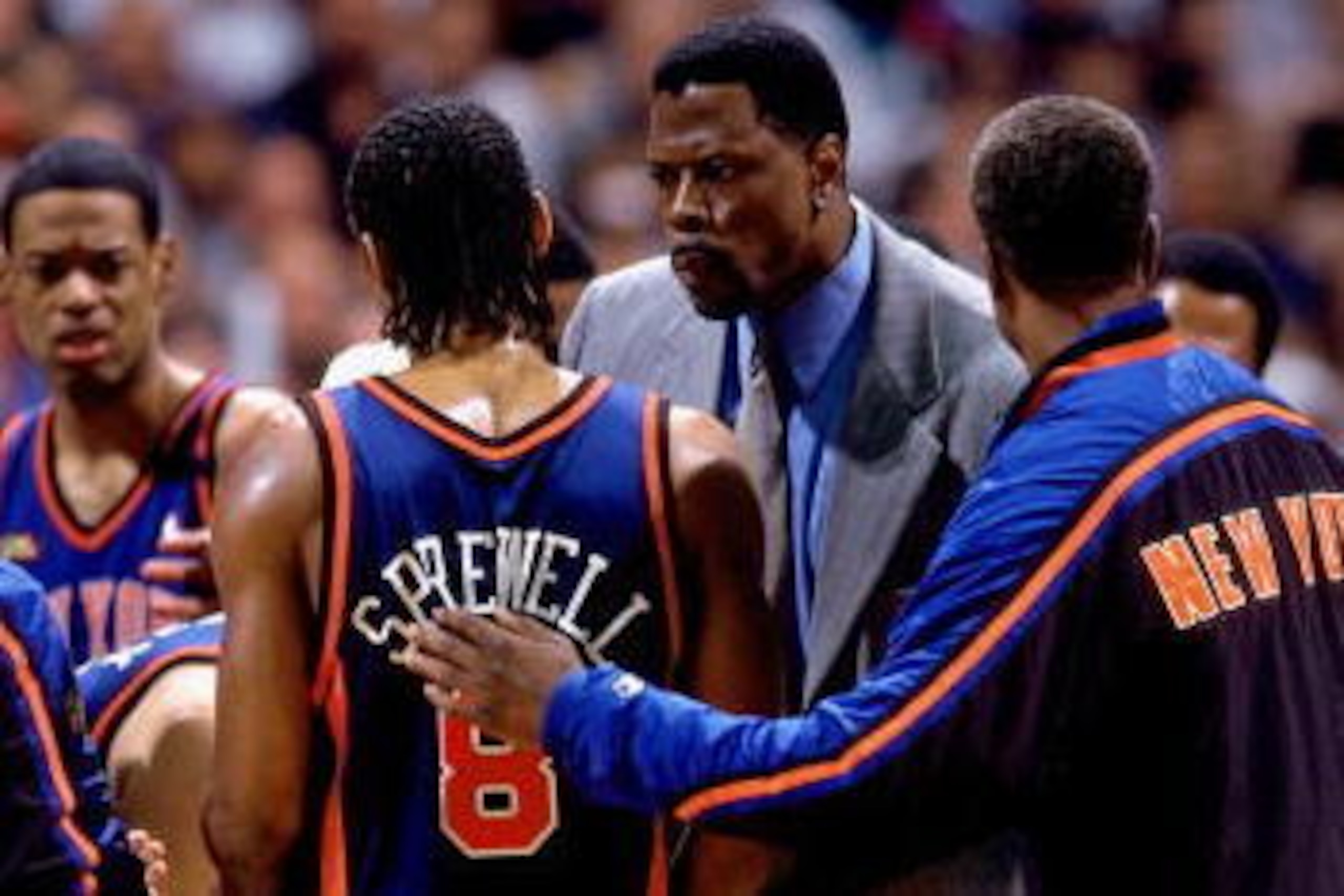
It's just that, in his view, it wasn't as challenging as what the Cavaliers now confront. Ewing had already helped the Knicks seize home court with 16 points and 10 rebounds in Game 1. But, while he had led the Knicks in shots and points per game during the regular season, he wasn't, at age 36, the same guy who had carried their hopes for so many years. And the Knicks had grown accustomed to playing without him during the regular season, as he missed 12 of 50 games, while Love missed just seven of 82 for the Cavaliers this season.
"At that point, not as much ran through Patrick," Van Gundy said. "We ran a lot more stuff through Sprewell and [Allan] Houston. So we didn't really have to recalibrate our offense. And we had really good frontcourt depth that year. We had Chris Dudley and Marcus Camby and Kurt Thomas behind Ewing and Larry Johnson. It's still hard without a great player like Pat. But some of these teams now, when they get hurt, the drop-off is so huge. In our case, we were blessed with great depth."
New York won three of the next four games against the veteran-laden Pacers to reach the NBA Finals, where the Spurs of David Robinson and Tim Duncan ultimately took the title in five games.
Again, those Knicks, while not champions, are relevant again because they represent such a rarity. You can count on one hand the teams that, over the past quarter-century, overcame a significant player's absence to advance to the NBA Finals. You'd even have a pinky to spare, since the 2008-09 Orlando Magic, the 2010-11 Dallas Mavericks and the 2011-12 Miami Heat are the only other extreme exceptions.
Can the Cavaliers become the next?
We'll start to find out when they open a second-round series on Monday against either Chicago or Milwaukee. By then, they'll have had about a week to adjust emotionally and tactically to the loss of Love, though that may not necessarily be a plus. Van Gundy felt it was actually advantageous that the Knicks were embroiled in a series, because "the games come quick, so you have to get ready again. You can't spend a lot of time lamenting what you've lost. You've got to try to maximize what you had."
What do the Cavaliers have?
Not as much in the necessary spots.
"The problem is, the Cavaliers don't have great depth in their frontcourt," Van Gundy said. "They have [Timofey] Mozgov and Tristan Thompson and then they have a lot of guys who haven't played. I think they'll downsize some, put LeBron [James] at the 4, maybe [Shawn] Marion plays some at the 4, James Jones has been an undersized 4-man. But this is a devastating injury. They may make the Finals, but I just can't see how they can win against the West."
That's how much Van Gundy values Love.
"You would think you would have great three-point shooting on the floor (by going small)," Van Gundy said. "But they already had that with Love. So they don't really gain anything out of it. They just lose. You may be able to play at a little bit faster pace, but your rebounding most likely is not going to be as good. Anybody tells you that there is a positive out of this, that's just crazy. There's no positive out of this for the Cleveland Cavaliers."
Nor is recent history especially encouraging.
After the East's top-seeded Bulls lost Derrick Rose to a knee injury during a Game 1 win in the first round of the 2012 playoffs, they dropped four of the next five to eighth-seeded Philadelphia. After the West's top-seeded Thunder lost Russell Westbrook to a knee injury in a Game 2 win in the first round of the 2013 playoffs, they split the next four to take the series against Houston. Then they lost to the Grizzlies in five games.
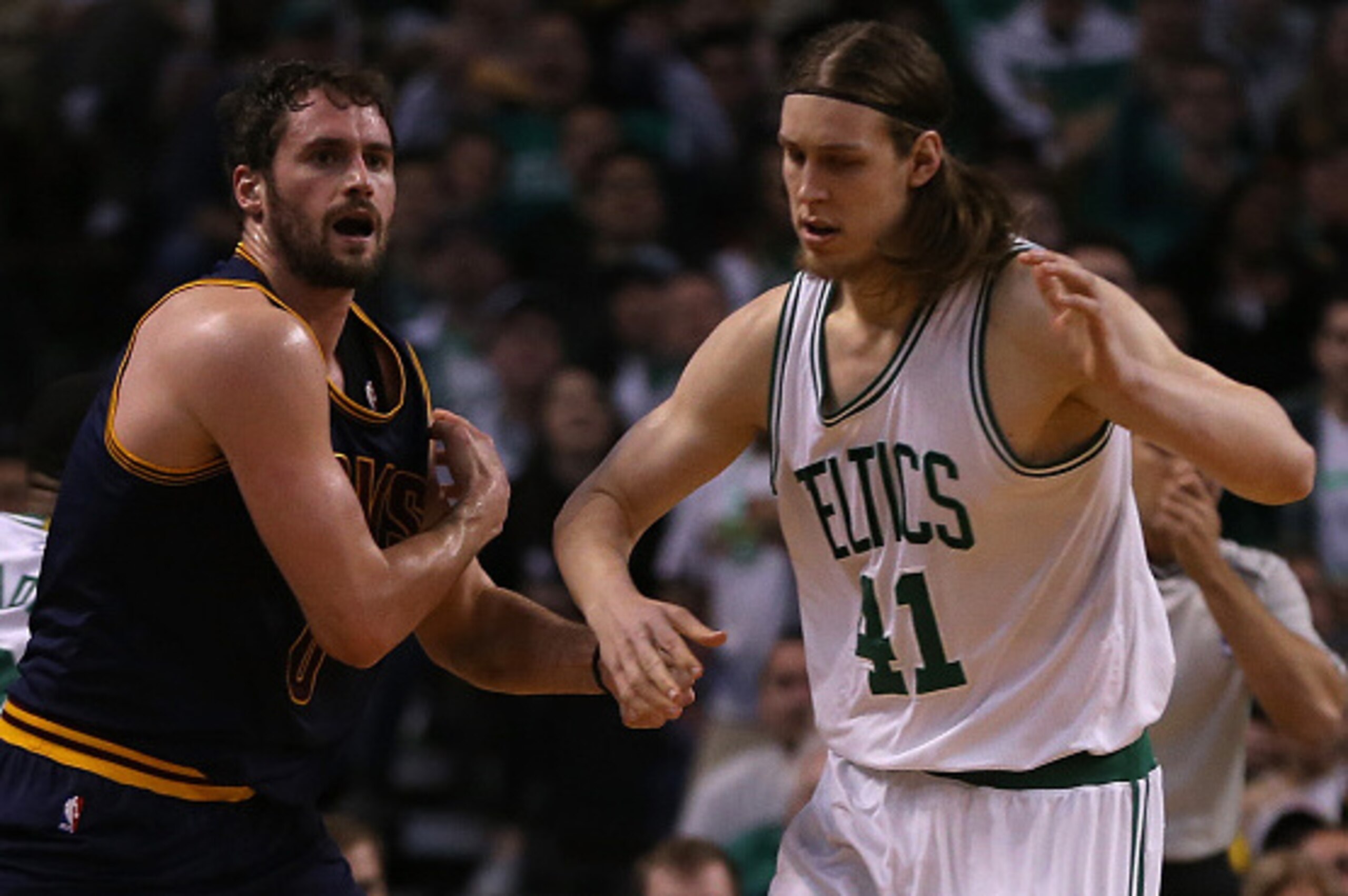
NBA lore is littered with such examples. Playoff teams are typically so even, especially in later rounds, that one missing starter, even for a game or two, whether due to injury or discipline—think of Amar'e Stoudemire's one-game suspension for the 2006-07 Suns against the Spurs—can mean the difference. What if Serge Ibaka had been available for the Thunder for the first two games of the 2014 Western Conference Finals? Would the Spurs have routed the Thunder twice? Or would they have split those contests? And, if the latter had been the case, would San Antonio, which did split the four games that Ibaka played, have won the West, and ultimately a championship?
What's known is that between 1990 (when center Kevin Duckworth missed the first six games of the second round for Portland prior to returning to help it win Game 7 against the Spurs) and 1999, no team reached the NBA Finals after a key player missed more than three games in any of the other series. The only two such teams were the 1995-96 and 1997-98 Bulls, and it's not like they were without Michael Jordan or Scottie Pippen for that long but, rather, sixth man Toni Kukoc and replaceable center Luc Longley, respectively.
Between 2000 and 2008, the 2000-01 76ers were the only team to reach the NBA Finals without a key player for more than two of the preceding postseason games, and that's if you apply that characterization to role-playing forward George Lynch, who missed a month after breaking a bone in his foot in the second round against Toronto and returned to play limited minutes in two games of the NBA Finals against the Lakers. No team during that period reached the NBA Finals while a star missed more than one game on the road there; the clutch-shooting Robert Horry missed two, due to his part in that Spurs-Suns fight that also sidelined Stoudemire, in 2007, but the Spurs won without him.
Then came 2009, when another Van Gundy team proved its resilience. Stan Van Gundy's Orlando Magic lost their starting point guard, top assist man and fourth-leading scorer, Jameer Nelson, to a torn labrum in February. With Rafer Alston and Anthony Johnson filling in, the Magic still made the NBA Finals, where Nelson returned and was largely ineffective following his four-month layoff.
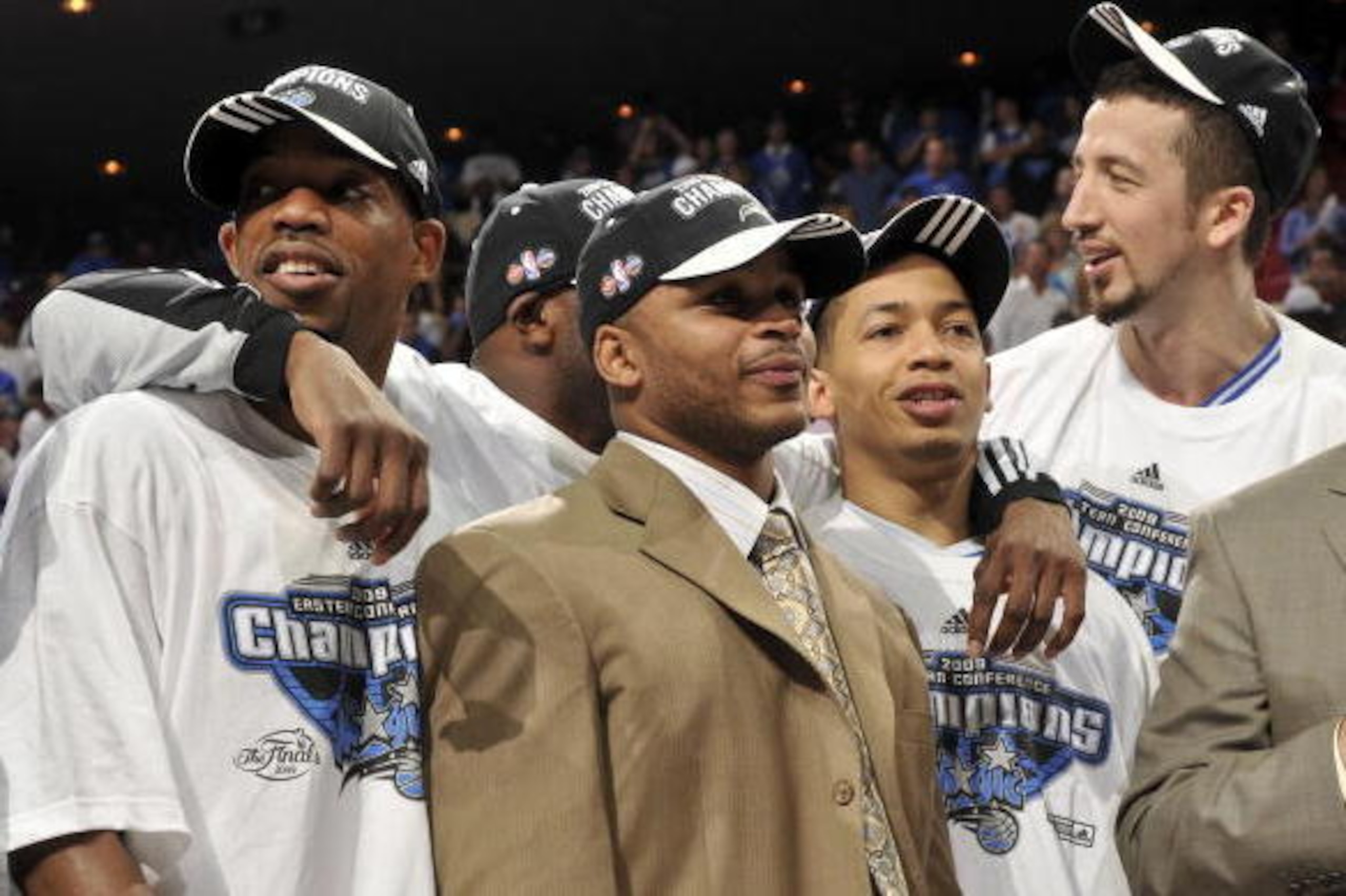
In 2011, the Heat and Mavericks both had to overcome some injury adversity, due—like Nelson's situation—to pre-existing conditions. Udonis Haslem, who began the Heat season as a starter before missing five months due to foot surgery and blood clots, came back to play parts of six playoff games prior to the 2011 NBA Finals against Dallas. On the other side, regular starting small forward Caron Butler hadn't played any playoff games, not since shredding his knee on New Year's Eve. Nor would Butler play in the NBA Finals, but at least the Mavericks had Shawn Marion around to step capably into his place.
"I was dying to get out there, bro," Butler recently told Bleacher Report. "I got cleared after Game 6. If it went seven, I definitely was playing. So I was just gearing up to that moment. I mean, I was happy we won in six, but I was hoping it went seven. Secretly, you know."
He hadn't played for over five months but would have returned, cold, to guard LeBron James.
"I would have been cool with that," Butler said, smiling.
The Heat weren't cool, or comfortable, with Chris Bosh missing nine games after straining an abdominal muscle in Game 1 of the 2012 East semifinals against Indiana, especially not when they fell behind, 2-1, against the Pacers, tinkered with several different lineups and needed James and Dwyane Wade to play at a superhuman level to reach the East finals. Nor when they were tied at 2-2 in the Eastern Conference Finals against Boston, before Bosh returned to play 14 minutes as a reserve in a Game 5 loss. But Bosh got more time in the next two wins and was back to his normal load in the five-game NBA Finals win against Oklahoma City.
The circumstances of the aforementioned teams are not completely comparable to Cleveland's. Bosh returned for the Heat; Love almost certainly won't for the Cavaliers. The Magic and Mavericks had become accustomed to playing without Nelson and Butler, respectively. In fact, Orlando may have been better off just shelving Nelson for the season and sticking with Alston as a starter.
The closest predecessors?
Those 1998-99 Knicks.
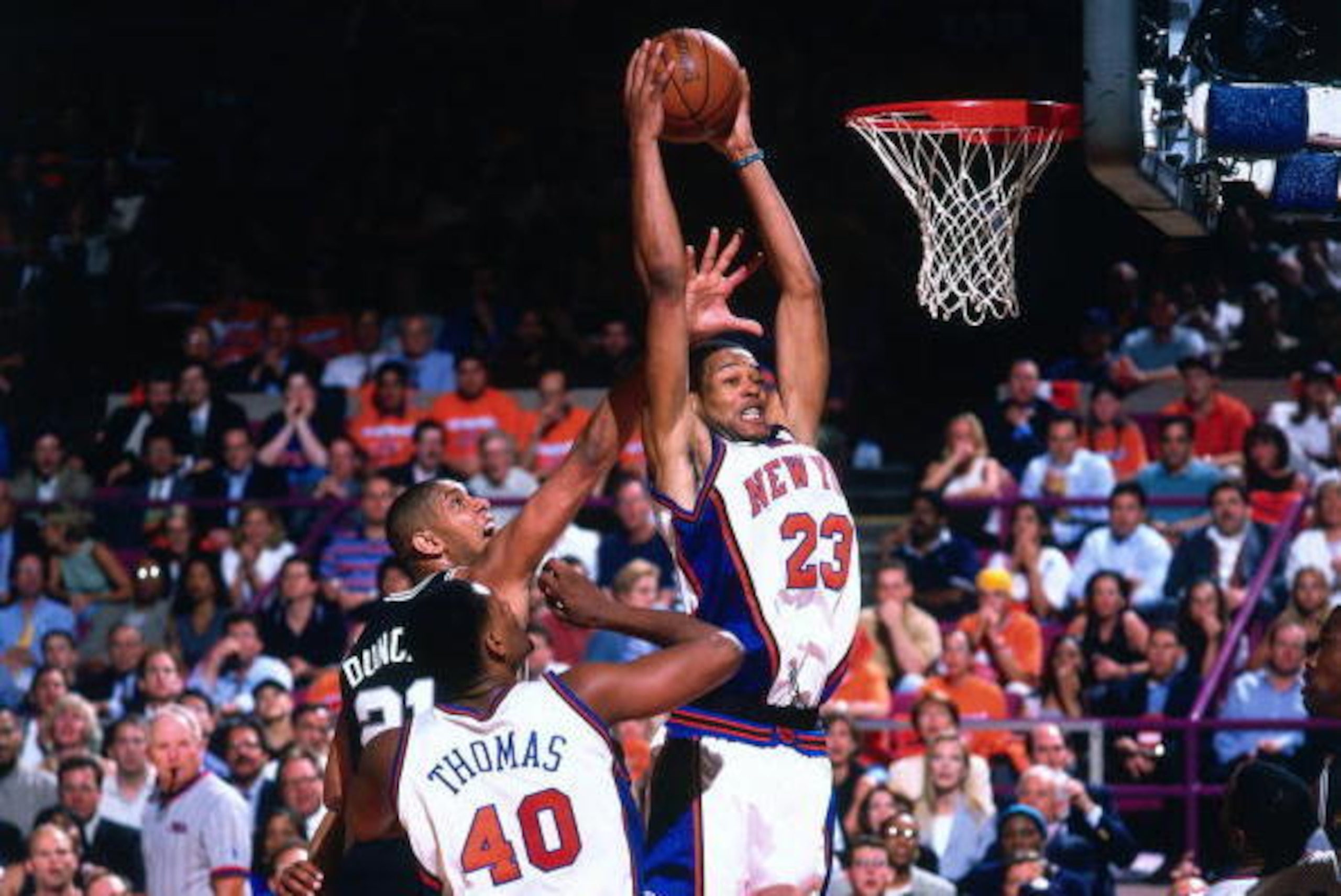
And even there, New York needed to get through just one more round, winning three more games, to get out of the East. Cleveland needs to take care of two more rounds, winning eight more games.
And that's just to get to the NBA Finals.
Then, they would see a West power like Golden State or Houston or Memphis or San Antonio on the other side, one with a better regular-season record, home-court advantage and, presumably, a more complete roster.
Jeff Van Gundy saw an earlier version of the Spurs in 1999, though a version that—in a testament to San Antonio's remarkable continuity—included two current components, Duncan and coach Gregg Popovich.
Still, does Van Gundy ever wonder what would have happened had Ewing been healthy?
"I really don't," he said. "During that Finals, we probably thought about it a little bit more than actually since then. I think that would be human nature, to play the 'what if' game. But you don't get do-overs. So it doesn't do you a lot of good."
History suggests that they did better than most.
Can the Cavaliers do them one better?
Ethan Skolnick covers the NBA for Bleacher Report and is a co-host of NBA Sunday Tip, 9-11 a.m. ET on SiriusXM Bleacher Report Radio. Follow him on Twitter, @EthanJSkolnick.





.jpg?w=2560 "Love's Body Already 'Tired'")

.jpg?w=2560 "Tyreek Deal May Come Soon")
.jpg?w=2560 "Mahomes' Wife Trolls Kubiak 💀")