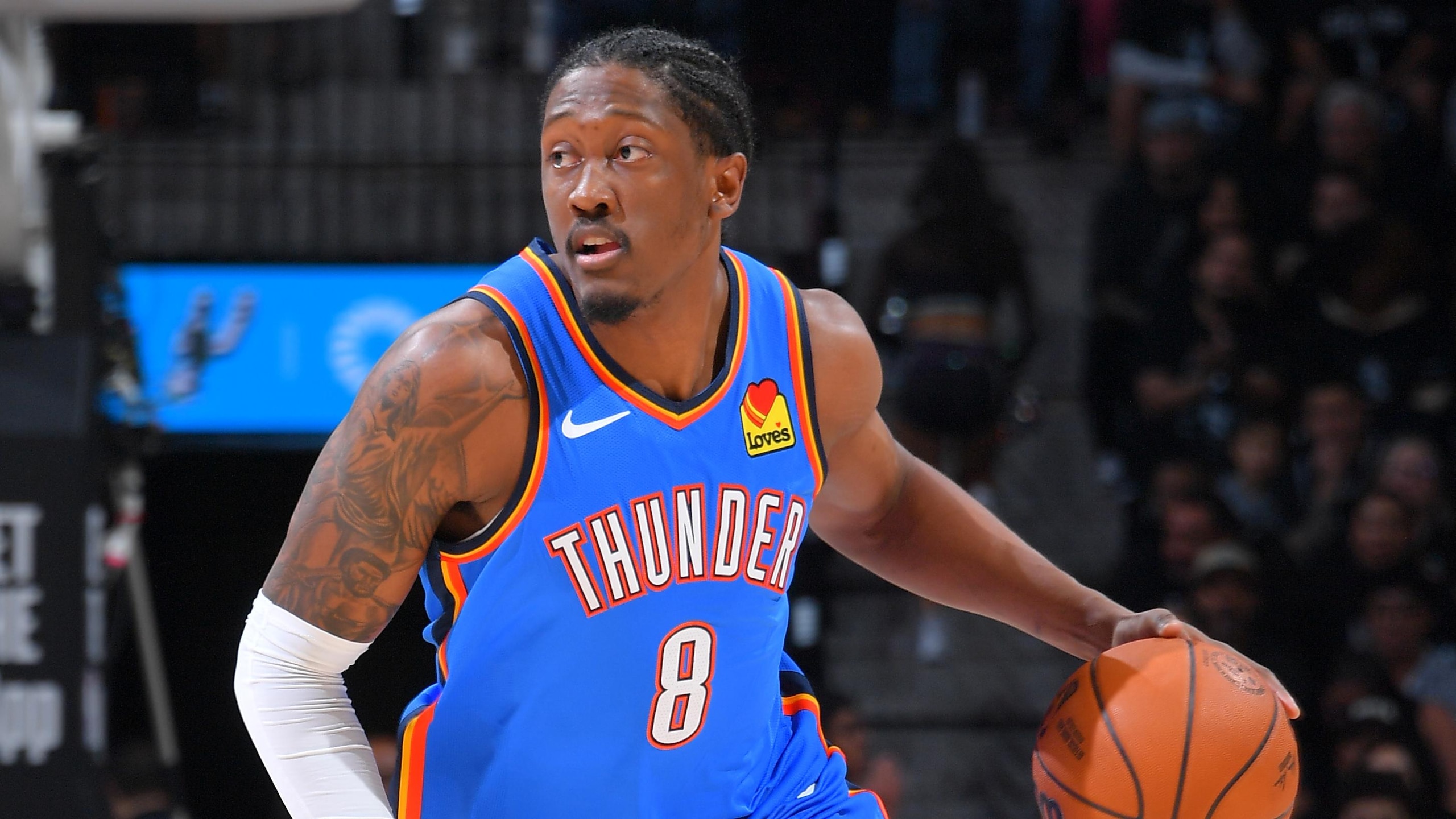
Jason Peters Tells His Story of the Undrafted Road to NFL Success
Sometimes Philadelphia Eagles left tackle Jason Peters gets asked a question: Why do you work so damn hard?
The question seems strange at first, then reasonable. He's a seven-time Pro Bowler and a premier player at his position who doesn't need to prove anything after 10 seasons. At 33 years old, he's also at a stage in his career where the body can begin to break down, with physical punishment accumulating. So taking it easy every now and then or even sitting out the odd voluntary offseason practice wouldn't draw sideways glances.
Peters’ answer is simple.
.jpg?w=2560 "Seahawks Chiefs Football")


“I’m a free agent,” he told Bleacher Report during a recent phone conversation. “That’s how I work, and that’s how I’ll always work. I didn’t get drafted.”
Peters isn't actually a free agent, of course, and the Eagles have his signature to prove it. But in his mind, he's been one his entire career. Once you’re undrafted, you stay undrafted.
The 2015 draft will begin with hope for prospects waiting to hear either their name or a buzzing phone, just as it does every year. And it will end in despair for most of them.
Right now, there are over 1,000 draft-eligible players anxiously anticipating April 30. Of them, only 256 will be selected. They’ll be scattered among a pool of 2,880 NFL players that shrinks to 1,696 by the end of training camp. That numbers game isn’t fair or fun.
The alternative undrafted path is long and winding, and it can require sacrifices as you venture deep into dark areas of the league’s depth-chart jungle. But it’s there and has been traveled by active stars such as New York Giants wide receiver Victor Cruz and Dallas Cowboys quarterback Tony Romo.
Hope fuels the undrafted-free-agent climb on both ends. The player simply wants an opportunity and claws for whatever bread crumbs he’s thrown. And the team is looking for that next sparkling gem hidden among the discarded draft castaways.
Peters satisfied all parties involved. There’s a lesson to be learned as the 2015 draft approaches and we look back on his journey that started with being passed over repeatedly by 32 teams: Being a misfit shouldn't be feared.
Eventually, talent rises, and the starting point fades away. Peters’ start was, in a word, unconventional.
“He was a special teams phenom”
One of the best blindside protectors and a possible future Hall of Famer hadn’t played a snap at left tackle when he entered the NFL as an undrafted free agent.
Instead, Peters was known more for this:
It seems like a 305-pound behemoth (Peters now weighs 328 lbs, standing 6’4”) with the mobility shown there should only exist in wildly woven scout stories told after several adult beverages.
“He was recruited as a defensive lineman!” the scout would scream after setting a juke box to play Bruce Springsteen’s greatest hits for yet another hour. “Now he plays tight end and finished 2003 with 21 receptions for 218 yards and four touchdowns.”
But that’s not fictional, and instead it describes the 2003 version of Jason Peters. He earned second-team All-SEC honors at tight end during his final collegiate season with the Arkansas Razorbacks.
Even as a tight end, though, he was still used primarily in a blocking role, recording 61 knockdown blocks during his junior year. Peters seemed too massive to be a tight end in the NFL, and he had no experience playing tackle at any level. Confusion grew when he ran the 40-yard dash in 4.93 seconds at the combine, blistering speed for his size.
Where exactly would he fit on a professional football field then? Imagining that future was difficult.
At the time, Phil Savage was a personnel director for the Baltimore Ravens, and he likely spoke for a lot of evaluators when describing his perplexed Peters projection to USA Today’s Jarrett Bell:
"He's what they call a 'jumbo athlete'. Very agile. Catches the ball well. Blocking? He's probably not as good as what people expect to see, as far as playing tackle. Plus, from everything I know, his mentality is more to be a skilled-position player. He'll be intriguing to watch the next couple of years, to see what he develops into.
"
Peters was viewed as a developmental project. He was filled with potential and possibilities as a tackle, and his athleticism led to curiosity.
“They asked me, ‘Have you ever played offensive line?’” Peters said, of his combine experience. “But they never directly said, ‘We’re going to put you on offensive line’ before the draft.”
Intrigue didn’t result in a draft investment from any team in 2004. Then when the final name wasn’t his, about 20 teams called. At that point, the Texas native was given exactly what he wanted: a choice.
“I told my agent after about the sixth round it would be good if I could just pick my team,” Peters said. “Instead of getting forced to go to a team and trying to fight, when it probably wouldn’t have been a fair fight for me.”
The excitement of getting drafted in the late rounds is often erased by a depth-chart burial. That happens with undrafted free agents, too, but the difference is having control over your destiny. The undrafted free agent can put himself in a more favorable position by picking a depth chart that at least offers a reaching, clawing chance.
Peters’ choice?
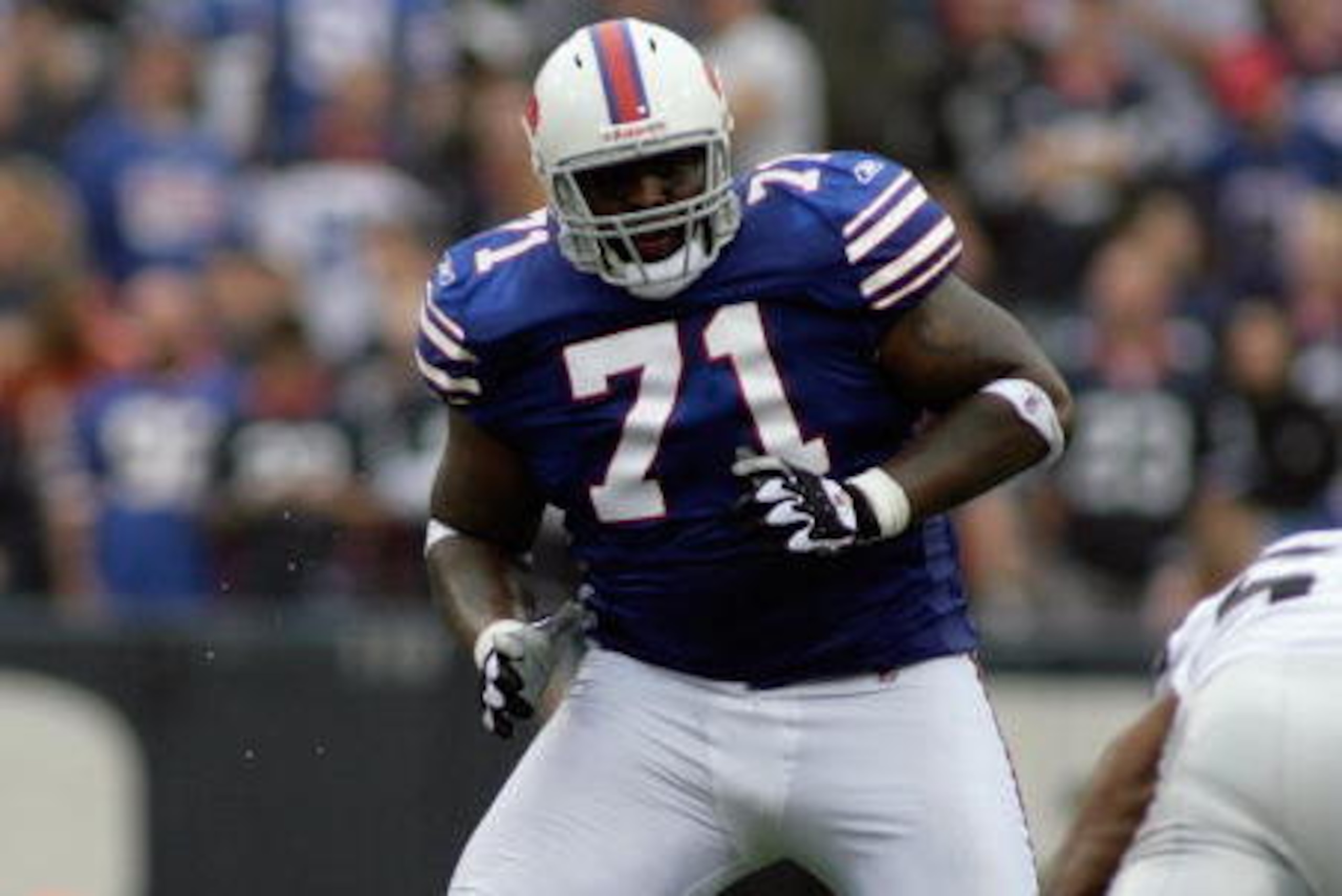
He signed with the Buffalo Bills. Then he was cut just prior to the 2004 season and re-signed to the practice squad. When he made the active roster, Peters played sparingly and was still a tight end but a blocking one used in short-yardage and goal-line situations.
He also excelled in another area that, in hindsight, creates a pretty comical mental image of a massive man sprinting downfield covering a kickoff.
“He was a phenom on special teams,” former Bills general manager Tom Donahoe told CSN Philly’s Reuben Frank. “He did everything—covered kicks, and he was on the punt block team. One year in Cincinnati, we beat Cincinnati, he got through and blocked a punt. He was a phenomenal athlete.”
Which led to a familiar riddle for the athlete who’s either drafted late or, in Peters’ case, not drafted at all. How can that raw athleticism be turned into a contributing role?
That was a question Peters had for Mike Mularkey one day.
“My first year, I didn’t have a clue what I was doing”
After his rookie season, Peters approached Mularkey—his first NFL head coach—with a simple question: How do I get on the field more?
“He said, 'The offensive line coach keeps asking about you. What would you think about that?’”
His response was automatic: “Whatever I can do to get on the field.”
Mularkey then asked Peters another question.
“He asked me if I had ever played there before,” Peters recalled. The answer: “Nope.”
For confirmation, one more easy question followed from Mularkey. The answer redirected Peters' career path as a first surviving, then thriving undrafted free agent.
“He asked if I would play there, and I said, ‘Yeah’. That’s how I started.”
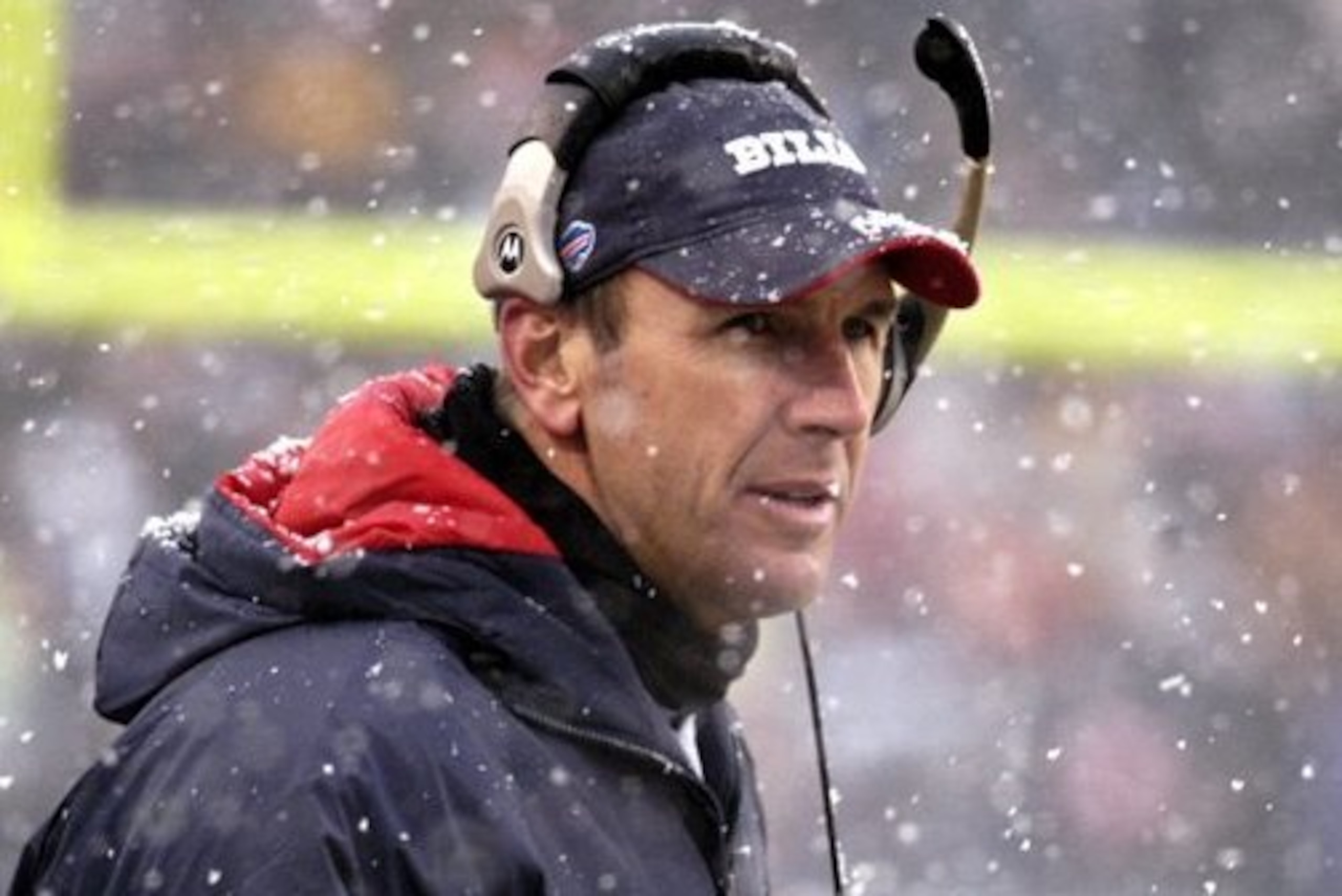
The man tasked with molding the athletic Play-Doh offered by Peters was Bills offensive line coach Jim McNally, who spent 28 years in that capacity around the NFL and now serves as a Cincinnati Bengals consultant.
As Peters remembers it, the transition wasn’t natural or smooth at first.
“I didn’t have a clue what I was doing my first year,” he said.
When he wasn’t on the field practicing technique, Peters spent the 2005 offseason watching tape of left tackle legends such as Anthony Munoz and Walter Jones. The Munoz example wasn’t an accident.
“I coached Anthony Munoz, who was the best player ever at his position,” McNally told Bleacher Report. “Jason Peters is the next best player I’ve ever coached.”
That’s some Hall of Fame-level praise (Munoz was inducted into the Pro Football Hall of Fame in 1998). McNally’s words are especially remarkable given Peters’ complete lack of experience. But that didn’t seem to matter much.
“He didn’t really make a lot of errors because he was a generally instinctive football player,” said McNally, outlining his first impressions of Peters as he attempted the position switch.
Technique needed to be honed, but the most significant adjustment laid in the intricacies of playing offensive tackle.
“It just took him maybe a little time to figure out the pass protection, and things like when to switch on a stunt,” said McNally. “Should he stay with the guy? Or should he pass him off to the guard? It was just little things like that, but it really didn’t take him very long.”

Peters started at right tackle, making his regular-season debut there in Week 6 of 2005 when Mike Williams went down with an injury. The following year, he moved to left tackle, and since 2007, the only Pro Bowl he’s missed came when Peters sat out a season after rupturing his Achilles twice (2012).
For most undrafted players, being effective or doing enough to keep a roster spot is an accomplishment worth celebrating. Peters soared past that minimum standard.
Since 2010, he's allowed a sack only once every 315.2 snaps.
| 2010 | 877 | 2 | 32 |
| 2011 | 954 | 3 | 21 |
| 2013 | 1,099 | 4 | 35 |
| 2014 | 1,168 | 4 | 25 |
Waiting through an entire draft and not getting picked can be a crushing experience. It can be shattering and a mental setback.
But, for Peters, it was a gift. His transition to tackle was made easier by the absence of any positional background.
“The stuff I didn’t know, it was almost good to not know,” he said. “I was fresh.”
He offered McNally a clean canvas with which to work. He was undrafted but also untouched and ready to become a sponge. Now, over a decade later, Peters has earned $70,642,185, according to Spotrac.
Not too bad for a guy who says he wasn’t truly comfortable at his position until after three NFL seasons.
“Man, it’s not the end of the world”
Success as an undrafted free agent is often grounded in a player's outlook. It’s an everlasting fight against negativity that begins when the draft ends.
First, the undrafted free agent needs to battle the feeling of being unwanted. Peters had a roommate who also didn’t get drafted. He was emotional and immediately started thinking about life’s large questions: Should he move back home? What was he going to do for work?
“I had to talk to him and just say, ‘Man, it’s not the end of the world,’” Peters said. “You’ll get a shot, and you just have to make the best of it.”
When the undrafted-free-agent seed is planted and you’re grasping for a roster spot, snaps and any recognition at all, the drive that grows never evaporates.
Every year, talented prospects are passed over. That can either be motivating or defeating.
Peters made his decision a long time ago.
“Every year when I come to work, I really come to work. I always have that mentality that I’m a free agent, and nobody is going to take my job.”