

Michigan Football: How Wolverines Can Improve the Ground Game
In 2014, Michigan had the No. 77-ranked rushing offense in the country, racking up an unimpressive 1,954 yards and a total of 17 touchdowns. That type of math simply won’t equate in 2015 for the Wolverines, who just completed their first spring game under new coach Jim Harbaugh.
Judging by Saturday, they need more practice. The simple solution to the problem is this: Get better up front and in the backfield.
That, of course, takes time; it can’t be done overnight. The new assistants need time to implement change.
TOP NEWS

Unranked CFB teams cause chaos in Week 8

More top teams upset and more takeaways from CFB Week 8

Arch Outduels Chambliss 😈
Harbaugh’s staff is partly composed of offensive coordinator Tim Drevno and running backs coach Tyrone Wheatley. Drevno, formerly of USC, is known for crafting sturdy lines. He's coached on and off for 11 years with Harbaugh in the NFL and NCAA.
Wheatley is Michigan’s No. 5 career rusher and has plenty of running experience to share with his student-athletes. He also has NFL and NCAA coaching experience.
Combined, Drevno and Wheatley's knowledge and expertise should help Michigan push toward re-establishing its once-proud ground-and-pound.
The ground game is a product of cohesiveness between the O-line and the running backs. The entire plan gets compromised if one position group is off-center. That was the problem in 2014. Things rarely, if ever, ran smoothly in unison.
Luckily for Michigan, there is a remedy, a cure to what has ailed its backs and line. That’s Harbaugh’s new staff and Harbaugh’s attitude.
But before the transformation can get started, the Wolverines must learn to embrace the fundamentals. Their lack of fundamentals is what put them in this predicament in the first place.
Evaluating the Offensive Line
Before stepping away from the game three weeks ago, Jack Miller was up to his eyeballs in practice with the Wolverines.
While watching the spring game on TV, the former starting center noticed subtle improvements in technique, such as the way tackles and guards “squared-up” against blitzing D-linemen, footwork and other fine details as they pertain to fighting up front.
But like most, he’s hesitant to lay out a firm assessment. The fact that starters played with depth guys didn’t provide enough to really analyze the offensive line. There were windows here and there, but nothing to take to the bank.
“That makes it hard when guys are playing next to guys who obviously they probably won’t play next to this season,” Miller said. “But you know, from an individual standpoint, Graham [Glasgow] is the clear-cut leader and best player up front, I think.”
Glasgow’s ability to “get leverage” on defensive linemen stood out to Miller, who sees a great season ahead for the 6’6”, 311-pound senior. Miller also noticed the performances of Kyle Kalis, Ben Braden and Mason Cole.
“They’re really trying to perfect their craft,” he said. “They’ve come a long way.”
The depth chart has sprouted. It’ll bloom as the weeks roll into August.
Kalis, a 6’5”, 292-pound senior, has grown into a leading man at guard. Cole, a 6’5”, 287-pound sophomore, could play center or left tackle. Braden, a 6’6”, 331-pound senior, is right for interior or exterior.
Despite two holding penalties and a false-start on Saturday, Logan Tuley-Tillman could find a starting role as a tackle.
There are a lot of not-so-hidden talents on the roster. Miller says they’ll be good to go this fall if they continue to train hard through the spring and summer months. That involves a renewed commitment to detail. In doing so, Michigan should see a decrease in mental mistakes such as penalties and missed assignments.
Evaluating the Running Backs
Chris Howard knows all about the prototypical Michigan run game—he was part of it during the mid-to-late 1990s.
As a senior in 1997, he led the 12-0, national champion Wolverines with 868 rushing yards and seven touchdowns (1,131 yards from scrimmage, eight touchdowns total), so he’s certainly in the know when it comes to X's, O's and expectations.
As a spectator and alum, he wasn’t blown away by Saturday’s spring game. But then again, it was just one live practice—meaning it’s nearly impossible to judge based on what was offered this past weekend, he says. It’d be unfair to do so as well.
“[Saturday was] just such a microcosm of a glimpse of what’s been done these past 15, 16 practices,” Howard said. “I thought [the backs] ran hard and did everything they could possibly do. There weren’t a lot of holes for them to run through, which has obviously been kind of an issue. And it’s really hard to judge a running back by that.”
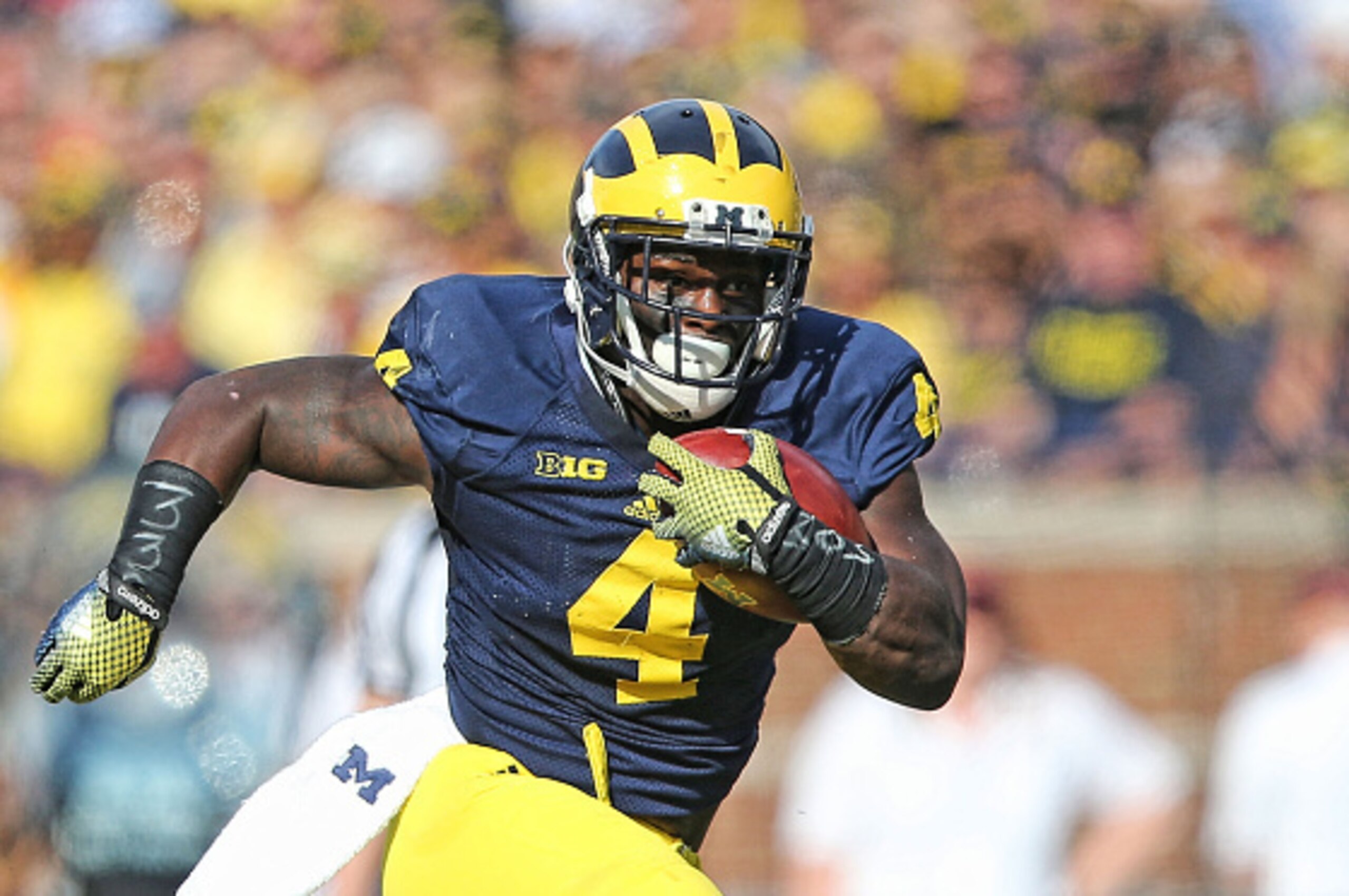
Right now, mastering square one should be the goal for De’Veon Smith and Derrick Green, a wrecking-ball pair that remains unproven but oozes potential. At roughly 5’11” and 230 pounds each, they possess ideal size for a Big Ten backfield but have yet to put their power to efficient use.
However, Howard believes the Wolverines can succeed with the pair of juniors, though they are missing something—something that’d make life a lot easier for Drevno and Wheatley.
“We don’t have that Barry Sanders-type running back who can make something out of nothing,” Howard said. “We’re just not there. We don’t have that.”
Green or Smith won’t turn into Sanders, but that doesn’t mean that one won’t truly emerge this fall. There are positives to be gleaned from Saturday.
“Derrick looked much faster,” Howard said. “He looked pretty good. De’Veon was very decisive in the way he hit holes. I think that was an issue for him last year; he tended to dance a little bit. But that comes from the uncertainty of knowing where the hole’s going to be at—you know?”
Staying the course, subscribing to the staff’s philosophies and studying film—Howard stressed doing homework—should yield future rewards for Green, who had a couple of nice totes Saturday, and Smith, who bust loose for a 34-yarder. They’re the known commodities.
But enter Ty Isaac, who, once integrated, could do wonders for Drevno and Wheatley.
Like Green and Smith, Isaac, a 6’3”, 240-pound junior, has a mixture of speed and power that could alter the tides for Michigan this fall. He’s yet to play a down in the regular season for the Wolverines and barely participated in Saturday’s spring game, yet he could end up being a key addition to the rotation.
He’s an unknown factor who could bring unreal results.
Once healthy, Drake Johnson, a 6’0”, 207-pound senior, could complement the power trio with his natural quickness. He’s already proven capable of contributing.
Then there’s Karan Higdon, a 5’10”, 190-pounder who arrives late this summer. The 3-star Floridian runs a 4.5-second 40-yard dash, per 247Sports.
The outlook tends to be the same for a lot of teams in the midst of change. Michigan is such a team.
Sifting through options and choosing the best fits is one obvious way Harbaugh can improve his program’s running game. Come fall, he’ll have a pool of at least Green, Smith, Isaac, Wyatt Shallman, Ross Taylor-Douglas and Higdon with which to work.
He’s working from the ground level, but Harbaugh could end up fielding a 1,000-yard rusher this season. Michigan hasn’t had one since Fitzgerald Toussaint rushed for 1,064 yards as a sophomore in 2011. With exception to 2007, Harbaugh's offenses at Stanford produced a 1,100-yard rusher. In 2008, Harbaugh's second season at Stanford, Toby Gerhart ran for 1,136 yards and Anthony Kimble rushed for 717.
In all likelihood, he'll need more than a year to right the ship in Ann Arbor, but Harbaugh's potential for quick results is very real.
Come Together
Once upon a time, the counter was Michigan’s “bread and butter," Howard said.
In all likelihood, it’ll be a big part of Drevno and Wheatley’s arsenal this fall. They’re traditional guys who have proven methods. The counter is both traditional and proven.
There are several variations of the play, but the counter is essentially based on a change of direction inside of the tackles; it’s used, in some form or fashion, by every team in America.
For that reason, it’ll serve as today’s example of X's and O's. Mastering this play—grasping basics has been difficult for Michigan—could lead to yards upon yards. It’s the type of run that often throws defenses off balance and sets up larger gains. It's also a nice change of pace when throwing body blows up the middle.
In an attempt to further detail technique, Howard was asked to describe what he looked for while running such a play:
“I always got on the hip of my offensive linemen because your offensive linemen are going to take you to the hole, and you’re going to have to read off of him—whether he continues to take you outside or he turns up [the field]…” said Howard, who noted that attention to detail, such as what he described, could help the ball-carriers.
"It’s probably something taught by Wheatley and Drevno," he added.
Running backs process a lot once they get the ball. With just a fraction of a second to make a decision, they need to know they can trust in their line’s ability to block and create holes.
Some backs are better at reading than others and can make do with a developing line. Some backs aren’t as good at reading the play but get by thanks to outstanding lines.
Everything is tangled, woven and intertwined.
“It’s a symbiotic relationship,” said Howard.
Miller agrees with Howard’s idea. There is a lot more than running and blocking going on during a running play. The backs aren’t the only ones surveying the field, either. Linemen are tasked with reading levels as well.
What does that entail? Again, to further detail the specifics, Miller was asked to describe a lineman’s role during a counter/power play:
“The idea is that you’re going to get movement from whatever side you’re running it towards and have the guard come around and create a big hole—a kick-out—usually the defensive end and SAM linebacker on the ball, to create a seam right there [at designated spot for runner]," Miller said.
Typically, a fullback helps plow the trail. Other times, a teammate from the other side of the play will fly in and provide assistance further up the field.
Got all of that?
Now throw all of that, seven or eight guys aiming to maim, into a split-second window. There isn’t a lot of time to read, let alone breathe. However, Michigan must improve its ability to make adjustments on the fly and adapt while under duress.
That process began last year, says Miller. He's confident that it’ll produce results this fall.
“I think it’s important to know that the running game requires more than a good offensive line,” Miller said. “You’ve got to have tight ends who can block, you’ve got to have running backs who can hit the holes and read where it’s at, and you’ve got to have a passing game that opens up it up and puts safeties further back instead of crowding the box.
"So it’s a whole offensive effort, and I think they’re moving in the right direction.”
Like Howard said, it’s a “symbiotic relationship” between those up front and those in the back. The running backs go as the offensive line goes, so on and so forth.
That relationship is formed in practice and on game day, but it’s perfected in the film room.
Follow Bleacher Report’s Michigan Wolverines football writer Adam Biggers on Twitter @AdamBiggers81
Unless otherwise noted, all quotes and references were obtained firsthand by the writer via press conference, press release or other media availability.


.jpg?w=2560 "Mahomes Told Teammate to Leave Meeting")

.jpg?w=2560 "5 Teams Eyeing Jonathan Taylor")

.jpg?w=2560 "NFL investigating Eagles")


.jpg?w=2560 "Jonathan Taylor Landing Spots 📍")