

Only Bayern Munich in Europe's Last 8: Has the Bundesliga Regressed Since 2013?
"Football is a simple game," Gary Lineker once said. "Twenty-two men chase a ball for 90 minutes and at the end, the Germans always win."
The English striker's iconic quote came after England's exit to the Nationalmannschaft at the 1990 World Cup, which the Germans would go on to win.
Germans know well that Lineker's quote doesn't hold true, having gone 24 years between their triumph in Italy and their next victory at the 2014 World Cup, and 16 years between winning Euro 1996 and claiming last summer's prize in Brazil. For Germans, a more valid phrase ends with the Spaniards always winning.
TOP NEWS
Live Highlights and Viral Moments 🍿

Final Men's Ballon d'Or Rankings 📊

Carrick Replacement Options 📝
Tuesday evening's match between Bayer Leverkusen and Atletico Madrid marked the third time in 2015 that Spanish opposition knocked a Bundesliga club out of European competitions. The result followed Real Madrid's defeat of Schalke and Borussia Monchengladbach's exit to Sevilla.
A year ago, Real Madrid downed Schalke, Borussia Dortmund and Bayern Munich en route to the Champions League final. And although the year before BVB and Bayern famously sent Real and Barcelona out of Europe's most elite club competition, the record stands that in their last 24 elimination-round ties with foreign opponents, Spanish teams have advanced on 22 occasions.
The evidence is undeniable that Spanish clubs are really, really good at getting the results they need. The question German clubs must now ask is: Has there been real, tangible progress in the last few years? Dortmund's capitulation at the hands of Juventus on Wednesday would seem to suggest otherwise, the Ruhr side losing 3-0 at home after falling 2-1 in the first leg in Turin.
It's important to first take a look at recent history to see where progress has been made. A big stepping stone for Germany was in 2012-13, the first year that the Bundesliga were allocated four spots for the Champions League.
There were many skeptics of the league's depth and many were critical of the German top flight usurping that spot from Serie A. And indeed, Gladbach were unable to win their playoff-round tie with Dynamo Kyiv. But they along with Hannover, Stuttgart and Leverkusen would advance to the Europa League knock-out rounds, and Champions League sides Bayern, Schalke and Dortmund would reach Europe's last 16. The Bundesliga's "magnificent seven" all progressed, and Bayern and BVB even reached the final at Wembley.

On the surface, the 2012-13 season was a real benchmark for German football. However, there were some less impressive points. Not only did Gladbach fail to justify the Bundesliga's fourth Champions League spot, but only Bayern, BVB and Stuttgart advanced past the first knockout round, with the latter being eliminated from the Europa League last-16 by Lazio.
The German clubs had shown some real class in the group stages, but most struggled thereafter. After dominating Arsenal at the Emirates in one group-stage game, Schalke couldn't find the nerve to progress past an entirely beatable Galatasaray. Modest teams like Anzhi and Lazio dumped their German opponents out of the Europa League.
Last year saw Germany send four clubs (Bayern, Dortmund, Schalke and Leverkusen) to the knockout rounds for the first time in the tournament's history, as England and Spain managed just three. However, it also further cemented the notion of a gap between Germany's perennial standard-bearers Bayern and the rest.
Despite finishing runners-up in Group A, Leverkusen were hammered by Manchester United's worst side in years by an aggregate 9-2 score during the group stage, before losing 6-1 on aggregate to Paris Saint-Germain in the round of 16.
Schalke were battered by eventual Champions Real Madrid in the round of 16 as well, losing 9-2 on aggregate. Like Leverkusen, they were found well out of their depth and hardly looked to be among the top-16 clubs in Europe.
Dortmund labored their way to the quarter-finals and put up a valiant second-leg effort against Real, but a 3-0 loss in Madrid made a second-leg miracle too great an ask. Even Bayern were humiliated, losing 5-0 on aggregate to Carlo Ancelotti's side.
Europa League results were even worse for German clubs, with only Frankfurt reaching the last-32, where they were eliminated by Porto on away goals.
"Bayer Leverkusen showed last night what vast potential they have. The second leg will be an intriguing test of their mental evolution.
— Marco Conradie (@MarcoConradie10) February 26, 2015"
Last season was a decided step backward for German football, in spite of the four Champions League last-16 sides. It's not just the results that mattered, but the manner in which they were obtained. In that regard, 2014-15 may not be such a disaster after all, and actually has shown some tangible progress.
There were no group-stage humiliations, and all four clubs advanced for a second consecutive season. This is progress, especially considering that again, no other league managed the same record. Critically, the clubs that advanced to the knockout rounds have looked worthy of their status.
Leverkusen played Atleti off the park at the BayArena and were somewhat unlucky only to win 1-0. They didn't show too much respect to the previous season's finalists, and their relatively inexperienced stars like Hakan Calhanoglu and Karim Bellarabi really stepped up. In the second leg, B04's old vices crept to the fore, and the Germans played very poorly overall.
And yet, Leverkusen only conceded once in 120 minutes, and in a very unlucky way. Mario Suarez's relatively tame shot from distance took a hard deflection, without which Bernd Leno would have had a rather easy save to make. And although Calhanoglu's weak spot-kick was easily saved by Jan Oblak before Omer Toprak and Stefan Kiessling missed the target altogether, one could see that Leverkusen had made considerable progress in becoming a worthy Champions League side. The result was disappointing but respectable.
A similar statement could be made for Schalke. The Gelsenkirchen side looked down and out in the first leg. It took just 26 minutes for Real to take the lead away from home in the first leg, and the Spaniards would go on to win 2-0 at the Veltins-Arena. It wasn't the 6-1 defeat of a year before, but Schalke were out within 90 minutes. Or so it seemed.
Schalke fought valiantly in the second leg, and despite going out in the end, they managed to do something very few teams have ever done: They scored four goals in a win at the Bernabeu. Real admittedly were poor, but this was a Schalke side that featured three 19-year-olds for most of the game and lacked half their first team. This time it wasn't Schalke who were humiliated, but Real.
Dortmund, on the other hand, were enormously disappointing. Losing the first leg in Turin was understandable and left the 2013 finalists with a task at home that did not suit them, but their effort on Wednesday was woeful.
In 2013 and 2014, they were always in the running before their elimination and lost with dignity. Last season, they did to Real what Schalke did this season, almost reversing what had appeared to be a huge first-leg deficit despite being ravaged by injuries.
This year, Dortmund returned to the Signal-Iduna Park with more first-team players and only a one-goal disadvantage against a Juve side that was no better than the Real side that won the 2014 Champions League. Yet the famous Dortmund home crowd didn't seem to have a magical effect this time and the players looked uninspired and out of ideas.
At present, BVB have some real problems. Whereas last season's squad was ravaged by injuries, it appears now that those who have returned are just not the same as they were in previous years. Instead of having something to look forward to, fans are faced with the reality that their team just isn't all that great.
They may need a few years and a lot of right business decisions if they are to become a relevant side in Europe at any point soon. Their regression by now is abundantly clear.
Leverkusen, on the other hand, are a lot closer. The only thing they lacked against Atleti was what Schalke had this season and in their run to the 2011 semifinals: A veteran, quality striker to provide leadership in the attack and get the necessary goals.
The Werkself already have Christoph Kramer returning from loan this summer and one of Germany's best academies to bolster the squad for years to come. And having signed the enormously talented Tin Jedvaj and two of Germany's best 1996-born talents in Julian Brandt and Levin Oztunali, the latter of whom is now making big steps on loan at Bremen, their scouting is excellent.
Provided they keep young stars like Calhanoglu for at least a year or two more, and that they continue to qualify for the Champions League, Leverkusen could develop into a formidable side on the international stage.
Schalke similarly have a bright future if they make the right decisions. The Klaas-Jan Huntelaar era won't last forever, and rising talents like Max Meyer, Leroy Sane, Leon Goretzka and Julian Draxler will surely be on the radar of top European clubs sooner than later.
However, the Schalke academy continues to produce talents of exceptional quality and the club's performance against Real this year could mark a turning point in which they truly believe in themselves. In this regard, they are unquestionably a step ahead of their position a year ago.
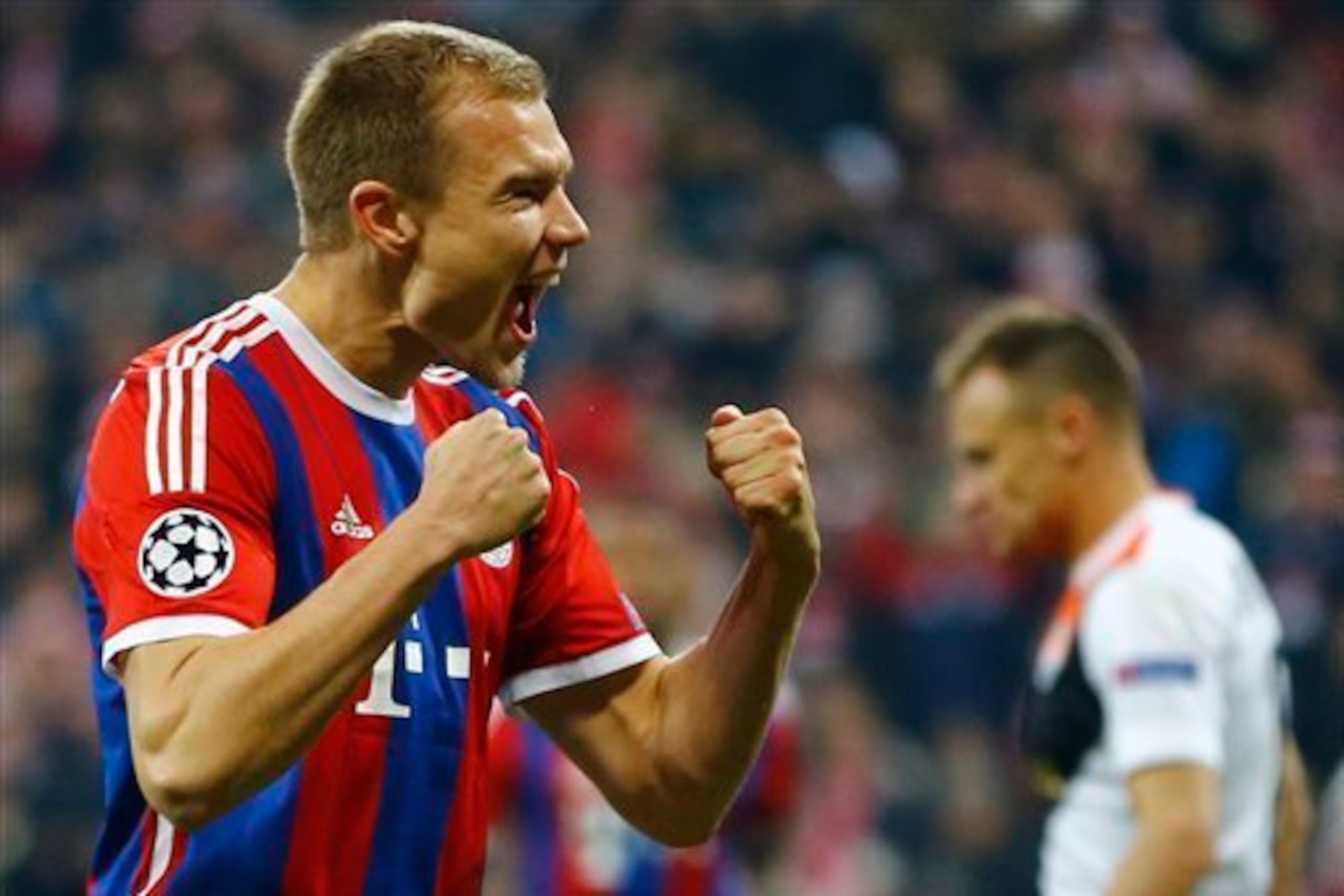
The one unignorable topic that has not been discussed in this article is perennial giants Bayern Munich. The jury is still out on whether Pep Guardiola can bring the 2010, 2012 and 2013 finalists back to the pinnacle of European football, but the Bavarians have been and continue to be Germany's best chance.
The Champions League is decided by just a few games, so it's unfair to expect a club to reach the final every year. The only way the Bavarians could truly contribute to a lowering of the Bundesliga's status would be to, like perennial Italian champions Juventus have on many occasions, fail to reach the last four. In any case, the quality of the Bundesliga cannot be measured by the performance of just one club.
It's easy to see that beyond Bayern, Germany's lesser clubs are generally on the rise. And it's apparent that setbacks like those Schalke and Leverkusen faced a year ago are in fact surmountable. The key now is consistency. These clubs will have football's vultures aiming to pick them apart in the transfer market, and that and their limited financial resources will leave little room for error.
Consistency in qualifying for the Champions League is crucial to building the kind of mental fortitude needed for clubs to truly compete on this level. England's best years were when Manchester United, Chelsea, Liverpool and Arsenal were regularly the top four, and La Liga and Serie A have seen one-offs like Athletic Bilbao, Real Sociedad, Villarreal, Sampdoria and Udinese struggle hugely.
Gladbach had similar struggles as they failed to negotiate their play-off with Dynamo Kyiv, and could struggle again this fall should they finish in the top four this May. A similar statement could be made for Wolfsburg, who failed to progress past the group stage after winning the Bundesliga title in 2009. Their current Europa League campaign will be good experience to draw upon ahead of next season, but the Champions League will be a much greater task.
At present, it appears that Bayern, Wolfsburg, and two of Gladbach, Leverkusen and Schalke will represent Germany in the Champions League next season. Augsburg have a chance at the top four but more likely will finish in a Europa League spot, with Hoffenheim and possibly Werder Bremen and Dortmund fighting for the last European spot at season's end.
There are good chances of the Bundesliga having a formidable set of teams in Europe in 2015-16, and another "magnificent seven" is possible. It would be a stretch to expect any team other than Bayern to reach the last four in the Champions League, but after this season's performances, three teams in the quarter-finals doesn't seem like a stretch of the imagination. That, it can be said, is progress.
.jpg?w=2560 "Chiefs Giants Football")
.jpg?w=2560 "🚨 Week 8 AP Top 25 Poll")

.jpg?w=2560 "Baker Gets Glove From Rays 🧤")
.jpg?w=2560 "5 Teams Eyeing Jonathan Taylor")


.jpg?w=2560 "Steelers Roll Saints in Paris")
.jpg?w=2560 "NFL investigating Eagles")
