

Can Mike Wallace Shine in the Vikings' Boom-or-Bust Passing Game?
Minnesota Vikings quarterback Teddy Bridgewater figures to enter his second NFL season with a collection of receiving targets that are the very definition of "boom-or-bust."
Charles Johnson is a former practice squad player who remains mostly an unknown commodity. Cordarrelle Patterson was once a consensus breakout candidate, but his wildly disappointing 2014 season has rendered him an afterthought. Kyle Rudolph has all the talent of a top-five tight end but none of the availability.
And now there's Mike Wallace, one of the NFL's premier boom-or-bust receivers.
.jpg?w=2560 "Cardinals Giants Football")

.jpg?w=2560 "Jets Dolphins Football")
The Vikings swung a deal for Wallace last Friday afternoon, parting with a fifth-round pick and gaining a seventh-rounder to pull off the deal with the Miami Dolphins. He arrives in Minnesota just two years after signing for five years and $60 million in Miami.
The domino effect once again followed. Missing out on Wallace in free agency two springs ago eventually led general manager Rick Spielman to sign Greg Jennings to a five-year, $45 million deal. But with Wallace and his sizable contract now in Minnesota, Spielman made the expected move and released Jennings on Saturday.
Yet it can be argued that Jennings was far and away the Vikings' most reliable receiver over the last two seasons and likely would have been again in 2015.
Now it's on Wallace and his cast of question marks to be much more boom than bust.
The Vikings are assuming some level of risk. A group that started to jell with Bridgewater late in the 2014 season is being partly dismantled, with Wallace arriving and Jennings departing.
In Jennings, the Vikings had a steady but unspectacular veteran who ran crisp routes and brought veteran leadership to a young receiving group. He didn't quite live up to the deal he signed, but reliability and stability can be an underrated assets.
Wallace is far more combustible.
Then again, he also possesses the kind of game-breaking ability no other receiver on Minnesota's roster can match—with or without Jennings.
There's no doubting Wallace's downfield speed. Few receivers in the game can get to top speed faster, and even fewer have a higher top speed. It could be a deadly combination in Norv Turner's preferred vertical passing game.
"Norv's system is based on speed and having a vertical threat," Spielman said, via Ben Goessling of ESPN.com.
Turner mostly lacked a deep threat during his first season in Minnesota. Patterson has speed but very little spatial awareness down the field. Jennings lost a step or two, and Johnson only flashed onto the scene late in 2014.
That lack of a vertical asset is no more.
Wallace has averaged almost 15 catches of 20 or more yards and nearly six of 40 or more per season since entering the NFL in 2009. Back in 2010, Wallace averaged 21.0 yards per catch for the Pittsburgh Steelers, with a staggering 26 receptions over 20 yards and 10 over 40.
| 2009 | 14 | 6 |
| 2010 | 26 | 10 |
| 2011 | 18 | 7 |
| 2012 | 9 | 4 |
| 2013 | 11 | 5 |
| 2014 | 10 | 2 |
| Totals | 88 | 34 |
Even with a deep-challenged quarterback like Ryan Tannehill over the last two seasons, Wallace managed to haul in 21 passes over 20 yards and seven over 40. He's only 28 years old and in no way slowing down speed-wise.
But then again, Wallace quickly fell out of favor in Miami—despite being hailed as the same vertical chess piece for Tannehill, a young quarterback. He signed an elite-level contract but failed to produce the accompanying numbers, totaling less than 1,000 receiving yards while also averaging less than 13 yards per catch in both 2013 and 2014.
Bridgewater will either enter 2015 with one of the league's most underrated receiving groups or one of the most unstable.
Wallace could as easily catch 60 passes for 1,200 yards and 12 touchdowns as he could haul in 50 for 800 and five.
Johnson averaged nearly 17 yards per catch with 415 receiving yards and two scores over his final seven games of 2014, but he's still a former seventh-round pick who has spent the majority of his NFL career either on a practice squad or recovering from injury. He could break out next season or regress to the mean of his draft status.
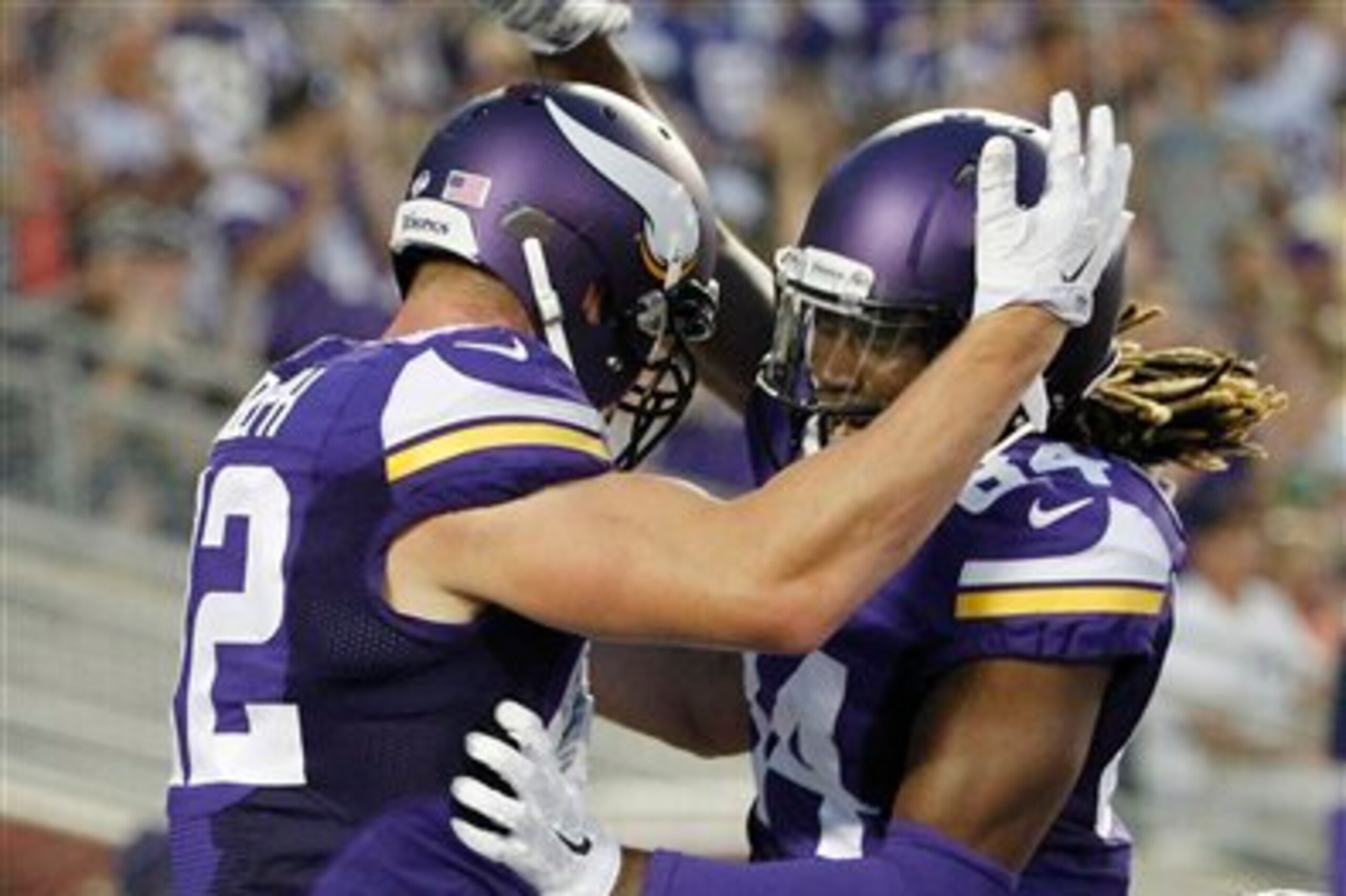
Rudolph has 17 career touchdown catches over 48 NFL games. He's shown flashes of being an athletic mismatch and red-zone weapon over his four seasons, but the 25-year-old tight end has also missed 15 games since 2013.
Then there's Patterson, who went from first-round pick to breakout star to utter disappointment in the blink of an eye. His physical skills are undeniable, but his first attempt at trying to be a legitimate NFL receiver failed miserably in 2014. The Vikings must now wonder if he's nothing more than a returner and gadget player on offense.
It can be added up to equal a bunch of question marks around one of the game's bright young quarterbacks. And we haven't even mentioned the name Adrian Peterson.
Add it all up a different way, and the whole thing makes perfect sense.
The Vikings essentially traded Jennings, an overpaid possession receiver, for Wallace, an ideal fit in Turner's vertical-based scheme. There's inherent risk, but the potential reward from Wallace is far more than what Jennings could have produced.
Minnesota remains head-over-heels in love with Johnson, and for good reason. He's unproven, but his size and physical skill set resemble an impact pass-catcher more than a fringe roster receiver.
Injuries with Rudolph can be viewed two ways. While he's missed almost a full season over the last two years, he also played in 31 or 32 possible games during his first two NFL seasons. Injuries are impossible to predict. If he's healthy for 16 games, there's no doubt he's capable of making another Pro Bowl.
Patterson is a harder sell for the good, but it's possible the speed of Wallace combined with another year learning the position could make him a dangerous intermediate player. And if the Vikings must manufacture touches for him, so be it. He's still too good with the ball in his hands to rot on the sideline.
There's still the possibility the Vikings will add a receiver in the draft, but the need is certainly much less urgent today than it was this time last week.
The linchpin in the whole deal will be Wallace.
He's assuming the role as Minnesota's No. 1 receiver, which Jennings was never able to do. He'll also slot in as Turner's must-have deep threat in an offense designed to push the ball down the field vertically. If Wallace is a hit, the whole operation should be better than it was last season.
The Vikings are mixing some combustible ingredients together for Bridgewater in the passing game. The experiment will either blow up in Minnesota's face or result in explosive results, with Wallace the most likely fuse.
Zach Kruse covers the NFC North for Bleacher Report.
.jpg?w=2560 "Titans Ravens Football")

.jpg?w=2560 "NFL investigating 2 referees for separate viral exchanges")
